
Global employee engagement declined for a second consecutive year in 2025, with each percentage point loss representing approximately 21 million fewer engaged employees, according to Gallup's State of the Global Workplace report. That decline exposes a hard truth for operations and human resources (HR) leaders: engagement suffers when workers cannot hear from leadership, and companies have built most internal communication infrastructure for desk-based employees. It does not reach the factory floor, the loading dock, the job site, or the housekeeping cart.
Frontline workers keep operations running, yet they often lack access to company email or workstations, leaving them with no reliable way to hear from leadership. Frontline communication breaks down when workers miss messages or cannot understand what leaders need them to do.
TL;DR
- Most communication tools are designed around desk-based teams, so frontline workers miss day-to-day updates.
- Any tool that requires a download or a company email login excludes many of the workers leaders need to reach.
- Updates disappear at predictable points: shift handovers, manager cascades, bulletin boards, and one-way broadcasts.
- A better listening layer combines zero-download access with translation and targeted two-way replies.
- Message frequency and timing shape whether workers keep reading, so cadence deserves the same attention as channel.
- Measure by shift and location, because company-wide averages hide the teams that never received the message.
- Large deployments need encryption, role-based access, and searchable message records alongside universal reach.
- SMS-based platforms like Yourco reach every worker on any mobile phone, with no app download required.
Start Solving Frontline Communication Challenges With Adoption First
Common frontline communication plans start with a mobile app, translation, and a feedback channel. Each approach assumes workers can access the tool at all. Frontline communication challenges begin when a tool requires setup or a company email address, because that requirement recreates the exclusion leaders were trying to solve. Most frontline workers have no corporate email address, and many do not carry a smartphone at work.
Workers who cannot access the tool keep missing messages. App-based tools stall on adoption, and an app-only tool excludes workers without smartphones entirely. Leaders can treat adoption as the first design constraint, then test any tool against the access workers actually have:
- No company email required: workers receive messages without a corporate address
- Basic flip phone support: the channel works on the device a worker already carries
- No account setup: password resets do not sit between a worker and an urgent update
- No connectivity requirement: messages arrive without Wi-Fi, a data plan, or a download
If any requirement excludes part of the workforce, the tool recreates the missed-message problem. A channel that meets workers on the device and connection they already have clears this bar before anything else.
Fix Frontline Communication Challenges at the Breakdown Points That Cost the Most
Frontline communication fails at predictable points. Once leaders identify where updates disappear, they can choose the channel and workflow that keep information moving. The same pattern repeats across operations. Leaders assume a message reached workers because they sent it, while workers report never receiving or understanding it.
Shift handovers
Shift handovers often lose safety and operational updates. In manufacturing, the business runs 24/7, but the workforce does not, so the second shift never hears the safety alert the first shift logged. The U.S. Chemical Safety Board has identified the lack of effective shift-change communication as a contributing factor in major process-industry incidents, and more recent operations research shows that 40% of all plant incidents occur during or immediately after shift changes, even though handovers account for less than 5% of operations staff time. When handovers are verbal-only, that is where information evaporates.
This information is for general awareness only. For specific compliance guidance, consult with qualified legal professionals.
Outdated channels and one-way broadcasts
Handovers are only the first failure point. Outdated channels create a second failure point because many organizations still rely on physical postings or manager cascades, both of which can fail before messages reach the floor. One-way broadcasts create a third, because frontline insight never reaches the people making decisions.
Shift-based teams miss real-time updates when information stays with individuals instead of moving through the team, and email cascades and physical postings compound the problem because workers cannot check them during a shift.
Build a Listening Layer on a Zero-Download Channel
Text messaging avoids the adoption problem because SMS works without an app, Wi-Fi, or a data plan. A message reaches a worker whether they own a smartphone or a basic flip phone. If someone can receive a phone call, they can receive a text. Every phone already has a native messaging interface, so workers need no training session to use it. SMS also carries delivery confirmation, so a manager can see that the message went through rather than assuming it did.
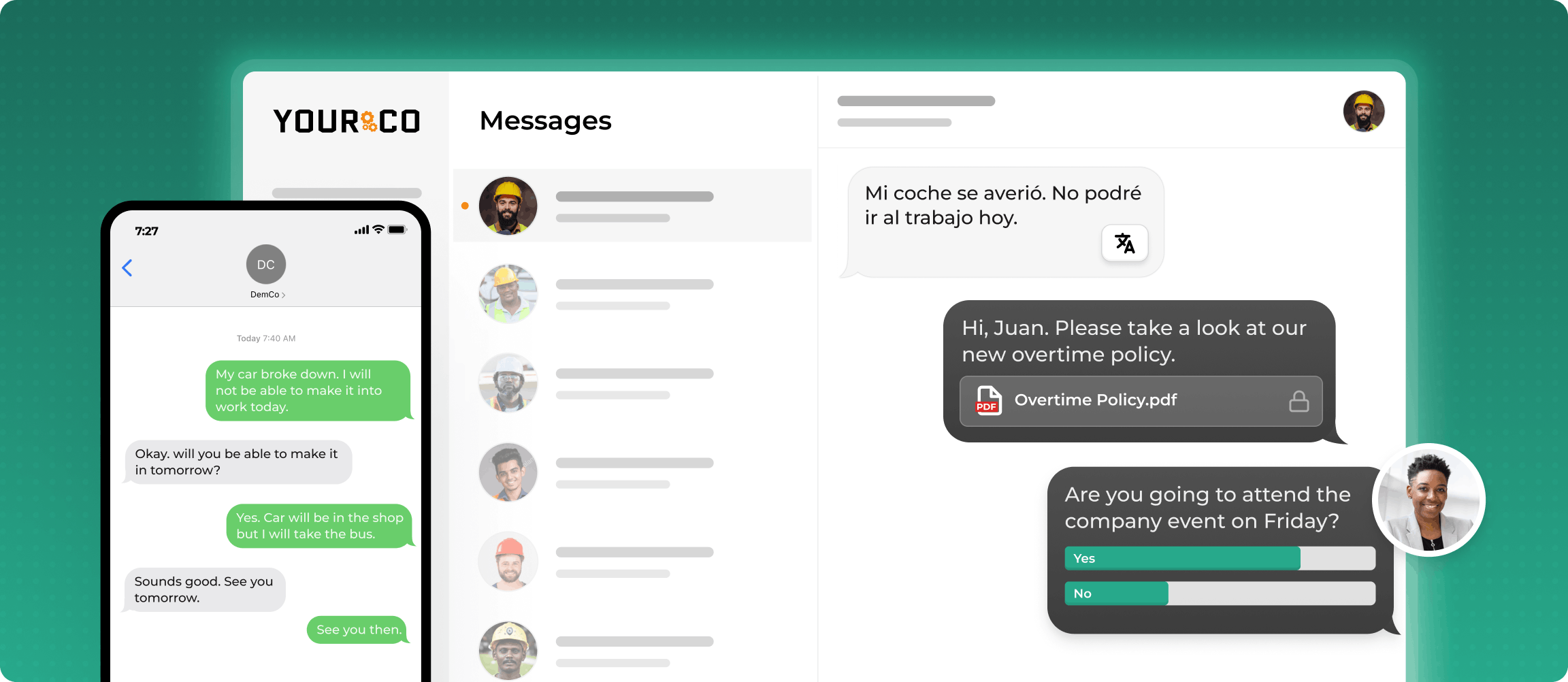
Two-way SMS turns a broadcast problem into a listening problem leaders can manage. SMS-based platforms like Yourco support confirmations, survey responses, absence reporting, and open replies, enabling a worker to report a problem as soon as it occurs. Frontline workers who can respond are more likely to raise safety and operational issues before those issues grow.
A strong listening layer also removes language barriers and keeps messages relevant. 27.7 million individuals living in the United States had limited proficiency in English as of 2023, and more than half of them were US citizens, according to the Migration Policy Institute's language access research. Daily conversational fluency does not always mean a worker can interpret a safety directive, benefits update, or policy change.
Four capabilities make that layer work:
- Zero-download delivery: workers receive messages on the phones they already carry
- Automatic translation: safety directives and benefits updates arrive in each worker's preferred language, with no wait for a manual translator
- Role and location targeting: warehouse staff get safety protocols, retail associates get promotional guidance
- Two-way replies: a shift lead can confirm receipt or raise a concern from the floor
When these capabilities run on a zero-download channel, neither language nor device blocks understanding.
Target Frontline Communication Challenges by Workforce Segment
Even after leaders choose the right channel, generic mass messages pose their own frontline communication challenges. A warehouse safety reminder and a retail promotion may both matter, but not to the same people in the same way. When every worker receives every message, important updates start to read as noise.
Targeting gives each message a clear audience. Operations and HR teams can segment communication by role, shift, location, and language preference so workers receive updates tied to the work they actually do. A night-shift crew receives the handover note before clocking in. A construction site receives a safety alert tailored to its specific job conditions. A multilingual team gets the same policy update in the language each worker reads.
This approach also reduces overload without withholding information Frontline communication challenges become easier to manage when urgent messages stay urgent, local updates stay local, and company-wide announcements reach everyone through a channel they can access.
How to Set a Message Cadence Workers Keep Reading
Channel and targeting solve who receives a message. Cadence determines whether workers still read it three months later. A channel that starts strong can lose its audience when every message arrives with the same urgency, or when nothing arrives for weeks, and workers stop checking. The choices below separate a cadence that holds attention from one that erodes it:
Cadence also shapes what workers do with a channel over time. When most messages ask nothing and matter little, workers stop reading the ones that do.
Measure Whether Messages Actually Reach Workers
A sent message does not prove a worker received or understood it. Email data can show activity without proving understanding; workers can walk past a bulletin without seeing it, and a headquarters-weighted average can hide a field team that missed the message. Leaders can measure reach and comprehension, with response patterns showing engagement.
App-based analytics only capture workers who use the app. These analytics undercount workers with the lowest access and the highest need, producing a skewed picture and misdirected fixes.
To see the real picture, operations and HR leaders can segment every metric and read it by group rather than in aggregate:
- Delivery and response trends: review by shift and location to separate headquarters reach from frontline reach
- Pulse survey participation: SMS-based surveys show whether workers can answer from the channel they already use
- Comprehension checks: a short "Was this clear?" reply after a policy or safety update shows whether workers understood the message
With this approach, a leader can identify a location that did not respond to a safety alert, or a shift where workers respond less often, and act before the problem grows.
Scale Frontline Communication Securely Across Locations
A channel that works for one plant faces different demands across 40 sites in three countries. Employee phone numbers, absence reasons, and policy acknowledgments are sensitive records, so the channel carrying them needs the same controls and operations that HR leaders expect from any core workforce system.
That raises the evaluation bar past reach alone. Yourco's security controls include encryption in transit and at rest, a multi-tenant architecture that isolates each customer's data, and platform access governed by single sign-on, role-based permissions, and passwordless authentication. Every message is logged and searchable, giving HR teams a timestamped record for audits, disputes, and policy documentation.
Scale then shows up in structure rather than seat count. Unlimited locations, departments, and custom groups let a single deployment mirror how an organization is actually built, while centralized dashboards give corporate teams oversight across sites, and local managers maintain direct conversations with their own crews. The same configuration supports a single facility or a workforce of more than 2,000 employees.
Connect Every Frontline Worker With Yourco
Yourco helps leaders solve frontline communication challenges by reaching every worker, in their language, on the device they already carry. As an SMS-based employee communication platform for frontline organizations, Yourco removes the adoption barrier that stalls app-based tools.
Yourco delivers the core capabilities frontline teams rely on:
- SMS to any phone, including basic flip phones, with no app download, Wi-Fi, or data plan
- two-way messaging so workers can confirm, report absences, respond to surveys, and raise concerns
- AI-powered translation across 135+ languages and dialects, so language never gates understanding
Yourco connects to existing systems via 240+ HRIS and payroll integrations, keeping employee data in sync across brands and locations. For multi-location enterprises, Enterprise Bridge allows corporate leadership to send centralized, one-way updates across all locations, while local managers maintain direct communication with their teams.
Frontline Intelligence gives HR and leadership teams centralized visibility into communication engagement across locations and shifts. It surfaces response and sentiment trends, including locations that may need follow-up. Corporate teams can see which shifts and sites are actually reading messages, rather than relying on aggregates that hide unreached groups.
Organizations with large non-desk workforces describe what one accessible channel changes.
"We have nearly 700 employees and 80% are non-desk based, communication is a challenge. Yourco provides a quick easy way to reach everyone and a secure way for employees to reach HR and leadership without a computer."
— Felisha Parker, VP Human Resources, McCarthy Auto Group
After 90 days with Yourco, two-way employee engagement increased to 86%.
Try Yourco for free today, or schedule a demo to see the difference the right workplace communication solution can make for your company.
Frequently Asked Questions About Frontline Communication Challenges
What causes frontline communication challenges?
Frontline communication challenges usually start when companies rely on tools built for desk-based employees, which miss workers without company email or reliable computer access. Shift patterns and distance across sites compound the problem, as do one-way broadcasts that leave workers no way to respond.
How can companies improve communication with frontline workers?
Companies can reduce frontline communication challenges by starting with a channel that requires no setup or company email. Adding translation, targeting messages by role and location, and giving workers a way to respond turns a broadcast into a conversation.
Why do frontline communication apps often fail?
Frontline communication apps often fail because they require smartphone access, account setup, and ongoing adoption. Those requirements exclude workers on basic phones and those without a company email address, so critical messages never reach a portion of the workforce.
How can leaders measure whether frontline workers actually receive messages?
Leaders can track delivery signals and response rates by shift and location, then add quick clarity confirmations. Segmenting results by group reveals whether a message reached the field or only headquarters, and comprehension checks show whether workers understood what leaders needed them to do.
How often should companies message frontline workers?
Results vary by organization and shift structure, so the useful test is whether workers still read messages months into a rollout. Routing updates by role and location, and reserving urgent framing for safety and schedule changes, keep volume manageable without withholding information.
Is SMS an effective way to reach frontline workers?
Yes, SMS works on any mobile phone, including basic flip phones, without an app, Wi-Fi, or data plan. SMS-based platforms like Yourco pair that universal reach with two-way replies, automatic translation, and location-based targeting for frontline teams.