


Compliance documentation stays audit-ready when organizations create records as work happens, assign clear owners and retention rules, and make those records easy to retrieve across every location. For frontline safety communication, a company-managed channel can help preserve part of that record as work happens. Safety teams can send policy updates, training reminders, and other critical notices through SMS and capture timestamped employee responses. Those responses provide a documented record of communication and acknowledgment, while formal training, incident, certification, and other compliance records remain in the appropriate EHS or HR system. Short Message Service (SMS) reaches frontline workers at a 98% open rate, well above email or a printed posting.
TL;DR
- One standard, with named owners and retention rules, builds records into daily operations instead of after the fact.
- Formal records belong in the Environmental, Health, and Safety (EHS) or human resources (HR) system, while a timestamped, employer-controlled SMS channel collects acknowledgments.
- A “Reply YES” documents receipt of a named policy version; delivery status does not.
- A site audit kit and quarterly mock inspections set a retrieval target of minutes.
- SMS-based platforms like Yourco reach workers without company email, and log timestamped acknowledgments by site.
Prevent Compliance Documentation Breakdowns
The request can come from a government safety inspector, customer, insurer, or internal auditor. Compliance documentation fails when teams leave records incomplete or outdated, scatter them across filing cabinets, local drives, email chains, and personal phones, or cannot prove receipt. Audit-ready documentation comes from creating and storing records during daily operations, not assembling evidence after a request arrives. A company-controlled, searchable communication channel can preserve the distribution and acknowledgment trail without relying on supervisors’ personal phones.
Keep these categories ready:
- Current safety policies, emergency procedures and protocols, with revision history.
- Occupational Safety and Health Administration (OSHA) training requirement records, competency checks, rosters, and completion certificates.
- Acknowledgments tied to employee, version, and date.
- Injury and hazard reports, incident documentation records and near-miss reports, with investigations and corrective actions.
- Equipment inspections, maintenance and service histories, certifications, and work orders.
- Safety Data Sheets (SDS) and hazard communication training.
- Injury and illness logs and supporting documentation, where applicable.
Each site works from the same list instead of guessing which records matter most during an inspection.
Title 29 of the Code of Federal Regulations (29 CFR) 1904.33 describes a five-year retention period for Forms 300, 300A, and 301 under the federal retention rule. Other record types and state-plan rules differ, so a counsel-approved retention schedule can account for the difference.
This information is for general awareness only. For specific compliance guidance, consult with qualified legal professionals.
Give Each System a Clear Documentation Role
88% of HR leaders say they need a reliable way to reach frontline employees, while only 55% are confident they already have one, according to a Yourco-commissioned survey of 150 HR leaders. That mismatch is why work conversations drift onto a supervisor’s own device instead of a company-controlled system.
Each method has a distinct role:
Formal records live in EHS, HR, maintenance, or document-management systems, while SMS-based platforms like Yourco supply the acknowledgment trail. Messages sent and stored this way sit behind role-based access control and encryption in transit and at rest, the same standard for one site or for dozens through a centralized dashboard.
A delivery receipt confirms a message reached the device; an acknowledgment adds the worker, policy version, and confirmation time that make an employee message acknowledgment record attributable. Once each system has a defined role, every site needs to create the same evidence trail for the same type of safety event.
Create One Compliance Documentation Standard Across Every Site
A lockout/tagout (LOTO) update at two sister plants should leave identical documentation trails. SOP compliance practices standardize six elements:
- Title, version, effective date, and review date.
- Audience by site, department, shift, role, and language.
- Acknowledgment wording and deadline.
- Storage location and retention period.
- Escalation path for non-responders.
- Named owner for updates.
These elements keep documentation consistent across locations. With the standard in place, safety leaders can apply it first to the communications that most often need proof of receipt: policy updates, procedure changes, and urgent safety notices.
At a warehouse, a revised forklift procedure goes out as one approved template by facility and shift, and the platform tracks replies and flags no-shows. On a multi-employer construction site, the controlling employer can send the same lockout procedure update to each subcontractor’s contacts and log replies, while each employer keeps its own training and recordkeeping duties.
Create Consistent Safety Communication Across Every Location
Yourco gives organizations a company-managed communication channel for reaching frontline employees and documenting the conversations that happen around safety.
Corporate teams can communicate critical safety updates consistently across locations while local managers maintain direct, two-way communication with their own teams. Employees receive and respond through SMS without requiring company email or another workplace app.
Those interactions also give safety and Operations leaders another source of visibility into what's happening across the organization. Frontline Intelligence can analyze safety-related employee conversations and help leaders identify recurring concerns across locations, departments, shifts, or other organizational dimensions.
Turn Safety Communications Into Documented Acknowledgments
The acknowledgment wording that standard specifies has to produce the same evidence every time, whatever moves through it: policy revisions, personal protective equipment (PPE) reminders, heat alerts, LOTO updates, or training reminders. SMS-based platforms like Yourco, one type of workplace safety communication platform, carry that wording to any phone and timestamp the reply.
Each acknowledgment request should contain:
- Policy or procedure name.
- Version number or effective date, part of a policy acknowledgment statement.
- Plain-language instructions telling the worker what to do.
- A link to approved content.
- The reply instruction: “Reply YES to confirm receipt.”
- A deadline, with follow-up for non-responders.
This leaves no question about who confirmed what, and when.
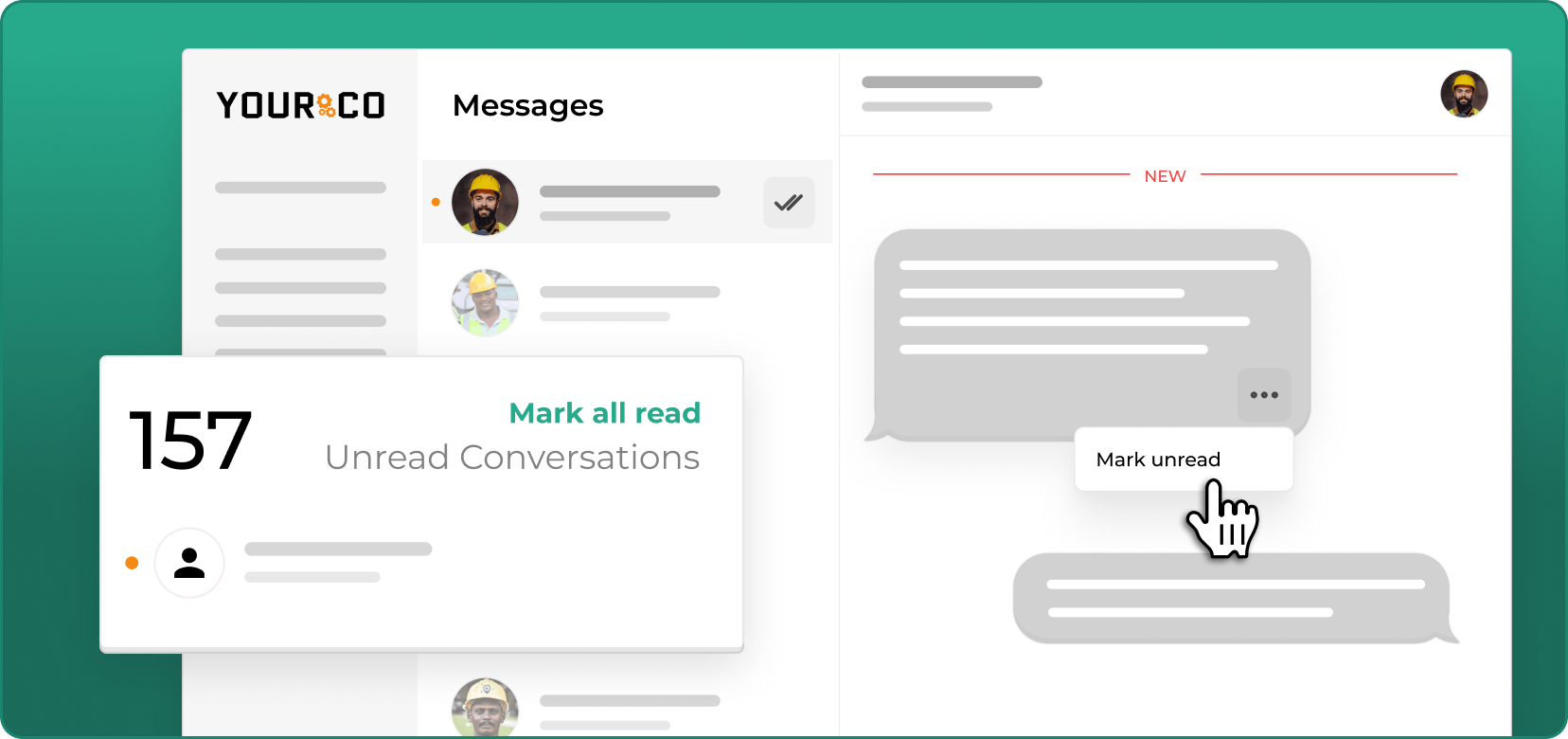
A reply documents receipt, not comprehension. A 2019 interpretation letter discusses the limits of training without hands-on components or trainer interaction, and a YES reply never replaces required practical assessments or trainer signatures. Acknowledgment proves that a notice reached the worker; training, competency, and certification records require a separate follow-up process.
Capture Training, Policy, and Certification Follow-Up in Real Time
Audit readiness depends on follow-up after each training event. Teams tracking safety-training completion capture records as training happens. Common fields often include employee ID, topic, date, language, completion evidence, delivery method, and refresher requirements.
The same Yourco-commissioned survey of 150 HR leaders found that 56% have missed vital deadlines because they could not reach a frontline employee in time. That same failure point can lead to a lapsed certification. Scheduled reminders tied to each worker’s renewal date catch it before an inspection does.
SMS supports five follow-up tasks:
- Reminders target workers by site, shift, job classification, and language.
- SMS captures completion confirmations after toolbox talks.
- Where policy allows, SMS collects photos of renewed licenses or certifications.
- Alerts go out before certifications or refreshers expire.
- Supervisors receive flags for unanswered reminders.
Missing confirmations and expiring credentials surface weeks before an inspector would otherwise find them. The same discipline applies when something goes wrong: the organization needs to preserve the initial report along with the response, investigation, and closure trail.
Ahead of each operator’s required performance evaluation under 29 CFR 1910.178(l), due at least every three years, HR or safety can send a reminder, confirm the evaluation is scheduled, and flag incomplete records. Refresher training is a separate trigger-based requirement, prompted by unsafe operation, an accident or near miss, a different truck assignment, or a workplace change, and is logged separately.
Document Incidents, Near Misses, and Corrective Actions
A complete documentation record shows how the team identified a hazard, communicated, investigated the incident, and closed the corrective action. SMS covers the communication half:
- A night-shift worker texts a photo of a damaged loading-dock guardrail.
- The safety lead acknowledges the report and closes the area.
- The lead texts a site-specific update.
- The platform preserves timestamps and conversation history.
- The safety team files the investigation and corrective action in the EHS system.
This connects the report and communication trail to the investigation record.
That same message log gives teams a record to reference alongside the formal EHS file. At Great Day Improvements (GDI), a home-improvement provider operating 338 locations, leadership used that kind of record to see communication activity across the organization in real time, including which locations raised the most scheduling and safety issues and where call-off trends concentrated.
29 CFR 1904.35 requires a reasonable reporting procedure for workplace injuries and illnesses, one that does not discourage prompt, accurate reports. A communication log can support that process but never replaces formal investigation. Once policies, training, certifications, and incident records are stored in their designated systems, the remaining challenge is retrieval.
Build and Test an Inspection-Ready Audit Kit
Building the index and testing it under pressure are two parts of the same practice: an index that has never been checked against a mock inspection is not audit-ready.
Build the Site Audit Kit
The audit kit is an access-controlled index pointing to verified records in their systems of record. Each site’s audit kit should include:
- Record index by category and a “who to call” list.
- Current policy versions.
- Training matrix and certification status.
- Acknowledgment reports and non-responder follow-up.
- Injury and illness logs, where applicable.
- Incident, near-miss, and corrective-action summaries.
- Equipment inspection and maintenance records.
Retrieval stays quick, and no site keeps a second, uncontrolled file set.
Run Quarterly Mock Inspections
Run each quarterly mock inspection in five steps:
- Select a site and the record types to test.
- Include a training record, policy version, acknowledgment, incident report, and corrective-action trail in the request.
- Record the retrieval time for each item.
- For every record, check the worker, version, date, and owner.
- Log missing items, assign fixes, and rerun the drill.
These drills test whether records stay retrievable under pressure.
29 CFR 1904.40 requires producing Forms 300, 300A, and 301 within four business hours when an authorized government representative requests them. Organizations can set their own faster internal target, such as minutes, for other high-priority documentation.
This information is for general awareness only. For specific compliance guidance, consult with qualified legal professionals.
Measure Audit Readiness
Track these by site:
Document Every Safety Notice and Acknowledgment With Yourco
Yourco is an SMS-based employee communication platform that timestamps and retains every message, even after an employee leaves. This gives safety teams attributable records without company email or smartphones.
Yourco sends SMS to any phone, including basic flip phones, with no app download. Other core features include:
- Two-way messaging, so “Reply YES” becomes a timestamped, named record.
- AI-powered translation across 190+ languages.
These features keep safety responses attributable across sites.
Yourco syncs with the human resources information system (HRIS) through 240+ HRIS and payroll integrations, keeping location, role, shift, and language segments up to date.
Enterprise Bridge allows corporate leadership to send centralized, one-way safety updates across all locations, while local managers maintain direct two-way communication with their teams.
Frontline Intelligence gives safety and operations leaders centralized visibility into compliance documentation activity across all locations. It surfaces document-submission and acknowledgment patterns, along with safety-related language by site, so corporate teams can act on what they see. A safety leader can put a question to it directly, such as:
- Which locations are slowest to confirm receipt of a policy update?
- Where are certification renewals most at risk of lapsing this quarter?
- Which sites show the highest rate of unanswered acknowledgment requests?
- Where are incident reports and corrective-action replies taking longest to close?
“The Yourco texting system has helped the Railroad communicate with a 24/7 workforce. Sharing weather events, safety concerns and company bulletins have been priceless.”
— Carl Kocur, Vice President, Engineering, New Orleans Public Belt Railroad
After 90 days on Yourco, companies see two-way employee engagement reach 86%.
Try Yourco for free today or schedule a demo and see the difference the right workplace communication solution can make in your company.

Frequently Asked Questions About Compliance Documentation for Safety Inspections
How Do I Ensure Proper Compliance Documentation for Safety Audits?
Compliance documentation stays audit-ready when safety teams build acknowledgment and training records into daily communication, rather than recreating them after a request arrives. Formal records belong in an EHS or HR system, while a company-controlled, timestamped channel preserves acknowledgment of policies and notices. Quarterly mock inspections confirm each site can retrieve what it needs under time pressure.
What Documents Does a Safety Inspector Ask for First?
Inspectors often begin with written safety programs, injury and illness logs, training records, and hazard communication records. They may then request lockout/tagout, forklift, incident, or equipment records based on the inspection’s scope. An audit kit should point to verified records without creating uncontrolled copies outside the formal system of record.
Are Text Message Acknowledgments Valid Proof of Safety Policy Receipt?
An attributable reply on an employer-controlled platform can show that a named employee confirmed a specific notice at a specific time. The request and reply should identify the policy version and date. The reply documents receipt, but it does not establish comprehension or replace hands-on training, competency checks, or trainer certification.
How Long Should Employers Keep Safety Training Records?
Retention varies by record type, applicable standard, industry, and jurisdiction. Federal recordkeeping rules and state-plan requirements, including those in California, may address records differently. A counsel-approved schedule can identify each record type, its retention period, its owner, and the process for documented deletion.
How Do I Keep Compliance Documentation Consistent Across Multiple Sites?
Give every site one compliance documentation standard covering ownership, version, audience, acknowledgment wording, storage, and retention. Use the same naming conventions and audit-kit index everywhere. Quarterly mock inspections can test whether each location creates equivalent records and retrieves them consistently under time pressure.
How Can SMS-Based Platforms Support Audit-Ready Compliance Documentation?
SMS-based platforms like Yourco can distribute safety notices to any mobile phone and preserve timestamped, attributable replies in an employer-controlled archive. Safety teams can use those records for notification and acknowledgment trails while keeping training certifications, investigations, injury logs, and other formal compliance documentation in the appropriate EHS or HR system.

