Safety messages that never reach your workers put lives at risk. When a forklift incident happens on the night shift, does everyone on your team know about it by morning? When safety guidance recommends multilingual training, can you reach every worker in their native language? Most workplace safety communication fails because it wasn't designed for frontline workers: the manufacturing teams, construction crews, logistics staff, and hospitality workers who keep operations running but rarely sit at computers.
TL;DR
- SMS-based platforms reach workers on any phone without apps, WiFi, or email access
- AI-powered translation across 135+ languages and dialects keeps multilingual teams informed
- Two-way hazard reporting lets workers flag safety concerns in real time with photo documentation
- Emergency alerts with acknowledgment tracking confirm workers received critical messages
- Frontline Intelligence turns daily communication into actionable safety insights
Reach Every Worker on Any Device Without Apps or WiFi
Your safety platform must work for every employee, not just those with smartphones and reliable internet. Frontline workers move constantly throughout facilities, job sites, and delivery routes. They don't check email, can't access company intranets, and often work in areas without WiFi coverage.
When critical hazard alerts only reach office staff through email, your warehouse workers, construction crews, and drivers remain uninformed. This creates dangerous information gaps that lead to preventable incidents.
SMS-based communication solves this accessibility problem:
- Works on any mobile phone, from smartphones to basic flip phones
- Requires no app downloads, email accounts, or internet connectivity
- Reaches workers in noisy environments where radios fail
- Delivers messages instantly with near-universal read rates
Learn more about reaching frontline workers through SMS in our complete guide.
Deliver Multilingual Safety Training That Meets OSHA Requirements
OSHA guidance indicates that safety information and training should be provided in a language and vocabulary that workers understand. This guidance applies particularly to the Hazard Communication Standard (29 CFR 1910.1200) for chemical safety.
Organizations frequently face significant barriers when providing safety information to multilingual workforces:
- Manual translation creates delays and inconsistencies
- Hiring interpreters for every training session is costly
- Bilingual supervisors become bottlenecks for critical information
- Documentation gaps elevate injury risk and compliance exposure
Your communication platform should integrate translation capabilities that handle technical safety terminology correctly. Language barriers prevent workers from fully understanding lockout/tagout procedures, chemical hazard warnings, and emergency evacuation instructions.
Essential multilingual capabilities include AI-powered translation into 135+ languages and dialects, visual communication elements like icons and infographics, audio and video content options, and cultural adaptation beyond literal translation.
Send Emergency Alerts With Real-Time Confirmation Tracking
When hazardous chemical spills occur, severe weather threatens job sites, or equipment failures create immediate danger, every second matters. Workers without digital access face consistent delays in receiving safety alerts and emergency instructions.
Email-based alerts fail frontline workers who lack corporate email addresses or regular computer access. Effective emergency notification systems require three critical capabilities:
- Simultaneous mass broadcasting that reaches every affected worker instantly
- Acknowledgment tracking that confirms workers received and understood the alert
- Supervisor follow-up for non-responders after designated timeframes
A randomized controlled trial found SMS demonstrated a median response time of 14 minutes versus 25 minutes for phone tree systems.
Enable Two-Way Hazard Reporting From the Field
Safety communication isn't just about broadcasting information downward from management. It's about creating channels where frontline workers can report hazards, near-misses, and safety concerns before they become incidents.
When workers can easily report hazards and see management respond, safety commitment increases and incidents decrease. The key is making reporting simple enough that workers actually use it.
Your platform should make hazard reporting as simple as sending a text message:
- Digital near-miss and hazard reporting from mobile devices
- Anonymous reporting options for sensitive concerns
- Photo and video documentation capabilities
- Status tracking showing how reports are addressed
- Feedback loops demonstrating management responsiveness
For more strategies on building a speak-up culture, see our guide to improving workplace safety communication.
Track Safety Training Completion Across All Locations
Safety training only works when workers complete it, comprehend the content, and apply it in real work situations. Most organizations struggle to deliver training materials to non-desk employees, track completion across shifts and locations, and verify understanding.
Training and compliance tracking capabilities should include:
- Digital training content delivery with completion verification
- Quizzes to verify understanding
- Automated compliance deadline tracking for required renewals
- Certification management for industry-specific credentials
- Audit trails for regulatory compliance and investigation documentation
Management dashboards provide visibility into training completion rates across all locations. When your Dallas warehouse shows high completion but your Phoenix facility underperforms, you can intervene before audits identify the gap.
7 Best Workplace Safety Communication Platforms
Choosing a safety communication platform means weighing how well each tool reaches your most at-risk workers, not just the ones with smartphones and desk access. Some platforms focus on emergency alerting, others on inspections and compliance, and a few try to cover the full spectrum of frontline communication alongside safety-specific features. The right fit depends on your workforce's device access, your industry's hazard profile, and whether you need a standalone safety tool or one that also handles daily operations.
Here's how seven platforms compare for keeping frontline teams safe, informed, and connected.
1. Yourco
Every platform above either requires workers to download apps, carry specialized hardware, or navigate digital interfaces that create barriers for the employees most exposed to workplace hazards. When safety alerts only reach workers who adopted the technology, the people at greatest risk are the ones most likely to miss critical information.
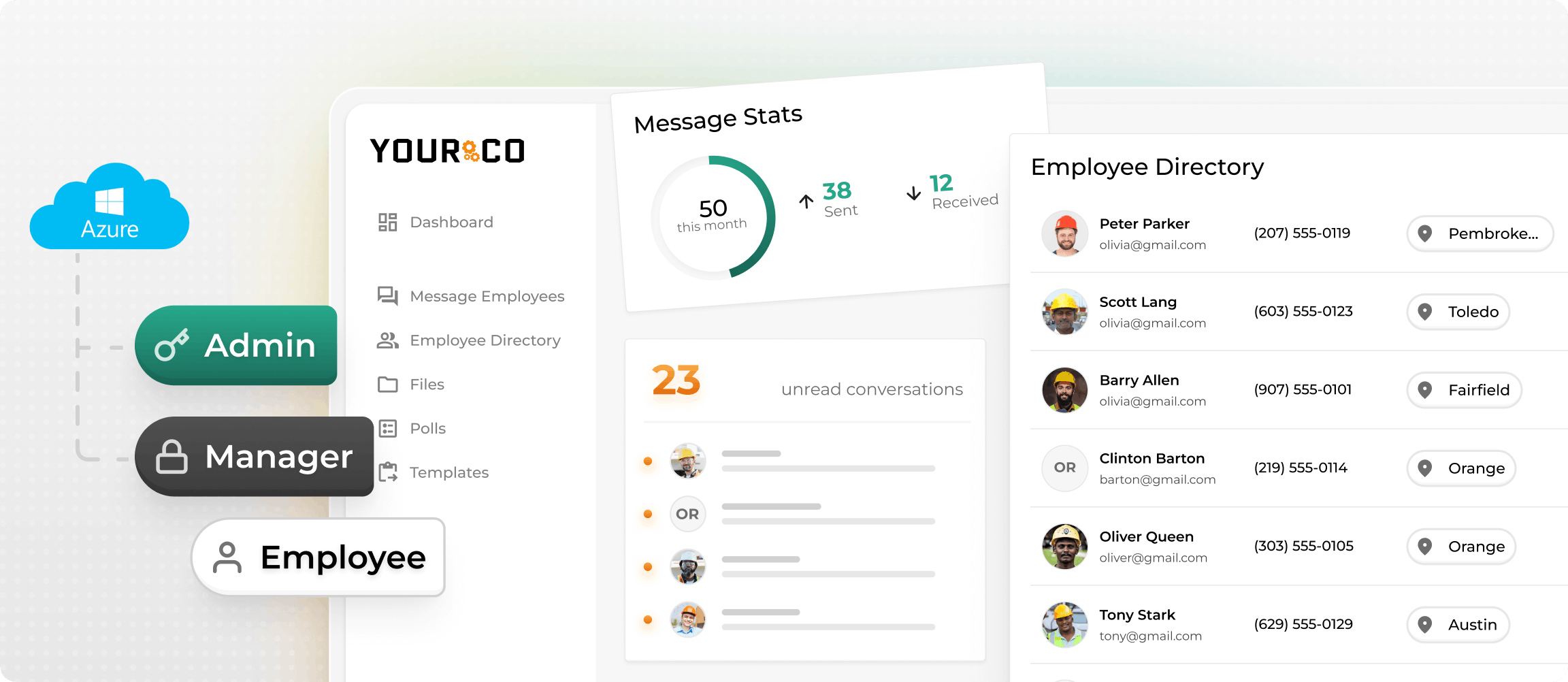
Yourco eliminates this gap by delivering safety communication through SMS, the channel every worker already uses. Text messages reach any mobile phone, from the latest smartphone to a basic flip phone, without downloads, logins, passwords, or internet connectivity. The result is a 98% read rate and near-universal reach from day one.
Yourco's key capabilities include:
- Two-way messaging between frontline employees and local managers, with one-way corporate broadcasts for leadership and company-wide updates (Enterprise Bridge)
- Free tier for up to 50 employees, with pilot programs available for mid-market teams (up to 500 employees) and enterprise organizations (500+ employees)
- SMS-first approach, no app download or Wi-Fi required; works on flip phones and basic mobile devices
- AI-powered translation across 135+ languages and dialects; integrates with 240+ HRIS and payroll systems
- AI-powered Frontline Intelligence to detect disengagement and call-off signals, surface safety risks, support staffing predictions, and deliver actionable reporting
- Surveys and forms to collect real-time employee feedback and workforce data
- Enterprise-grade security and compliance, including SOC 2 Type II compliance and GDPR readiness
After using Yourco for 90 days, companies see two-way employee engagement increase to 86% (Yourco's internal data).
For safety communication specifically, Yourco's SMS approach means every worker can report hazards by texting a photo and description directly to the company's Yourco number. Each report is automatically time-stamped and stored, creating documentation for OSHA audits, insurance claims, and incident investigations. AI-powered translation ensures safety alerts reach multilingual teams in their preferred language, and Frontline Intelligence surfaces safety concern patterns across locations before incidents escalate.
Where app-based and hardware-dependent platforms measure safety engagement among the workers who opted in, Yourco captures safety data from your entire workforce. That complete picture is the difference between a reactive safety program and a proactive one.
2. AlertMedia
AlertMedia is an emergency communication and threat intelligence platform designed to help organizations send mass notifications during critical events. It monitors global threats in real time and provides tools for crisis response coordination across large, distributed workforces.
Key safety capabilities include:
- Mass emergency notifications across text, voice, email, push, Slack, Teams, WhatsApp, and desktop alerts
- Real-time threat intelligence with analyst-vetted alerts for weather, civil unrest, and active threats
- Two-way acknowledgment tracking to confirm employee safety during emergencies
- Lone worker monitoring with panic buttons, timed check-ins, and GPS tracking
- Geospatial mapping to identify impacted employees and locations
- Integration with HR systems like Workday, ADP, and Oracle for automated contact management
AlertMedia excels at crisis communication but is designed primarily as an emergency notification tool, not a daily communication platform. It doesn't handle routine safety messaging, training delivery, or hazard reporting. Organizations that need ongoing two-way safety communication alongside emergency alerts typically need to pair AlertMedia with a separate frontline communication tool, which adds cost and complexity.
3. Weavix (Walt Smart Radio System)
Weavix combines software with proprietary Smart Radio hardware to create a unified safety and communication platform for industrial environments. Its Walt Smart Radio includes a dedicated SOS button, location tracking, and real-time alerting designed for high-risk facilities.
Key safety capabilities include:
- Dedicated SOS button on Smart Radio hardware for instant man-down alerts
- Geofencing and muster tracking for evacuation verification
- Mass and targeted alerts based on worker location within a facility
- Incident investigation tools with historical location and communication data
- AI-powered translation for multilingual teams
- Voice, text, photo, and video communication on a single device
Weavix is purpose-built for large industrial facilities like manufacturing plants, energy sites, and warehouses. The hardware requirement means significant upfront investment, and the platform works best in fixed-location environments where every worker can carry a Smart Radio. Organizations with mobile crews, remote job sites, or workers who move between locations may find the hardware model impractical. The platform also doesn't address broader HR communication needs like benefits updates, surveys, or onboarding.
4. SafetyCulture
SafetyCulture provides inspection, incident reporting, and operational auditing tools through a mobile-first platform. Originally known for its iAuditor inspection app, it has expanded into training delivery, hazard reporting, and emergency notification through its Heads Up feature.
Key safety capabilities include:
- Digital inspection checklists with photo documentation and corrective action tracking
- Incident and hazard reporting with customizable workflows
- Emergency alerting through the Heads Up notification tool
- Training modules with completion tracking and certification management
- Analytics dashboards showing inspection trends and compliance gaps
- Pre-built template library for OSHA, ISO, and industry-specific audits
SafetyCulture is strong on compliance documentation and inspection management but requires app installation and some digital comfort from workers. The platform is designed around structured forms and checklists rather than free-form communication, which means it supplements rather than replaces daily workforce messaging. Workers on basic phones without app access can't participate, and the platform doesn't provide the kind of ongoing two-way communication that builds the safety culture it's named after.
5. Beekeeper
Beekeeper is a mobile-first employee communication app with workflow automation features that extend into safety use cases. Its automated workflows can digitize incident reporting, safety checklists, and maintenance requests, making it popular in hospitality, manufacturing, and logistics.
Key safety capabilities include:
- Automated safety workflows for incident reporting and maintenance requests
- Secure messaging with streams for safety-specific channels
- Document library for SOPs, safety manuals, and compliance materials
- Inline translations for multilingual safety communications
- Analytics dashboard tracking engagement with safety content
- Integration with HR, scheduling, and operational tools
Beekeeper requires employees to download an app and navigate a digital interface, which creates barriers for less tech-savvy workers. Its safety features are built on top of a general communication platform rather than designed specifically for safety use cases, so organizations with complex safety requirements may find the workflows insufficient compared to dedicated EHS tools. Workers on basic phones or in low-connectivity environments can't access the platform.
6. Connecteam
Connecteam bundles communication, scheduling, time tracking, and task management into a single mobile app. Its digital forms and checklists make it functional for basic safety reporting and training delivery, particularly for small to mid-sized operations.
Key safety capabilities include:
- Digital safety checklists and inspection forms with photo attachments
- Training modules with quiz-based completion verification
- Push notification alerts for safety updates and emergency messages
- Document library for safety procedures and compliance materials
- GPS-based clock-in for field workers and lone worker visibility
- Free tier for small teams with scalable paid plans
Connecteam's breadth comes at the cost of depth. Safety features like incident reporting and compliance tracking are more basic than dedicated EHS platforms, and advanced reporting requires higher-tier plans. The platform depends on smartphone access and app downloads, which excludes workers using basic phones. For organizations focused primarily on safety communication, the operational management features can add unnecessary complexity.
7. ANVL (Benchmark Gensuite)
ANVL is a frontline safety software platform focused on turning safety inspections, observations, and reporting into real-time data. Named the 2025 OH&S New Product of the Year in the EHS Apps category, it emphasizes configurable workflows and AI-powered analytics for safety leaders.
Key safety capabilities include:
- Configurable safety workflows with branching logic and escalation triggers
- Voice-to-text dictation, photo and video capture, and sketch annotations for field reporting
- Two-way communication tools connecting workers with supervisors during active issues
- AI-powered analytics for identifying trends, risk patterns, and areas for improvement
- Digital signatures and QR code lookups for compliance verification
- Pre-built template library for quick deployment of common safety processes
ANVL is designed specifically for safety and EHS professionals, making it powerful for organizations with mature safety programs. However, it focuses on structured safety processes rather than general workforce communication. Workers need app access to participate, and the platform doesn't address broader communication needs like shift updates, benefits information, or employee engagement. Organizations would need a separate communication tool alongside ANVL for daily frontline messaging.
Increase Two-Way Employee Engagement With Yourco
After using Yourco for 90 days, companies see two-way employee engagement increase to 86% (Yourco's internal data).
Try Yourco for free today or schedule a demo and see the difference the right workplace communication solution can make in your company.
Frequently Asked Questions
What's the difference between safety communication platforms and general workplace messaging apps?
Safety communication platforms are specifically designed to support workplace safety requirements, including multilingual capabilities, two-way hazard reporting with documentation trails, and functionality on any mobile device including basic phones without internet access. These platforms provide audit trails and specialized features that general messaging apps don't offer.
Do we need to provide company phones to all frontline workers to use these platforms?
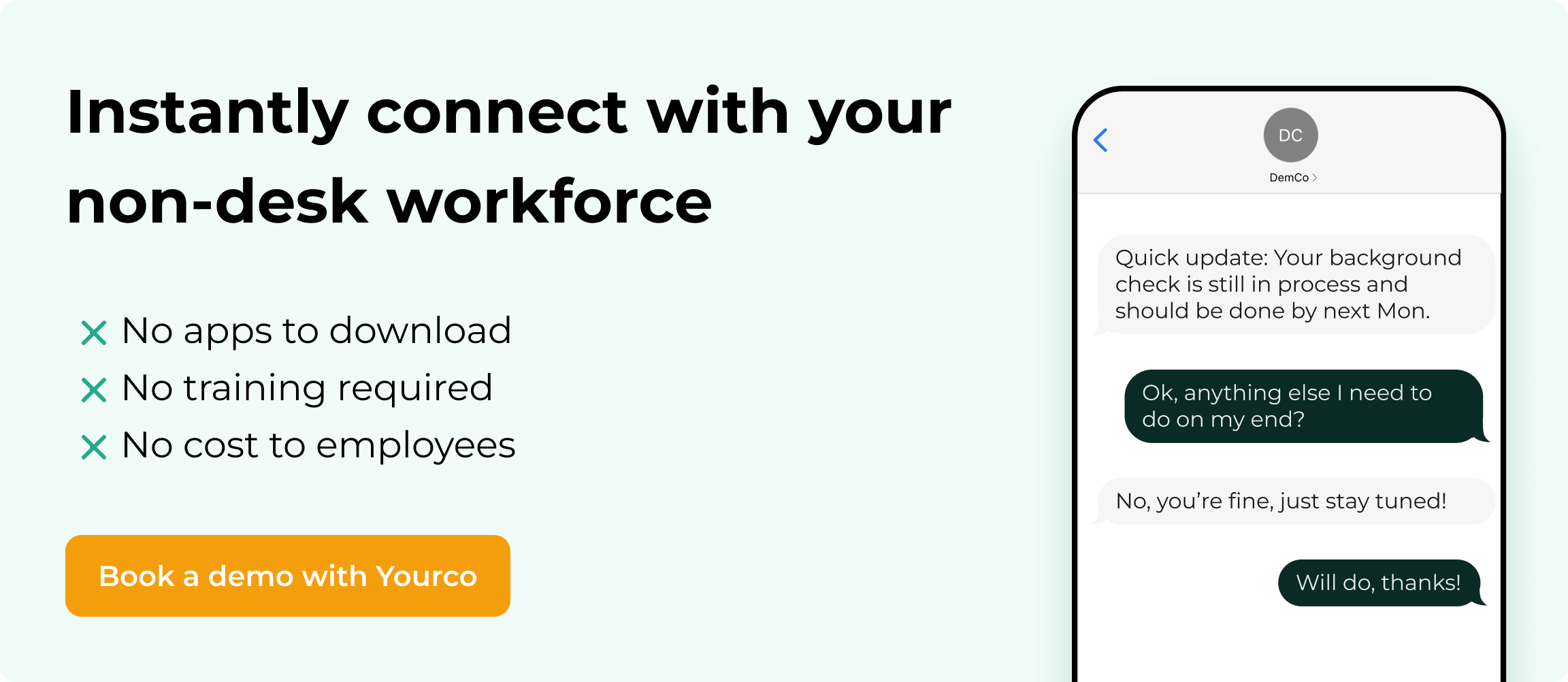
No. SMS-based safety communication platforms work on workers' personal mobile phones through toll-free messaging that costs employees nothing. This approach addresses the infrastructure gap facing frontline workers who lack corporate email access or reliable internet connectivity.
What ROI should we expect from investing in better safety communication?
Better safety communication typically improves workplace safety outcomes, which can reduce workers' compensation costs and injury rates. Track both leading indicators like near-miss reporting frequency and outcome metrics like incident rates to measure communication effectiveness. Most organizations see measurable improvements within six to twelve months.