A single missed safety message can mean the difference between a close call and a serious injury. When your team is scattered across shifts, working in noisy environments, and rarely near a computer, traditional communication methods fall flat. You need a system that reaches every worker with critical safety information before they start their day.
This article provides proven safety message templates, shows you exactly when and how to deliver them, and helps you choose the right format for your manufacturing plant, warehouse, construction site, transportation operation, or hospitality business.
TL;DR
- Deliver safety messages at shift start when cognitive alertness is highest
- Use SMS-based communication to reach dispersed workers on any phone, including flip phones
- Match your message format to operational needs: quick briefings (2-3 minutes) for daily reminders, toolbox talks (5-10 minutes) for OSHA compliance
- Frame messages positively to increase behavior change rather than relying on threats
- Address common barriers like language differences, shift handoffs, and limited technology access
Boost Safety Performance With Pre-Shift Message Delivery
Timing matters more than most managers realize. Worker alertness and safety performance decline as shifts progress, making pre-shift communication the optimal window for safety messages.
Face-to-face delivery at shift start produces the strongest results. When you gather your team for a quick safety briefing before work begins, everyone's cognitive alertness is at its peak. They haven't yet encountered the time pressure, equipment issues, or production demands that will consume their attention.
Keep briefings under five minutes. Your team needs enough information to work safely, not a lecture that delays production. The most effective format follows three parts:
- Identify the specific hazard
- Explain the expected protective action
- Clarify why it matters for that day's work
For teams that don't gather in one location at shift start, SMS-based communication offers a proven solution for reaching dispersed workers across multiple job sites or staggered start times.
Match Message Formats to Your Team's Daily Workflow
Five distinct safety message formats serve different operational needs. Choose based on your situation:
- Topic-Discussion-Action format: Works across all industries for daily pre-shift briefings. Start with a single-line safety focus, provide 2-3 sentences explaining the hazard, list specific steps employees should take, and end with a discussion question.
- Construction Toolbox Talks: Follow AGC industry standard for OSHA compliance documentation. Include date and project location fields, conduct a 5-7 minute safety discussion, and collect employee signatures.
- Safety Moments: Condense critical information into 2-3 minutes for manufacturing and warehouse pre-shift huddles. Open with an engaging question, provide one impactful safety fact, and close with a reminder.
- Transportation visual format: Use a structured five-element approach with visual elements, bold headlines, brief explanations, behavioral reminders, and reporting mechanisms.
Interactive Discussion formats: Best for equipment-specific training and hands-on skill development with demonstrations and practice sessions.
Prevent Fatal Injuries With Targeted Safety Topics
Your daily message topics should align with the hazards causing injuries in your industry.
Safety Message Templates by Industry
Use these ready-to-send SMS templates to address the most common fatal and serious injuries in your industry. Copy, customize with your site details, and send through your Yourco dashboard.
Construction Templates
Fall Protection Reminder Safety reminder: Before starting any work above 6 feet today, confirm your harness is inspected and your anchor point is secure. If your fall protection gear is damaged or missing, text back now so we can replace it before you go up.
Struck-By Hazard Alert Heads up: Crane operations are active on the east side of the site today. Stay clear of the swing radius and wear your hard hat at all times. If you see an unsecured load overhead, stop work and text this number immediately.
Electrocution Prevention Reminder: Before starting any work near power lines or electrical panels today, confirm your de-energization checklist is complete. If you're unsure whether a line is live, stop and contact your supervisor. No task is worth the risk.
Trench and Excavation Safety All crews working in or near trenches today: Do not enter any excavation deeper than 5 feet without shoring, sloping, or a trench box in place. If you see signs of wall instability, exit immediately and text this number.
Daily Toolbox Talk Prompt Good morning, team. Today's focus: [TOPIC]. Before starting your shift, take 5 minutes with your crew lead to review today's hazards. Reply DONE when your crew has completed the briefing.
Manufacturing and Warehouse Templates
Lockout/Tagout Reminder Before performing any maintenance or clearing a jam today, verify lockout/tagout is complete. Never reach into equipment that hasn't been locked out, even for a quick fix. Your safety comes first.
Machine Guarding Check Daily check: Make sure all machine guards are in place before operating equipment today. If a guard is missing, damaged, or removed, do not run the machine. Text back the machine number and we'll get it fixed.
Forklift and Powered Industrial Truck Safety Reminder for all forklift operators: Complete your pre-shift inspection before operating. Check brakes, steering, horn, and forks. If anything fails inspection, tag it out and text this number for a replacement assignment.
Chemical Safety and Hazard Communication New chemicals arriving on the floor today. SDS sheets are posted at [LOCATION]. Make sure you review them before handling. If you need PPE or have questions about safe handling, text back and we'll get you what you need.
Ergonomics and Material Handling Reminder: Use team lifts for anything over 50 lbs. Mechanical assists are available at [LOCATION]. Back injuries are one of the most common reasons for lost time. Take the extra minute to lift safely.
Fall Protection for Elevated Work Anyone working on mezzanines, loading docks, or elevated platforms today: Confirm guardrails are in place and use your harness for any work near open edges. Report missing rails to your supervisor right away.
Transportation Templates
Driver Fatigue Alert Reminder: If you feel drowsy behind the wheel, pull over at the nearest safe location and take a break. Fatigue is the leading cause of crashes. Your load can wait. Your safety can't. Text this number if you need to adjust your route or schedule.
Distracted Driving Reminder Before you start your route: Secure your phone, set your GPS, and stow any loose items. Once you're moving, your only focus should be the road. Calls and texts can wait until your next stop.
Pre-Trip Vehicle Inspection Daily reminder: Complete your pre-trip inspection before heading out. Check tires, brakes, lights, mirrors, and fluid levels. If anything needs attention, text back with your vehicle number and the issue. Don't drive an unsafe vehicle.
Severe Weather Driving Advisory Weather alert: [WEATHER CONDITION] expected on today's routes. Reduce speed, increase following distance, and pull over if conditions get dangerous. Text this number for real-time route updates or if you need to delay departure.
Hours of Service Reminder Reminder: Log your hours accurately and take your required breaks. Pushing past your limits puts you and everyone on the road at risk. If your schedule feels tight, text your dispatcher now so we can adjust before it becomes a problem.
Hospitality Templates
Slip, Trip, and Fall Prevention Reminder: Wet floors are our number one injury risk. Place warning signs immediately after mopping or spills. If you see a hazard in a hallway, lobby, or kitchen, clean it up or mark it and text this number so we can address it.
Kitchen Burn and Fire Safety Kitchen team: Remember to use dry towels when handling hot items and keep oven mitts within reach at all times. If grease builds up on equipment, report it to your manager. Grease fires start when we skip cleaning routines.
Chemical Safety for Cleaning Products Before using any cleaning product, check the label for PPE requirements. Wear gloves and eye protection when mixing chemicals. Never combine products unless the label says it's safe. If you have a reaction, text this number right away.
Manual Handling and Lifting Reminder: Use carts for heavy supply loads. Ask a teammate for help with anything awkward or heavy. If you feel strain in your back or shoulders, stop and text this number. We'd rather adjust your tasks than lose you to an injury.
Electrical Safety in Kitchen Areas Keep all electrical cords away from water and wet surfaces. If you notice frayed cords, sparking outlets, or equipment that shocks you, stop using it immediately and text this number with the equipment name and location.
Increase Behavior Change With Positive Safety Messaging
The way you phrase safety messages determines whether workers actually change their behavior. Messages designed to evoke emotional engagement prove significantly more effective than those relying on cognitive processing alone.
Compare these two approaches:
- Gain-framed: "Wearing your PPE ensures you go home safely to your family every night"
- Loss-framed: "Failure to wear PPE will result in disciplinary action"
Both address the same requirement, but the first connects to what workers value while the second triggers defensive resistance.
Make safety real with specific examples. Instead of citing national statistics, say: "Last month, John in shipping strained his back lifting without proper technique—he's still in physical therapy." This narrative-based approach creates an immediate mental image that statistics never achieve.
Build psychological safety as your foundation. When workers fear punishment or ridicule for speaking up, they dismiss safety messages as bureaucratic theater.
Reach Every Worker Despite Common Communication Barriers
Frontline workers don't sit at desks checking email. Manufacturing, construction, healthcare, and field service teams lack consistent access to intranets and desktop communication systems.
Limited technology access: Mobile-first platforms and face-to-face pre-shift huddles address this challenge by reaching workers regardless of technology availability.
Language barriers: This is particularly acute in construction, food processing, and healthcare where workers speak different primary languages. Communicating with multilingual teams effectively requires providing safety training in workers' primary languages and using pictograms that transcend language barriers.
Shift work challenges: Organizations running multiple shifts frequently deliver conflicting information across time periods. Establish standardized handoff procedures where outgoing supervisors brief incoming supervisors on safety status.
Message overload: When safety messages aren't differentiated or prioritized, they become lost in the noise of daily communications. Make communications specific to workers' roles and current tasks rather than generic company-wide messages.
Reach Every Worker Instantly With Yourco
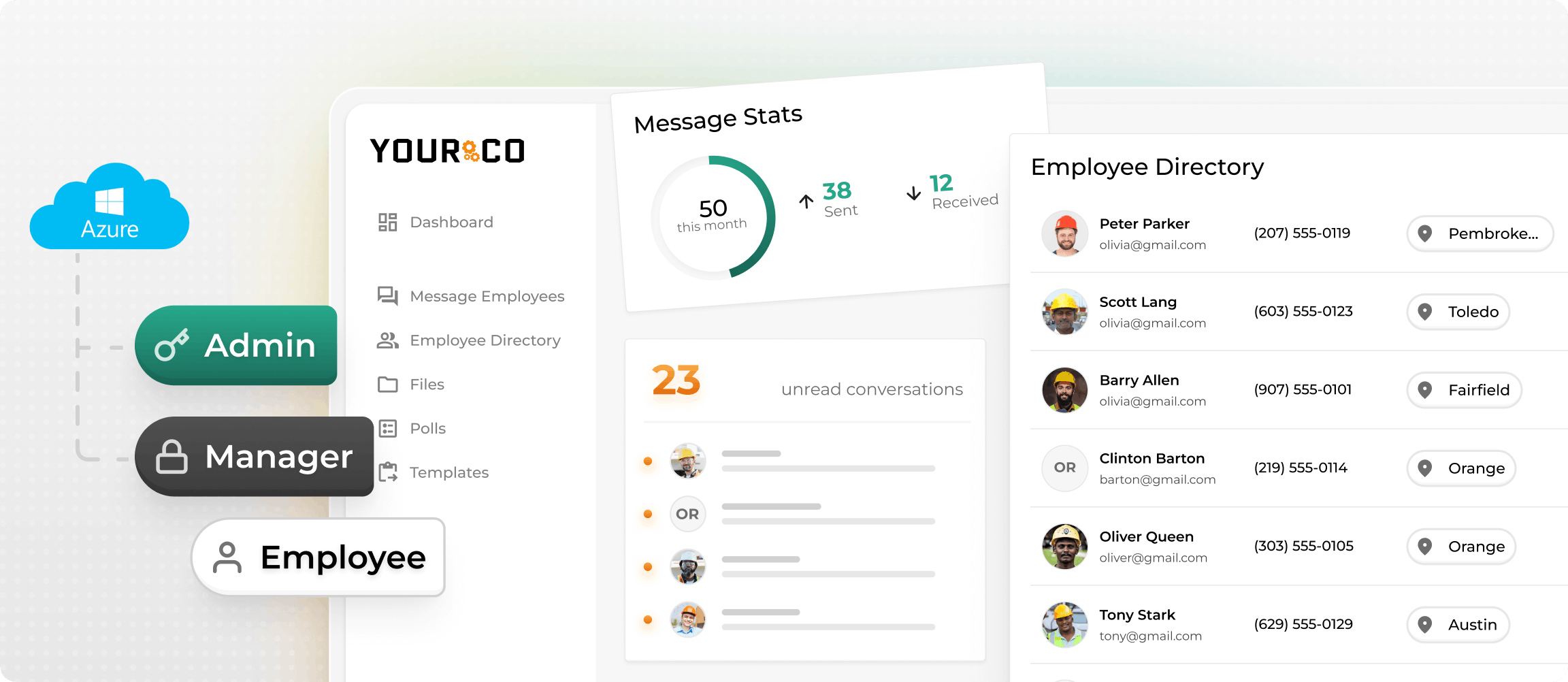
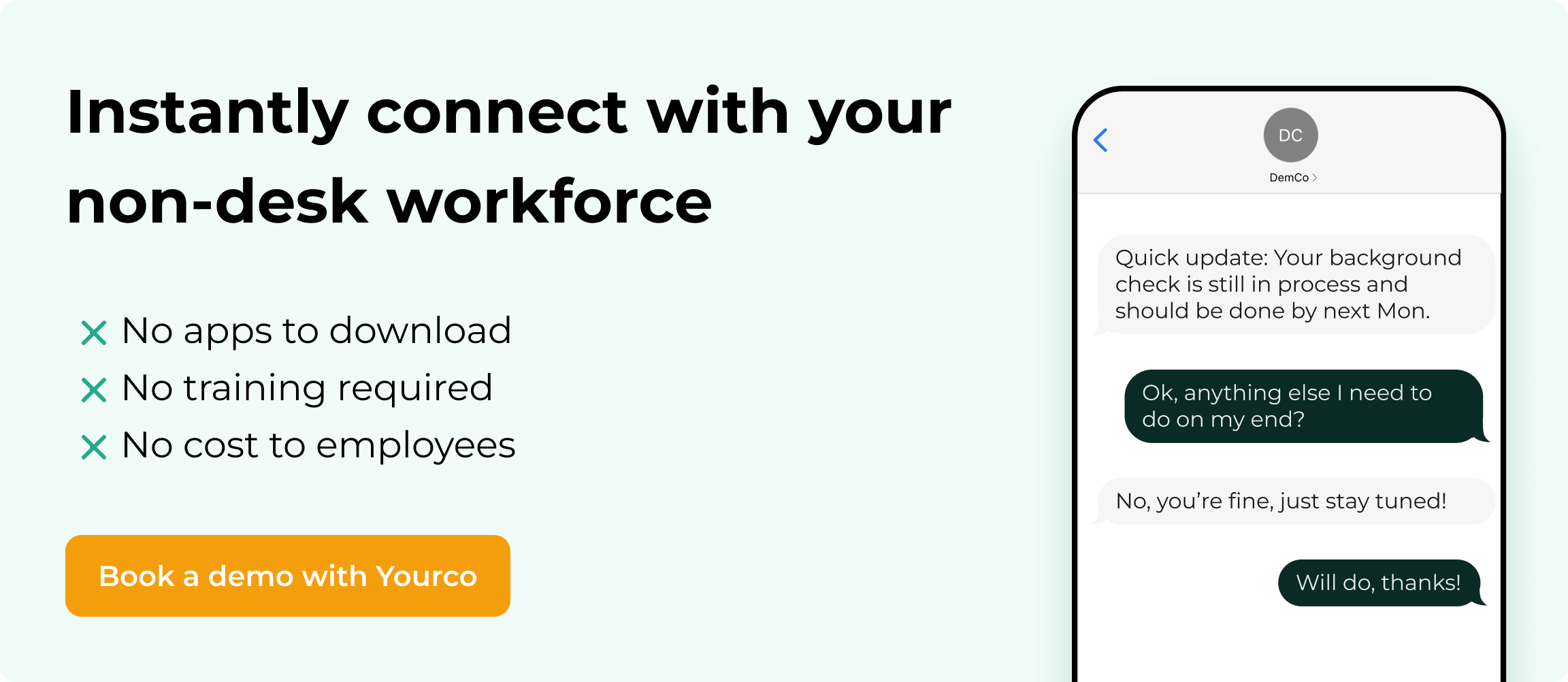
Yourco delivers safety messages via text to any mobile phone, ensuring frontline workers receive critical communications within minutes. The platform eliminates communication gaps by reaching workers on the devices they already carry.
Key capabilities include:
- Two-way messaging between frontline employees and local managers, with one-way corporate broadcasts for leadership and company-wide updates (Enterprise Bridge)
- Free tier for up to 50 employees, with pilot programs available for mid-market teams (up to 500 employees) and enterprise organizations (500+ employees)
- SMS-first approach, no app download or Wi-Fi required
- Works on flip phones and basic mobile devices
- AI-powered translation across 135+ languages and dialects
- Integrates with 240+ HRIS and payroll systems
- AI-powered Frontline Intelligence to detect disengagement and call-off signals, surface safety risks, support staffing predictions, and deliver actionable reporting
- Surveys and forms to collect real-time employee feedback and workforce data
- Enterprise-grade security and compliance, including SOC 2 compliance and GDPR readiness
Yourco's scheduled delivery feature solves the shift-start timing challenge by automatically sending safety messages at each shift's start time with no manual coordination needed. Two-way messaging enables workers to confirm receipt, ask clarifying questions, and report hazards directly from their phones.
After using Yourco for 90 days, companies see two-way employee engagement increase to 86% (Yourco's internal data).
Try Yourco for free today or schedule a demo and see the difference the right workplace communication solution can make in your company.
Frequently Asked Questions
When should I deliver daily safety messages?
Deliver messages at shift start when cognitive alertness is highest. Worker alertness and safety performance typically decline as shifts progress, making pre-shift communication the optimal window. For operations with staggered starts, use SMS-based delivery to reach everyone at their individual shift start time.
How long should a daily safety message last?
Keep daily safety messages under 5 minutes for maximum engagement. Brief safety moments work best at two to three minutes, while comprehensive toolbox talks required for OSHA compliance documentation can extend to 5-10 minutes. Longer messages create disengagement and delay production unnecessarily.
What topics should I prioritize for daily safety messages in my industry?
Prioritize OSHA's most frequently cited violations and the hazards causing injuries in your specific industry. Construction should focus on the Fatal Four (falls, struck-by, electrocutions, caught-in/between), manufacturing should emphasize machine guarding and lockout/tagout, warehouses should address powered industrial truck operations and material handling, and transportation should cover driver fatigue and distracted driving.