Tracking who reads a message means separating three records: delivery to a device, an open, and an acknowledgment from a named person at a named time. Only the third holds up when someone asks whether a specific worker was told.
A lockout/tagout revision goes out to all forty people on second shift, three send a thumbs-up in the group chat, and nothing shows what the other thirty-seven ever saw. Email open rates are an estimate, intranet posts disappear into analytics nobody reads, and when something goes wrong, there is no way to show the message landed.
TL;DR
- Delivered, read, and acknowledged are three different records, and only the last one names a person, a message version, and a time.
- Email pixels, app push receipts, intranet analytics, and SMS delivery reports each confirm less than they seem to.
- Confirm high-stakes safety and compliance messages only, because tracking everything reads as surveillance and costs trust.
- State the confirmation window in the message, then follow up only with workers who haven't replied.
- Timestamped acknowledgments are the record an incident review or a compliance question actually needs.
- SMS-based platforms like Yourco confirm delivery to any phone and capture reply-based acknowledgments.
What Is the Difference Between Delivered, Read, and Acknowledged?
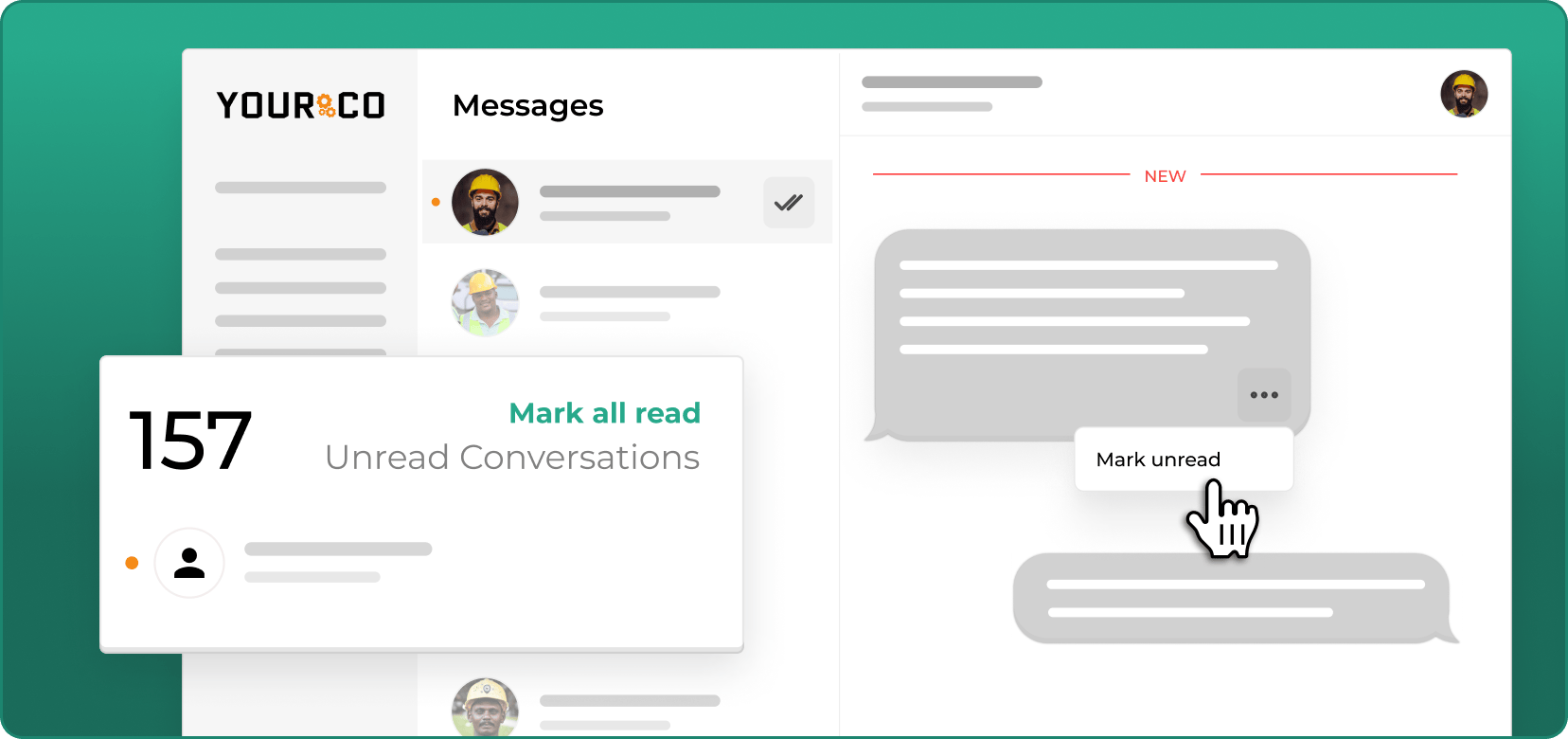
Delivered means the message reached the handset or the mailbox. A read receipt indicates that someone opened it, which says nothing about comprehension, and recipients can decline read-receipt requests in most email clients. Standard SMS carries no native read receipt.
Acknowledged is different in kind. It is a worker-generated record showing that a named person confirmed a specific message version at a specific time. That is the only one that answers the question an investigator asks: not whether a message was sent, but whether this employee was told.
Training documentation follows the same logic. Under the process safety management rule, which covers work with highly hazardous chemicals, the training record is expected to carry the identity of the employee, the date of the training, and "the means used to verify that the employee understood the training." Delivering the training and documenting who understood it are treated separately, and qualified legal professionals can advise which records apply.
How Do You Track Which Employees Read Your Messages on Each Channel?
Every channel produces a different confirmation, and none proves comprehension. The table below shows what each can and cannot establish.
For a workforce with no company email, delivery data alone leaves the loop open. Pairing a delivery report with a reply closes it: the report shows the message reached a working number, and the reply shows a person acted on it.
88% of HR leaders say they need a reliable way to reach frontline employees, while only 55% are confident they have one, according to a Yourco-commissioned survey of 150 HR leaders, and an acknowledgment only exists if the message reached someone who could reply.
Messages That Justify Confirmation, and Messages That Do Not
Confirm messages where proof of receipt carries consequences, and leave the rest alone. Four categories usually justify per-person confirmation:
- Emergency alerts and severe-weather notices
- Safety directives and hazard communications
- Compliance policy updates that carry a formal acknowledgment
- Mandatory regulatory training notices
Newsletters, culture updates, and general announcements sit on the other side of that line. When every message demands acknowledgment, confirming becomes a reflex tap and the record stops proving anything.
Tracking everything is also a surveillance problem, not just a data-quality one. A 2026 study of 2,515 US workers in the Journal of Business and Psychology found that workers in precarious jobs were more likely to be subject to electronic monitoring, were monitored more intensively, and reported substantially more negative reactions to it than workers with secure jobs, whose responses were likelier to name benefits such as safety.
The same review describes earlier findings on stress and performance as mixed. It does show that the workers most likely to be tracked closely are the ones it costs the most. Naming the message types the organization confirms, and saying why, before any tracking starts is what separates a documentation practice from monitoring.
Federal guidance on electronic training documentation treats badge swipes and identification scans as acceptable records, which is a useful boundary: the record establishes that a person received something, not what they did all day.
Set a Confirmation Window by Urgency
An acknowledgment request with no deadline is a suggestion. State the window inside the message and match it to the stakes:
- Emergency messages: immediate confirmation, on the channel workers carry
- Urgent operational changes: one to two hours
- Action-required items: 12 to 24 hours
- General updates: 24 to 48 hours, or no confirmation at all
Publish the windows once so supervisors and crews work off the same clock.
A worked case makes the clock visible. A lockout/tagout revision goes to 40 workers on second shift at 09:00 with a two-hour window. At 11:00, 31 have replied YES, 4 bounced on invalid numbers, and 5 are silent.
The bounces go to HR as a contact-data fix, the silent five get a reworded second message, and anyone still unconfirmed by 13:00 gets a supervisor conversation before the shift starts. The record afterward shows 40 names, 40 outcomes, and the time each one landed.
The window also sets when follow-up starts, since a directive that expects confirmation in two hours produces an unconfirmed list at the two-hour mark. Confirmation and speed are separate measurements, and tracking response times by message type is what shows whether the published windows match how crews actually work.
Follow Up With Non-Readers Without Nagging the Roster
Send the reminder only to workers who have not confirmed. Blasting all forty because five are missing teaches the thirty-five who replied to ignore the next one. A workable sequence runs in four steps:
- Resend to the unconfirmed list only.
- Reword the second message so it doesn't read as a duplicate of the first.
- Trigger that second send automatically at the end of the window, rather than asking a supervisor to pull lists by hand.
- Escalate channels for critical items: from email or an app to text, then to an in-person conversation with a supervisor.
For the worker who never confirms anything, rule out access before behavior. A wrong number, an opted-out line, or a phone that changed hands is a data problem, and delivery tracking with invalid-number identification catches it before it looks like defiance. Language is the second check, since a worker who cannot read a message cannot confirm it.
Only when contact data and language both check out does the pattern belong in a supervisor conversation, with repeated failures to acknowledge mandatory items documented as they happen.
Across many sites, AI analytics layers such as Yourco's Frontline Intelligence show which locations are replying and which are quiet, so follow-up goes where the silence actually is.
How Acknowledgment Records Become an Audit Trail
An acknowledgment record is only useful if it names four things: the employee, the policy title and version, the timestamp, and the affirmative confirmation itself. Federal guidance allows employers to keep training records in any form they consider appropriate, as long as the employer, employees, and the Occupational Safety and Health Administration (OSHA) can readily access them.
Those records matter most in a dispute. In a 2017 decision on unpreventable employee misconduct, the Occupational Safety and Health Review Commission set out a four-part test that includes whether the employer adequately communicated its work rules to employees, with the employer bearing the burden of proof. In that case, the judge noted that some safety communication was delivered only in English, while the crew included Spanish-speaking workers.
Records that tie each confirmation to a named worker, in a language that worker reads, are harder to argue with than a delivery log or a sign-in sheet from a shared terminal. Pairing policy acknowledgment statements with timestamped confirmations creates that trail.
This information is for general awareness only. For specific compliance guidance, consult with qualified legal professionals.
Close the Loop on Every Message With Yourco
Yourco is an SMS-based employee communication platform that separates delivery from acknowledgment rather than treating an open as proof. Workers reply "YES" to a policy or safety notice, and the reply becomes a timestamped record tied to a named person, with no app, login, or company email involved. Core capabilities include:
- SMS to any phone, including basic flip phones, with no app download, no Wi-Fi, and no cost to employees
- Real-time delivery tracking with invalid-number identification, so stale contact data shows up as a data problem rather than a silent worker
- Two-way messaging, so workers confirm receipt, ask a question, or flag a problem in the same thread
- AI-powered translation across 135+ languages and dialects, in each worker's preferred language, so language differences never block an acknowledgment
- Message archiving with timestamps, which keeps each confirmation retrievable after the shift, the season, or the employee
Yourco connects to 240+ HRIS and payroll systems, so confirmation reports never chase workers who left last month.
Enterprise Bridge gives corporate leadership a one-way channel for policy and safety updates across every location at once, while local managers keep two-way conversations with their own crews.
Frontline Intelligence gives HR and operations leaders site-level visibility into message activity and reply patterns across locations, so leadership can see which sites are responding and where follow-up is needed rather than reconstructing it from separate exports.
"Yourco is the best thing we did last year! We are able to send instant text message communications to all our employees. We have had other sites within Sherwin start to use them as well."
— Carolina Abrams, HR Manager, Sherwin-Williams - CEP
After 90 days on Yourco, companies see two-way employee engagement reach 86%.
Try Yourco for free today or schedule a demo and see the difference the right workplace communication solution can make in your company.
Frequently Asked Questions About Employee Message Read Receipts
How do I track which employees read my messages?
Use a channel that reports delivery per recipient, then ask for a reply so a named worker confirms the message. Delivery data shows the message reached a working number, and the reply is the record that names the person and the time, which is what an incident review or a compliance question actually asks for.
What is the difference between delivered, read, and acknowledged messages?
Delivered means the message reached the device or mailbox. Read means someone opened it, which says nothing about comprehension. Acknowledged means a named employee actively confirmed a specific message at a specific time, and it is the only one of the three that produces a per-person record worth keeping.
Do standard text messages have read receipts?
No, standard SMS produces carrier delivery reports showing whether a message reached the handset, with no native read receipt. SMS-based platforms like Yourco pair that delivery tracking with reply-based acknowledgment, so a worker's text confirmation becomes a timestamped record without an app, Wi-Fi, or a data plan.
How do you follow up with employees who have not read a message?
Re-send only to workers who have not confirmed, reword the second message so it doesn't read as a duplicate, and escalate critical items to another channel before treating silence as refusal. Check the contact record and language settings first, since both can cause silence that looks like non-compliance.
Which employee messages should require acknowledgment?
Confirm messages where missing them has consequences: emergency alerts, safety directives, compliance policy updates, and mandatory training notices. Newsletters and culture updates rarely justify it. When every message demands acknowledgement, workers start tapping confirm without reading, which weakens exactly the records the organization wanted.
Is tracking employee messages surveillance?
That depends on scope and transparency. Confirming acknowledgment of selected safety and compliance messages is a documentation practice. Tracking every message a worker opens is monitoring, and it hits least-secure workers hardest. Publishing which message types are confirmed, and why, keeps the practice defensible.