Global employee engagement fell to 20% in 2025, its lowest level since 2020, costing the world economy an estimated $10 trillion in lost productivity, Gallup reports. On a manufacturing floor, that decline starts with reach: workers without a company inbox or a desk rarely get timely information or a way to respond. An employee experience strategy shapes culture, physical conditions, and technology across the employee journey and, when done well, lowers turnover and strengthens the organization's reputation. It also gives HR managers a practical answer to which platforms and tools can carry that strategy to the plant floor.
TL;DR
- An employee experience strategy covers culture, physical workspace, and technology, planned for every employee, including those on the plant floor.
- On a plant floor, technology decides whether anything reaches workers at all: no login means no intranet post.
- Evaluate platforms on reach first, without an app or company email, then HRIS and payroll integrations, translation, surveys, archiving, and vendor stability.
- SMS platforms like Yourco reach any mobile phone, including flip phones, with no app download and no cost to employees.
What Is an Employee Experience Strategy?
An employee experience strategy is a deliberate plan for shaping how employees perceive their workplace at every stage of employment, from the first job posting to the exit interview.
It treats culture, physical conditions, and technology as design touchpoints. In a manufacturing setting, the plan has to support the second-shift machine operator who never opens a computer as fully as it supports the front office.
How employees feel about their workplace shapes how they perform, collaborate, and decide whether to stay. Employee experience (EX) spans recruitment, onboarding, daily work, professional development, and eventually offboarding. A well-designed EX strategy examines each stage of the journey to identify ways to support people and build lasting trust.
Companies that prioritize EX often see higher engagement and lower turnover. They also often see improved productivity. In a plant where a single line depends on a full crew showing up, that means fewer open positions to backfill and less overtime spent covering them.
What Are the Components of an Effective Employee Experience Strategy?
An effective employee experience strategy includes nine interconnected parts that cover the physical workspace, supervisor relationships, and other touchpoints. Production employees feel each one directly, and neglecting any piece can unravel the entire experience.
Its main components include:
- Physical Workspace: Comfort and design affect productivity and mood.
- Organizational Culture: Employees stay engaged when shared values and mutual respect guide the workplace.
- Technology: Efficient tools reduce frustration and improve performance.
- Hiring and Onboarding: A thorough welcome creates a positive first impression.
- Engagement and Retention: Meaningful work and recognition keep people motivated. Programs for motivating frontline employees keep every crew member engaged.
- Growth and Development: Clear learning and advancement paths signal genuine investment.
- Health, Wellness, and Financial Benefits: Morale soars when people feel cared for.
- Diversity, Equity, and Inclusion: A sense of belonging supports stronger collaboration.
- Manager and Team Relationships: Employees need supportive leadership and cohesive teamwork.
On a plant floor, technology is often the weakest link because a policy update that lives on an intranet never reaches a worker without a login.
What Are the Foundational Elements of a Strong Employee Experience Strategy?
Three of the nine components above function as the foundation everything else depends on: cultural, technological, and physical environments. Culture sets how people are treated. Technology determines whether information reaches them, while the physical workspace shapes how they feel during a shift. Developing an effective strategy begins with recognizing how each environment influences the employee journey.
How Does the Cultural Environment Shape Employee Experience?
The cultural environment sets the tone for the whole employee experience strategy, because it determines whether people feel valued, heard, and connected to shared goals. Employees who feel valued show stronger motivation and alignment with company objectives, and that sense of belonging reduces turnover, which matters given the cost of frontline turnover.
Great Day Improvements (GDI), a vertically integrated, direct-to-consumer provider of premium home improvement products with 5,000 employees across 338 locations, saw manufacturing-line turnover fall from 12.7% to 2.3%, a 10.4 percentage-point reduction, after moving frontline communication onto two-way SMS. Organization-wide retention improved too, from 87% to 93%, a 6 percentage-point increase.
A positive culture also influences how employees talk about their workplace. When people feel connected, they become brand advocates who attract new talent, which matters in a labor market where manufacturers compete for the same machinists and technicians.
A documented communication structure keeps that message consistent from shift to shift, rather than depending on which supervisor is on the floor that day.
A healthy culture unites people under shared objectives and strengthens collaboration and trust, creating an environment where employees thrive.
Leaders shape this culture by recognizing achievements and promoting inclusivity. They also keep communication open.
For a shift supervisor, that can be as concrete as acknowledging a line's safety record at the start of the shift, or making sure the night crew hears about a policy change at the same time the day crew does. When employees feel heard and supported, they are more likely to stay engaged and contribute.
What Role Does Technology Play in Employee Experience?
Technology determines whether an employee experience strategy reaches the people itis meant for. For frontline workers without company email or a computer, the phone in their pocket is the only realistic delivery point, so tools that assume an inbox or an app download exclude them.
Practical HR systems simplify transactions and avoid red tape. The best employee experience platforms and tools solve exactly that delivery problem.
Nationally, 88% of HR leaders say they need a reliable way to reach frontline employees, while only 55% feel confident they already have one, according to a Yourco-commissioned survey of 150 HR leaders. That eighteen-point shortfall is why so many work conversations drift onto a supervisor's personal phone.
Advancements in artificial intelligence (AI) and machine learning allow organizations to personalize the employee experience. These tools can anticipate needs, refine workforce strategies, and translate messages automatically for multilingual crews.
Employee experience isn't something HR measures once a year in a survey. Employees provide signals about their experience through everyday workforce interactions, a shift-change text, a call-off, a question to a supervisor, and those signals accumulate whether or not anyone is looking for them. Frontline Intelligence helps HR ask questions across those interactions, such as which locations are going quiet or where a policy update is landing poorly, turning routine communication into a continuous listening channel instead of a once-a-year measurement.
Effective technology keeps multi-site and multi-shift teams connected, so changes made at one plant reach every location the same day. Effective technology also keeps remote and hybrid teams connected, minimizing isolation and maintaining collaboration.
User-friendly digital platforms reinforce an organization's commitment to employee health and work-life balance. The right tools streamline workflows and help employees feel confident they can succeed.
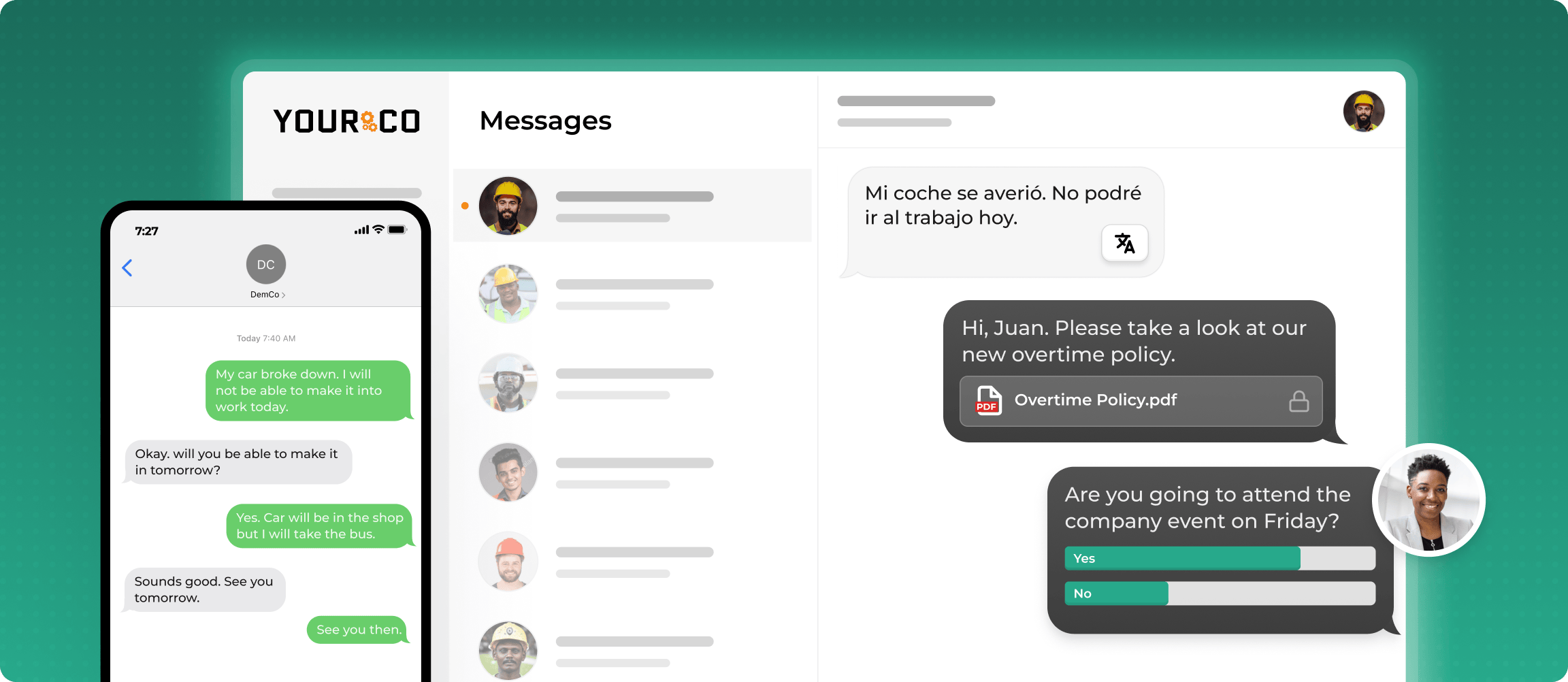
For frontline workers, efficient communication strategies start with the channel. SMS-based platforms like Yourco deliver two-way text messages to any mobile phone, including a basic flip phone, with no app download, no WiFi, and no cost to the employee.
How Does the Physical Environment Affect Employee Experience?
The physical environment affects employee well-being and productivity through light, noise, layout, and the condition of shared spaces. On a plant floor, the options are narrower than in an office, but break rooms, shift-change areas, and rest zones are all within HR's reach.
Designers often use the term biophilic design for natural light and greenery, which can improve mood. These features can also help reduce stress and absenteeism.
Functional meeting areas, lunchrooms, and flexible layouts matter, too. Manufacturers have limits on what they can change around heavy equipment, but a clean, well-lit break room with seating and a working microwave is within reach at almost any site.
Improving the physical environment can greatly improve frontline teams' work experience. Clean, functional shared spaces show workers that the company invests in their working conditions. Some crews work well in open spaces, while others need quieter areas for focused work or private supervisor conversations that should not happen in front of the line.
In education and healthcare settings, exposure to natural elements can support faster healing and better learning outcomes. The same design logic applies to a plant's break and training areas. Once the physical environment is as good as a site allows, the next lever HR can pull is which platform reaches people while they're in it.
What Are the Best Employee Experience Platforms and Tools for Frontline Teams?
The best employee experience platforms and tools for a frontline manufacturing workforce all share one trait: they reach every worker on the phone already in their pocket, without a company email address or an app download.
That holds whether you're looking for employee experience management platforms, employee experience platform solutions, employee experience software solutions, employee experience survey tools, or employee experience tools and employee experience solutions.
Staffbase, Beekeeper, WorkJam, Connecteam, and Poppulo each cover part of that requirement, and SMS-based platforms like Yourco cover it directly. The comparison below rates each against industry criteria for frontline buyers.
The comparison excludes intranet-first and email-first tools because their core delivery requires a corporate inbox or a login, which most production staff do not have.
For the culture side of employee experience, recognition, pulse surveys, and two-way feedback give supervisors actionable information. The comparison therefore focuses on survey capability and two-way reach instead of social feeds or document libraries. Industry guidance supports the following evaluation criteria, and buyers can check each criterion against a vendor's own documentation before a demo:
- Reach without an app or company email: Start by determining whether a production worker with no corporate inbox can receive and answer a message on a personal phone on day one. Ragan's 2026 mid-year internal communications review treats mobile accessibility as the core of the strategy for frontline workforces, and any platform that fails this test leaves whole shifts uncovered.
- SMS as the primary channel for time-sensitive messages: For shift changes, safety alerts, and absence confirmations, messages need to arrive without WiFi or a login. A platform that offers SMS only as an add-on or a supplementary push notification routes those messages through the app first. In a Yourco-commissioned survey of 150 HR leaders, 91% said SMS increases how often frontline employees respond.
- Multilingual auto-translation with a published language count: When significant employee populations speak languages other than English, SHRM's guidance, published in response to the English-as-official-language executive order, recommends proactively translating handbooks, training materials, and policies. Per-message automatic translation removes the wait for a bilingual supervisor, without the ongoing cost of professional translation services.
- Named human resources information system (HRIS) and payroll integrations, and total cost of ownership: A per-user monthly price is only one part of the cost; data migration, implementation, support, integration, and training all add to it. Named connectors to the plant's existing HRIS and payroll system matter more than a headline integration count.
- Survey participation and anonymity for shift workers: Failing to protect anonymity erodes employee trust, according to Gallup's survey guidance, and a crew that works away from a computer will not complete a computer-only survey. Short, text-delivered, anonymous pulse surveys fit a break period.
- Archiving and audit trails for text communications: Many employers retain work-related text messages the way they retain email. The platform should store, timestamp, and export every exchange rather than auto-delete it.
- Implementation time and vendor stability: Finally, per Reworked's 2026 market analysis, consolidation has accelerated across the intranet and employee experience software sector: at least eleven major deals closed in 2025 and 2026 alone, including Beekeeper's merger with LumApps and Poppulo's acquisition of Sociabble.
Weighed against those seven criteria, the table below shows where each platform's own documentation confirms a capability, where it does not, and what each costs.
1. Yourco
Yourco is an SMS-based employee communication platform for frontline workforces. It sends two-way text messages to any mobile phone, including basic flip phones, with no app download, no company email, and no cost to the employee.
It translates each message into the employee's preferred language, across 135+ languages and dialects. It requires no employee training, which shortens rollout. Surveys run over the same text thread, and archiving and audit trails cover every exchange. Named integrations connect to 240+ HRIS and payroll systems, and it's backed by encrypted, role-based platform security controls.
Admin access is customizable by department or site, so local managers message only their own teams while corporate leadership keeps centralized oversight. The platform confirms message delivery in real time and flags anything that doesn't go through. Corporate teams can broadcast one-way updates through Enterprise Bridge while local managers keep two-way threads open, and Frontline Intelligence rolls attendance, response, and sentiment data from every site into a single dashboard, a layer none of the platforms above document.
2. Staffbase
Staffbase's support documentation describes a named SMS product, Staffbase SMS, that texts frontline workers from the Staffbase Studio without the employee app. Workers without corporate email complete onboarding with scannable codes and access codes.
Staffbase publishes no price, and a third-party Vendr marketplace listing puts costs at $8–$15 per employee per year with minimum contracts often between $25,000 and $40,000. The documentation does not present two-way messaging as a primary feature.
3. Beekeeper
Beekeeper's help center documents SMS Campaigns that reach employees who carry an SMS-capable device instead of a smartphone. Independent 2025 and 2026 reports named the company a leader.
SMS delivery runs through a separate paid Twilio account that an administrator must configure. Beekeeper's onboarding documentation also recommends workarounds such as slideshows on screens in the staff restaurant for staff without smartphones.
Beekeeper merged with LumApps in 2025, and its pricing page now redirects there, so the $4 per user per month Essential tier listed on Capterra is a pre-merger, third-party figure.
4. WorkJam
WorkJam publishes its Frontline Connect pricing and bills the $799-per-month Essential plan annually for up to 500 users. Its integrations page names ADP, Workday, SAP SuccessFactors, and Salesforce.
Its 2026 platform overview lists inline translation across 50+ languages and read tracking with audit reporting. WorkJam delivers its service through a single application for mobile devices, desktop, and browsers, with no documented SMS fallback for workers who will not install it.
Surveys and polls sit in the Operations Elite 500 plan at $1,599 per month, and Capterra reviewers describe the platform as overwhelming at first.
5. Connecteam
Connecteam offers a free Small Business Plan for up to 10 users and paid hubs starting at $29 per month on annual billing for the first 30 users. It also names Gusto, PrismHR, BambooHR, and Zapier among its integrations.
Connecteam's own text-messaging page states that the platform does not support external text messaging, so all communication must happen in the app. A verified Capterra reviewer reports that Connecteam requires a separate purchase for in-app language translation. Because Connecteam sells communications, operations, and HR features as separate hubs, a plant that needs all three pays $29 per month for each.
6. Poppulo
Poppulo documents email, mobile app, digital signage, and SMS channels, and its Roeslein case study describes digital signage across six manufacturing facilities alongside SMS to workers on the factory floor.
Its employee app page lists AI translation in 50+ languages. Poppulo prices SMS as a separate add-on on its pricing page rather than as the primary delivery channel, and the company publishes no dollar amounts. A verified SelectSoftwareReviews user notes the platform can feel complex for teams without dedicated internal communications staff.
How Do Organizations Align HR Practices With an Employee Experience Strategy?
Once the platform is chosen, the next step is ensuring HR practices reinforce it. Aligning HR practices with an employee experience strategy means onboarding, development, policy updates, and every other HR function reinforce the same message.
Onboarding is the first test: for a new hire on the floor, it is a chance to connect the person to the company's larger purpose while also collecting paperwork.
That is especially true for frontline employee onboarding, where clear communication in the first weeks has to happen without a company inbox.
Efficient processes during those first weeks build trust early, and professional development programs reinforce that investment with new skills and a sense of forward momentum.
Consistent updates to HR interventions matter, too. HR also needs to stay nimble enough to handle business shifts, whether a new line, a new plant, or a new schedule pattern, without derailing the experience employees have come to value.
A welcome text for new hires, sent the same way at every location, builds that trust more than a folder of paperwork.
This alignment sends a clear message that every employee's growth and well-being are priorities. The next five stages turn that alignment into a repeatable process.
How Do Organizations Implement an Employee Experience Strategy Step by Step?
Organizations implement an employee experience strategy in five stages: preparation, research and data collection, analysis and strategy development, implementation, and continuous improvement. Each stage builds on the last, and skipping ahead usually produces a program that looks good on paper but never reaches the floor.
How Do Organizations Prepare for an Employee Experience Strategy?
Preparation starts with an honest picture of where the organization stands. HR collects candid feedback through surveys, focus groups, and direct conversations, then looks for patterns that reveal underlying concerns beyond surface complaints. The stage ends with a clear vision, leadership support, and cross-department alignment.
That data shows what employees need and where improvements can make a real difference. In a plant, it often surfaces shift-to-shift communication failures, where an instruction passes from an affected operator to a foreman, to a manager, to the next shift's manager, and back down.
Each handoff loses detail. Design thinking, a structured method of prototyping and testing ideas with the people who'll use them, turns those insights into targeted approaches, engaging production staff from every shift in brainstorming and prototypes.
True progress also requires choosing the right tools. Avoid investing in flashy HR software if it doesn't address real pain points. A quick scan of top employee engagement tools shows the pattern: the ones that stick solve one specific pain point well, not five poorly.
How Do Organizations Collect Employee Experience Data?
Organizations collect employee experience data through engagement surveys, regular pulse surveys, sentiment analysis, and exit and stay interviews. For a frontline workforce, the collection method matters as much as the questions: a survey link that only works on a company laptop will never reach a forklift operator.
Engagement surveys capture whether employees feel connected to the company's mission, and regular pulse surveys track morale shifts before they become larger issues.
HR can deliver a three-question pulse survey by text during a break, and automated survey platforms make that distribution routine. Sentiment analysis sifts through unstructured data, including emails, social media, open-ended comments, and two-way text replies, while exit and stay interviews explain why people leave or stay; in manufacturing, answers often point to the supervisor and the schedule.
HR should tailor questions to the organization's objectives and combine quantitative surveys with qualitative feedback. This dual approach provides the nuance needed to drive meaningful change and build a workplace where people feel valued.
How Do Organizations Turn Findings Into an Employee Experience Strategy?
Turning findings into a strategy means connecting the data points to a clear Employer Value Proposition (EVP), the overlap between what employees need and what the company stands for.
From there, design thinking and employee journey mapping shape approaches that fit each stage of the lifecycle. The output is a plan tied to specific pain points, not a list of perks.
A strong EVP aligns values, career growth, and workplace culture alongside pay and benefits. For hourly production workers, that often means a visible path from operator to lead to technician.
HR should communicate that path in plain language and make it readily available outside a binder. Mapping each stage of the lifecycle then identifies ways to personalize support, and a day-shift map and a night-shift map for the same role often look different.
Design thinking can shape approaches from the ground up. Teams can break down issues, brainstorm fixes, prototype quickly, and test early to determine what resonates. Regular feedback loops, including employee sentiment analysis, help keep the strategy relevant.
How Do Organizations Put the Strategy Into Practice?
Organizations put the strategy into practice through collaboration. The implementation team involves employees at every step so they participate actively and help shape the initiatives, while stakeholders from every relevant department refine the details. When employees feel included, they are more likely to accept new initiatives.
Engaging frontline employees requires tailored communication strategies such as mobile-friendly text updates or in-person shift huddles because intranet posts often miss them. Regular surveys and sentiment analysis uncover pain points before they escalate, so adjustments happen in time. Technology stays front and center through HR platforms that simplify processes and reduce complications.
Open communication and responsive leadership make the biggest impact.
How Do Organizations Maintain and Improve the Strategy?
Organizations maintain and improve an employee experience strategy through constant refinement after launch. Real-time communication tools shorten feedback loops so teams act on fresh input instead of waiting for an annual review. Dedicated time, budget, and leadership attention turn that feedback into visible change.
Commit resources before collecting feedback because employees tend to disengage further when they share concerns and see nothing change. Growth and development programs keep employees challenged, while strong analytics highlight where a change of direction is needed.
Mistakes happen, but a willingness to learn and adapt ensures the employee experience approach remains a lasting asset that shapes a motivated, future-ready workforce.
Yourco Turns Frontline Communication Into Better Business Outcomes
Direct, two-way communication with frontline employees supports business outcomes because informed workers who feel heard stay longer, work more safely, and carry the culture to new hires.
Industries like manufacturing, retail, and healthcare rely on frontline employees who work shifts or at sites with limited online access, so reaching them requires simple, accessible communication. A mass text alert system delivers updates to every location at once, so employees stay informed without needing regular email access.
Yourco is the SMS-based employee communication platform built for the frontline workforce. It keeps every team member informed and engaged through simple text messaging, without complex technology. This approach supports morale and productivity while improving retention across every site.
Yourco sends SMS to any mobile phone, including basic flip phones, with no app download. The same text thread supports employee replies, questions, and absence reports, while AI translation covers 135+ languages and dialects.
Together, these capabilities put policy updates, questions, and absence reports in the same text thread workers already use on a personal phone.
Yourco's 240+ HRIS and payroll integrations keep employee records, locations, and shifts in sync as the workforce changes.
Enterprise Bridge allows one-way broadcasts from corporate leadership to the entire frontline. Corporate leadership can use it to keep every location aligned without requesting responses.
Frontline Intelligence gives HR and operations leadership centralized visibility into employee experience data across every plant, department, and shift, instead of relying on one manager's read on morale. It tracks sentiment trends, flags safety concerns as they surface in text replies, and lets corporate teams spot patterns a single-site view would miss.
Leaders can ask it directly, such as which locations show sentiment dropping ahead of a turnover spike or where new-hire onboarding messages go unanswered.
“We have tried 3 text communication tools, and this is the best experience we’ve had by far. A consistent line of communication to our employees is one of the most important things, and Yourco is the most reliable system around.”
— Terri Kasper, HR Manager, Calumet Carton Company
After 90 days on Yourco, companies see two-way employee engagement reach 86%.
Try Yourco for free today or schedule a demo and see the difference the right workplace communication solution can make in your company.
Frequently Asked Questions About Employee Experience Strategy
What Is the Difference Between Employee Experience and Employee Engagement?
Employee experience comprises every touchpoint a worker has with the organization, from recruitment through exit, including the role, the workspace, the manager relationship, and well-being. Employee engagement describes the psychological response to those touchpoints: the involvement and enthusiasm a worker feels about the job.
How Can HR Survey Frontline Employees Without Company Email?
HR can survey frontline employees without company email by sending the survey where those employees already are: a text link to a personal mobile phone, a scannable code posted in the break room, or a shared kiosk near the line.f
HR should keep surveys short, anonymous, and translated into each crew's language. Employees should complete them during scheduled shift time, with visible follow-up.
What Should HR Look for in an Employee Experience Platform for Frontline Workers?
When choosing an employee experience platform for frontline workers, HR should prioritize reach: a worker with no company email must be able to receive and respond to a message on a personal phone, including a basic phone, on day one. After reach comes multilingual translation, HRIS and payroll integration, survey tools, message archiving, and vendor stability.
How Is Employee Experience Measured for Shift Workers?
HR teams measure employee experience for shift workers by layering three kinds of listening: a census survey covering role clarity, tools, safety, the supervisor relationship, and belonging; short pulse surveys every few weeks; and lifecycle check-ins at onboarding and exit. HR teams segment results by shift, line, and site because day and night crews often report different experiences.
What Is the Difference Between an Employee Experience Platform and an HRIS?
An HRIS is the system of record for payroll, contracts, and org structure. An employee experience platform is the engagement system that delivers communication, surveys, and feedback to workers. Connecting the two keeps employee records, locations, and shifts in sync without duplicate data entry.
Do Frontline Workers Need a Smartphone to Take Part in an Employee Experience Program?
Frontline workers do not need a smartphone to take part in an employee experience program when the platform delivers by text message. Many app-based tools assume a smartphone, a download, and a login, so workers on basic phones cannot use them. SMS-based platforms like Yourco send and receive messages on any mobile phone, including flip phones, with no app.