
When critical safety alerts never reach your warehouse floor or schedule changes get lost before hitting the construction site, you're not just dealing with communication gaps—you're losing money, risking safety incidents, and watching turnover climb. Frontline workers in manufacturing, logistics, hospitality, and construction rarely sit at desks or check company email, yet they represent 80% of the global workforce. The right communication tools close this gap by meeting workers where they are: on their mobile devices, in their preferred languages, during their actual shifts.
TL;DR
- SMS-based platforms achieve 98% read rates compared to email's 20%, making text messaging the most reliable channel for reaching frontline teams
- Mobile-first design is mandatory since frontline workers lack computer access and often use basic phones or shared devices
- Real-time translation across 135+ languages and dialects eliminates communication barriers on multilingual teams
- Two-way messaging enables workers to report issues, confirm shifts, and provide feedback instantly
- Integration with HRIS and payroll systems keeps employee data synchronized and messaging accurate
- Message tracking and delivery confirmation create audit trails for compliance and safety documentation
1. Yourco
Every platform above shares a common assumption: that frontline workers will download, learn, and regularly open a mobile app. For many workforces, that assumption doesn't hold. Workers with basic phones, limited data plans, shared devices, or low digital literacy face real barriers with app-based tools. Even when workers do have smartphones, app fatigue and competing notifications push adoption rates below expectations.
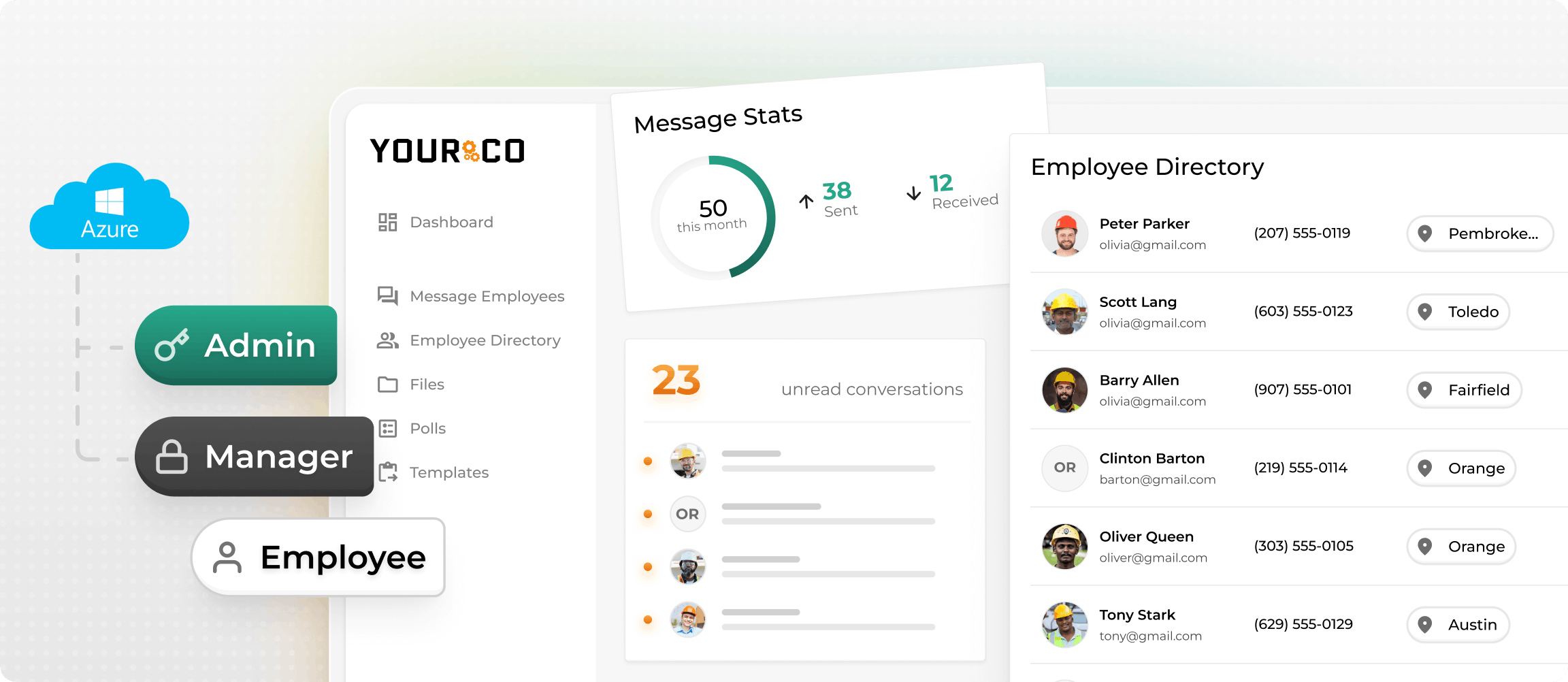
Yourco takes a fundamentally different approach. Instead of asking workers to adopt new technology, Yourco meets them on the channel they already use every day: SMS. Text messages reach any mobile phone, from the latest smartphone to a basic flip phone, without downloads, logins, passwords, or internet connectivity. The result is a 98% read rate and near-universal adoption from day one.
Yourco's key capabilities include:
- Two-way messaging between frontline employees and local managers, with one-way corporate broadcasts for leadership and company-wide updates (Enterprise Bridge)
- Free tier for up to 50 employees, with pilot programs available for mid-market teams (up to 500 employees) and enterprise organizations (500+ employees)
- SMS-first approach, no app download or Wi-Fi required
- Works on flip phones and basic mobile devices
- AI-powered translation across 135+ languages and dialects
- Integrates with 240+ HRIS and payroll systems
- AI-powered Frontline Intelligence to detect disengagement and call-off signals, surface safety risks, support staffing predictions, and deliver actionable reporting
- Surveys and forms to collect real-time employee feedback and workforce data
- Enterprise-grade security and compliance, including SOC 2 Type II compliance and GDPR readiness
After using Yourco for 90 days, companies see two-way employee engagement increase to 86% (Yourco's internal data).
Because app-based platforms only collect data from employees who adopted the app, their analytics are inherently incomplete. When every worker participates through SMS, leaders get a complete picture of sentiment, engagement, safety concerns, and staffing patterns across every location. Where app-based platforms measure engagement among the workers who opted in, Yourco captures intelligence from your entire workforce.
2. Beekeeper
Beekeeper is a mobile-first app designed to connect frontline employees through secure messaging, automated workflows, and a social-style news feed. It works well for organizations that already have strong app adoption, and its workflow automation helps digitize paper-based processes like maintenance requests and shift handoffs.
Key capabilities include:
- Secure one-on-one and group messaging through Slack-style streams and chats
- Workflow automation for maintenance requests, onboarding, and compliance tasks
- Social-style news feed for company announcements and employee engagement
- Inline translations for multilingual workforces
- Analytics dashboard for tracking engagement and content performance
- Integrations with HR, payroll, and scheduling tools
However, Beekeeper requires employees to download an app and navigate a digital interface that can feel complex for less tech-savvy workers. Its scheduling module has been noted as dated and manual, and advanced workflow setup often requires technical support. For workforces that include workers on basic phones or in low-connectivity environments, the app-first model creates a barrier that limits reach from day one.
3. Connecteam
Connecteam bundles communication with scheduling, time tracking, task management, and training into a single mobile app. Its breadth makes it popular with small to mid-sized businesses that want to consolidate multiple tools.
Key capabilities include:
- One-on-one and group messaging with channel segmentation
- Shift scheduling with automatic alerts and drag-and-drop tools
- Time tracking and GPS-based clock-in/clock-out
- Digital checklists, forms, and task assignments
- Training modules and knowledge base for onboarding
- Free tier for small teams with scalable paid plans
The tradeoff is complexity. Combining so many operational features into one app means employees face a steeper learning curve, and advanced reporting or integrations require higher-tier plans. Connecteam also depends on smartphone access and app downloads, which excludes workers using basic phones.
4. Staffbase
Staffbase specializes in enterprise internal communications, offering branded employee apps, intranet portals, email newsletters, and content publishing tools. It excels at top-down communication for large, complex organizations that need to plan, create, and measure campaigns across regions and languages.
Key capabilities include:
- Branded mobile employee app and desktop intranet portal
- Content publishing with editorial planning and campaign tools
- Targeted messaging by location, role, department, or language
- Newsletter creation and email distribution
- Analytics for measuring content reach and engagement
- Integrations with Microsoft 365, Google Workspace, and HR systems
Staffbase's strength in content distribution becomes a limitation for frontline teams. The platform is more content-heavy than interactive, and its setup requires significant configuration time. Workers without company email addresses or smartphones face onboarding friction, and the platform's desktop-first design heritage means the mobile experience still trails behind purpose-built frontline tools.
5. Blink
Blink positions itself as an employee experience platform that unifies communication, engagement, and productivity. Its social media-style news feed, secure chat, document hub, and survey tools give organizations a polished interface for connecting desk-based and frontline workers.
Key capabilities include:
- Social media-style news feed for company updates and employee interaction
- Secure one-on-one and group messaging with file sharing
- Digital forms, surveys, and employee recognition tools
- Document hub for policies, procedures, and resources
- Shift scheduling and HR system integrations
- Fast deployment with pre-built templates
Like other app-based platforms, Blink requires downloads, onboarding, and smartphone access. Some users report the feed can feel cluttered with high volumes of content, and moderation tools for employee-generated posts are limited. Its analytics capabilities are more basic than enterprise alternatives, and the platform may not reach workers who rely on older devices.
6. Workvivo (Zoom)
Workvivo, now owned by Zoom, blends internal communication with a social media-style interface designed to build company culture. Employees can post updates, engage with leadership content, and access resources in a familiar format.
Key capabilities include:
- Social media-style feed with likes, comments, and sharing
- Company news and leadership broadcast tools
- Translation capabilities for large multilingual workforces
- Employee recognition and shout-out features
- Integrations with Zoom, Microsoft Teams, and HR platforms
- Podcasts, live video, and rich media content support
Workvivo leans heavily toward culture-building and engagement rather than operational communication. It works best for organizations that already have strong digital infrastructure and employees comfortable with app-based tools. Workers on basic phones or without consistent internet access are effectively left out.
7. YOOBIC
YOOBIC combines real-time communication with task management, microlearning, and store execution tools. It's particularly popular in retail, where managers need to assign tasks, deliver training modules, and track compliance from a single mobile platform.
Key capabilities include:
- Task assignment and completion tracking with photo verification
- Microlearning modules for product knowledge and compliance training
- Real-time messaging and team communication
- Store audit and inspection checklists
- Performance dashboards and analytics by location
- Integrations with retail operations and workforce management tools
YOOBIC's specialization in retail and task execution means it's less versatile for industries like construction, manufacturing, or logistics where communication needs differ significantly. The platform requires app adoption and works best with smartphone-equipped workforces.
Reach Every Worker With Yourco’s Mobile-First Communication
Your frontline team needs critical information—schedules, safety updates, and company news—delivered instantly without requiring them to log into a computer they don't have. Traditional mobile-first platforms struggle because they still create barriers for the majority of the global workforce.
Frontline workers face particular challenges that Yourco solves:
- Many use older phones or share devices across shifts, which app-based tools don't support.
- Work areas often lack reliable cellular data or Wi-Fi, making app usage impossible.
- App downloads and logins create barriers for workers with limited storage or technical comfort.
Yourco eliminates these challenges with SMS-first communication. By meeting workers on the channel they already use every day, regular text messages, Yourco works on any mobile phone, from the latest smartphone to a basic flip phone, requiring no app download, login, or internet connectivity. This direct, accessible method ensures a 98% read rate and near-universal adoption from day one.
Break Through Language Barriers With Real-Time Translation
Language barriers create real problems on the shop floor. When critical safety updates or production changes only come in English, mistakes happen and people get hurt.
Yourco’s automatic translation solves this without extra work for supervisors. When evaluating translation capabilities:
- Confirm support for your workforce's specific languages
- Verify that urgent safety communications translate in real time
- Ensure context-aware models handle workplace terminology accurately
Teams that receive safety instructions in their native language see improved compliance rates and reduced accident risks.
Track Message Delivery and Confirmation
Sending a message doesn't mean your team received it. For safety communications and compliance training, you need documented proof that specific workers opened and acknowledged critical information.
Yourco includes:
- Verification of who opened safety bulletins
- Documentation of policy acknowledgment for compliance
- Creation of audit trails for regulatory inspections
- Timestamped records suitable for OSHA, DOT, and food safety audits
This information is for general awareness only. For specific compliance guidance, consult with qualified legal professionals.
Integrate Communication With Your Existing Workforce Systems
Effective communication platforms require direct integration with your scheduling, HR, and payroll systems. When platforms operate in isolation, manual data entry creates errors and delays.
Workers don't want to switch between separate apps for schedules, paystubs, and company news. Integrated platforms combine internal communication tools with workforce management capabilities.
With Yourco, you can easily send:
- Automatic employee data synchronization with HRIS
- Role-based messaging based on job codes and location
- Real-time updates when employee status changes
Respond to Crises With Instant Alert Capabilities
During safety emergencies, severe weather, or operational disruptions, you need to reach every worker immediately. Traditional methods like bulletin boards reach only workers currently on-site.
Effective crisis communication requires:
- Speed of alert delivery measured in seconds
- Reach regardless of device type or connectivity
- Confirmation showing who received and acknowledged critical messages
- Follow-up capability based on acknowledgment status
After using Yourco for 90 days, companies see two-way employee engagement increase to 86% (Yourco's internal data).
Try Yourco for free today or schedule a demo and see the difference the right workplace communication solution can make in your company.
Frequently Asked Questions
What's the difference between employee communication apps and SMS-based platforms?
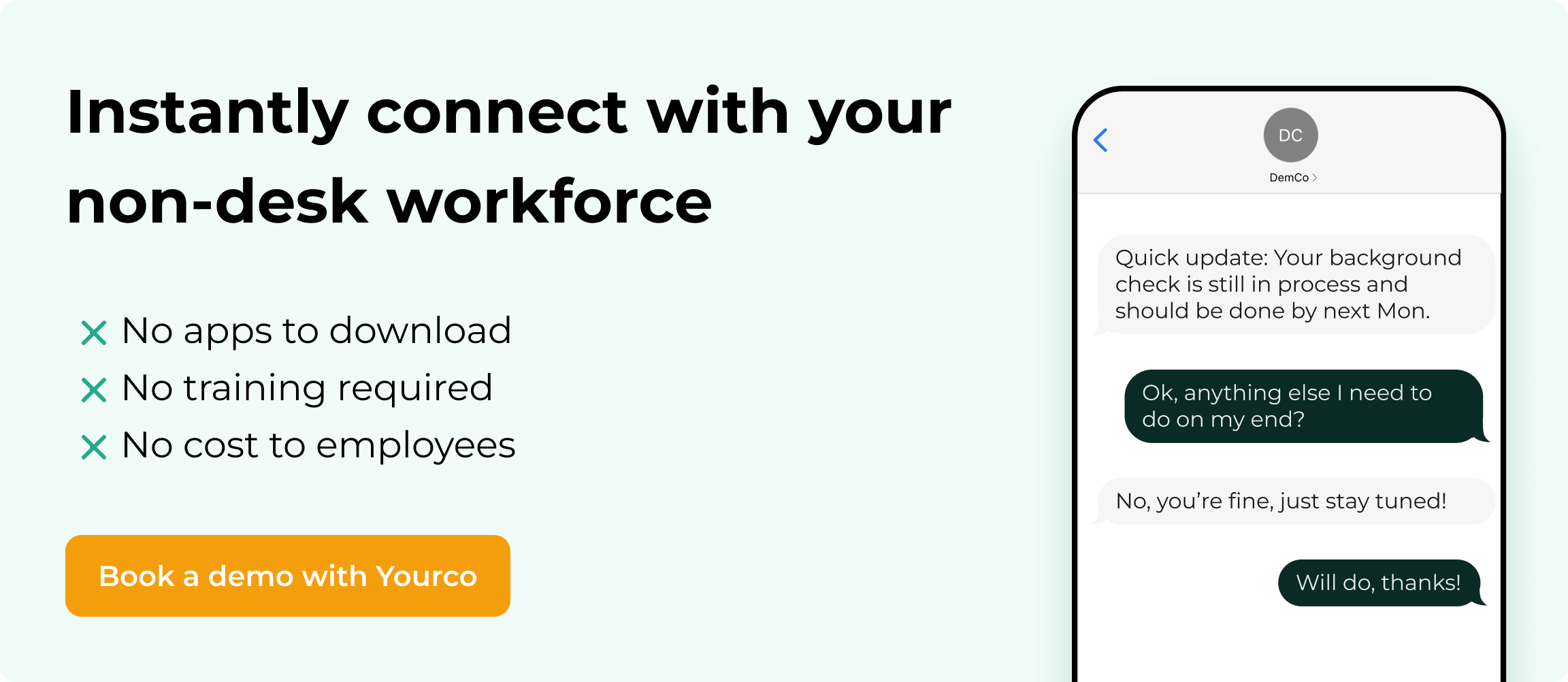
Employee communication apps require workers to download software, create accounts, and have smartphones with data access. SMS-based platforms send messages as regular text messages that reach any mobile phone without apps, logins, or internet connectivity. For workforces using older devices or working in low-connectivity environments, SMS provides an accessible alternative that achieves 98% read rates compared to email's 20%.
How do I measure if a communication tool is working?
Track adoption rates across your workforce, message open rates for critical communications, and operational metrics including turnover rates, absenteeism patterns, and safety incident reporting volume. Equally important are impact metrics: whether shift handoff failures decreased, safety alert response times improved, and cross-shift information continuity strengthened after implementation.
Do frontline workers really need different tools than office employees?
Yes. Office workers have computers, company email addresses, and regular desk time to check messages. Frontline workers lack computer access, often don't have company email, and work in environments where checking apps during shifts is impractical or unsafe. Tools designed for desk workers systematically exclude the majority of frontline employees who need information delivered directly to devices they already carry.