


A good welcome text to a new employee names the person and their role, gives the start date, time, and reporting point, says what to bring or wear, names who will meet them, and closes with one clear reply prompt. U.S. employers made 5.1 million hires in July 2026 alone, according to the Bureau of Labor Statistics, and every one of those hires had a first day that either felt organized or did not. For a frontline hire with no company inbox, that first text is often the only pre-arrival contact the company makes. The 45 examples, three reusable templates, and six categories below cover the messages a manager, a peer, or an HR team sends in the first week.
TL;DR
- A welcome text works when it carries the name, role, start date and time, reporting point, what to bring, and who to find.
- Keep it short enough to read between tasks on a personal phone, and close with one reply prompt.
- Match the tone to the setting, since a plant crew and a professional services team read the same words differently.
- Send the logistics message 2 to 3 days before the first shift, and the welcome on the morning of the first shift.
- Store the wording as templates with merge fields so every new hire gets the same standard of welcome.
- SMS-based platforms like Yourco deliver welcome texts to any phone, in the employee's preferred language, without an app download.
Anatomy of a Memorable Welcome Message to a New Employee
Six elements turn a notification into a welcome, and a message carrying all six runs to about three lines:
- Genuine, personal greeting: "Hi Sarah, excited to have your marketing expertise on board" does more than a name merge, because it names why this person was hired.
- Direct support: "Any questions, I'm one text away" answers the first-day worry before it forms.
- Team anticipation: "The crew can't wait to meet you" tells a new hire that people are expecting them by name.
- Feedback invitation: "Your ideas matter, tell us what you think" signals a two-way relationship from the first exchange.
- Cultural cues and practical details: "Clock in at Gate 3, we have your safety gear prepared" shows preparation and removes a first-morning unknown.
- A clear next step: "Reply YES if you got this" confirms delivery and starts the conversation.
Beyond the six elements, tone is what makes the message sound like the organization sending it. A professional services firm might send "Welcome to our team, James. We're pleased to have your expertise," while a retail team lands better with "Hey Maria! The team's pumped you're joining us." Healthcare and legal settings usually call for formal wording, and hospitality and creative environments carry casual enthusiasm well.
One structural note worth applying across all six categories: a welcome text is read standing up, often mid-task, on a personal phone. That constraint shapes the wording, so the strongest examples front-load the logistics and leave the warmth in a single closing line.
Copy-Paste Templates for Your Welcome Message to a New Employee
Three templates cover the settings most organizations hire into. Each one drops into a messaging platform with the merge fields left in place.
Corporate Office Template
Hi {Name}, welcome to {Company}! We're excited to have you join the {Department} team. Your first day is {Start Date} at {Time}. Report to reception and ask for {Manager Name}. We've prepared your workspace and can't wait to introduce you to the team. Any questions? Just reply here!
Field Worker Template
Welcome to {Company}, {Name}! Your first shift starts {Start Date} at {Time}. Report to {Gate/Entry Location} wearing {Safety Requirements}. Your supervisor {Manager Name} will meet you for safety orientation. Bring your ID and {Required Documents}. Text me with any questions; safety first!
Multilingual and Multi-Site Template
Hola {Name}, ¡bienvenido a {Company}! Your first shift is {Start Date} at {Time} at {Site Name}. Report to {Entry Location} and ask for {Manager Name}. Wear {Safety Requirements} and bring your ID. Reply in your own language with any questions; we'll answer in the same language.
Store all three in a template library using merge fields such as {Name}, {Company}, and {Start Date}. One setup gives every new hire the same standard of welcome regardless of which manager sends it, which is the practical reason to build the library before the next hiring wave rather than during it.
Copy These 45 Welcome Text Message Examples Right Now
The 45 examples below fall into six categories, so a manager sending a first-shift message and a teammate sending a peer greeting aren't reaching for the same wording. Replace the {bracketed} placeholders and send.
1. Short and Sweet Welcome Texts
These messages cover the essentials at a glance, which suits a hire confirmed a day or two before the first shift.
- Hi {Name}! Welcome to {Company}. First shift: {Date} at {Time}. Excited to have you aboard! - {Manager}
- Welcome {Name}! We're thrilled you joined {Team}. See you {Day} at {Location}. Questions? Just text back!
- {Name}, welcome to the crew! First day: {Date} - come ready to learn. We've got your back. - {Supervisor}
- Hi {Name}! Welcome aboard. Your badge is ready at security. Shift starts at {Time}. Can't wait to meet you!
- Welcome {Name}! {Team} is excited to have you. Check in at {Location} tomorrow at {Time}. Let's do this!
- {Name} - welcome to {Company}! Your locker is #{Number}. First shift: {Day} at {Time}. Ready to get started?
- Hi {Name}! Welcome to the team. Training starts {Day} with {Trainer}. You're going to love it here!
Short messages carry more weight once the logistics are settled, so pair them with a separate details message when the first shift involves gear or a site change.
2. Manager-to-Hire Welcome Texts
A message from the direct supervisor establishes who the new hire reports to and what support looks like, which is the question most first-day nerves come down to.
- {Name}, this is {Manager} welcoming you to {Company}. I'm here to support your success. First day: {Date} - let's make it great!
- Welcome {Name}! As your supervisor, I want you to know my door is always open. See you {Day} at {Time} for orientation.
- Hi {Name}, {Manager} here. Welcome to {Department}! Your experience will be valuable here. First shift is {Date} - any questions, call me.
- {Name}, welcome aboard! I'm {Manager}, your supervisor. We've been waiting for someone with your skills. Ready to start {Day}?
- Welcome to {Company}, {Name}! This is {Manager}. Your first day, {Date} will be training with me. Excited to work together!
- Hi {Name}, {Manager} here. Welcome to our team! I know you'll make a real difference here. See you {Day} morning at {Time}.
- {Name}, welcome! I'm {Manager}, and I'll be supporting your growth here. First day: {Date} - come with questions, leave with answers.
- Welcome {Name}! {Manager} here. Your skills are exactly what {Department} needs. Training starts {Day} - we'll take great care of you.
- Hi {Name}! This is {Manager}. Welcome to {Company}! I'm committed to your success here. First shift is {Date} at {Time} - ready?
- {Name}, welcome to the team! {Manager} here. Your safety and success are my priorities. See you {Day} for a great start!
Naming the sender is what makes these work, because a new hire who knows the supervisor's name before day one has someone to look for when they arrive.
3. Peer-to-Peer Welcome Texts From the Team
A message from a future colleague does what a manager's message can't: it signals that the crew expects the new person.
- Hey {Name}! {Colleague} from {Team} here. We're pumped you're joining us! First day: {Date} - we'll show you the ropes!
- {Name}, welcome! The whole crew is excited to meet you. {Colleague} here - can't wait to work together starting {Day}!
- Hi {Name}! {Teammate} from {Department} here. We've heard great things! Ready to have some fun while we work hard?
- Welcome {Name}! {Coworker} here. The team's been waiting for you! First day: {Date} - we'll make sure you feel at home.
- Hey {Name}! {Colleague} from your new team here. We're all rooting for you! See you {Day} - it's going to be awesome!
Assigning one teammate to send this deliberately, rather than hoping someone thinks of it, is what turns a peer welcome into part of the process.
4. Field Worker First-Shift Welcome Texts for Hourly and Shift Crews
First-shift messages for field and plant crews include the practical details that decide whether someone arrives at the right gate with the right footwear.
- {Name}, welcome to {Company}! First shift: {Date}, 6 AM. Enter Gate B; safety gear required. Hard hat provided. Ready to build something great!
- Hi {Name}! Welcome to {Plant}. First day: {Date} - clock in at Station 3. Wear steel-toed boots & safety glasses. {Supervisor} will meet you.
- Welcome, {Name}! {Site} crew is excited! First shift: {Date} at 7 AM. Park in Lot C. Safety briefing first. Lunch provided!
- {Name}, welcome aboard! {Construction Site} - first day {Date}. Check in with {Foreman} at the trailer. Hard hat & boots required.
- Hi {Name}! Welcome to {Hospital}. First shift {Date} at {Time}. Badge pickup at Security. Scrubs provided. Ready to care!
- Welcome {Name}! {Warehouse} team is pumped! First day: {Date} - safety shoes required. Time clock by the loading dock. Let's move!
- {Name}, welcome to {Facility}! First shift: {Date}. Enter Employee Entrance. Safety training first. {Supervisor} has your gear ready.
- Hi {Name}! Welcome to {Store}! First day: {Date} at {Time}. Use the employee entrance. Name tag ready at customer service. Let's serve!
These first-shift messages are the first step in a longer sequence, and the onboarding phases build on them through preboarding paperwork, first-week training, and 90-day check-ins.
5. Warm and Enthusiastic Welcome Texts
Higher-energy wording suits teams whose day-to-day communication already sounds like this, and reads as forced anywhere else.
- {Name}, we are SO excited you're here! Welcome to {Company}! Your energy is exactly what we need. First day: {Date} - let's shine!
- Welcome to the family, {Name}! We absolutely can't wait to see what you bring to {Team}. {Date} will be an amazing first day!
- {Name}, WELCOME! The whole {Department} is buzzing with excitement! You'll love it here. Ready to start {Day}?
- Hi {Name}! Welcome to our incredible team! Your passion for {Field} shows, and we're thrilled you chose us. See you {Date}!
- {Name}, welcome to {Company}! We're over the moon that you're joining us! First day: {Date} - prepare for an awesome adventure!
- Welcome {Name}! Your positive attitude is exactly what {Team} needs. We're genuinely excited to work with you starting {Day}!
- {Name}, WELCOME ABOARD! We've been counting down to your arrival! {Date} will be the start of something incredible!
Enthusiasm lands where it matches how the team already talks, so check these against the last few messages the crew actually sent each other.
6. Formal and Professional Welcome Texts to a New Employee
Formal wording holds a professional register while still reading as a welcome, which suits regulated settings and senior hires.
- Dear {Name}, welcome to {Company}. We are pleased to have you join {Department}. Your first day is {Date} at {Time}. Best regards, {Manager}.
- {Name}, welcome to our organization. Your expertise in {Field} will be valuable to our team. Please report to {Location} on {Date}.
- Dear {Name}, we warmly welcome you to {Company}. Your first day on {Date} begins with orientation at {Time}. We look forward to working together.
- {Name}, welcome to {Organization}. We are confident your skills will contribute significantly to our mission. On your first day, {Date}, {Contact} will assist you.
- Dear {Name}, welcome aboard. We are honored to have you join {Department}. Please arrive at {Time} on {Date} for your orientation session.
- {Name}, we are pleased to welcome you to our team. Your background in {Area} aligns perfectly with our goals. First day: {Date} at {Location}.
- Dear {Name}, welcome to {Company}. We look forward to your contributions to {Project/Department}. Orientation begins {Date} at {Time} in {Room}.
- {Name}, we extend a professional welcome to {Organization}. Your experience will be an asset to our team. Please report to {Manager} on {Date}.
Across all six categories, the same message repeated for every hire is what a new employee notices, so vary the closing line even where the logistics stay identical.
Send Welcome Texts by Category, Language, and Site
For an enterprise running multiple locations, departments, shifts, and managers, the risk isn't just a missed welcome: it's an inconsistent one. A hire in one region gets a detailed, warm sequence while another gets a rushed text or nothing at all. Standardizing the sequence gives every new hire the same experience regardless of who's managing them or what language they speak.
Getting the wording right is one problem, and getting it to the right new hire at the right hour is another. Reach is where most welcome sequences fail: 88% of HR leaders say they need a reliable way to reach frontline employees, while only 55% are confident they have one, according to a Yourco-commissioned survey of 150 HR leaders. A message that never arrives is a welcome that never happened.
Four operational choices carry a welcome sequence:
- Timing: send the logistics message two to three days ahead, the welcome on the morning of the first shift, and a check-in during week one
- Sender: use the direct supervisor for the manager message and a named teammate for the peer message
- Segmentation: split by role, site, and shift, so a plant hire gets gate and PPE detail while a store hire gets the employee entrance
- Language: send in the employee's preferred language rather than expecting them to translate a safety instruction
Missing that window has a cost. 56% of HR leaders say they have missed vital deadlines because they could not reach a frontline employee in time, according to a Yourco-commissioned survey of 150 HR leaders, and a first-shift start time is exactly that kind of deadline.
For multilingual crews, onboarding runs deeper than translated wording. The dedicated checklist for onboarding Spanish-speaking employees covers culturally adapted welcome messages, mentor assignments, and milestone check-ins rather than a translated copy of one document.
The same structure exists for other language groups. The checklist for onboarding Vietnamese-speaking employees follows the same three components rather than restating the Spanish version in another language.
Crews with Tagalog speakers work the same way, and the equivalent Tagalog onboarding checklist covers the welcome wording, mentor pairing, and check-in schedule.
Where the welcome sits in the wider sequence matters as much as its wording, and on SMS-based platforms like Yourco, SMS onboarding keeps the pre-arrival message, the first-day message, and the week-one check-in on one channel.
Recognition follows the same logic once someone is established, and employee appreciation messages pick up where a welcome sequence ends.
Organizations mapping the whole flow tend to start with their employee communication structures, since who sends what to whom is the decision underneath it all, and a welcome text is the first instance of that decision a new hire ever sees.
Simplify SMS Welcome Texts to a New Employee With Yourco
A welcome sequence needs one channel that reaches every new hire, templates that keep the standard consistent, and a record of what was sent. Yourco does all three over SMS, so a first-shift message lands on the phone the new employee already carries.
Yourco's core capabilities cover the mechanics of a welcome sequence:
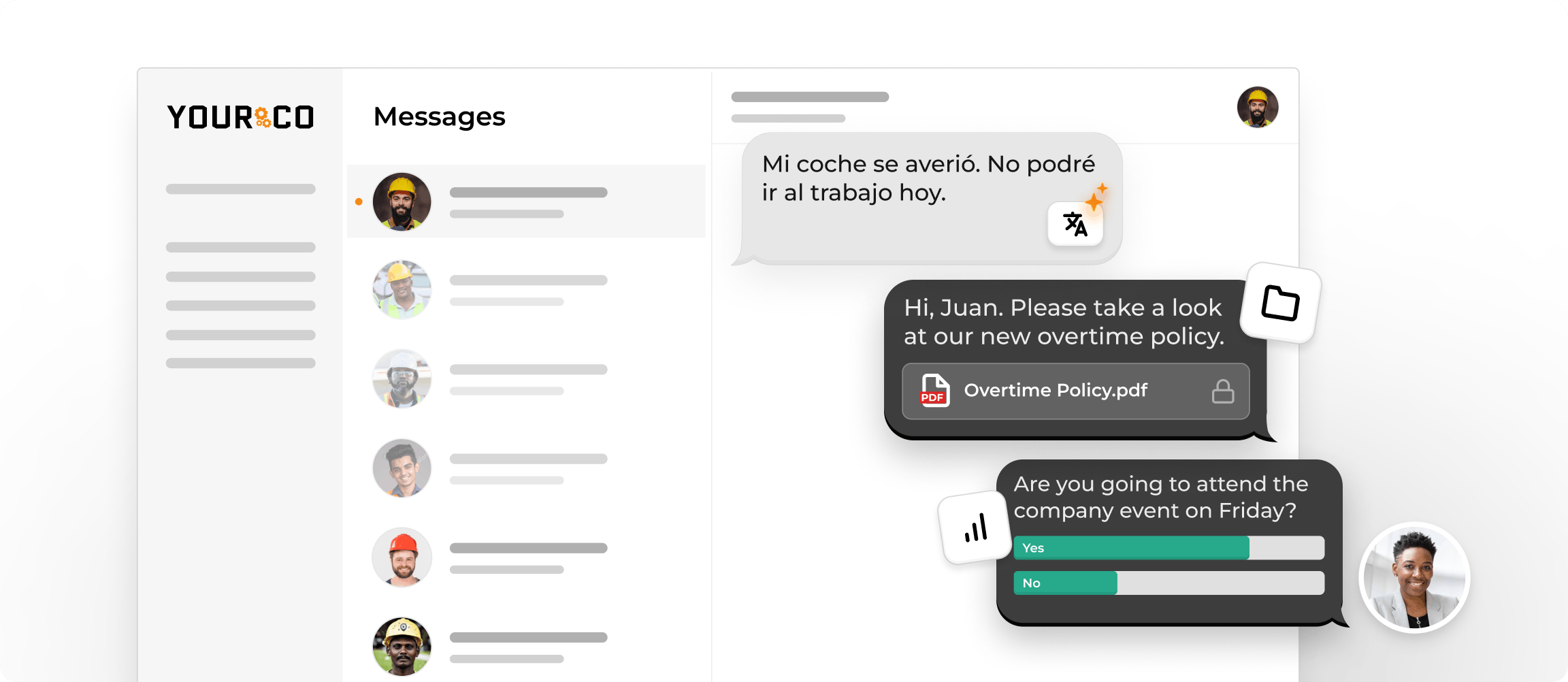
- Two-way SMS to any phone, with no app download, no WiFi, and no data plan required, including basic and flip phones
- AI-powered translation across 135+ languages and dialects, so a safety instruction arrives in the language the new hire reads
- Scheduled messaging, so the pre-arrival message goes out at 4 p.m. the day before regardless of when HR processed the paperwork
- A template library with merge fields, plus segmentation by location, role, or shift
- Timestamped records of every message and reply, with delivery confirmed at the platform level
Yourco's 240+ HRIS and payroll integrations pull new hires, job titles, sites, and start dates from the system of record, so a welcome message goes out without anyone retyping a roster.
Enterprise Bridge gives corporate leadership a one-way channel to introduce company-wide programs and announcements to every location at once, while local managers keep their own two-way conversations with new crew members.
Frontline Intelligence gives HR and operations leaders centralized visibility into onboarding communication across all locations. Leadership can compare new-hire message activity by site, department, and shift, see which locations generate the strongest early engagement, and identify where welcome messages go unanswered while a new hire is still in week one. Leaders can ask questions like, "What are new hires asking most in their first week?" or "Which locations have recurring onboarding issues?" and get answers instead of pulling a report.
"Yourco has significantly improved how we connect with employees, making it easier to share important updates, reminders, and announcements in real time. It has become an essential tool in streamlining our internal communication."
— Courtney Martin, Recruiting Manager, The Seagate
After 90 days on Yourco, companies see two-way employee engagement reach 86%.
Try Yourco for free today or schedule a demo and see the difference the right workplace communication solution can make in your company.

Frequently Asked Questions About Welcome Texts to a New Employee
What's the Best Time to Send a Welcome Text to a New Employee?
Send the logistics message 2 to 3 days before the first shift, the welcome message on the morning of the first shift, and a short check-in during week one. Frontline hires benefit most from the pre-arrival message, since it is often the only contact before they walk through the gate.
How Long Should My Welcome Text to a New Employee Be?
About three lines, or roughly 300 characters. That is short enough to read between tasks on a personal phone and long enough to carry the start time, reporting point, and who to find. If you need more detail, send a brief welcome and follow with a separate details message.
Can I Include Images, PDFs, or Links in an SMS?
Yes, with two caveats. Adding an image or a document converts the message to MMS, which can behave differently on delivery. Links work, provided the destination opens on a phone without a company account, a VPN, or an intranet login a new hire doesn't have yet.
How Do I Know Whether the Welcome Text Reached the New Hire?
Platforms confirm delivery, not reading, so the reliable signal is a reply. Closing with a prompt such as "Reply YES if you got this" makes confirmation visible, and an unanswered message flags a wrong number or an unreachable new hire before the first shift.
Are There Compliance or Privacy Concerns With Texting Employees?
Many employers handle consent as part of onboarding paperwork, alongside the other forms a new hire signs, and state what kinds of messages will be sent. SMS-based platforms like Yourco handle carrier compliance in the background, and messages cost employees nothing because they provide toll-free numbers.
How Do I Start a Welcome Text to a New Employee or Introduce a New Team Member?
Open with the person's name and the specific reason they were hired, then add a practical detail. "Hi Sarah, welcome to the Metro Construction crew" reads better than a generic greeting because it places the person somewhere. Close with one reply prompt rather than an open-ended question.


