
Most frontline employees rarely see employee engagement surveys, and that silence costs organizations operational insight. Email, the primary delivery channel for most survey tools, misses the majority of frontline workers who lack regular access to a work address. SMS-based platforms consistently reach this workforce at higher response rates than email, a pattern that holds across industries from manufacturing and construction to logistics and hospitality.
This guide compares 10 platforms across the features that matter most for frontline reach: SMS delivery, reusable templates, anonymity controls, multilingual support, and AI-powered analytics.
TL;DR
- Email misses most frontline workers. SMS reaches them on any phone, with no app or email required.
- Reusable templates let HR teams launch pulse, onboarding, exit, and engagement surveys without having to rebuild from scratch each cycle.
- Anonymity controls, including a configurable toggle and response-threshold suppression, determine whether workers actually share honest feedback.
- Automatic translation in 135+ languages and dialects means multilingual teams can participate fully.
- HRIS integration keeps surveys accurate without manual roster management.
- Frontline Intelligence turns survey responses into operational signals across disengagement risk, safety, and location-level sentiment.
- SMS-based platforms like Yourco are built specifically for frontline reach, with no app downloads required, flip-phone compatibility, and AI-powered analytics.
What Features Should You Evaluate in Frontline Survey Platforms?
Frontline survey platforms need SMS delivery, reusable templates, anonymity controls, multilingual support, HRIS sync, and analytics that connect feedback to operational signals. The right combination determines whether your surveys reach everyone or only the workers already connected to your intranet.
Before shortlisting platforms, map your workforce's actual access constraints: smartphones, flip phones, shared devices, or no company device at all. Then filter by delivery channel and anonymity controls before comparing template depth and pricing.
Mobile-First Delivery
Frontline teams need SMS-based distribution that works on any phone, including basic flip phones, without app downloads, corporate email addresses, or Wi-Fi. Simple response mechanisms let workers complete a survey during a two-minute break, and offline capabilities should sync when a connection resumes. 91% of HR leaders say SMS increases frontline employee response rates, according to a Yourco-commissioned survey of 150 HR leaders, which reflects how much the channel outperforms email for workers without desk access.
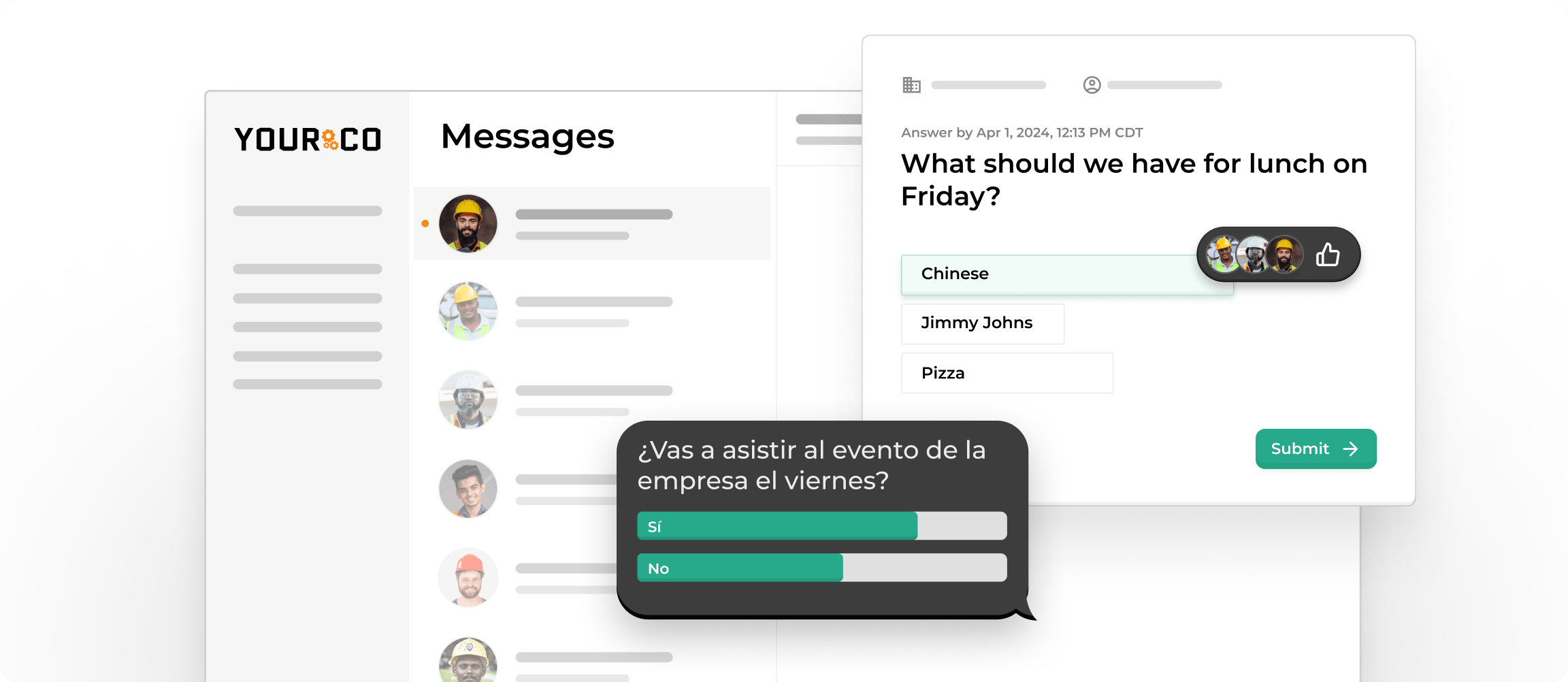
Reusable Survey Templates
Templates reduce the time required to rebuild each survey cycle from scratch. Look for pre-built, research-backed libraries spanning engagement, eNPS (Employee Net Promoter Score), onboarding, exit, and DEI (Diversity, Equity, and Inclusion) use cases.
The ability to save and reuse a branded survey format means HR teams can launch a new pulse cycle in minutes rather than hours. Flexible question types, branching logic, and the ability to clone and adapt templates across locations or departments separate purpose-built platforms from generic survey tools.
Anonymity Controls
Workers answer more honestly when anonymity settings fit the survey topic. Frontline workers may worry that managers can identify respondents even when surveys are labeled anonymous. Platforms with genuine anonymity controls include minimum response thresholds, suppression rules that prevent small-team identification, two-way anonymous messaging options, and the ability to toggle between fully anonymous and confidential modes depending on the survey topic.
Gallup notes that employees need to trust the anonymity of the survey before they give accurate responses. Evaluate whether admins can separately configure identified and anonymous response modes for different survey types.
Multilingual Support
In multilingual workplaces, survey design has to reflect how frontline teams actually communicate. Manufacturing, construction, logistics, and hospitality teams often employ workforces with significant shares of workers who speak English as a second language. Effective platforms provide multilingual interfaces for survey questions and response options, automatic language detection based on employee preferences, and a consistent experience across languages to reduce errors. When workers receive surveys in their native language, participation rates improve.
HRIS Integration
Roster accuracy depends on workforce-system integration. Automatic synchronization with HRIS and payroll systems ensures that surveys reach current employees using real-time roster information. Segmenting surveys by department, location, shift, or role automatically avoids manual list management and outdated spreadsheets that cause surveys to miss new hires or reach employees who left months ago.
Analytics and Frontline Intelligence
Raw survey scores alone do not help you act. Segmented results by manager and department, heatmaps, and driver analysis help HR teams pinpoint where to focus. Platforms that layer AI onto survey data can surface disengagement signals, flag safety concerns, identify call-off patterns, and detect sentiment shifts before they escalate into turnover. That makes frontline survey data useful beyond a slide deck.
The Best Automated Survey Employee Platforms at a Glance
Each platform below was evaluated on frontline reach, SMS delivery, anonymity controls, template reuse, multilingual support, and analytics depth. The table below gives a quick read on how each platform stacks up before the full breakdowns.
Platform-by-Platform Breakdown
Some platforms on this list were purpose-built for frontline teams; others serve broader workforces where frontline reach is a secondary consideration. The reviews below evaluate each tool on the criteria that matter for hourly, shift-based, and mobile-first workforces: how surveys are delivered, whether workers need a smartphone or app, and how deeply the analytics connect survey data to operational decisions.
1. Yourco
Yourco takes an SMS-first approach that works on any mobile device, including basic flip phones, with no app downloads or internet access required. That makes it effective for frontline workers who may not have smartphones or reliable connectivity. Survey distribution reaches workers wherever they are, and AI-powered translation across 135+ languages and dialects ensures that every employee automatically receives and responds to surveys in their preferred language.
The platform integrates with 240+ HRIS and payroll systems for automatic roster sync, with real-time response tracking and analytics dashboards built in. AI-powered Frontline Intelligence surfaces sentiment trends and engagement patterns across locations. This combination of accessibility and analytics makes Yourco effective for manufacturing, warehousing, logistics, and hospitality operations with multilingual workforces and workers without smartphone access.
Pros
- Works on any phone, including basic flip phones, with no app or internet required.
- Free tier for up to 50 employees; pilot programs available for mid-market and enterprise.
- Reusable templates for pulse, onboarding, exit, safety, and engagement programs.
- Configurable anonymity toggle with response-threshold suppression and confidential-mode options.
- AI-powered translation across 135+ languages and dialects.
- Frontline Intelligence surfaces disengagement signals, safety concerns, call-off patterns, and sentiment trends by location.
- Enterprise Bridge for one-way leadership broadcasts across large frontline organizations.
- Enterprise-grade security: SOC 2 Type II, SSO, GDPR compliant.
Cons
- Fits frontline workers better than desk-based teams.
- Translation applies to SMS messages only, not attached documents.
2. WorkTango
For teams that want surveys tied to recognition and rewards, WorkTango combines employee surveys, insights, recognition, and rewards into a single employee experience platform. Organizations use it to measure engagement throughout the employee lifecycle with unlimited surveys, dashboards, and AI-based action-planning tools.
Pros
- Unified platform combining surveys with recognition and rewards.
- Unlimited surveys across the entire employee lifecycle.
- AI-based analytics and action-planning tools.
- Surveys work without requiring employee email addresses.
- Competitive pricing starting around $8 per employee per month.
- I/O psychologists created their science-backed survey templates.
- Zero-markup rewards marketplace with no hidden fees.
Cons
- Deep functionality can create a learning curve for new users.
- Frequent pulse surveys can cause survey fatigue without careful cadence management.
- Requires a 12-month minimum contract.
- Implementation typically takes 2--6 weeks.
3. Culture Amp
Culture Amp focuses on enterprise employee-engagement surveys and data-driven insights. Organizations use it to collect and analyze employee feedback across the full employee lifecycle.
Pros
- Organizational psychologists designed 30+ science-backed survey templates.
- Industry benchmarking for comparison with similar organizations.
- Predictive analytics help identify employees at risk of leaving.
- Diversity and inclusion measurement tools.
- Strong action-planning features tied to survey results.
- Manager enablement resources.
Cons
- Enterprise pricing may be too expensive for smaller organizations.
- Platform complexity requires dedicated people analytics resources.
- Web-first design creates barriers for frontline workers without access to computers.
- Implementation may require dedicated setup time.
4. Qualtrics Employee Experience
Qualtrics EmployeeXM (Employee Experience Management) is the enterprise-heavy option in this list, with advanced analytics, customization, and reporting features.
Pros
- Highly sophisticated text analytics and sentiment analysis.
- Predictive analytics for attrition-risk identification.
- Multi-language support for 70+ languages.
- Integration capabilities with enterprise systems.
- Reporting dashboards with real-time trends.
Cons
- Premium pricing puts it out of reach for smaller organizations.
- Complexity requires training and dedicated administrators.
- A web-first platform does not improve reach for frontline workers.
5. Workday Peakon
Workday Peakon's strength is continuous listening: it supports real-time employee listening and engagement tracking through an automated recurring survey model.
Pros
- The continuous-listening model provides real-time engagement insights.
- Automated recurring surveys reduce administrative burden.
- The actionable insights engine provides data-backed improvement suggestions.
- Supports 50+ languages for global workforces.
- Collaborative action-planning tools for managers.
- Scales effectively for organizations with 10,000+ employees.
Cons
- Enterprise pricing may exceed smaller-organization budgets.
- A continuous survey model requires cultural buy-in to avoid fatigue.
- The platform fits knowledge workers better than frontline teams.
- Requires Workday tools to achieve the deepest integration benefits.
6. 15Five
15Five uses weekly check-ins as an alternative to annual engagement surveys, focusing on lightweight, regular touchpoints between employees and managers.
Pros
- Lightweight weekly check-ins take only 60--90 seconds to complete.
- Manager-coaching tools improve one-on-one conversations.
- Integrated performance-management features.
- Recognition tools reinforce desired behaviors.
- Mobile app helps respond on the go.
- Continuous engagement tracking monitors progress over time.
Cons
- A weekly cadence may feel excessive in some cultures.
- Weekly check-ins can exacerbate survey fatigue without careful topic rotation.
- Does not specifically target frontline workers.
7. Blink
Blink offers an employee-engagement app for frontline workers, with survey functionality inside a broader communication and engagement platform.
Pros
- Purpose-built for frontline workers.
- Employees do not need a desktop computer or a company email.
- Unified platform combining surveys, communication, and recognition.
- Simple sign-on process reduces barriers.
- Mobile-first design fits how frontline workers actually work.
- Includes secure chat and document-access features.
Cons
- Requires an app download, which creates barriers for some workers.
- Data plan usage may concern employees with limited personal plans.
- Less detailed survey analytics than dedicated survey platforms.
- May be more platforms than needed for organizations focused solely on surveys.
8. Workleap Officevibe
Workleap Officevibe helps teams monitor employee morale through regular feedback and easy-to-use survey features, with an emphasis on manager-accessible dashboards.
Pros
- Engaging design increases survey participation.
- Anonymous feedback encourages honest responses.
- Manager dashboards provide team-level insights.
- Trending-topic identification helps prioritize issues.
- One-on-one meeting tools integrate with feedback data.
- Easy-to-understand reporting.
Cons
- Desktop and web-first design limits frontline adoption.
- Less detailed analytics than enterprise-grade platforms.
- Limited language support compared with global platforms.
9. iTacit
iTacit brings surveys into a broader frontline hub for learning management, communication, and mobile access.
Pros
- Mobile-first design works well for frontline teams.
- Combines surveys with learning management and training.
- Custom survey paths adapt to different employee roles.
- Social intranet features encourage peer interaction.
- Multi-channel distribution reaches employees through mobile and email.
- The document and resource library keeps materials accessible.
Cons
- Requires app download for full functionality.
- Maybe more than needed for survey-only use cases.
- Learning curve for organizations that do not use all integrated features.
- Less specialized survey analytics than dedicated survey platforms.
10. Lattice
Lattice approaches engagement surveys through the performance-management workflow, connecting them with goal setting, feedback, and performance reviews.
Pros
- Unified platform connects engagement surveys with performance management and goals.
- AI-based analysis delivers instant insights and action recommendations.
- Industry benchmarking through the Mercer partnership.
- Integrates with Slack and Microsoft Teams for in-workflow accessibility.
- Customizable survey templates for pulse, eNPS, onboarding, and exit surveys.
- Presentation-ready PPT exports simplify reporting.
Cons
- Pricing starts around $11 per user per month.
- Web-first design creates adoption barriers for frontline workers.
- Platform complexity means a steeper learning curve.
- Administrators must manually close survey end dates.
- Better suited to knowledge workers than to frontline teams.
Why Yourco Is Built for Frontline Survey Distribution
Getting surveys to frontline workers is a structural problem most platforms were not built to solve, and Yourco's approach to employee survey distribution starts with the delivery channel itself: a text message on the phone workers already carry.
Yourco's core capabilities for frontline survey distribution include:
- SMS delivery to any phone, including basic flip phones, with no app or login required
- Two-way messaging so employees can respond, ask questions, and flag concerns directly
- AI-powered translation across 135+ languages and dialects, so every worker receives surveys in their preferred language
- Reusable templates for pulse, onboarding, exit, safety, and engagement programs, so HR teams can launch a new cycle in minutes
- Configurable anonymity toggle that lets admins set each survey as fully anonymous or confidential, with minimum response thresholds to protect small-team privacy
Yourco integrates with 240+ HRIS and payroll systems to automatically keep distribution lists current, so surveys reach the right employees without manual list management.
Enterprise Bridge enables corporate leadership to send centralized, one-way announcements across all frontline locations simultaneously, keeping every site aligned on company-wide updates.
Frontline Intelligence takes survey data beyond a dashboard. Every SMS interaction, survey response, and absence report feeds an AI analytics layer that surfaces disengagement signals by location and shift, flags emerging safety concerns, tracks sentiment trends, and delivers reports leaders can query and download without waiting for a weekly export. Survey data becomes a live operational signal.
"Yourco is the best thing we did last year! We are able to send instant text message communications to all our employees. We have had other sites within Sherwin start to use them as well."
— Carolina Abrams, HR Manager, Sherwin-Williams
After 90 days on Yourco, companies see two-way employee engagement reach 86%.
Try Yourco for free today, or schedule a demo to see the difference the right workplace communication solution can make for your company.
Frequently Asked Questions About Frontline Employee Survey Platforms
What response rates can I expect from SMS surveys versus email surveys for frontline workers?
For frontline workers, SMS surveys consistently reach more employees than email because most frontline workers don't have regular access to a work email address, while SMS works on any phone they already carry. Gallup research found that combining SMS with email produces the highest overall survey response rates. Workers open SMS messages within minutes and can respond during breaks without logging into anything, which removes the friction that suppresses frontline participation.
Do frontline workers need smartphones to complete surveys?
Frontline workers do not need smartphones to participate. SMS-based platforms like Yourco work on any mobile phone through simple text messaging, including basic flip phones. Workers don't need app downloads, internet access, or email accounts. No-app, no-Wi-Fi delivery is a structural requirement for reaching the full frontline workforce.
How do I handle multilingual workforces in employee surveys?
Choose platforms with automatic language detection and translation. Manufacturing, construction, logistics, and hospitality workforces are often multilingual, and survey participation drops when workers receive questions in a language they're not fluent in. SMS-based platforms like Yourco support 135+ languages and dialects, automatically delivering surveys in each worker's preferred language.
Should frontline employee surveys be anonymous, and how do I know if a platform's anonymity controls actually work?
Anonymity directly determines whether frontline workers give honest answers. Platforms with genuine anonymity controls include minimum response thresholds, demographic suppression rules that prevent small-group identification, and a configurable anonymity toggle that lets you set different modes for sensitive versus routine survey topics. When evaluating platforms, ask specifically how the platform enforces anonymity technically, and whether admins can separate confidential and identified responses by survey type.
How does Frontline Intelligence make survey data more valuable than a standard dashboard?
Raw survey scores tell you what employees said. Frontline Intelligence shows how those responses connect to risk and workforce trends. Platforms like Yourco layer AI onto survey responses and everyday SMS communication to surface disengagement signals before they lead to turnover, highlight safety concerns as they emerge in messages, identify spikes in call-off patterns tied to specific locations or shifts, and track sentiment trends across departments over time. Survey data from frontline workers becomes more useful when it feeds an intelligence layer that flags problems early enough to intervene.