
Bad team communication is a breakdown in how updates, instructions, and expectations reach workers, and on frontline teams it usually traces back to unclear expectations, language barriers, or low trust. When teams miss updates or work from unclear instructions, small issues turn into delayed projects, safety risks, and costly rework.
TL;DR
- Unclear expectations, language barriers, and low trust are three of the most common root causes of communication breakdowns on frontline teams.
- Channel choice depends on device access, connectivity, message urgency, and whether the message must be documented in writing.
- Two-way radios, bulletin boards, email, and team messaging apps each cover a narrower slice of frontline communication.
- Consolidating onto one channel that reaches everyone shows up in retention and engagement, not just message volume.
- SMS-based platforms like Yourco reach any phone, in the languages the crew speaks.
Identify the Root Causes of Communication Breakdown
Bad team communication has three common root causes: unclear goals and expectations, cultural and language barriers, and a lack of trust and transparency. Pinpointing which one drives the breakdown is the first step in fixing it.
Unclear Goals and Expectations
When workers are uncertain what success requires, effort scatters into confusion, duplicated work, and frustration. Construction crews without clearly defined tasks struggle to coordinate on-site activities, which costs time and productivity.
Cultural and Language Barriers
Cultural misunderstandings lead to misread intentions, while language barriers stop workers from expressing ideas clearly or following instructions accurately. Manufacturing teams with multilingual members make errors when instructions aren't delivered in a language everyone understands.
Employers that adopt multilingual communication strategies can improve both safety and productivity, starting with recording each worker's preferred language rather than assuming a shared one.
Lack of Trust and Transparency
When workers don't feel safe raising concerns, information stays with them and surfaces later as a misunderstanding or conflict. Unclear decision-making and undisclosed company changes deepen that distrust.
What Are the Best Team Communication Tools?
The best team communication tools for frontline teams are SMS text messaging, team messaging apps, two-way radios, bulletin boards, and email. Five conditions decide which of them fits a given message:
- Device access and whether employees have company email
- How urgent the message is
- Connectivity and known dead zones
- Whether the message needs acknowledgment
- Whether it must leave a written record
For crews without company email or reliable Wi-Fi, SMS-based employee communication is a dependable default. Each channel does one job well and carries a matching limitation:
91% of HR leaders say use of SMS increases frontline employee response rates, according to a Yourco-commissioned survey of 150 HR leaders. That figure reports what HR leaders observe rather than a measured response rate.
No single channel should stand alone. A practical default routes urgent employee alerts through SMS and keeps radios, boards, and email in supporting roles.
How Does Better Communication Create a More Connected Frontline Workforce?
A connected frontline workforce is one where every worker gets the same update at the same time, in a language they read, and can reply on the same thread. Consolidating scattered channels into one that reaches everyone turns better protocols into measurable operational results.
Great Day Improvements (GDI), a home improvement provider with 5,000 employees across 338 locations and 167 markets, moved frontline communication onto a single SMS channel. Corporate leadership sends company-wide announcements and executive updates, while local HR teams handle day-to-day, two-way conversations with their crews.
After the change, GDI reported:
- Organization-wide retention up from 87% to 93%
- Manufacturing turnover down from 12.7% to 2.3%
- Inbound employee engagement roughly doubled during leadership campaigns
- An estimated $1.5M in annual value from retention alone, using a conservative $5,000 replacement cost per frontline employee
GDI also consolidated multiple HRIS systems without interrupting employee communication, which matters for employers managing multiple teams through system changes and rapid growth.
How Should Employers Establish Clear Communication Protocols?
Communication protocols spell out which channel carries which message, how fast a response is expected, and what counts as urgent. Protocols that stay unwritten default to whichever channel the supervisor prefers that day.
Guidelines should cover:
- Urgent vs. non-urgent communications
- Response time expectations
- Rules for on-site communications
Urgent safety alerts might go out via SMS or radio, while non-urgent updates can wait for a bulletin board.
How Do Teams Learn New Communication Protocols?
Protocols only hold if workers know them. During and after onboarding, employers confirm that every team member is comfortable with the chosen tools and understands the rules. Refreshers keep them from drifting.
What Makes a Team Communication Culture Open and Inclusive?
An open communication culture is one where workers raise problems early because doing so carries no penalty. Three habits build it:
- Active listening: supervisors paraphrase what they heard and ask clarifying questions, so a worker knows the message landed.
- Psychological safety: leaders stay reachable and respond to bad news without punishing the messenger.
- Diverse perspectives: crews spanning languages and backgrounds surface risks a single vantage point misses.
Culture and channel reinforce each other. A crew that trusts its supervisor still needs a channel that reaches back, and a channel nobody trusts stays quiet, no matter how reliable the delivery.
How Should Employers Keep Frontline Messages Clear and Documented?
Frontline messages work when they are short, plain, and recorded somewhere workers can find them again:
- Short messages, one subject each
- Plain language, no jargon
- Timing that matches the shift
Literacy levels and language preferences also affect understanding, and common translation mistakes put workers at risk in safety-critical environments.
Recorded decisions and action items give the next shift a reference, not a rumor. Posted bulletins, shift reports, and SMS summaries all serve, and in transportation and warehousing, clearly posted schedules keep everyone aligned.
How Can Communication Technology Support Frontline Teams?
Communication technology helps frontline teams by reaching workers who have no company email, no app, and no reliable Wi-Fi. SMS-based platforms like Yourco send messages in each worker's preferred language, report who receives and answers each message, and give distributed operations location-level controls.
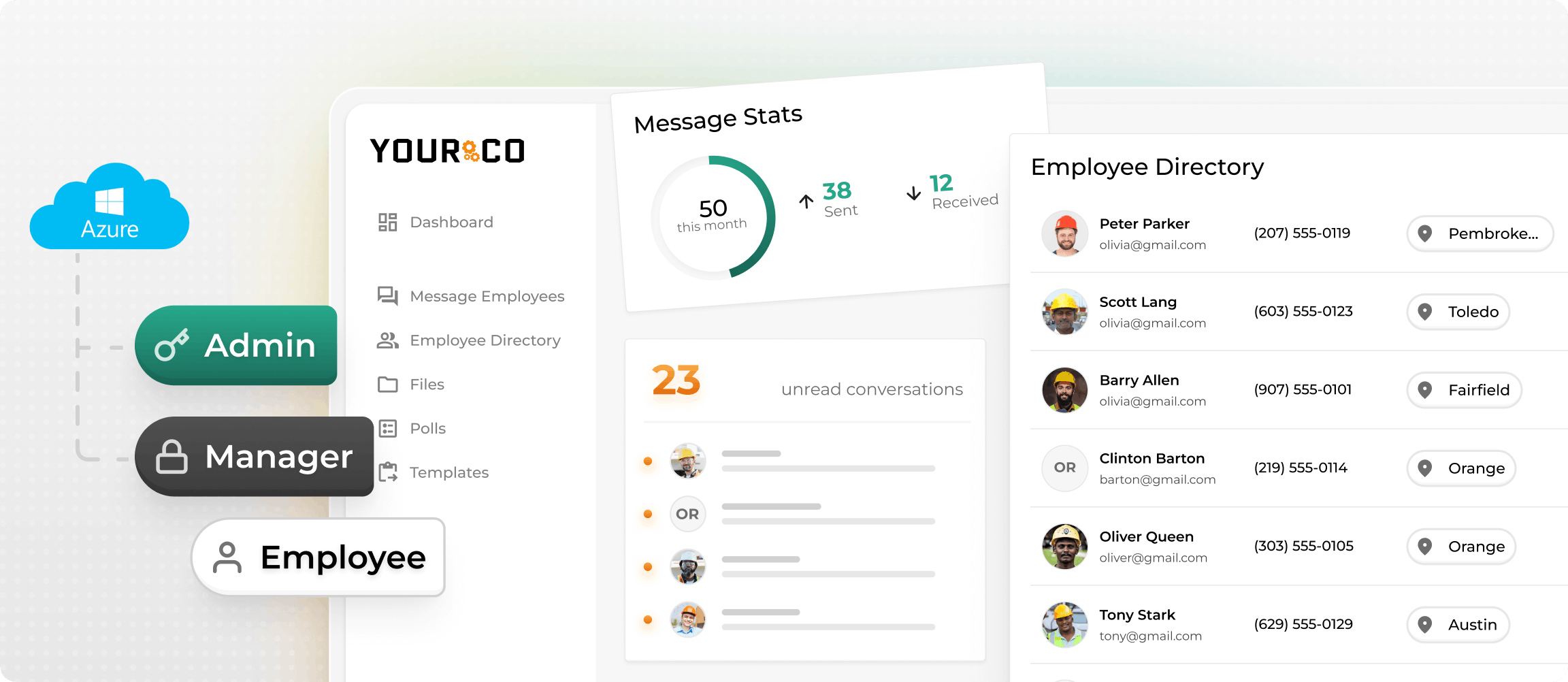
Message analytics pair well with periodic employee surveys, which test whether communication practices meet workers' needs. Survey questions need the same translation care as safety alerts, since a mistranslated question distorts the answers.
How Does Automatic Translation Help Multilingual Frontline Teams?
Artificial intelligence (AI) does the conversion: AI translation rewrites each SMS automatically, so one safety alert goes out once and reaches each worker in their preferred language.
Multilingual SMS also keeps one alert from splitting into English and Spanish versions that drift apart.
The Occupational Safety and Health Administration (OSHA) Hazard Communication standard sets English as the baseline for workplace labels and safety data sheets, and many employers add the same information in their workers' languages alongside it. For safety-critical alerts, a bilingual team member can confirm the translated wording matches the intent.
This information is for general awareness only. For specific compliance guidance, consult with qualified legal professionals.
How Should Employers Manage Communication Across Multiple Locations?
Multi-location management pairs one centralized dashboard with message segmentation by location, shift, or department, so headquarters sees every site while each crew receives only what applies to it.
One consolidated channel also lifted GDI's communication score from 49% to 53%. A healthy site-wide response rate can hide a night shift that barely answers.
How Should Employers Train Frontline Teams on Communication Skills?
Frontline communication training works best during real shifts, where practice ties to the work in front of the crew:
- Mentorship pairing: a newer worker shadows someone who already handles shift handoffs well.
- Drills during shifts: a short practice run tests whether instructions survive noise and distance.
- Role-playing exercises: supervisors rehearse the conversations they avoid, such as correcting a shortcut.
Supervisors carry most of this. Gallup's workplace research says lower manager engagement accounts for much of the global decline in employee engagement since 2023. Training reaches a crew through its supervisor, so it lands only if the supervisor has the capacity to carry it.
Do Visual Aids Help Communication Training?
Visual aids do help, particularly for workers who learn by doing. Videos, demonstrations, and posters also cross language barriers better than a written handout.
How Do Employers Sustain Communication Improvements?
Constructive feedback from team leaders, plus recognition when communication improves, keeps the habits in place. Without it, crews revert to whatever worked before the training.
Fix Bad Team Communication With Yourco
Better protocols, plainer wording, and stronger training all depend on the message arriving in the first place. Yourco is an SMS-based employee communication platform built for the conditions frontline work imposes: no company email, no app, and no reliable Wi-Fi.
- No prerequisites: SMS reaches any mobile phone, including basic flip phones, with no app download and no company email address.
- Two-way as standard: workers reply and confirm receipt on the same thread the alert arrived on.
- AI translation across 135+ languages and dialects: one alert goes out once and lands in each worker's own language.
Human Resources Information System (HRIS) and payroll systems sync through Yourco's 240+ integrations, so the contact list stays current as people join and leave.
Enterprise Bridge enables corporate leadership to send centralized, one-way policy and safety updates across all locations, while local managers maintain direct communication with their teams.
Frontline Intelligence gives HR and operations teams centralized visibility into message activity across every location. Leadership can compare response rates site by site and see where sentiment or safety signals cluster.
"Yourco has helped me streamline communication between the field and the corporate office. The software is easy to use, and their service department is always available to help when needed."
— Roxana Abreu, HR Director, Central Civil Construction
After 90 days on Yourco, companies see two-way employee engagement reach 86%.
Try Yourco for free today or schedule a demo and see the difference the right workplace communication solution can make in your company.
Frequently Asked Questions About Bad Team Communication at Work
What are the best team communication tools?
The best team communication tools for frontline teams are SMS text messaging, team messaging apps, two-way radios, bulletin boards, and email. SMS-based platforms like Yourco are among the most reliable defaults, because they reach any mobile phone without an app, an email account, or Wi-Fi.
How can employers improve communication with multilingual teams?
Employers document each employee's preferred language, then use SMS tools with built-in AI translation that convert messages automatically. Messages stay short and avoid jargon or idioms that translate poorly. For critical safety communications, a bilingual team member reviews the translation before it goes out.
What is the most effective way to communicate with frontline workers?
SMS is among the most effective ways to communicate with frontline workers, because it works on any mobile phone, including basic flip phones, without internet access or app downloads. Unlike email or workplace apps, text messages reach workers where they already are and need no separate account.
How can employers measure whether team communication is improving?
Useful measures include message response rates, time to acknowledgment, safety incident reports, and engagement survey results. Reduced absenteeism, fewer scheduling conflicts, and fewer safety incidents all signal more effective communication. Comparing those numbers by site and shift shows where the improvement is real.
What should employers do if employees are not responding to important communications?
First, check whether the contact database is accurate and messages are reaching the phones on file. Segmenting communications so workers receive only what applies to them reduces the message fatigue that drives non-response. For critical messages, two-way features let employees confirm receipt.
How do employers communicate with employees who have no company email address?
Channels that do not depend on email include SMS text messaging, two-way radios for on-site coordination, and posted bulletins for reference. SMS reaches the widest group, because virtually any mobile phone can receive it, and two-way replies let workers confirm receipt.