
For non-exempt hourly workers, time spent reading and answering work texts can count as compensable work under the Fair Labor Standards Act. For hourly frontline teams, including logistics operations, work often follows people home as a text. Sometimes a quick request quietly becomes unpaid work. Most managers who send these messages mean well, but the habits behind them create pay questions, missing records, and worn-down crews.
TL;DR
- After-hours texts to hourly workers can blur into off-the-clock work.
- Messages scattered across managers' personal phones leave no record when a dispute arrives.
- Leaders' always-on behavior overrides the written policy.
- Restrict which roles may message off-shift, define "emergency" narrowly, and label genuine urgency consistently.
- Schedule non-urgent updates to land at the start of each worker's next shift.
- Log and archive every message in one central channel.
- SMS-based platforms like Yourco combine scheduled sending with a logged record of each sender, message, and timestamp.
Where After-Hours Communication Blurs Into Unpaid Work
A supervisor texts an hourly worker at 8 p.m. about tomorrow's line changeover, the worker spends five minutes reading and replying, and nobody logs it. Repeat that across a crew and a season, and the pattern hardens into an expectation.
Four after-hours communication patterns recur across frontline operations:
- Unpaid work: for many non-exempt hourly employees, reading and answering work texts may become unpaid work because that time can count as compensable work, depending on the circumstances.
- Unstated expectations: when a manager sends a "casual" message with no stated expectation, workers often fill the silence with the safest assumption: answer now.
- No record: texts on a supervisor's personal device can leave no formal record for shift handoffs or disputes, including safety follow-ups, and departing employees keep the threads.
- Manager behavior: a written rule against after-hours contact means little when leaders keep texting at night, because repeated behavior becomes the real policy.
Each pitfall feeds the others, since unlogged messages make unclear expectations impossible to audit and manager habits normalize all of it.
What Pay Rules and Right-to-Disconnect Laws Actually Say
Time spent reading and answering work texts can count as paid work time for non-exempt hourly workers, which is part of why many employers limit after-hours communication. The Fair Labor Standards Act (FLSA) defines "employ" to include suffering or permitting work, and the Department of Labor's guidance states that hours worked include all time an employee is required or allowed to work regardless of where the work happens, including at home.
A written rule against off-the-clock work does not settle the question on its own. Department of Labor guidance on suffer or permit to work states plainly that merely making a rule against such work is not enough, and that management has a duty to exercise control and see that work is not performed if the employer does not want it performed.
A "right to disconnect" conversation is growing internationally. France's right-to-disconnect framework and Australia's right to disconnect, which the Fair Work Commission describes as a workplace right for national system employees under the Fair Work Act 2009, both allow workers to decline routine after-hours contact. The United States currently has no enacted federal or state right-to-disconnect law, though several state proposals have surfaced, including bills introduced in Kentucky, Maryland, and Vermont.
This information is for general awareness only. For specific compliance guidance, consult with qualified legal professionals.
Why Work Texts on Personal Phones Leave No Record
When an employee texts a supervisor about a spill and the supervisor logs nothing, there is no record that anyone reported the hazard if the spill later injures someone in the same spot. The same problem shows up in shift-swap confusion and disputes over who asked whom to work. Offboarding creates another, because departing employees keep every thread on their own devices.
Deletion compounds it. Someone can clear a thread before anyone captures it, and the risks of unlogged texting sit with the employer rather than the person who deleted it. In a Yourco-commissioned survey of 150 HR leaders, 56% said communication gaps caused missed deadlines.
A centralized, archived channel timestamps every message and identifies the sender in a searchable record. That record protects workers when managers interrupt off-shift time, and it shows operations leaders whether managers follow the after-hours communication policy.
How to Define a Real Emergency and Limit Who Can Send
California’s proposed AB 2751, which did not pass, defined an emergency exception as an unforeseen situation that threatens an employee, customer, or the public, disrupts or shuts down operations, or causes physical or environmental damage, while also allowing scheduling-related contact within 24 hours. A minor task, a forgotten handoff, or a routine reminder would not fit that exception, though a case-specific operational disruption might.
Narrow definitions cut both ways. Employment attorneys reviewing the bill argued that its definition of "emergency" fails to account for many critical situations in which an employer may genuinely need to contact an employee, and that a tight 24-hour scheduling window could impede an employer's ability to arrange work coverage.
Not every supervisor with a worker's number should be able to message that worker at night. A clear workplace texting policy identifies the specific roles that may send after-hours messages, designates trained backups, and requires approval before anything is sent off-shift. A smaller sender pool cuts message volume and helps workers trust that an off-hours ping actually matters.
A policy definition that names the operation's real edge cases works better than one borrowed wholesale. The decisions below separate a policy that holds from one workers learn to ignore:
This information is for general awareness only. For specific compliance guidance, consult with qualified legal professionals.
How to Time Broadcasts Around Rotating Shifts
For shift-based teams, after hours is not a fixed window. A plant running day, afternoon, and night rotations means a broadcast sent at 2 p.m. reaches some workers mid-shift and others in the middle of their sleep. Hospitality runs around the clock, and drivers cross time zones.
Responsibility sits with the sender, not the recipient. The sender considers the timing and the potential for disturbance, and the recipient is not expected to respond until their working time recommences. When a message is not urgent, the sender either states that an immediate response is not expected or uses delay-send options set to a specified time on the next working day.
Scheduled messaging keeps after-hours communication tied to each worker's shift without asking managers to change work hours. A supervisor can draft an announcement at 10 p.m. and set it to deliver at the start of each group's next shift. The message loses nothing, and the worker gains an uninterrupted evening.
How to Set Reply Expectations That Hold
When after-hours communication goes out with no stated expectation, workers read the silence as pressure and answer now. A manager sending a non-emergency message after hours removes that ambiguity by saying in the message itself that the worker can reply during the next shift. Setting that expectation at hire keeps the rule from arriving as a surprise months later. Workers should not have to infer it message by message.
Two protections have to back the statement, or it means nothing. Managers never discipline workers for ignoring a non-urgent message sent outside their shift, and the policy provides a clear way for workers to opt out of non-essential after-hours texting. With both in place, no-response-required becomes a boundary that workers can rely on rather than a suggestion they quietly ignore.
Why Manager Behavior Outranks the Written Policy
Workers read the behavior, not the handbook. A supervisor who texts at 10 p.m. every night has set the real policy regardless of what the document says, which is why manager conduct carries more weight than the written rule in any right-to-disconnect approach.
Commitment looks specific in practice: drafting the evening message but scheduling it for morning delivery, adding no reply needed tonight when contact genuinely cannot wait, and declining to treat fast off-shift responses as a mark of commitment.
It is worth noting when an employee's reluctance to disconnect stems from excessive workload rather than habit. In those cases, the fix sits in workload planning, and messaging etiquette will not touch it.
Keep After-Hours Communication Organized With Yourco
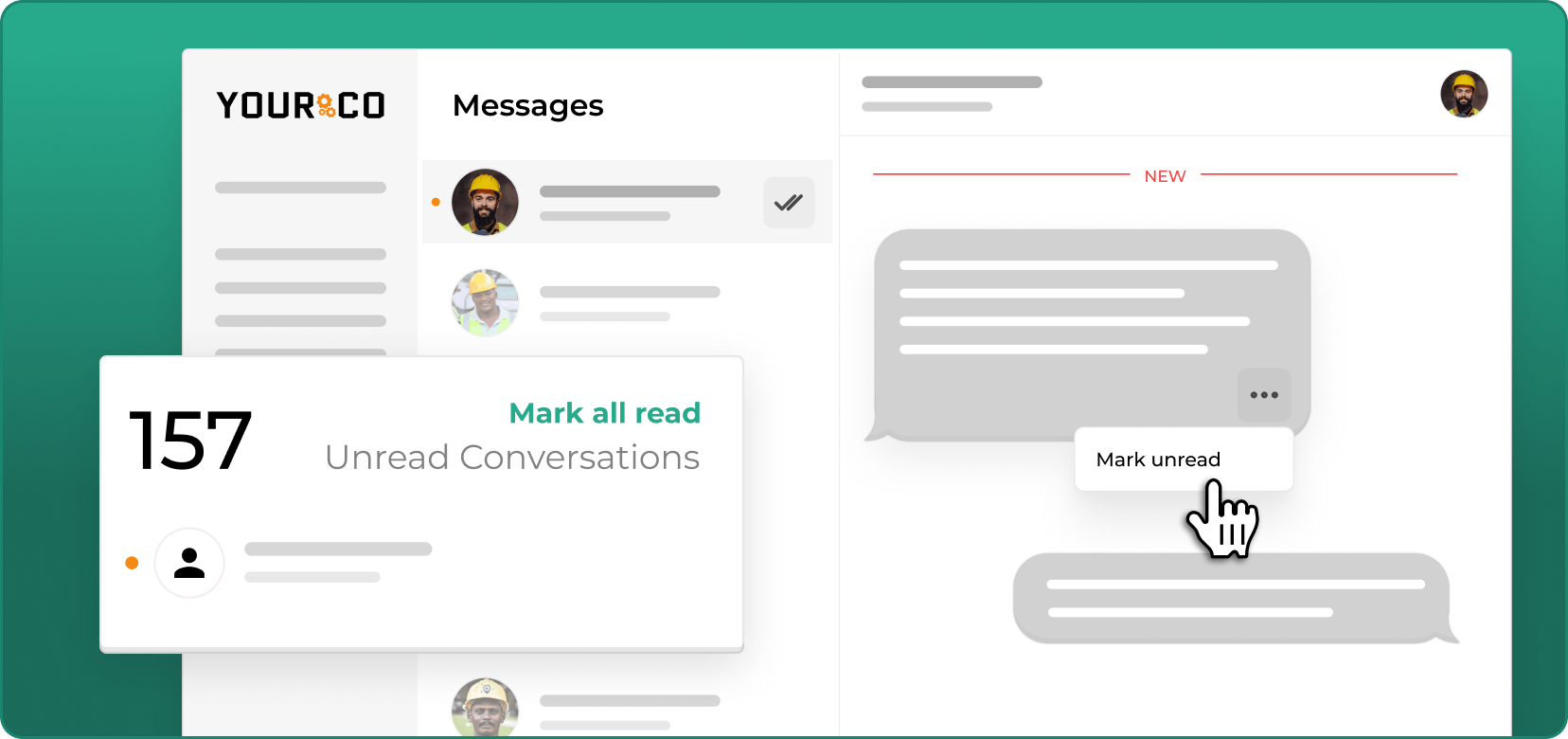
Yourco keeps frontline communication on one centralized, logged channel. Authorized senders message workers from a single dashboard. Scheduled messaging holds non-urgent announcements until each group's next shift begins, while the system records who sent each message, what it said, and when it went out.
The platform reaches every worker where they already are:
- SMS to any phone, including basic flip phones, with no app download required and no need for Wi-Fi or a data plan
- Two-way messaging so workers reply through the same archived thread to confirm coverage or raise concerns
- AI-powered translation across 135+ languages and dialects, so scheduled announcements can arrive in each worker's preferred language
These capabilities help managers reach every frontline worker without adding another app or scattering records across personal devices.
A human resources information system (HRIS) can keep employee data aligned with communication groups. Yourco's 240+ HRIS and payroll integrations automatically keep contact lists and shift groups up to date, ensuring scheduled messages reach the right rotation.
For multi-location organizations, Enterprise Bridge supports one-way broadcasts from corporate leadership to the entire frontline. Every location stays aligned without requiring responses.
Frontline Intelligence gives HR and operations leadership centralized visibility into how after-hours communication actually lands across all locations. Leaders can see which announcements reached each site and identify patterns in worker replies, so they can adjust sending norms.
Operations teams describe how routing notices through one channel changes daily communication.
"We use Yourco for our absence management and for sending out notices, reminders, and event announcements. It keeps everyone who needs to know informed when people are absent."
— Kyle Stover, HR Assistant, J-Lenco Inc.
After 90 days with Yourco, two-way employee engagement increased to 86%.
Try Yourco for free today or schedule a demo and see the difference the right workplace communication platform can make.
Frequently Asked Questions About After-Hours Communication
Can an employer contact employees after hours?
In the United States, no federal law prevents an employer from contacting employees outside scheduled hours. For non-exempt hourly workers, reading and responding to work messages outside scheduled hours may count as paid work time depending on the circumstances. Many employers limit after-hours contact to genuine emergencies for exactly that reason.
Should employers text employees off the clock?
Only when the matter genuinely cannot wait for the next shift, such as a safety issue or an immediate staffing shortage. Routine reminders, announcements, and schedule preferences belong during working hours or in a scheduled message timed to shift start. Even a brief reply from an hourly worker may count as compensable work.
What is a right-to-disconnect policy?
A right-to-disconnect policy states that managers do not expect employees to routinely perform work outside normal working hours and that managers will not penalize employees for declining after-hours contact. France, Australia, and Ireland are among the countries that have adopted versions of this. The United States has no enacted version, though several states have proposed bills.
How should managers handle urgent after-hours messages?
Defining what counts as urgent in writing comes first, alongside limiting which roles the policy authorizes to send after hours. True emergencies need a consistent label so workers can tell at a glance. SMS-based platforms like Yourco route those messages through a single archived channel, so the alert reaches affected workers, and the record survives.
Does a written policy against off-the-clock work protect an employer?
Not by itself. Federal guidance places a duty on management to actually prevent the work from happening rather than relying on a written rule alone. Scheduling non-urgent messages for the next shift removes the opportunity for off-the-clock replies rather than prohibiting them on paper.