
Managing communication with frontline workers has always required a careful balance between speed and accountability. The disconnect runs deep: according to ZipRecruiter's Breakroom Workplace Index, only 23% of frontline workers believe senior leaders understand their day-to-day reality. Text messaging is often the fastest way to reach hourly and shift-based employees, and organizations that implement a clear policy find it straightforward to run a consistent, well-documented program. A thoughtful, written texting policy protects your organization and your workforce while ensuring every worker stays informed. These nine best practices give HR teams a ready-to-implement framework for professional manager-employee texting.
TL;DR
- A workplace texting policy protects your organization by defining consent, communication windows, prohibited content, and record retention standards.
- Most organizations formalize their texting practices to address consent, communication windows, and data handling in a practical, documented way.
- The policy template in this article covers 9 best practices in a ready-to-use format for HR teams.
- Platforms like Yourco make policy enforcement automatic by handling opt-in consent, opt-out processing, archiving, and delivery to every frontline worker via SMS.
Quantify the Business Case for Compliant Texting
Compliant workplace texting drives measurable outcomes for frontline teams. Organizations that establish clear communication policies for frontline workers tend to see higher employee engagement, fewer documentation gaps, and reduced administrative overhead from managing informal message threads. Frontline workers who receive timely, consistent updates through an organized channel report stronger connections to their teams and managers.
The retention stakes are real. According to Gallup, replacing a frontline worker costs approximately 40% of their annual wages, and 42% of employee turnover is preventable. According to Yourco's research, which surveyed 150 HR leaders, 93% say better communication tools increase productivity, and 56% say their organization has missed a vital deadline because they couldn't reach a frontline worker in time.
When a compliant texting policy replaces ad hoc manager texts and personal phones, organizations close the communication gaps that most likely drive preventable attrition.
Understand What a Strong Texting Policy Covers
Knowing what a well-built workplace texting policy needs to cover helps HR teams build a policy that works consistently across all locations and shifts. The Telephone Consumer Protection Act (TCPA) is commonly cited in employer-employee text communications because it requires you to get consent before sending automated messages. Documentation of this consent is widely considered a best practice. Beyond the TCPA, after-hours texts to non-exempt employees may create compensable work-time considerations under the FLSA, and transmitting sensitive data via standard SMS may raise concerns under HIPAA, GDPR, or CCPA.
For jurisdiction-specific guidance, it's worth reviewing these topics with qualified legal counsel before drafting your policy. Common regulatory areas HR teams monitor when building texting policies include:
- Consent requirements for sending automated or recurring text messages
- Wage and hour obligations related to after-hours communication to non-exempt workers
- Data privacy protections for sensitive employee information
- Motor carrier rules for organizations with drivers, where distracted driving policies intersect with communication practices
These are the areas most organizations address when building a texting policy, and each one has a practical, straightforward solution. Let’s dig into the most common guidelines companies often include in their policies.
Set Up Your Policy Before the First Message Goes Out
Every compliant texting program starts with the right foundation: who has consented, when messages can be sent, and what cannot be sent via SMS. These guidelines provide a framework for texting your employees. The industry is highly regulated, so it’s always best to consult legal counsel before implementing a policy. Here are the nine most common things you might want to include:
1. Require opt-in consent during onboarding
For internal workplace communication, obtaining employees' consent to receive work-related text messages is typically straightforward. In most cases, employers simply inform employees that SMS will be the primary communication channel for work updates and ask them to acknowledge and agree to it.
This is often included during onboarding alongside other HR policies. A brief acknowledgment form or policy statement is usually sufficient, letting employees know that they may receive messages about schedules, shift updates, operational alerts, and safety notices.
Because the messages are strictly for internal workplace communication, the process is simple: make employees aware of the communication method and have them confirm their agreement to receive work-related texts. If you don’t already have a consent form that is TCPA compliant, you’ll need to review a draft with your legal counsel to make sure all your bases are covered.
2. Set clear communication windows
Sending work-related texts outside scheduled hours to non-exempt employees may raise wage-and-hour considerations under the FLSA. For most organizations, a default window of 7 AM to 9 PM in the recipient's local time zone provides a reasonable boundary. Frontline operations running multiple shifts may benefit from shift-aligned windows instead.
Sample policy language: "Managers may send work-related texts only during an employee's scheduled shift or within 30 minutes before or after. Exceptions are limited to genuine operational emergencies."
3. Beware of sensitive content that can’t be sent over standard SMS
Standard SMS lacks the security controls expected for regulated or confidential information. Organizations commonly restrict these data types from workplace text messages:
Ideally, you also run this by your general counsel or the head of HR to confirm compliance with all relevant regulations for your industry and employee communications.
Sample policy language: "Employees and managers should never transmit wages, medical information, Social Security numbers, or disciplinary actions via text."
Establish Standards for Every Message You Send
Once consent and boundaries are in place, Tips 4 and 5 govern how messages should be written and how employees can exit the channel at any time.
4. Mandate professional standards
Workplace texts are business communications that may come up in HR reviews, audits, or internal documentation. Keeping a professional, consistent tone also ensures messages translate clearly across cultures and languages. All business texts should use complete sentences, avoid slang, and remain concise and factual.
This part of the policy can typically follow your employee handbook’s guidance on internal communication.
Sample policy language: "All work-related texts must use professional language, complete sentences, and avoid slang or emojis."
5. Protect employee opt-out rights
Employees can request to stop receiving text messages at any time. However, because workplace SMS is the primary communication channel between HR managers and frontline employees, it's important that workers understand what opting out means. Employees who opt out will miss schedule changes, safety alerts, policy updates, and other critical company communications that directly affect their work.
Before processing an opt-out, encourage the employee to follow up with HR to discuss their concerns and explore alternatives, such as adjusting message frequency or categories. If the employee still chooses to opt out, confirm the request, document it, and ensure alternative communication methods are in place so they continue to receive critical operational information.
Build the Operational Backbone of Your Policy
Consent forms and communication windows are easy to draft. Consistent records, trained managers, and enforced accountability take a bit more structure, and getting these right from the start saves significant time down the road.
6. Retain message records
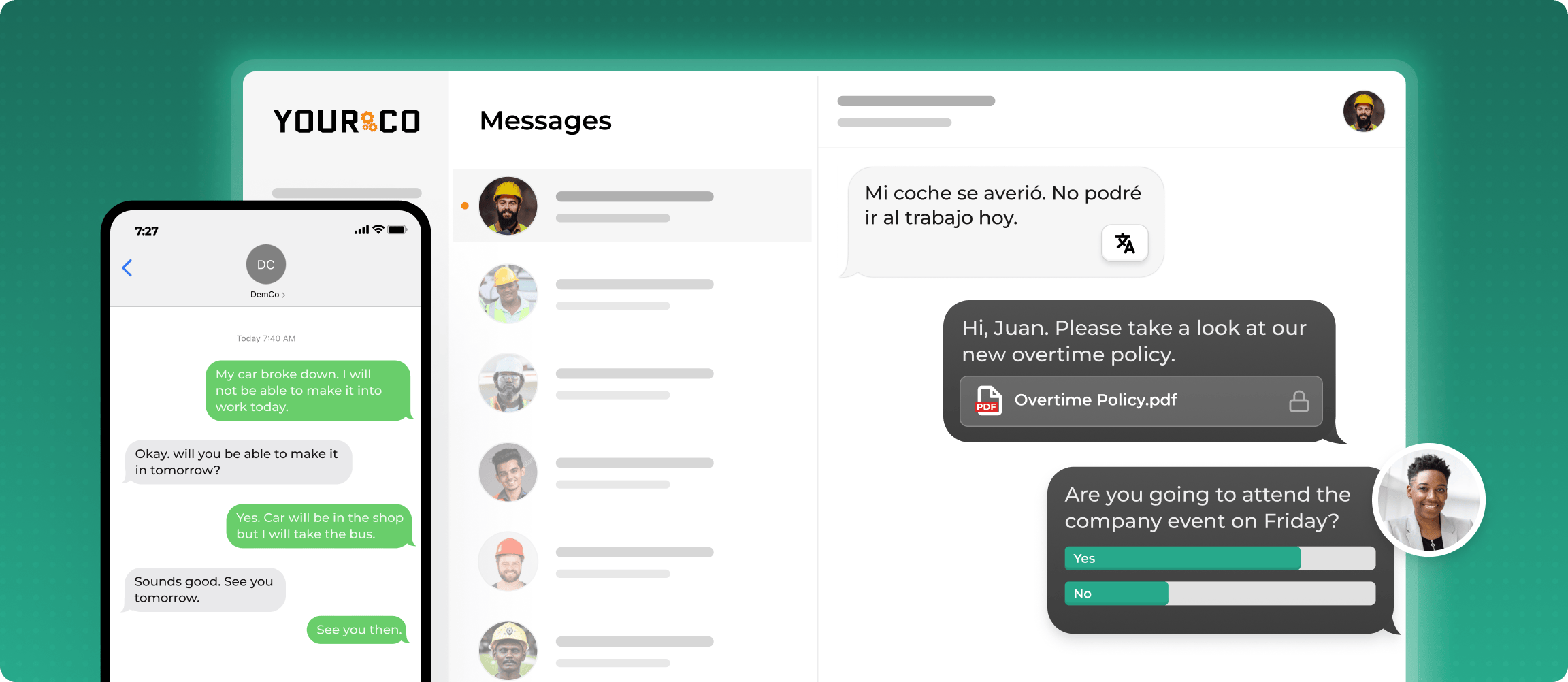
Workplace text messages are employment records that many organizations retain for multiple years. Payroll- and FMLA-related communications are commonly retained for at least 3 years, and maintaining complete records becomes more important whenever a dispute or question arises. Platforms that route messages through personal phones make centralized recordkeeping difficult to maintain reliably, which is why many HR teams move to a dedicated SMS tool.
7. Train managers before they text
Managers need clear escalation protocols before they start using SMS for workforce communication. As a general rule, harassment or discrimination complaints should go to HR immediately; medical leave requests should be routed to the appropriate HR channels; and disciplinary conversations should always happen in person or through secure, documented channels. Check in with your legal counsel about the types of communication that are red flags, and adjust your policy accordingly.
Sample policy language: "Managers must complete texting policy training within 30 days of hire and participate in annual refreshers."
8. Enforce the policy consistently
A progressive approach to enforcement provides clear expectations while preserving flexibility for serious misconduct. Here’s a typical structure:
- First violation: Verbal warning with documented memo
- Second violation: Written warning and performance improvement plan
- Third or serious violation: Suspension or termination, with serious misconduct able to skip tiers
Sample policy language: "Violations follow progressive discipline; serious violations may skip tiers."
Keep the Policy Current
9. Conduct annual policy reviews
Regulations shift, workforces change, and communication tools evolve. Each annual review should cover:
- Federal and state updates to communication and wage-and-hour guidelines
- Audit of message logs for compliance gaps
- Feedback from managers and employees on what's working
- Compliance review from legal
Organizations in states with stricter wage-and-hour rules should pay particular attention to how after-hours communication intersects with hours worked calculations.
Sample policy language: "This texting policy will be reviewed annually by HR leadership in coordination with legal counsel. Updates will be communicated to all employees within 30 days of adoption."
Assemble Your Complete Texting Policy Template
Use this template as a guide to draft your policy and share with legal.
[Company Name] Workplace Texting Policy
Once your policy is set, confirm formal acknowledgment with policy acknowledgment statements to document employee understanding and agreement.
Build a Compliant Texting Policy Faster With Yourco
Yourco is the SMS-based employee communication platform built specifically for frontline workforces. It makes policy enforcement automatic across every location:
- Handle opt-in consent tracking, automatic opt-out processing, and message archiving so compliance documentation stays audit-ready without manual effort
- Send messages through a centralized platform with role-based access controls, keeping communication professional and documented
- Translate every message automatically across 135+ languages and dialects so every worker receives updates in their preferred language
- Reach any phone, including basic flip phones, at zero cost to employees, with 98%+ SMS read rates typically achieved within 90 seconds
- Broadcast one-way policy updates, compliance notices, and announcements from corporate leadership to every location through Enterprise Bridge, while local managers maintain direct two-way conversations for day-to-day operations
- Connect with 240+ HRIS and payroll systems, keeping employee data synchronized without manual updates
Frontline Intelligence adds another layer of visibility by turning everyday communication data into actionable insights. HR and operations leaders can spot disengagement trends, track policy acknowledgment rates by location, and surface early signals of compliance gaps before they become problems. It's the difference between reacting to issues and preventing them.
The data backs this up: in Yourco's Closing the Comms Gap whitepaper, 88% of HR leaders say better communication tools reduce employee churn, and 92% say improved communication would boost frontline engagement.
After 90 days of using Yourco, two-way employee engagement increased to 86%.
"We have tried 3 text communication tools, and this is the best experience we've had by far. A consistent line of communication to our employees is one of the most important things when it comes to our employee communication strategy, and Yourco is the most reliable system around."
— Terri Kasper, HR Manager, Calumet Carton Company
Try Yourco for free today, or schedule a demo to see the difference a right workplace communication solution can make for your company.
Frequently Asked Questions about Workplace Texting Policies
Does the TCPA apply to text messages between managers and employees?
The TCPA is frequently cited in employer-employee text communication practices. Many employers collect express consent before sending automated texts and treat opt-out requests as time-sensitive priorities. Consulting legal counsel is always advisable for your specific situation.
Can managers text employees after hours about work-related topics?
After-hours work-related texts to non-exempt employees may be considered compensable time under the FLSA when they create hours worked. Many employers establish communication windows aligned with scheduled shifts and limit exceptions to genuine emergencies, which is the approach reflected in the policy guidelines above.
What information should never be sent via standard text message?
Protected health information, Social Security numbers, compensation details, disciplinary actions, and performance evaluations are commonly restricted from standard SMS. These categories are treated as confidential or regulated under applicable privacy and employment frameworks. Your industry may have stricter requirements. Consult your legal counsel before finalizing a policy.
How long do employers need to keep workplace text message records?
Retention timelines vary by record type and jurisdiction, but many employers retain payroll-related and leave-related communications for multiple years. A centralized SMS platform makes this straightforward by automatically archiving messages, so records are available whenever needed.
What happens if an employee opts out of workplace texts?
Employers should honor the opt-out promptly and provide equivalent information through alternative channels, such as posted notices or direct communication with the supervisor. Platforms like Yourco automatically process opt-outs and maintain suppression lists, so no messages are sent to opted-out employees.