
Your frontline workers keep operations running, yet they're often the last to receive meaningful feedback opportunities. While desk-based employees enjoy regular check-ins and digital communication tools, non-desk teams face a widening disconnect that threatens engagement, retention, and productivity. Real-time employee insights give you the visibility to spot disengagement early, respond faster, and build stronger connections with your workforce across every shift and location.
TL;DR
- Frontline workers make up the majority of the global workforce, yet most lack company email or regular computer access
- Annual surveys capture outdated snapshots; pulse surveys track sentiment as it shifts
- SMS-based feedback reaches workers on any phone with 98% open rates, no app required
- Predictive analytics can identify at-risk employees 6 to 12 months before they resign
- Managers who close feedback loops drive higher participation and lower turnover
- SMS-based platforms like Yourco turn frontline feedback into real-time insights leaders can act on the same day
Close the Communication Gap Facing Frontline Workers
Workplace messages often fail to reach frontline workers because most channels assume employees have company email and desk access. These channels also assume standard hours, which frontline jobs rarely provide. The cost shows up as missed updates, weaker engagement, and turnover that runs well above office norms.
Most communication tools were built for offices, not factory floors, warehouse aisles, or construction sites. This mismatch creates real problems for HR and operations leaders trying to keep frontline teams informed and engaged.
When workers feel out of the loop, they disengage. When they disengage, they leave. The consequences show up clearly in turnover numbers:
- Manufacturing's total separations ran 2.3% a month, an annualized pace near 28%
- Leisure and hospitality ran 5.3% a month, an annualized pace near 64%
- Construction ran 3.9% a month, an annualized pace near 47%
Figures are July 2026 monthly total separation rates, annualized, from BLS JOLTS Table 3, "Total separations levels and rates by industry and region".
Real-time insights help you catch warning signs before they become resignation letters. Frontline workers often miss critical updates because they lack email access or work nonstandard hours, making traditional communication channels ineffective.
Why Should Employers Shift from Annual Surveys to Real-Time Feedback?
A yearly survey snapshot can become outdated before leaders review it, especially when frontline teams turn over quickly. Pulse-based, continuous listening shortens the time between an employee raising a concern and a leader acting on it from months to days, and that speed decides whether problems get fixed before people quit.
Annual engagement surveys capture how employees felt on a single day, often months before leaders review the results. In high-turnover industries, many workers who completed that survey may have already left by the time anyone acts on the data.
Pulse surveys change this dynamic by delivering brief, focused questionnaires at regular intervals. They track sentiment shifts as they happen and create visible feedback loops showing employees their input drives decisions.
For shift-based and multilingual workers, real-time feedback also addresses practical barriers:
- Surveys arrive during break times rather than standard business hours
- Questions translate automatically into each worker's preferred language
- Responses come through mobile-friendly formats requiring no app downloads
How Can Employers Collect Feedback from Frontline Workers?
Text messaging lets frontline workers provide feedback on a device they already carry, without an app, login, or company email. SMS-based programs therefore reach employees who never touch email-based surveys. Traditional engagement programs depend on employees answering a survey. Real-time workforce intelligence goes further by analyzing the signals employees generate through everyday communication, feedback, surveys, and frontline workflows.
Only about 20% of employees worldwide were engaged at work in 2025, according to Gallup's State of the Global Workplace report, and many frontline workers have limited or no email access. Any feedback system relying on traditional corporate communication will miss a large portion of your workforce.
SMS-based feedback collection meets workers where they already are. Text messaging reaches any mobile phone, including basic flip phones, without requiring WiFi, app downloads, or technical setup. This approach proves particularly effective in low-connectivity zones typical of manufacturing floors, warehouses, and construction sites.
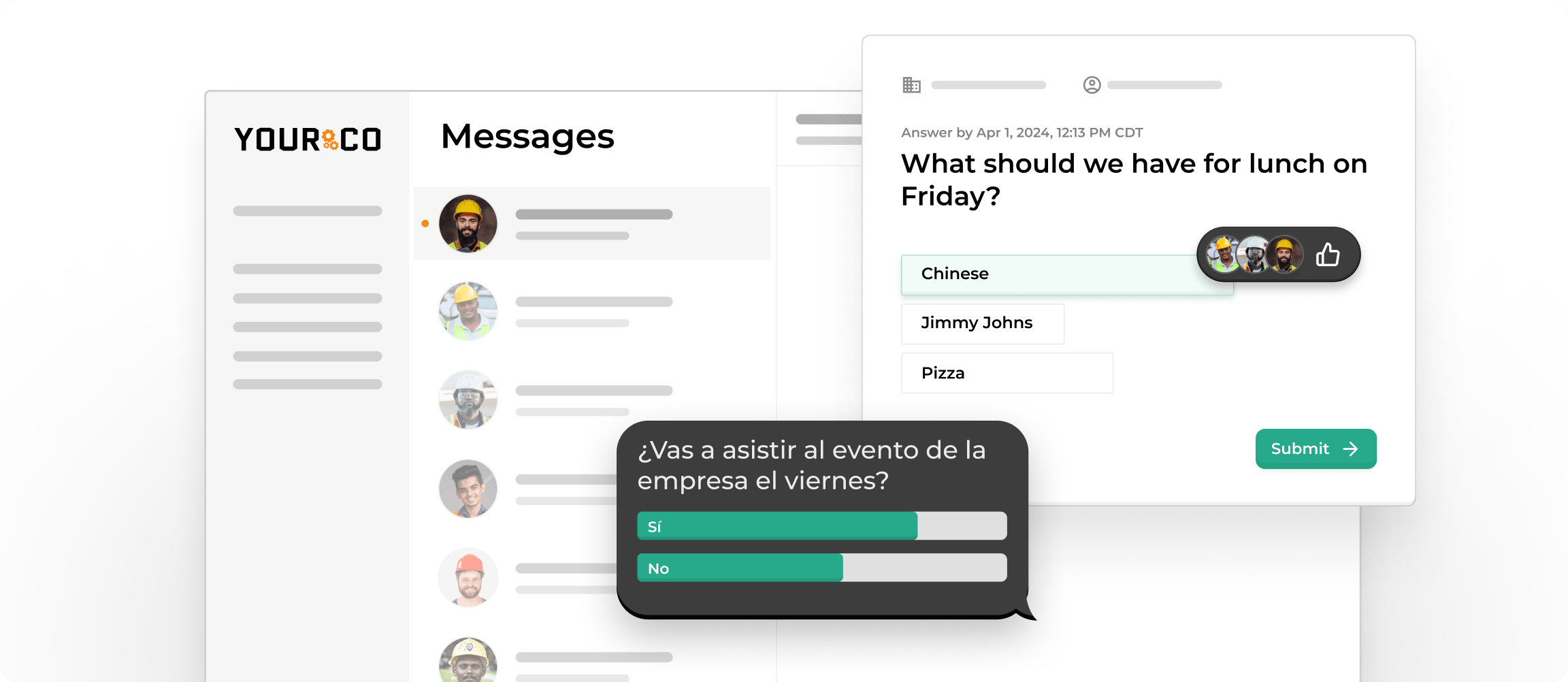
Effective mobile-first feedback programs share several characteristics:
- Questions arrive at times aligned with shift patterns
- Surveys stay short enough to complete during a quick break
- Responses flow back to HR and operations teams in real time
- Workers receive confirmation their feedback was received
Beyond surveys, two-way communication capabilities let workers share concerns, report issues, and ask questions through the same familiar text interface, a habit that goes a long way toward improving frontline employee engagement over time.
How Can Real-Time Employee Insights Help Predict Turnover?
Behavioral and sentiment signals can surface months before an employee resigns, leaving time to intervene. According to Gallup research on preventable turnover, 42% of voluntary departures are preventable, yet 45% of departing employees say their manager never had a proactive conversation about their job satisfaction or future in the three months before they left.
Real-time insights do more than measure current sentiment. Combined with workforce analytics, they enable predictive identification of employees at risk of leaving within 6 to 12 months by analyzing behavioral patterns, engagement metrics, and sentiment data. Real-time employee insights don't come from surveys alone. They come from understanding the conversations, responses, questions, call-offs, and feedback already happening across your workforce.
Key behavioral signals that often precede turnover include:
- Declining engagement scores across consecutive periods
- Reduced participation in voluntary training
- Changes in communication patterns with peers and supervisors
- Increased absenteeism
These patterns emerge months before employees resign, giving you time to intervene.
How Can Managers Close the Employee Feedback Loop?
Acknowledging every piece of input and telling the employee what will happen next closes the feedback loop, even when the answer is no. According to Gallup research on frontline managers, managers alone account for 70% of the variance in team engagement, so how you respond to feedback matters more than how much you collect.
Many frontline managers struggle with their own engagement challenges. Overwhelmed or disengaged supervisors can't provide the responsive communication their teams need.
Successful feedback programs equip managers with clear guidance on closing the loop. When employees share input, supervisors should respond with one of three messages:
We are implementing your suggestion
- We are implementing a modified version with explanation
- We cannot implement this, and here is why
This structured approach ensures workers see their feedback acknowledged even when specific suggestions cannot be adopted.
How Can Employers Overcome Frontline Feedback Implementation Challenges?
Frontline feedback programs work when employers remove two barriers at once: technology the workforce doesn't have and skepticism that anything will change. A program that works on any phone and responds visibly to early input clears both.
Rolling out real-time feedback programs for frontline workers requires careful attention to barriers that differ from office-based environments.
Technology access remains the foundational barrier. Many frontline workers lack regular email access or the technology they need to do their jobs well. SMS-based systems work on any mobile device and function even in low-connectivity environments.
Trust deficits undermine adoption. Frontline workers often feel disconnected from corporate decision-making, making them skeptical that feedback matters. Launching a feedback program without explaining how you'll use input and what protections exist will limit participation.
Start with clear business outcomes, not technology features. Focus feedback collection on areas where you can demonstrate rapid, visible response: safety concerns, scheduling issues, and equipment problems.
How Do You Select the Best Employee Engagement Platform for a Frontline Workforce?
Select an employee engagement platform for frontline workers by scoring it against four criteria: reach without company email or app installation, response rates from frontline workers, manager-level actionability, and time-to-insight. Feature lists matter less than the delivery channel, because a platform produces real-time employee insights only from frontline workers it can actually reach. The four main platform categories (annual-survey suites, pulse-survey tools, mobile-first frontline apps, and SMS-based tools) trade off differently against those criteria.
Annual-survey suites deliver long-form census surveys with industry benchmarks and deep organization-wide analytics, and they work well for desk-based teams with company email. Annual-survey suites also undercount frontline engagement in practice: many manufacturers can't assess it at all, either because too few frontline workers complete the survey or because they don't run one for that population in the first place.
Pulse-survey tools send short questionnaires monthly or quarterly to track sentiment shifts between annual cycles. They suit monitoring morale during transitions and catching early disengagement. Delivery remains a limitation for frontline teams, since most pulse tools run on email or an app. Frequent pulse surveys can exceed managers' capacity to respond. Only 8% of employees strongly agree that their organization takes action on surveys, according to Gallup's post-survey guidance, which names overusing pulse surveys while rarely acting on them as a common engagement-strategy failure.
Workers with smartphones can use mobile-first frontline apps that package communication feeds, training, and task tools. These platforms can serve smartphone-equipped teams well. Adoption depends on whether workers install the app and maintain logins on personal devices. Smartphone ownership itself splits by income: 98% of adults in households earning $100,000 or more own one, versus 79% in households under $30,000, according to Pew Research Center's 2024 mobile technology report. Workers also hesitate to install employer apps on personal phones over privacy concerns, and many production floors restrict phone use mid-shift.
With SMS-based tools, text messaging delivers surveys and two-way conversations to any mobile phone, including basic flip phones, with no app, login, or company email. Replies reach managers the same day, so problems surface while they can still be fixed. The format supports short pulse surveys and open conversations, including quick polls, over long-form census instruments.
Scored against all four criteria for a frontline workforce, SMS-based platforms like Yourco come out ahead. Any worker can answer from the phone already in their pocket, and replies route straight to the manager responsible for acting on them. Time-to-insight drops from a reporting cycle to the same day, which makes real-time employee insights workable on a factory floor or job site. Organizations that still want deep annual benchmarks can keep a periodic census survey and use SMS for the continuous listening between cycles.
91% of HR leaders report that SMS increases frontline employee response rates, according to a Yourco-commissioned survey of 150 HR leaders.
Capture Real-Time Frontline Insights With Yourco
Real-time employee insights only work if the platform collecting them actually reaches your frontline. Yourco is an SMS-based employee communication platform, backed by enterprise-grade security including SOC 2 Type II certification and GDPR compliance, that reaches every worker instantly on any phone, which achieves 98% read rates as an industry benchmark. Three capabilities carry that across a frontline workforce:
- SMS reaches any phone, including basic flip phones, with no app download or Wi-Fi required
- Two-way messaging lets workers answer pulse surveys, report concerns, and reply to managers through the same familiar text interface
- AI-powered translation across 135+ languages and dialects keeps feedback requests clear for multilingual crews
Surveys and forms collect real-time feedback and workforce data through that same channel, so a pulse check reaches workers the same way a shift update does.
Human Resources Information System (HRIS) and payroll data sync through Yourco's 240+ integrations, so engagement data lines up with the workforce records HR already tracks.
For multi-location organizations, Enterprise Bridge lets corporate leadership send one-way updates across every site, while local managers keep direct two-way conversations with their own teams.
Frontline Intelligence gives HR and operations leaders centralized visibility into engagement and sentiment trends across every location, so a site with declining response rates surfaces without waiting on a manual roll-up. You can ask it questions like:
- What percentage of frontline employees responded positively to the last pulse survey?
- How has employee engagement changed over the past 30 days?
- Which locations show declining engagement scores?
- What themes appear most often in negative survey comments?
Great Day Improvements saw its frontline sentiment score climb from 0.125 to 0.36 (on a -1 to +1 scale) after consolidating communication onto Yourco, alongside a 2x increase in employee engagement during major initiatives:
"Yourco's Frontline Intelligence has completely changed how we understand our distributed workforce. For the first time, we have real-time visibility into frontline engagement and communication across brands and locations. We can see how employees are responding to leadership initiatives, measure sentiment after company-wide campaigns, and understand what truly resonates."
— Elizabeth Huldin, CHRO, Great Day Improvements
"We have tried 3 text communication tools, and this is the best experience we've had by far. A consistent line of communication to our employees is one of the most important things, and Yourco is the most reliable system around."
— Terri Kasper, HR Manager, Calumet Carton Company
After 90 days on Yourco, companies see two-way employee engagement reach 86%.
Try Yourco for free today or schedule a demo and see the difference the right workplace communication solution can make in your company.

Frequently Asked Questions About Real-Time Employee Insights
What Are Real-Time Employee Insights?
Real-time employee insights come from continuous feedback collection methods like pulse surveys and two-way communication rather than once-a-year engagement surveys. These approaches capture how workers feel right now and allow you to track sentiment changes as they happen. Leaders can then intervene sooner when problems arise.
How Do You Collect Feedback From Workers Without Email Access?
SMS-based feedback systems reach workers through text messaging on any mobile phone, including basic devices without internet connectivity. By removing barriers created by email-dependent or app-based platforms, these systems connect with frontline workers who would otherwise remain disconnected from feedback initiatives.
Can Real-Time Feedback Help Reduce Employee Turnover?
Yes, by collecting continuous feedback and acting on what you learn, you can identify disengaged employees and address their concerns before they decide to leave. Early intervention based on ongoing feedback data supports retention strategies that reduce turnover costs.
How Do I Select the Best Employee Engagement Platforms?
Match the platform's delivery channel to your workforce before comparing features. If many employees lack company email or cannot install apps at work, score each option on four criteria: reach without email or app installation, frontline response rates, manager-level actionability, and time-to-insight. The platform that meets all four for your workforce is the best choice.
What Are the Best Employee Engagement Companies?
The best employee engagement company is the one whose delivery channel matches your workforce. Annual-survey suites work well for desk-based teams that need deep benchmarks. Pulse tools support frequent sentiment tracking, while app-based platforms work for smartphone-equipped teams. For frontline workforces without company email or app access, SMS-based platforms like Yourco offer the broadest reach and fastest time to insight.