


The Department of Labor's Wage and Hour Division recovered more than $184 million in Fair Labor Standards Act (FLSA) back wages in fiscal year 2025. A worker who prepped a station 15 minutes before punching in or answered a supervisor's text after dinner may have performed work that never reached the timekeeping system, leaving no record to settle a disagreement about hours. For HR and operations leaders managing frontline teams across multiple shifts and locations, unpaid overtime often traces back to untracked work that happens when the clock is not watching.
TL;DR
- Off-the-clock work is any time an employer requires or allows an employee to work outside recorded hours.
- Unpaid overtime is the pay problem that follows when those unrecorded hours push someone past 40 hours in a week.
- Missing time entries cluster in predictable spots, from pre-shift setup to interrupted breaks and after-hours texts.
- Paper timesheets and memory record punches, not the work around them, so disagreements have no evidence to settle them.
- SMS-based platforms like Yourco keep after-hours and shift-related communication in one timestamped, auditable record.
What Off-the-Clock Work Actually Means
The FLSA defines employment to include any work an employer suffers or permits, which the Department of Labor (DOL) generally treats as time an employer requires or allows an employee to work, whether or not it falls within a scheduled shift.
Off-the-clock work generally refers to work employees perform outside recorded hours that goes unpaid. Common examples include finishing a task after clocking out, staying at a station during lunch to answer phones, or arriving early to set up before punching in.
Frontline work is especially prone to this because so much of it happens away from a desk and a login. A warehouse crew gears up before reaching the punch clock, a care worker answers a text between visits, a line lead stays through a half-interrupted lunch. None of that runs through email or a computer, so the usual paper trail that documents office work never forms. The same tasks that would leave a digital footprint in a corporate role leave nothing behind on the floor.
Off-the-clock work creates unpaid overtime exposure when total hours worked in a workweek exceed 40, and that total includes any work that was never recorded in the timekeeping system. DOL guidance generally applies an overtime premium of 1.5 times the regular rate to hours worked over 40.
A policy requiring pre-authorization for overtime generally does not change how employers treat the hours an employee actually worked. Understanding both terms is the first step toward reducing the missing records that create them.
Where Off-the-Clock Work Records Go Missing
Work creates operational risk when it occurs outside the logs, because managers and employees then have no record to refer to when resolving questions later. The moments below are where entries most often slip through, and each one tends to escape timekeeping for a specific reason.
- Pre-shift and post-shift tasks: putting on safety gear, setting up a workstation, booting up equipment, or attending a shift briefing before the clock starts, since workers often clock in at the production floor rather than the locker room
- Meal-break interruptions: a system auto-deducts 30 minutes whether or not the employee was actually relieved of duty, so interrupted breaks quietly become unpaid work
- After-hours texts, calls, and emails: after-hours texts happen on personal devices, so no clock-in event is ever triggered, even when the work may be compensable
- Unlogged training or meetings: employees complete required training or mandatory meetings next to a shift boundary, or through a learning platform on their own device
- Rework on personal time: finishing paperwork or making follow-up calls after clocking out, often off-site, where no formal record gets created
Each of these moments can involve real work, and each one tends to escape the timekeeping system entirely.
Why Paper and Memory-Based Tracking Fall Short
Under DOL recordkeeping guidance, employers may use employee self-reporting as long as the records remain complete and accurate and time clocks operate consistently to produce complete and accurate records. Paper timesheets and memory-based reporting often miss pre-shift gear, interrupted lunches, and late-night texts that never make it to the page.
When a time entry is missing, managers and employees have fewer records to reconstruct the hours worked. In a later disagreement, an employee may rely on a reasonable estimate when employer records are incomplete. Once the record is gone, the organization loses the ability to reconstruct what actually happened.
The cost is not only the unpaid hours themselves. Reconstructing what happened months later pulls managers and HR into hours of back-and-forth over shifts no one wrote down, and the answer often comes down to whose memory sounds more credible. A complete record replaces that guesswork with a timestamped account that both sides can look at.
Know That Some States Set Stricter Standards
Federal rules set a floor, and some states apply stricter standards for what counts as paid time and how employers keep records. As one recent example, a March 2026 New Jersey Supreme Court decision, Lopez v. Marmic LLC, reinforced that complete recordkeeping is a state obligation, not just a federal one. Standards vary widely from state to state, so many organizations keep complete, timestamped records as a general practice rather than tracking each jurisdiction's rules separately.
This information is for general awareness only. For specific compliance guidance, consult with qualified legal professionals.
How California's Overtime Rules Differ
California applies stricter overtime standards than the federal FLSA. Under California overtime law, the pay structure breaks down like this:
Source: California Department of Industrial Relations, Division of Labor Standards Enforcement
That daily structure raises the same record-gap stakes described above: a single unrecorded entry can push a workday beyond 8 hours, even within a 40-hour week. Multi-state employers keep timestamped records because California's overtime calculation rules differ from a simple weekly total.
This information is for general awareness only. For specific compliance guidance, consult with qualified legal professionals.
Build Centralized, Timestamped Records
Incomplete records leave organizations unable to reconstruct what happened, while complete, auditable records reduce that uncertainty. A few common practices help keep time and communication records complete:
- Consolidate records: pull time and message records from separate systems, spreadsheets, and personal phones into one place, so managers can surface discrepancies quickly
- Timestamp everything: give every record a timestamp, so managers have a durable, reviewable log of when work-related communication and activity happened
- Centralize after-hours contact: move after-hours texts and calls off employees' personal devices and into a single logged channel
- Audit routinely: review timekeeping processes on a regular schedule to catch discrepancies early
Centralizing after-hours contact does not mean encouraging more of it. The same logged channel that captures a message also makes after-hours patterns visible, so leaders can see which sites or managers reach out most and set clearer expectations. Visibility tends to reduce unnecessary contact, not increase it, because the pattern is finally something a manager can see and manage.
When the work and the communication around it live in a single timestamped place, teams have a clear record whenever a question comes up. Keeping that communication in a centralized, auditable channel also keeps it off personal devices, where scattered messages are harder to find and review.
Keep Shift Communication in One Auditable Record With Yourco
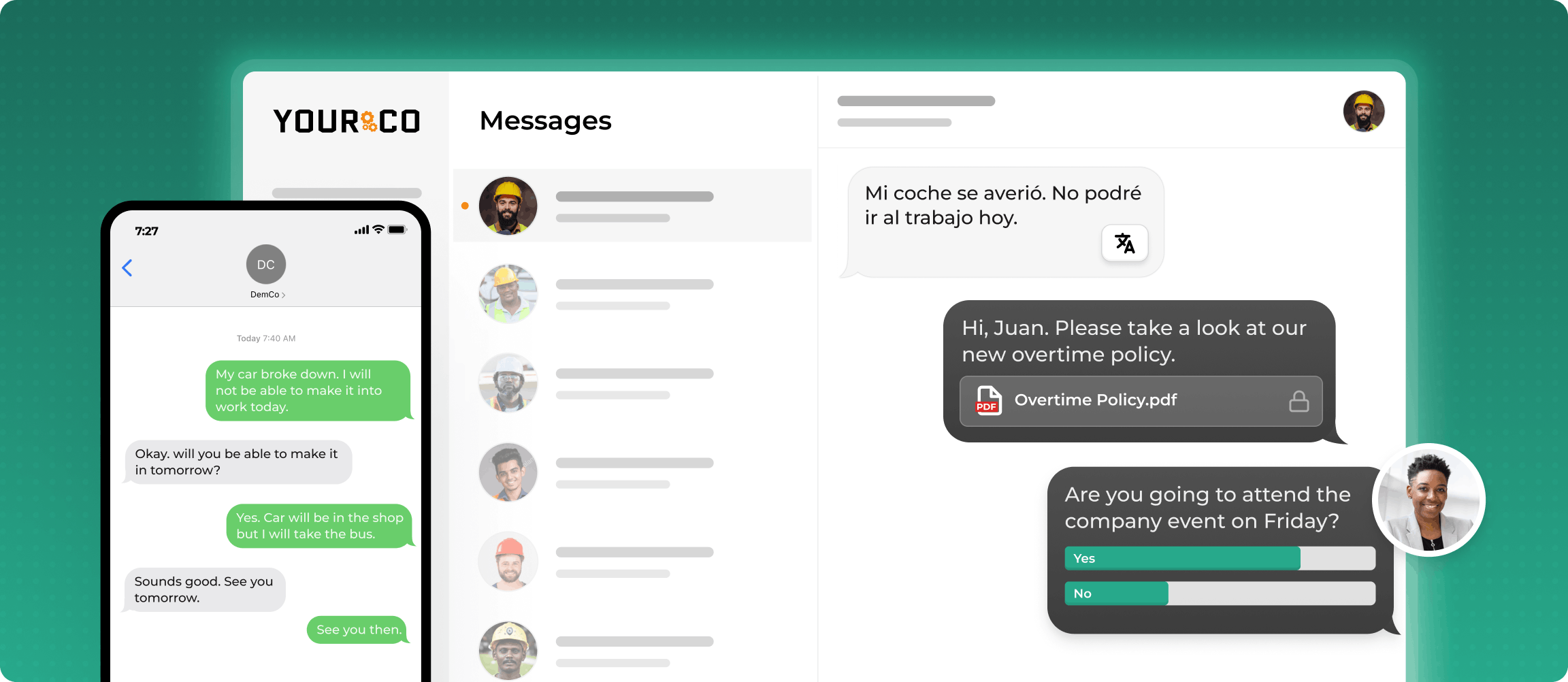
Reducing unrecorded work starts with putting shift-related communication in a place where managers can log and review it. Yourco is an SMS-based employee communication platform for frontline employees. HR and operations leaders can reach every worker and keep the resulting conversations in a timestamped record.
Yourco delivers the core capabilities frontline teams rely on:
- SMS to any phone, including basic flip phones, with no app download or Wi-Fi
- Two-way messaging between frontline employees and local managers
- AI-powered translation across 135+ languages and dialects
- Enterprise-grade security, so timestamped records stay protected and access stays controlled
Yourco connects to 240+ HRIS and payroll systems, so HR teams can keep employee data synced across them. For multi-location organizations, Enterprise Bridge lets corporate leadership send centralized, one-way policy and shift updates across all locations, while local managers keep direct conversations with their teams.
Frontline Intelligence gives leadership centralized visibility into communication patterns across all locations. It surfaces after-hours messaging patterns and response-time trends, and lets leaders review communication activity by location or department. Individual location managers can also review their own site's communication and time records directly, without waiting for a corporate report. Every message lives in a timestamped, archived record with audit trails, so managers can see what was communicated and when.
Companies with large frontline teams describe the reach a single SMS channel provides.
"We have nearly 700 employees and 80% are non-desk based, communication is a challenge. Yourco provides a quick easy way to reach everyone and a secure way for employees to reach HR and leadership without a computer."
— Felisha Parker, VP Human Resources, McCarthy Auto Group
After 90 days on Yourco, companies see two-way employee engagement reach 86%.
Try Yourco for free today, or schedule a demo to see the difference the right workplace communication solution can make for your company.
Frequently Asked Questions About Off-the-Clock Work
What is off-the-clock work?
Off-the-clock work generally refers to time an employer requires or allows an employee to work outside recorded or scheduled hours without pay. It commonly includes pre-shift setup, interrupted meal breaks, after-hours messages, and tasks finished after clock-out. A review often asks whether supervisors knew, or should have known, that the work was happening.
How is off-the-clock work different from unpaid overtime?
Off-the-clock work is the unrecorded work itself, while unpaid overtime is the pay issue that can follow. If those unrecorded hours move a nonexempt employee past the weekly overtime threshold, many employers review whether payroll missed the overtime premium and whether records need to be corrected.
Where do missing time records most often appear?
Missing time records most often appear around shift boundaries and informal communication. Common examples include putting on safety gear or setting up before punching in, interrupted or auto-deducted meal breaks, after-hours texts and calls on personal phones, unlogged training or mandatory meetings, and rework done after clock-out.
How can employers reduce off-the-clock wage risk in general terms?
Many employers focus on keeping time and communication records complete and centralized in a timestamped system, so there is a clear record when a question arises. Common approaches include written time policies, routine audits, manager training on work-hour boundaries, and maintaining shift-related communication in a single logged channel.
Can a centralized communication platform help with record-keeping?
A centralized SMS-based platform like Yourco can consolidate after-hours and shift-related communication into a single, timestamped, auditable record. That gives HR and operations leaders a single reviewable log of what managers and employees communicated and when, reducing the need for later reconstruction from memory.
How do frontline workers without email or computer access report off-the-clock time?
SMS-based platforms let workers text a supervisor directly from any phone, including basic flip phones, so a report doesn't depend on logging into email or a time-tracking portal they may not have access to during a shift.
How do you get employees to actually report time worked off the clock?
Reporting improves when it's low-friction and doesn't require extra steps. A worker who can text "worked through lunch, 20 min" to a supervisor is far more likely to flag it than one who has to remember to log it in a separate system later.
Does California's overtime law treat off-the-clock work differently?
California's overtime law treats off-the-clock work differently, since the state counts overtime by the day, not just the week. A few unrecorded pre-shift minutes or an unlogged after-hours text can trigger daily overtime in California, even when total weekly hours stay under 40.


