


A 98% open rate for Short Message Service (SMS) is why after-hours text contact can feel urgent even when no right-to-disconnect law exists. For organizations running frontline teams across multiple shifts and locations, managing after-hours contact gets complicated fast, especially when workers ask for clearer boundaries, and legislators float rules that never quite become law. California's right-to-disconnect bill did not change what employers owe their teams. AB 2751 died in committee, and employers still set their own rules for after-hours contact.
TL;DR
- No federal or state right-to-disconnect law is in effect in the US. California's AB 2751 died in committee.
- A statutory right to disconnect is different from a voluntary employer policy, and it carries legal weight that a policy does not.
- Telepressure is the pressure to answer off-hours messages, and workplace culture can drive it on its own.
- A few countries, including France and Australia, have passed these laws, while US attempts have stalled.
- Existing wage-and-hour guidance already shapes how employers handle after-hours contact with hourly workers.
- SMS-based platforms like Yourco give employers one logged record of after-hours contact.
Understand What the Right to Disconnect Actually Means
A right-to-disconnect law gives employees the right to disengage from work communications outside normal working hours. The term describes a statutory concept, not a voluntary employer practice. Ireland's Workplace Relations Commission defines it as the right to disengage from work and refrain from work-related electronic communications, such as emails, calls, or messages, outside normal hours, as well as the right to refuse contact without penalty.
That differs sharply from a voluntary internal policy. A statutory right runs through courts or labor tribunals, carries anti-retaliation protection, and gives employees legal recourse. An internal policy is a commitment that the employer can change or withdraw, and HR handles any grievance through internal processes alone. Even where these laws exist, they usually give workers the choice to disconnect, which often shifts the burden of disconnecting onto the worker.
Recognize Telepressure and Why It Drives This Search
Psychologists Larissa K. Barber and Alecia M. Santuzzi introduced the term "workplace telepressure" to describe this pattern, and a 2025 study confirms it still predicts burnout among employees today. Telepressure is defined as the preoccupation and urge to respond quickly to work-related digital messages. The term names the behavior driving this topic, even where no law applies.
Recent research continues to link telepressure to burnout, poor sleep, absenteeism, stress, anxiety, and weaker detachment from work. A 2025 study of French-speaking employees found that telepressure correlated with higher stress and greater rumination about work during off-hours. A 2024 study found telepressure reduces psychological recovery even after accounting for workaholism.
The expectation of having to answer after-hours messages creates anticipatory stress on its own. Managers do not have to state that expectation or write it into a policy. A culture that normalizes after-hours availability imposes a cost even when managers send no message.
Separate What Passed From What Didn't
No federal, state, or local right-to-disconnect law is currently in effect in the United States. California's AB 2751 is the case most people are asking about, and it did not pass. The record breaks down into three clear buckets.
- What failed in California: Assemblymember Matt Haney introduced AB 2751. The Assembly Committee on Appropriations held it under submission on May 16, 2024, and the state's legislative tracker now classifies it as an inactive, dead bill.
- What remains pending: New Jersey introduced a similar bill requiring covered employers to adopt a written right-to-disconnect policy, but it stalled in the legislature. Analysts expect California's measure to resurface in revised form.
- What passed abroad: A few countries have enacted statutory versions. Australia's rules for larger employers began on August 26, 2024, and extended to small businesses on August 26, 2025, giving workers the right to refuse unreasonable after-hours contact.
Legislative status can change. This information is for general awareness only. For specific compliance guidance, consult with qualified legal professionals.
Why California's Bill Stalled and What the Debate Revealed
AB 2751 died in the Assembly Committee on Appropriations, and the reasons matter for any successor bill. The Assembly Labor and Employment Committee had advanced it earlier, but recommended excluding exempt professionals, which showed unresolved questions about scope. The Society for Human Resource Management (SHRM) opposed the bill and warned that it might restrict the natural flow of work that sometimes requires overtime.
The debate centered on employer flexibility against employee burnout. AB 2751 proposed a formal, enforceable boundary around after-hours contact, and SHRM noted that no US law had used this European-style framework before.
Schedule and coverage questions also weighed on the bill. Its definition of nonworking hours created ambiguity for workers without fixed schedules, a real problem for shift-based industries. A collective-bargaining exemption also removed a large share of manufacturing and logistics workers from its protections. Any future bill will need clearer definitions of schedules and coverage rules to advance.
Set After-Hours Expectations Without Waiting on a Mandate
Employers still need rules for after-hours contact, and they can start with written ones. HR and employment-law advisors commonly recommend clear policies governing time reporting and mobile-device use, since wage-and-hour rules make no exception for after-hours emails and texts. The practices below help organizations manage after-hours contact without any mandate in place.
- Set clear windows for non-urgent contact, so workers have a default for routine messages.
- Define what counts as an emergency versus a routine question that can wait until morning.
- Keep a visible, centralized record of after-hours messages to make patterns easier to trace.
- Ask leaders to model the behavior, since managers who visibly disconnect set a norm more reliably than any policy.
- Use scheduled-send features, so messages written after hours arrive during work hours.
Frontline operations often trip over the line between an emergency and a routine matter. AB 2751's proposed definition offers a useful benchmark: an unforeseen situation that threatens people at the worksite or the public, disrupts operations, or causes physical or environmental damage. Contacting a worker after hours with a question that could wait until morning generally falls outside that line.
What Frontline and Hourly Teams Need Specifically
For non-exempt frontline workers, wage-and-hour rules already shape how employers manage after-hours communication. The Department of Labor's Fact Sheet #22 states that employers count work they suffer or permit as work time, even when they did not request it. A policy prohibiting after-hours work does not remove the pay obligation when the employer knows or has reason to know that the work occurred.
When a supervisor sends an after-hours message, the resulting record can help employers identify and manage that contact. After-hours messages create greater wage-and-hour exposure in around-the-clock industries because supervisors may contact non-exempt workers outside scheduled shifts.
In warehouses, an escalation call may follow a late trailer, or a site may need certified staff on short notice. Hospitality teams often handle call-outs when a front desk or kitchen shift needs coverage. A centralized, logged channel gives operations leaders one place to see and manage that contact, with fewer scattered personal-phone messages and voicemails.
This information is for general awareness only. For specific compliance guidance, consult with qualified legal professionals.
Track Every After-Hours Message With Yourco
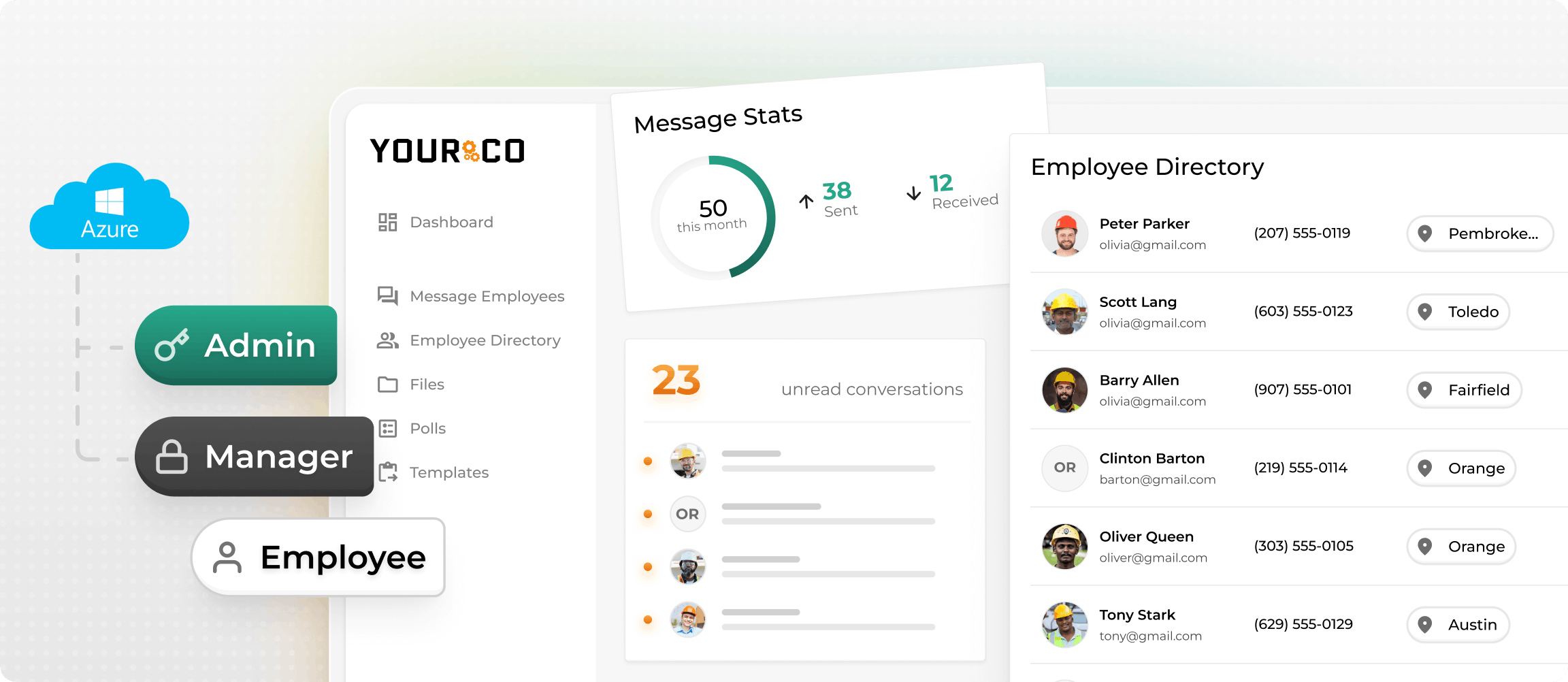
Setting clear after-hours expectations is far easier when every message lives in one visible, auditable place instead of on dozens of personal phones. Yourco is an SMS-based employee communication platform for frontline and hourly teams. It gives employers a centralized, timestamped record of after-hours contact without waiting for future legislation.
Yourco supports after-hours communication management through a few core capabilities:
- SMS to any phone, including basic flip phones, with no app download or Wi-Fi
- Two-way messaging between managers and frontline workers
- AI-powered translation across 135+ languages and dialects
- Enterprise-grade security, so after-hours records stay protected and access stays controlled
Yourco connects to 240+ HRIS and payroll systems, so HR teams can keep employee records synced across them. For multi-location employers, Enterprise Bridge lets corporate leadership send centralized, one-way policy and safety updates across all locations, while local managers keep direct conversations with their teams.
Frontline Intelligence gives HR and operations teams centralized visibility into after-hours communication patterns across all locations. Individual site managers can also see their own location's after-hours activity directly, without waiting for a corporate rollup. That visibility turns scattered contact into a record that every level of the organization can actually manage.
Companies with large frontline teams describe the reach a single SMS channel provides.
"We have nearly 700 employees and 80% are non-desk based, communication is a challenge. Yourco provides a quick easy way to reach everyone and a secure way for employees to reach HR and leadership without a computer."
— Felisha Parker, VP Human Resources, McCarthy Auto Group
After 90 days on Yourco, companies see two-way employee engagement reach 86%.
Try Yourco for free today, or schedule a demo to see the difference the right workplace communication solution can make for your company.
Frequently Asked Questions About the Right to Disconnect
What does the right to disconnect mean?
The right to disconnect means employees can disengage from work communications outside normal working hours without penalty, where a statute creates that right. It differs from an internal company policy because legislation can impose external enforcement, whereas an internal policy typically operates within employer-run HR processes and can change at the employer's discretion.
Does California have a right-to-disconnect law?
No, California does not have a right-to-disconnect law. AB 2751 was the bill most people are asking about, and it died in committee without becoming law. No federal, state, or local right-to-disconnect law is currently in effect in the US, though similar proposals may return in revised form.
What is telepressure?
Telepressure is the psychological urge to respond quickly to work messages outside working hours. It can make employees feel they should stay available even when no policy says so. For managers, workplace culture shapes the issue as much as the number of messages sent after a shift ends.
Do employers have to pay hourly workers for after-hours texts?
For non-exempt employees, employers often treat after-hours work time as compensable under federal wage-and-hour guidance when they know or have reason to know that the work occurred. Even a brief response can create a record, so many employers set clear reporting rules and manage after-hours contact carefully across shifts and locations.
How can employers keep a record of after-hours contact?
Employers can centralize after-hours messages in one auditable channel and keep them off personal phones and voicemails. SMS-based platforms like Yourco give employers a timestamped, centralized record of after-hours communication, so patterns stay visible and messages stay traceable across shifts, sites, and locations.
How do frontline workers without a company email or app report after-hours contact concerns?
SMS-based platforms let workers text HR or a supervisor directly from any phone, including basic flip phones, so reporting a concern doesn't depend on company email or an app they may not have or use.
How do you get managers to actually follow after-hours contact policies?
Written policies help, but visibility is what changes behavior. When after-hours messages live in a shared, logged channel rather than on personal phones, managers can see their own patterns, and leadership can see which sites or individuals reach out most, which tends to reduce unnecessary contact on its own.


