


Total US annual quits fell to 39.2 million in 2024, according to the Bureau of Labor Statistics (BLS), but retention pressure has not eased for frontline teams. Turnover still drains budgets and leaves managers absorbing the extra work. The standard retention playbook assumes access to company email, a desk, and scheduled meetings, which frontline workers rarely have. For these teams, retention depends on whether onboarding, feedback, and recognition actually reach the shift.
TL;DR
- Talent retention is the work of keeping good employees, and it is not the same as retention rate or engagement.
- Frontline teams face tight labor markets, wage competition, burnout, and stalled careers all at once.
- Pay matters, but so do recognition, career paths, and feedback that actually reaches workers on shift.
- The first month is the highest-risk window, so early onboarding and manager check-ins matter most.
- Track retention signals by location and shift, since company-wide averages hide the teams about to leave.
- SMS-based platforms like Yourco reach every worker on any phone and show engagement patterns by shift.
What is Talent Retention?
Talent retention is an organization's ability to keep valuable employees through practices, leadership habits, and policies that motivate people to stay. The Society for Human Resource Management (SHRM) frames retention as an ongoing process that requires leaders to continuously diagnose the causes of turnover as part of day-to-day management.
Leaders often blur two related terms. Retention rate measures the percentage of an employee cohort that stays over a set period. Employee engagement captures a worker's emotional commitment and enthusiasm, an input that drives the retention outcome. Retention capability uses engagement as the lever and retention rate as the scoreboard, so leaders can see whether their work actually changed behavior.
Recognize the Retention Pressures Facing Frontline Teams Today
The "Great Resignation" label no longer captures what HR and operations leaders face. Wage pressure, workload, manager capacity, and communication access now compound the retention challenge. Five pressures show up most often for frontline teams:
- Tight labor markets: manufacturing alone reports hundreds of thousands of open positions, and hourly roles stay hard to fill
- Wage competition: pay pressure runs high across construction, manufacturing, and logistics, and younger workers leave when compensation lags
- Burnout: heavy workloads and understaffing have made burnout a leading driver of frontline exits
- Career stagnation: workers leave when they see no path forward, and thin manager support accelerates it
- Communication breakdowns: recognition, feedback, and advancement news lose people when the message never reaches their shift
Pay answers only one part of that problem. A modern retention strategy has to answer the rest, and most of the rest depends on reaching workers who are rarely at a desk.
Build a Talent Retention Playbook That Reaches the Floor
A retention plan may start with competitive pay, but it also leans on work-life balance, career pathways, strong leadership, recognition, and feedback loops. Frontline workers can only use those levers when the message reaches them during or around the shift.
Each lever depends on communication and recognition moments that often happen in channels frontline workers cannot open during a shift. Well-recognized employees are 45% less likely to have left after two years, according to Gallup, underscoring that delivery matters as much as intent. Employee appreciation messages only help when they land with the people doing the work.
When a retention lever fails on the frontline, the message usually never reaches the shift. SMS-based team messaging changes the delivery model. SMS-based platforms like Yourco reach workers on any mobile phone, including basic flip phones, without an app download, company email, or Wi-Fi. That reach is the precondition for every lever below.
Fix Onboarding and Early Tenure First
Early departure follows a predictable curve for both hourly and shift-based teams, making early-tenure communication one of the highest-value retention fixes. New hires need clear first-shift instructions and phased training before frustration hardens into resignation.
Manager contact and quick answers to basic questions reduce uncertainty in that same early window. SHRM recommends a new-hire check-in after the first month to confirm the employee feels supported and engaged.
Effective early-tenure touchpoints tend to share a few traits:
- Phased delivery: spread mandatory training out instead of cramming it into the first week.
- Scheduled prompts: remind managers to check in at the moments that matter most.
- Manager one-on-one time: give new hires a real person to ask.
- Early recognition: acknowledge good work within the first month, not at the first review.
SMS employee alerts help the message land within the first shift. That matters when new employees have no company email and may work nights, weekends, or rotating assignments.
Replace Annual Surveys With Continuous Two-Way Feedback
A single annual survey gives one snapshot of a workforce that changes week by week. Rotating shifts, multi-site operations, and high early-tenure churn make that cadence too slow for frontline retention. Lower survey response rates, repeated workload complaints, and rising absenteeism often appear before someone resigns, and organizations miss those signals when feedback occurs only in annual cycles.
Add pulse checks and lifecycle touchpoints to the annual survey, then use manager conversations to close the loop before the next request goes out. Managers who hold one meaningful conversation per week with each report produce employees who are four times as likely to be highly engaged, according to Gallup.
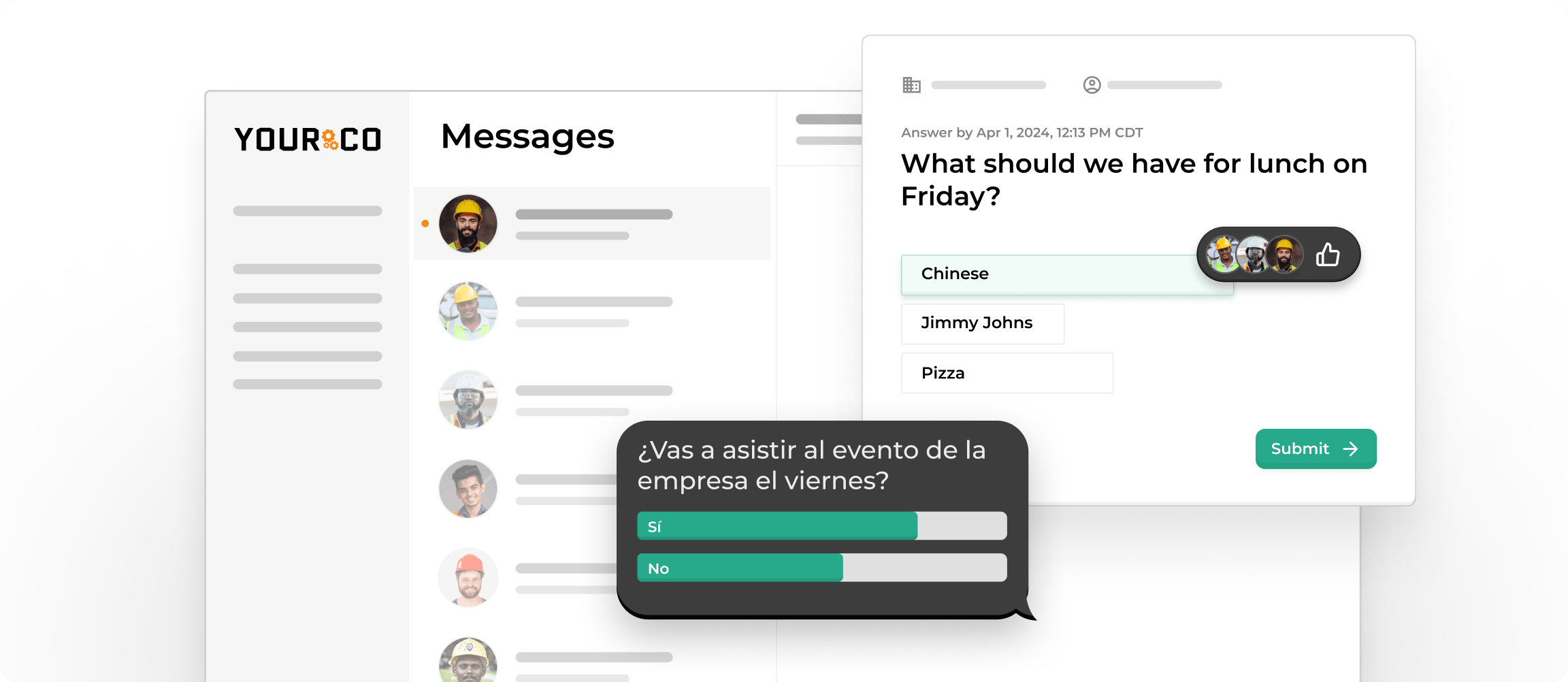
For frontline teams, the delivery vehicle decides whether feedback happens at all. 40% of frontline employees consistently respond to company communications, according to a Yourco-commissioned survey of 150 HR leaders, which leaves most of the workforce unheard through email alone. SMS-based survey distribution turns listening into a real-time, two-way channel that any worker can respond to from the shift floor.
Make Career Paths and Recognition Visible to Every Shift
Career growth only helps retention when frontline workers see the opportunities in time to act. Internal postings, training invitations, and promotion announcements often live in systems companies built for office employees, so workers who rarely check an intranet miss them before the deadline passes. A company newsletter can create the same problem.
Reporting on young hourly workers ties career visibility to longer tenure, and some large employers show a visible path from day one and promote many managers from within. Retention improves when companies make paths visible early and repeat them through channels that every shift can reach.
Targeted SMS messaging can push open roles and training offers to specific locations and shifts, and send promotional news by department. Managers need the same reach for recognition. When a manager can send appreciation to a shift in real time, the acknowledgment that supports retention reaches the people who earned it.
Track Retention Signals by Location and Shift, Not Company-Wide
Company-wide averages hide the teams about to churn. Gallup measures engagement at the business-unit level for a reason, because location and team data show patterns that broad averages miss. Reporting flight-risk data at the manager or department level surfaces patterns that company-wide averages miss, and exit surveys typically arrive too late to change the outcome for the employee leaving.
Several leading indicators become useful only when leaders review them by location and shift. The signals below repay that closer look:
- Survey response rate: a sudden drop matters most when a group that usually replies goes quiet
- Sentiment trends: track them by site and shift over time, against the same baseline
- Absenteeism: cross-check it against engagement drops at the team level
- Repeated concerns: workload, staffing, and thin manager support can each mark building burnout
Location- and shift-level data help leaders act on the teams most likely to lose workers before a single company-wide number buries the problem.
See Talent Retention Signals Across Every Shift With Yourco
Every retention lever in this guide depends on reaching frontline workers where they already are, on their phones, during real shifts, in every location. Yourco gives HR and operations leaders an SMS-based employee communication platform with a reliable channel to every worker and clearer visibility into the signals workers send back.
Yourco delivers the core capabilities frontline teams rely on:
- SMS to any phone, including basic flip phones, with no app download or Wi-Fi
- Two-way messaging so workers can report absences and answer surveys directly
- AI-powered translation across 135+ languages and dialects for multilingual teams
- Enterprise-grade security, so employee data and retention signals stay protected across every location
Yourco connects to 240+ HRIS and payroll systems, so HR teams can keep employee data synced across them. For multi-location employers, Enterprise Bridge lets corporate leadership send centralized, one-way announcements across every frontline location, while local managers keep direct conversations with their teams.
Frontline Intelligence gives HR and operations teams centralized visibility into retention-related communication signals across all locations. Leaders can review sentiment and response patterns by site and shift, track department trends over time, and see which locations show strong engagement and which need follow-up. That view supports retention decisions without relying on scattered averages.
Companies with large frontline teams describe the reach a single SMS channel provides.
"We have nearly 700 employees and 80% are non-desk based, communication is a challenge. Yourco provides a quick easy way to reach everyone and a secure way for employees to reach HR and leadership without a computer."
— Felisha Parker, VP Human Resources, McCarthy Auto Group
After 90 days on Yourco, companies see two-way employee engagement reach 86%.
Try Yourco for free today, or schedule a demo to see the difference the right workplace communication solution can make for your company.
Frequently Asked Questions About Talent Retention
What is talent retention?
Companies retain talent when employees feel supported and see a future with the organization. For frontline teams, the work also depends on whether communication, recognition, and growth opportunities reach every shift.
How is talent retention different from retention rate?
Retention rate measures the outcome, while talent retention covers the work behind that outcome. Leaders use retention rate to see whether their efforts are working, but the real work happens through onboarding, management, communication, recognition, and career development.
What strategies improve frontline employee retention?
Frontline employee retention improves when companies strengthen onboarding, keep two-way feedback open, make career paths visible, recognize good work quickly, and communicate shift changes clearly. Each strategy depends on reach because a message that does not reach anyone cannot influence anyone's day.
Why do frontline workers leave more often than office employees?
Frontline workers often face higher burnout, wage pressure, and limited career visibility, as well as limited access to company communication. Many have no company email or regular access to a computer, so they miss recognition, promotion news, policy updates, and feedback that help office employees feel connected.
How can HR reach shift workers who do not have company email addresses?
SMS-based platforms like Yourco help HR reach shift workers on any mobile phone, including basic flip phones, without an app download, Wi-Fi, or company email. HR teams can send onboarding prompts, surveys, recognition, alerts, and open-role announcements to the right locations and shifts.
How do you get frontline managers to actually act on retention signals rather than just collect them?
Data only changes outcomes when it reaches someone who can act on it quickly. Platforms that flag sentiment or response drops by site let a location manager see and respond to a problem in the same week it appears, rather than in a quarterly report reviewed weeks later.


