
At companies running dozens or hundreds of sites, leadership sees workforce performance secondhand and too late. Over 80% of manufacturing professionals reported that labor turnover had disrupted production, according to a 2024 Deloitte survey of more than 600 industry leaders, and the same pattern shows up across multi-location retail, hospitality, and healthcare. By the time site-level disruption reaches headquarters, the data has been filtered through supervisory layers, delayed by days or weeks, and compressed into summaries that flatten the very patterns leaders need to catch early.
TL;DR
- Multi-location workforce management means leaders can see, compare, and act on workforce data across every site simultaneously
- Leaders need standardized cross-location insights across five categories: labor cost, compliance, site performance, engagement and retention, and safety
- HRIS and shift-management data only show what already happened; communication data surfaces early signals of turnover, safety, and compliance risk
- Centralizing workforce data requires syncing site, role, and shift information through HRIS integrations and replacing filtered manager reports with real-time HQ visibility
- SMS-based platforms like Yourco reach every worker on any phone and surface sentiment, safety, and engagement patterns by location
Define What Multi-Location Workforce Insights Mean
Multi-location workforce management means that an HR director or operations manager can see, compare, and act on workforce data across all sites simultaneously. Without unified systems, each site generates siloed records, and leaders cannot identify which locations are understaffed, burning overtime, at compliance risk, or losing people fastest.
Cross-location insights are the standardized, comparable data points that make this visibility actionable. A single plant's turnover rate is just a number. That same rate, compared against the rest of the network, broken down by tenure band and shift type and then reviewed by manager, becomes a diagnostic tool. Normalized comparison isolates performance differences attributable to local management and site processes rather than to structural differences between sites.
Standardize the Five Categories of Cross-Location Data
Leaders at multi-site organizations need consistent data across five categories. Without standardization, each site defines metrics differently, and the resulting comparisons mislead more than they help:
- Labor cost and staffing optimization: Labor-cost comparisons show why costs vary between comparable sites. Key metrics to track by site include overtime hours per worker relative to the network average, labor cost as a percentage of revenue, schedule adherence rate, and headcount-to-demand alignment.
- Compliance across jurisdictions: An HR director running plants in states such as California and Texas simultaneously faces different wage rules and scheduling requirements. State-level employment regulation has expanded considerably in recent years, with new and amended rules covering paid leave, predictive scheduling, pay transparency, and AI in hiring across multiple states. Site-level compliance data lets leaders see which jurisdictions need different policy treatments.
- Site-by-site performance benchmarking: Comparing workforce KPIs across locations reveals which sites outperform or underperform network norms. Before any comparison is meaningful, organizations should agree on what counts as overtime, how schedule adherence is measured, and what denominators are used for rate-based metrics.
- Engagement and retention trends: Cross-location retention data turns elevated turnover from a fixed characteristic into a diagnosable variance. Track voluntary turnover rate, new-hire retention, and absenteeism rate by site versus the network median, then connect those trends to which sites have active two-way communication with workers.
- Safety patterns: Companies that operate near-miss reporting programs at the site level outperform those that rely only on lagging incident counts. Inadequate company responses to near-miss reports are linked to 1.80 times higher turnover intentions among workers, and unresponsive companies see 2.63 times higher turnover intentions, according to a 2024 study published in Safety and Health at Work, which surveyed 5,071 workers.
This information is for general awareness only. For specific compliance guidance, consult with qualified legal professionals.

Recognize Communication Data as the Missing Intelligence Layer
Shift-management and HRIS systems produce transactional, backward-looking records: attendance, tardiness, shift coverage, and turnover counts, all reported after the fact. Communication data provides the forward-looking behavioral signals that precede turnover, safety incidents, and compliance failures.
Four structural problems cause the visibility breakdown:
- Population reach: HRIS and attendance systems capture transactional records for frontline workers but generate no behavioral intelligence about them, because the formal systems were never designed to collect input from workers without email accounts or portal access.
- Signal timing: Shift-management systems detect turnover after a resignation or no-show. Communication data surfaces flight risk earlier, when workers stop responding to messages, opt out of voluntary polls, or shift their reply patterns.
- Safety intelligence: Two-way safety communication outperforms one-way broadcasts because workers report hazards, near-misses, and unsafe conditions directly. One-way safety notices cannot capture what only workers see on the floor.
- Shadow IT exposure: Without structured channels, frontline communication migrates to personal messaging threads and informal texts. Organizations without a structured two-way communication route workforce communication to channels that produce no analytics history and leave no safety signal trail.
Each of these problems points to the same structural deficit: organizations that lack a two-way communication channel that covers their entire workforce are making retention, safety, and compliance decisions with incomplete data. 96% of HR leaders agree that better communication tools boost productivity, according to a Yourco-commissioned survey of 150 HR leaders.
Centralize Everything into a Single Source of Truth
Multi-location insight requires a unified data layer. Many multi-site organizations run shift management data in one system, time and attendance in another, payroll in a third, and employee records in a fourth, with each site potentially using different tool combinations.
A single source of truth means employee master data, including demographics, job history, compensation, site assignment, role classification, and shift patterns, lives in one place and propagates automatically. When an employee record changes, that update flows to payroll, compliance tools, and frontline communication platforms without manual entry in each system. Consistent site codes, role classifications, and naming conventions should precede any integration work.
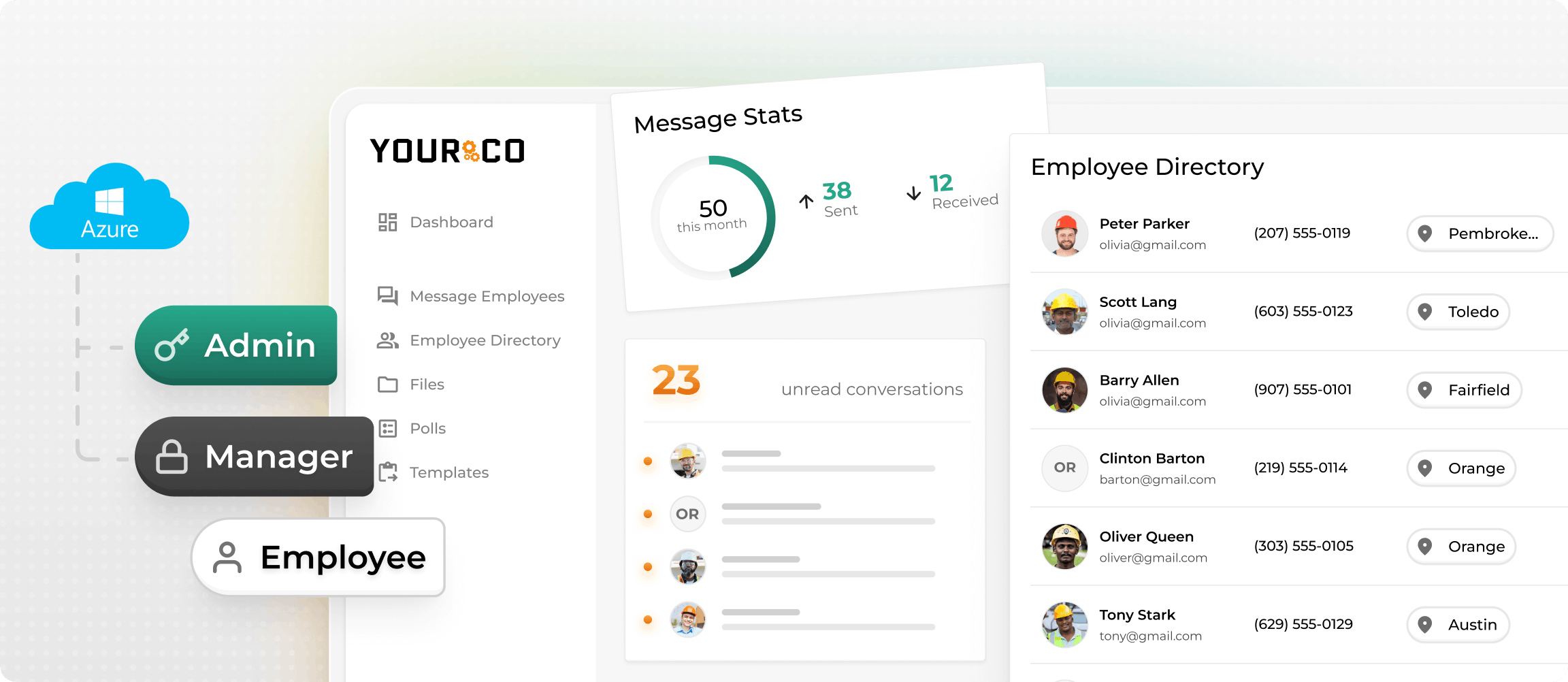
Real-time HQ visibility replaces weekly summaries compiled by site managers. Corporate teams can access up-to-the-minute attendance and performance data, so absenteeism spikes, overtime surges, and turnover risks appear as they occur rather than on Monday's report. The data capture point shifts from the manager, who previously compiled paper records, to the employee at the point of work.
Compare and Act on Performance Across Sites
Raw numbers mislead across sites. A turnover rate at a small site and the same rate at a much larger site can require different responses, so each metric should use rate- or ratio-based formulas that normalize for site size. Comparing the organization's own sites against each other controls for company-specific factors such as pay scales and benefits, so internal benchmarks come first, and external references serve as a secondary layer.
Apply segmentation filters before directly comparing sites. A site where a large share of workers have short tenure will structurally show higher turnover and lower productivity than a stable, tenured site. Night shifts produce different absenteeism and engagement profiles than day shifts. Compare like-for-like before drawing conclusions.
Separate leading from lagging indicators. Week-over-week absenteeism trends and near-miss reporting rates are leading indicators worth tracking weekly. The voluntary turnover rate and the total recordable incident rate are lagging indicators best tracked quarterly. Leading indicators give an early warning system; lagging indicators confirm whether interventions worked.
Choose a System that Captures Data from Every Worker
A system built for multi-location workforce intelligence needs three layers:
- Transactional data from HRIS and shift-management systems, including attendance, payroll, and shift records
- Communication data from a channel that reaches every worker, including those without email, smartphones, or app access
- Analytics that connect both layers and surface patterns by location, role, and shift
Frequent AI use at work (a few times a week or more) has nearly doubled in two years, from 11% to 19% of U.S. employees, according to Gallup's 2025 workplace research. That lift has not reached frontline and production workers, whose use of AI slipped from 11% to 9% over the same period.
88% of HR leaders believe better communication tools can reduce employee churn, according to the same Yourco-commissioned survey of 150 HR leaders. Closing the visibility problem requires communication infrastructure that works for the entire workforce, not only the segment already on company laptops.
Gain Real-Time Visibility Across Every Location With Yourco
Yourco gives multi-location leaders a direct line to every frontline worker and the analytics to act on what they hear. The platform reaches workers where workforce-management tools and employee alert systems cannot.
Core communication capabilities:
- SMS to any phone, from smartphones to basic flip phones, with no app download, no Wi-Fi, and no cost to employees
- Two-way messaging so workers reply directly, creating a continuous stream of engagement, absence, and safety data that transactional systems cannot generate
- AI-powered translation across 135+ languages and dialects, so multilingual teams across every site receive and respond in their preferred language
Yourco connects to 240+ HRIS and payroll systems, automatically syncing employee status updates, site assignments, role changes, and language preferences across every location.
Enterprise Bridge lets corporate leadership send centralized announcements, policies, and safety directives across all locations, while local managers maintain direct communication with their teams.
Frontline Intelligence gives HR and operations teams centralized visibility into sentiment, safety signals, attendance patterns, and engagement trends across all locations. It highlights site-level patterns in real time and lets leaders ask natural-language questions about call-offs and absence causes, filtered by location or custom group.
"Getting a lot more response from employees than we have in the past, and it's so easy to just be able to send out a quick text company-wide, or just to a specific group. We love it!"
– Maddy Kristjanson, Human Resources Generalist, Plymouth
After 90 days on Yourco, companies see two-way employee engagement reach 86%.
Try Yourco for free today, or schedule a demo to see the difference the right workplace communication solution can make for your company.

Frequently Asked Questions About Multi-Location Workforce Insights
Why does multi-location workforce management matter?
Multi-location workforce management matters because it provides leaders with a single view across all sites rather than isolated local reports. That makes it easier to spot staffing inefficiencies and compliance risks early and respond based on patterns across the network rather than on delayed manager summaries.
How do you compare and standardize performance across sites?
Use rate- or ratio-based metrics that control for site size, then apply segmentation filters for tenure distribution and shift structure before comparing. Build internal benchmarks against the company's own network first, then use outside benchmarks as a secondary layer for context.
How do you manage compliance across multiple jurisdictions?
Manage compliance across multiple jurisdictions by tracking requirements at the site level instead of the company level. Centralized HRIS data with location-specific metadata makes that possible, and SMS-based platforms like Yourco can help distribute location-targeted policy updates and collect timestamped acknowledgments from workers in the field.
What data should headquarters track across all locations?
Headquarters should track five categories across all locations: labor cost and staffing, compliance, site performance, engagement and retention, and safety. Together, those categories give leaders a balanced view of what is happening across the network and where intervention is needed first.
Why is communication data more valuable than shift-management data alone for multi-site visibility?
Communication data is more valuable because it adds forward-looking signals that transaction records cannot capture on their own. Attendance and shift data show what has already happened, while communication data reveal sentiment and safety concerns, including early signs of disengagement that help leaders identify emerging issues sooner.
How do you choose a workforce management system for multiple locations?
Choose a system that integrates transactional HRIS and shifts data with a communication channel that reaches every worker, plus analytics that connect the two. The best fit gives headquarters visibility across locations while still helping site leaders act on local patterns quickly