
Three no-call/no-show incidents within a calendar year constitute the threshold at which Wisconsin state agencies treat a permanent employee's position as abandoned, according to the state's human resources handbook. Every plant, terminal, and site manager plans for people to miss work, but nobody can plan for the shift that starts with an empty station and no message. Supervisors spend the first hour calling around and moving coworkers onto overtime while they try to learn why the worker is absent. A written no-call/no-show policy removes the guesswork. It defines the offense, states the reporting rules, and sets the consequences before anyone has to improvise.
TL;DR
- A no-call/no-show is a missed shift with no advance notice via an approved method.
- A strong policy defines the offense, sets a reporting window, and names who to contact.
- It also lists a discipline schedule and a job abandonment threshold.
- No federal law sets a job abandonment number. Employers choose their own.
- Protected leave, including FMLA and ADA absences, stays outside the discipline process.
- Consistent enforcement across shifts and sites matters as much as the written rule.
- SMS-based platforms like Yourco let workers text off in seconds, with a timestamped record.
What Is a No Call No Show?
A no call no show is an absence from a scheduled shift where the employee neither reports to work nor notifies the employer in advance through an approved method, regardless of the reason. Managers log each missed shift without approved notice as a separate occurrence.
Definitions vary by employer. Wisconsin's state handbook classifies an absence as a no call/no show once it is more than two hours past the scheduled shift start and the employee has either not contacted the employer or not arrived for the shift. Neither element is required, so either failure alone triggers the classification.
Managers classify adjacent situations differently, and the distinctions matter for discipline.
8 Core Components of a No Call No Show Policy
The same core parts belong in the policy across shift-based operations, from distribution centers to jobsites. Eight elements make a policy enforceable:
- Definition: what counts as a no call no show, with examples of noncompliance
- Reporting window: a deadline set before shift start, with more notice where coverage is safety-critical
- Accepted methods: phone call, text, attendance hotline, or app, stated explicitly. If texting a supervisor does not count, say so
- Named contacts: direct supervisor, HR, a hotline, or another designated person. Some policies require two calls
- Discipline schedule: what happens on first, second, and third offenses
- Job abandonment threshold: the number of consecutive missed shifts that triggers separation review
- Protected-leave carve-out: ending with the phrase "or any other legally protected leave"
- Documentation: a signed employee acknowledgment in the personnel file, ideally re-signed annually
Distribution happens at onboarding, with the policy in the handbook and the signature on file before the first incident. Managers cannot enforce a threshold the company never wrote down.

Set Progressive Discipline and a Job Abandonment Threshold
A workable discipline ladder starts with a formal written warning for the first offense, with a meeting within 48 hours of the employee's return. The second offense adds a written warning and a possible one- to three-day unpaid suspension. The third brings a final warning, suspension, or termination after HR review.
Policy language should still preserve discretion: many employers state that violations may result in discipline "up to and including termination," which lets them respond to the facts of each case. Under at-will employment in most states, employers generally may discharge a worker after a single offense. Still, most HR professionals recommend against immediate termination for a first offense, both because the absence may stem from a genuine emergency or protected leave the employee couldn't communicate, and because progressive discipline is generally more defensible in potential wrongful termination claims.
Job abandonment sits at the top of the ladder. No federal law sets a threshold, so employers choose their own, and three consecutive missed shifts is a common benchmark. State rules can affect the consequences rather than the timing. In New Jersey, for instance, N.J.A.C. 12:17-9.11 treats an absence as job abandonment for unemployment-benefit purposes only after five or more consecutive workdays without good-cause notice. An employer may still discharge earlier, since the regulation governs benefit eligibility rather than the discharge itself.
Documentation of contact attempts happens each day before finalizing abandonment. A supervisor call and text on day one, HR contact to the employee's personal email and emergency contact on day two, and a certified letter with a response window on day three if nothing has come back. That record shows the employer tried to reach the worker first.
This information is for general awareness only. For specific compliance guidance, consult with qualified legal professionals.
Carve Out Legally Protected Leave
Laws may protect certain absences from discipline even when the employee gives no notice. Many policies state that they do not apply to Family and Medical Leave Act (FMLA) leave, Americans with Disabilities Act (ADA)-approved leave as a reasonable accommodation, Uniformed Services Employment and Reemployment Rights Act (USERRA) leave, jury duty, statutory paid sick leave, workers' compensation absences, pre-approved time off, or any other legally protected leave.
The protection has limits worth understanding. An employee taking unforeseeable FMLA leave must still comply with the employer's call-in procedures unless unusual circumstances prevent it, according to Department of Labor guidance, and an employee who fails to give timely notice may face whatever discipline the employer's rules provide. The same guidance notes that an employer and employee may agree to retroactively designate an absence as FMLA-protected.
The ADA side runs in the other direction. Automatically terminating workers who have exceeded a pre-set amount of leave for any reason violates the ADA, according to the ADA National Network's work-leave factsheet, because a no-fault leave policy denies the worker the right to use a reasonable accommodation. USERRA applies to virtually all employers regardless of size, with no minimum headcount, tenure, or hours threshold.
This information is for general awareness only. For specific compliance guidance, consult with qualified legal professionals.
Enforce the Policy Consistently Across Every Shift
Inconsistent enforcement undermines attendance discipline. Regardless of what the handbook says, past practices can be scrutinized for consistency, so applying the policy consistently in similar cases protects the employer.
An employee who can show that colleagues with identical violations received no discipline may support a retaliation claim. Strong policies say so directly: discipline applies to all employees and shifts; supervisors may not selectively enforce it; and exceptions require HR approval.
Every occurrence, including the first, is documented within 24 hours and in the personnel record, including the date, time, the employee's explanation, if any and the action the manager took. Supervisor training covers the reporting procedure, when they alert HR and where their discretion ends.
Protected-leave review comes before any action on an incident. Attorneys interviewed by SHRM recommend that HR check the employee's file for FMLA or ADA leave in the past year, ask the supervisor whether the employee has a disability needing accommodation, and follow the first phone call with a text and an email. Recent FMLA or ADA leave can strengthen a terminated employee's retaliation case, which is why determining the reason for the absence matters before disciplining for it.
Adapt This Sample No Call No Show Policy Template
The clauses below work as a starting point, with brackets filled to match the operation:
- Definition: a no call no show occurs when an employee misses a scheduled shift without notifying [contact] using an approved method at least [number] hours before the shift begins. Each missed shift counts as a separate occurrence, unless the absence is protected or approved
- Reporting rule: employees contact [direct supervisor/attendance line] at least [number] hours before their scheduled shift using one of these approved methods: [phone call], [text to the company absence line], or [attendance hotline]
- Discipline sequence: first occurrence, written warning and a meeting with the supervisor within 48 hours of returning. Second occurrence, second written warning and possible unpaid suspension. Third occurrence, final warning, suspension, or termination after HR review. The company may deviate from this sequence and impose discipline up to and including immediate termination when circumstances warrant
- Job abandonment clause: the company will treat [three] consecutive scheduled shifts missed without notice and without contact as a voluntary resignation after reasonable attempts to reach the employee have been documented
- Protected leave carve-out: the company will not count absences protected by FMLA, ADA accommodations, USERRA military leave, jury duty, statutory paid sick leave, workers' compensation, pre-approved leave, or any other legally protected leave as occurrences
- Acknowledgment: "By signing below, I confirm that I have received, read, and understood [Company Name]'s No Call No Show Policy."
Because thresholds and paid-sick-leave rules vary by state, counsel review of the final language before rollout is common practice, and multi-state operations often set the abandonment threshold conservatively.
This information is for general awareness only. For specific compliance guidance, consult with qualified legal professionals.
Give Workers a Reporting Method That Actually Works
Many no call no shows are really cases where the worker could not reach the right person in time. In a Yourco-commissioned survey of 150 HR leaders, 69% called poor frontline communication a recurring source of frustration. The policy benefits from naming a specific contact and approved backup methods. Frontline workers also face barriers that office-focused call-off reporting systems overlook, including lack of corporate email access, language differences, and unreliable internet access.
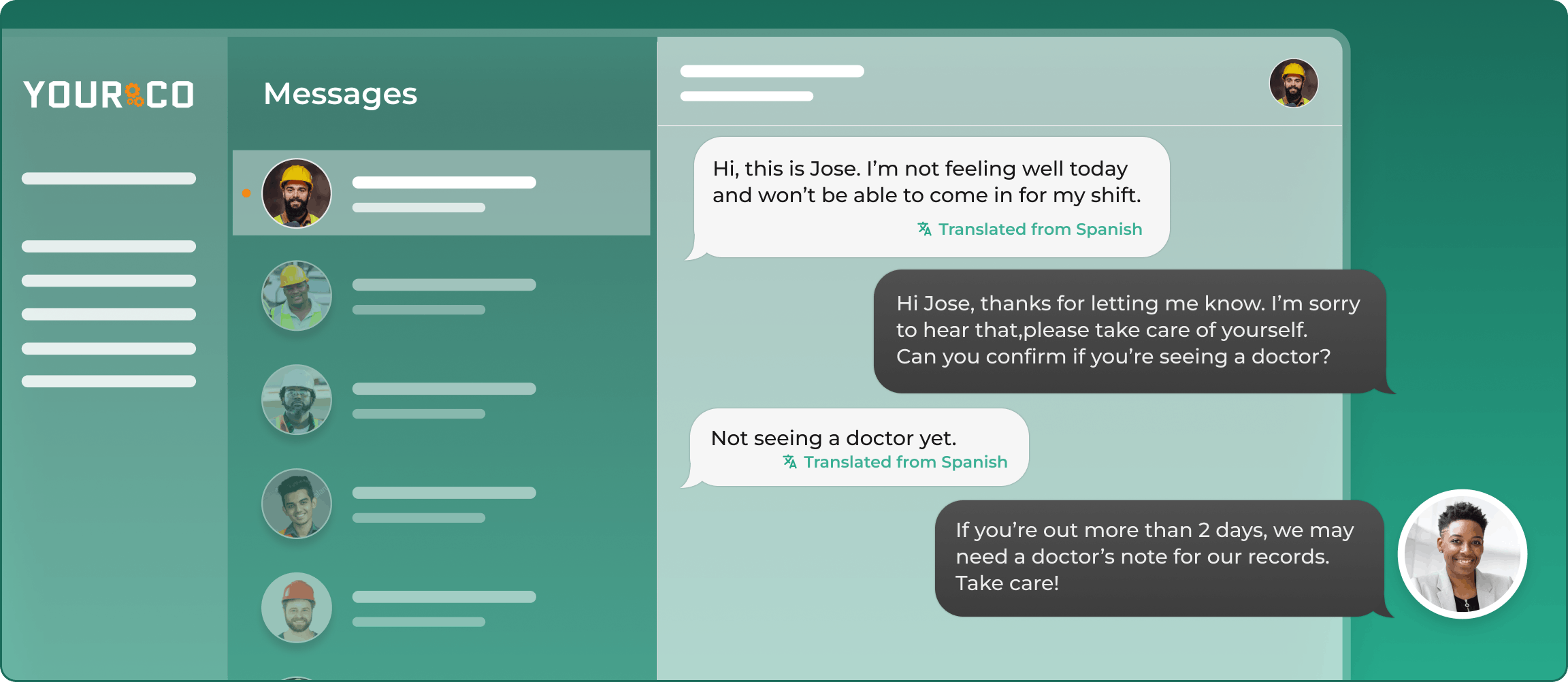
SMS removes most of that friction. A worker can text off in seconds from any phone, including a basic flip phone, and the system timestamps and logs the report. On a jobsite, where a single absent crew member can stop a phase of work, construction call-off procedures emphasize fast, documented notification over formality.
One caution applies to text-based reporting. Attorneys differ on whether texts constitute good evidence, since a manager can delete a text sent to a personal phone, leaving no record that the employee gave notice. That objection applies to ad hoc texting to a supervisor's cell, not to a platform that logs every message centrally.
Track Every Call-Off Instantly With Yourco
Yourco gives frontline workers a reporting channel that fits how they actually work. The AI Call-Off Agent lets workers report an absence with a single text, then handles the conversation from there.
The Agent collects the dates and reason, asks follow-up questions when details are missing, and sends a confirmation for the employee to reply to. Once confirmed, it logs the call-off, notifies the supervisor, and timestamps every message, building the audit trail that a policy depends on from the first notification.
Yourco delivers the core capabilities frontline teams rely on:
- SMS to any phone, including basic flip phones, with no app download required
- Two-way messaging so supervisors confirm receipt and ask follow-up questions
- AI-powered translation across 135+ languages and dialects, so workers report in their own language while managers read it in theirs
Yourco connects to 240+ HRIS and payroll integrations, keeping employee rosters and shift groups current without manual data entry. For multi-site organizations, Enterprise Bridge supports one-way broadcasts from corporate leadership to the entire frontline, so every location stays aligned on the same attendance policy.
Frontline Intelligence gives HR and operations leaders centralized visibility into call-off activity across all locations. Teams can generate site-level reports on call-off volume and attendance patterns. Because corporate sees the same documented record that local managers see, no-call/no-show enforcement rests on a single consistent data set rather than scattered voicemails.
Manufacturers using Yourco for absence reporting describe how it works day-to-day.
"We use Yourco for our absence management and for sending out notices, reminders, and event announcements. It keeps everyone who needs to know informed when people are absent."
— Kyle Stover, HR Assistant, J-Lenco Inc.
After using Yourco for 90 days, two-way employee engagement increased to 86%
Try Yourco for free today, or schedule a demo to see the difference the right workplace communication solution can make for your company.
Frequently Asked Questions About No Call No Show Policies
What counts as a no call no show?
A no call no show is an absence from a scheduled shift where the employee neither reports to work nor gives advance notice through an approved method. Each shift missed without notice is a separate event. An employee who calls after the deadline commits an unexcused absence handled under the late call-off rule.
How many no call no shows before termination?
Results vary by organization and jurisdiction. The employer's written policy usually controls, with progressive discipline for individual incidents and a separate job-abandonment threshold for consecutive shifts. Multi-state employers should review local requirements, since states like New Jersey define abandonment differently for unemployment purposes.
Is a no call no show the same as job abandonment?
They are different events. A single no call no show is an attendance violation handled through the discipline process. Job abandonment is the escalated form: multiple consecutive scheduled shifts without any contact, which employers typically treat as a voluntary resignation after documenting contact attempts.
Can you be fired for one no call no show?
Generally yes, depending on state law, the employer's policy, and the facts. A written warning is often the safer step first, both because first-offense termination can look harsh and because the absence may turn out to be protected leave or an emergency.
What is the best way for frontline workers to report an absence?
The best method is the lowest-friction channel available to every worker on every shift. SMS-based platforms like Yourco let employees report an absence by text from any phone, timestamp the message and route it to the right supervisor, with translation when needed.