
When a crew member doesn't show up and doesn't call, it's more than a scheduling headache: it can shut down an entire phase of work. According to a 2025 national workforce survey by the Associated General Contractors of America and NCCER, 92% of U.S. construction firms report difficulty hiring for open positions, so every unplanned absence hits harder than ever. When workers can't easily report an absence or miss a shift reminder, a no-show becomes as much a communication failure as a disciplinary problem. This guide walks through practical call-off procedures and no-show reduction strategies built specifically for construction operations.
TL;DR
- Unplanned no-shows cost more than one worker's wages; they slow the whole crew and can leave safety-critical roles uncovered.
- A centralized call-off channel reduces documentation gaps and gives you time to backfill before work starts. Supervisor's personal phones are not part of the system.
- SMS shift reminders reach frontline workers on any phone, with no app or email required, and significantly reduce silent no-shows.
- Discipline alone doesn't solve absenteeism. Supervisory support and communication quality matter more than most teams realize.
- SMS-based platforms like Yourco give construction teams an SMS-first system to manage call-offs, send reminders in 135+ languages, and log every absence with a timestamped audit trail.
Recognize the True Cost of a No-Show on Your Job Site
Most site supervisors feel the pain of a no-show in real time, scrambling for coverage and watching the schedule slip. But the operational damage goes deeper than the absent worker's daily wage.
A no-show typically creates a chain reaction that looks like this:
- Crew productivity drops when workers have to cover unfamiliar tasks, switch tools, or work out of sequence.
- Supervisors lose time to coordination, reassignment, and documentation instead of leading the job.
- Schedules get compressed, which can mean more overtime, more change-order friction, and greater risk of rework.
- Safety oversight gets strained, especially when a safety-critical role is uncovered.
OSHA guidance for multiemployer construction sites emphasizes coordinated work planning among general contractors, subcontractors, and staffing agencies, which becomes critical when staffing gaps or schedule changes could otherwise create safety exposures. When a designated competent person calls off without notice, and no qualified replacement is available, many employers consider delaying certain work rather than operating with unsafe coverage.
Consult with qualified legal professionals for site-specific compliance guidance.
Standardize Call-Off Procedures for Construction Crews
Construction call-off systems should account for early starts, remote sites, and frontline workers without email access. These practices build on OSHA guidance for multiemployer coordination, providing a safety-aligned framework.
- Require notification as early as possible, with a hard minimum of 30 minutes. For safety-critical roles, many teams set a longer window when practical.
- Allow multi-channel reporting, not just phone calls. Route all call-offs to a central, company-controlled channel rather than a supervisor's personal phone. A shared Yourco number automatically creates a timestamped log.
- Collect consistent information for every call-off: at a minimum, the worker's name, job site, shift, and reason. The more consistently supervisors capture this, the easier it is to spot and defend attendance patterns.
- Implement a daily check-in for workers between assignments. A simple "confirm tomorrow by late afternoon" message surfaces gaps while you still have time to backfill. Scheduled SMS in Yourco automates the prompt and keeps responses in one place.
- Document exception categories clearly. Carving out protected absences (medical leave, accommodations, workers' compensation, military duty, and bereavement) from your point system is both legally sound and fair. Clear categories also make attendance tracking more consistent across supervisors.
- Send an automated confirmation when a call-off is received, so workers know their absence has been logged and supervisors are notified. This closes the loop and reduces "I called, but nobody got the message" disputes.
- Communicate up the chain on multi-employer sites. When a subcontractor's worker calls off, the general contractor often needs that information before the shift starts, especially for coverage tied to safety plans.
The goal is a repeatable process that replaces scattered voicemails and gives you time to act.
Define No-Call/No-Show Policies With Clear Consequences
Workers are less likely to ghost a shift when they understand exactly what happens if they do. But "clear" doesn't mean "harsh"; it means documented, consistent, and legally defensible.
A no-call/no-show is an unapproved absence where a worker neither shows up nor notifies anyone by the required time. Apply progressive discipline that leaves room for judgment:
Policy language should preserve flexibility. Phrasing like "may be subject to discipline, up to and including termination" gives you room when legitimate emergencies arise.
Consider a no-fault point-based system that records late arrivals, early quits, and absences consistently while preserving protected exceptions. Centralizing call-offs via SMS gives you a timestamped notification trail that's easy to defend.
Before making final disciplinary decisions, review whether an absence involves protected leave, an accommodation need, or a workers' comp connection. The AGC guide discusses why protected absences are commonly excluded from no-fault attendance policies.
For specific compliance guidance, consult with qualified legal professionals.
Send Shift Reminders Your Crews Will Read
If you're relying on email or an app to remind construction crews about tomorrow's shift, the message often won't reach frontline workers. SMS changes the equation because it's simple, immediate, and works on virtually any mobile phone, including basic phones, without requiring downloads. According to a Yourco-commissioned survey of 150 HR leaders, 91% say SMS increases frontline employee response rates. For construction crews with 5 AM start times, a text reminder the evening before is the only channel that consistently reaches workers before they're already in the truck.
Here's a reminder approach that reduces "silent" no-shows:
- Send reminders the day before the shift starts so workers have time to confirm or flag any problems.
- Require a simple reply to confirm, such as "C" for confirmed or "BO" to call off.
- Auto-flag unconfirmed shifts so supervisors can start working backup plans hours earlier.
- Send the next week's schedule in advance so workers can plan transportation, childcare, and other logistics.
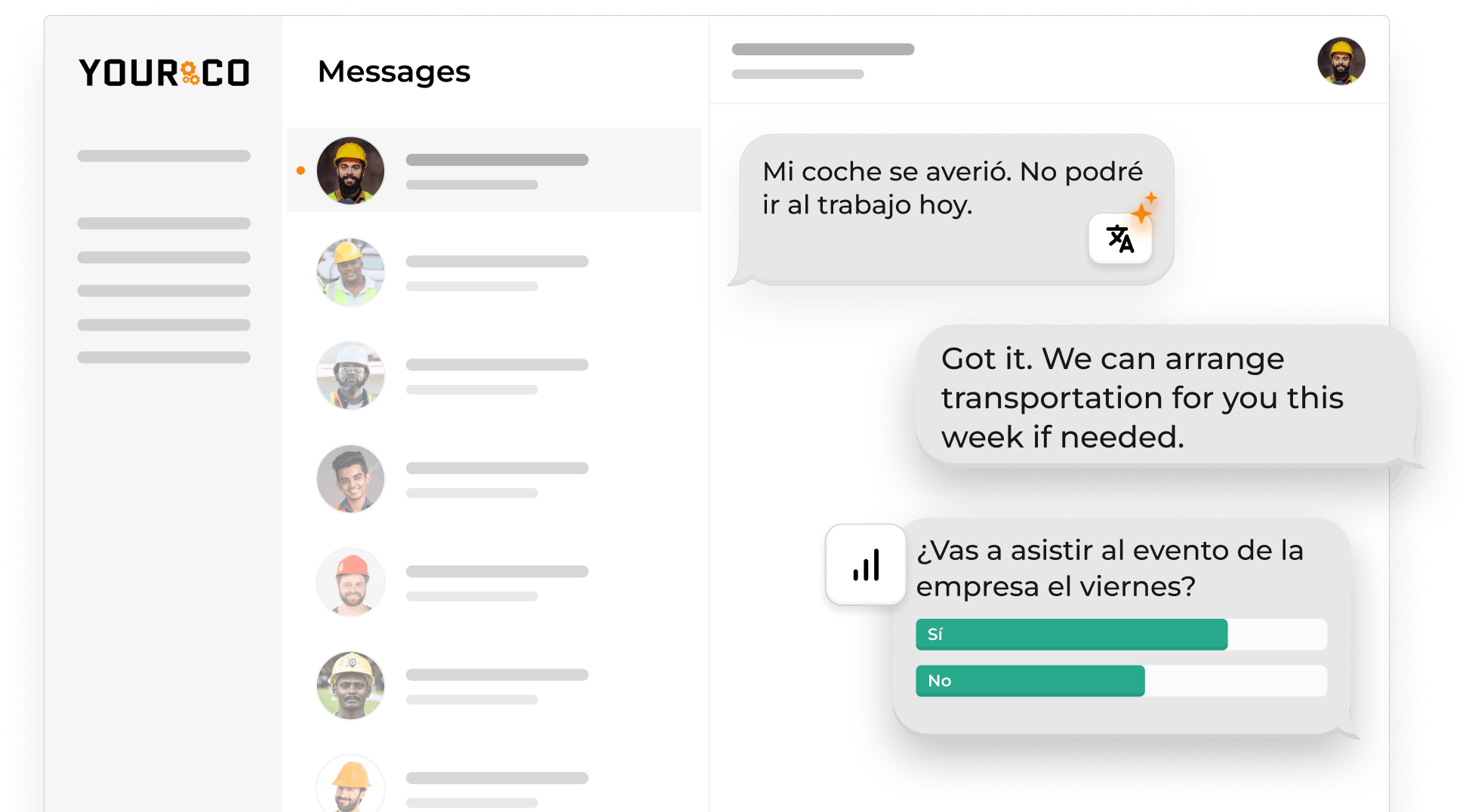
If you manage multilingual crews, confirmations are also where misunderstandings show up fast. With an SMS-based platform like Yourco, crews can receive reminders in their preferred language and reply in that language, which helps prevent missed shifts that are really communication issues.
Build Backup Staffing Plans Before You Need Them
No call-off system will eliminate no-shows entirely. The difference between a minor disruption and a work stoppage comes down to how fast you can fill the gap. These strategies help you prepare:
- Cross-train crew members across adjacent roles so one absence doesn't halt an entire task.
- Pre-establish labor-coverage relationships (trusted subs, union hall contacts where applicable, and staffing partners) before emergencies hit.
- Add extra coverage on high-risk days, such as periods of extreme heat or severe weather, when last-minute absences are more likely.
- Track absence patterns by crew, site, and day of week to focus backup resources where gaps are most likely.
- Rate and prioritize reliable workers by using attendance history to offer preferred assignments and first-call status, creating a visible incentive for consistency.
Speed matters in the moment. When a key person drops, having a single place to reach your on-call list can save the morning.
The AGC outlook shows that workforce volatility can surface without warning. Backup staffing is not optional; it's basic risk management.
Address Root Causes to Prevent Repeat Absences
Discipline alone doesn't solve construction absenteeism. Understanding root causes leads to better interventions.
Physical wear and tear drives chronic call-offs among construction crews. BLS data show the construction sector absence rate at 2.3% overall, with construction and extraction occupations at 2.7%, driven higher by aging workers facing physical strain that leads to unplanned no-shows.
Mental health and substance use can also show up as chronic call-offs or sudden no-shows. CPWR's opioid report underscores how serious these risks are in construction. In practice, that often means EAP referrals and connection to treatment resources, not escalating discipline.
Supervisory support matters more than most teams think. An NIH study links lower perceived support for safety and well-being to higher absenteeism. Even a brief daily huddle, a check-in after a tough day, or a proactive notice about schedule changes can reduce voluntary no-shows without any technology investment. A Yourco-commissioned survey of 150 HR leaders found that 92% say improved communication would boost frontline engagement. When workers feel connected and informed, the conditions that drive chronic no-shows start to shift.
Attendance-based incentives, such as bonuses, preferred shifts, or public recognition, can reinforce the behavior you want without relying solely on discipline. The ELECTRI report discusses how recognition and management practices can influence attendance and productivity.
Structured training programs can also help by increasing engagement and retention. The NCCER report links career pathways and skill development to meaningful improvements in attendance outcomes. Workers who see a future with you are less likely to disappear mid-project.
Track Every Call-Off Instantly With Yourco
Yourco is an SMS-based employee communication platform built specifically for frontline workforces, such as construction teams. For call-off management, workers report absences by sending a simple SMS in their own language to a central number. Every message is timestamped and logged automatically, supervisors receive instant notifications, and all records are searchable from a single dashboard.
Yourco works on any mobile phone, no app downloads, email addresses, or internet access required, and no cost to employees. Core features include:
- Any-phone SMS delivery reaches flip phones and basic handsets without internet access
- AI-powered translation across 135+ languages and dialects, so every crew member can receive and respond in their preferred language
- Automated call-off logging with timestamped records and instant supervisor notifications
- 240+ HRIS and payroll integrations to keep contact lists and assignment groups current
For multi-site construction operations, Enterprise Bridge enables corporate leadership to broadcast centralized, one-way call-off policy updates and operational directives across all locations simultaneously, while local site managers continue to maintain direct two-way communication with their crews.
Frontline Intelligence turns everyday call-off data into actionable workforce insights. Site managers and HR leaders can track shift confirmation rates, response times, and absence patterns by crew, site, or day of the week, spotting disengagement trends early and making proactive coverage decisions before gaps become disruptions. Corporate leadership gets real-time visibility across all locations from a single dashboard.
"Yourco has helped me streamline communication between the field and the corporate office. The software is easy to use, and their service department is always available to help when needed. I am very happy with their services."
— Roxana Abreu, HR Director, Central Civil Construction
After using Yourco for 90 days, two-way employee engagement increased to 86%, building the kind of consistent connection that directly reduces the disengagement behind chronic no-shows.
Try Yourco for free today, or schedule a demo to see the difference the right workplace communication solution can make for your company. For the research behind SMS-based frontline communication, explore Yourco's Closing the Comms Gap study of 150 HR leaders.
Frequently Asked Questions about Handling Call-Offs and Reducing No-Shows on Construction Sites
How should construction workers report a call-off?
Workers should notify their supervisor or a designated central number at least 30 minutes before the shift starts using an approved channel (phone call, SMS, or hotline). They should include their name, job site, reason for absence, and expected return date. A centralized process helps with documentation and coverage.
What is the difference between a call-off and a no-call/no-show?
A call-off is when a worker notifies the company before their shift that they can't come in. A no-call/no-show is when a worker neither shows up nor contacts anyone by the required deadline. Most construction companies treat no-call/no-shows more seriously and use progressive discipline.
How can construction companies reduce no-shows without being punitive?
Combine clear expectations with proactive support. Send shift reminders well in advance so workers can confirm, and make it easy to report issues early. Address root causes such as health, transportation challenges, and mental health needs through support resources and consistent communication with supervisors.
Why is SMS better than email or apps for reaching construction crews?
Many construction workers don't have a company email and may not reliably check apps during the day. SMS reaches almost any phone immediately, works without internet access, and keeps confirmations simple. SMS-based platforms like Yourco make this even more practical for construction teams, delivering shift reminders, call-off confirmations, and crew updates to any phone in 135+ languages, with no downloads required.
What should a construction no-call/no-show policy include?
A strong policy defines the notification deadline, lists acceptable reporting methods, outlines progressive discipline steps, and identifies protected absence categories that should be handled differently. It should also define job abandonment, often as several consecutive workdays without contact. Consult qualified legal professionals when drafting attendance policies.