


A 2025 workforce survey found that 45% of contractors named worker shortages as the leading cause of project delays. Time-off requests often start informally as a text to a superintendent's personal phone, a paper form in a trailer, or a conversation that never reaches HR. This guide separates planned paid time off (PTO) from unplanned call-offs and protected leave, then sets out the policy, channel, and tracking each one needs.
TL;DR
- Separate planned PTO, unplanned call-offs, and potentially protected leave: each follows a different process.
- Set policy first: notice, approvers, restricted periods, minimum staffing, tie-breakers, and when to escalate to HR.
- Give every worker one documented request channel instead of a foreperson's personal phone.
- Check each planned request against the schedule and certification roster, then send a written decision.
- Yourco carries the frontline communication: policy reminders, requests, decisions, and coverage updates by text, with the AI Call-Off Agent standardizing intake for planned and unplanned call-offs, late-ins, and early-outs.
- Keep PTO balances, accruals, eligibility, approvals, and official leave records in your human resources information system (HRIS); Yourco is the communication layer, not the system of record.
Why Construction Time-Off Requests Create Site-Level Risk
With no bench to pull from, one missing crane operator or first-aid designee can stall a critical-path lift, push the crew into overtime, or create a safety risk when remaining workers stretch to cover. A missed or late-answered request can leave a required certification uncovered, force last-minute overtime or subcontracting, or surface as a scheduling conflict that reaches HR too late to fix. Time-off requests also arrive from workers on different sites and shifts, each reporting to a different foreperson. When managers respond inconsistently, workers feel they were treated unfairly.
Some frontline workers lack company email and request time off by text to a foreperson's personal number, so HR hears about absences late. A Yourco-commissioned survey of 150 HR leaders found that 85% say improved communication would reduce absenteeism. SMS-based communication gives every crew one consistent, accessible path to request time off and receive a documented answer.
Define What Kind of Absence You Are Managing
Construction crews ask for time off for reasons that do not all belong on the same approval track: planned vacation, sick leave, personal days, jury duty, bereavement, military service, and unplanned call-offs. Treating every request the same way is where the risk starts.
A foreperson can weigh staffing and schedule for planned PTO. Whether a specific absence qualifies as protected leave is a different question. It can fall under the Family and Medical Leave Act (FMLA), the Uniformed Services Employment and Reemployment Rights Act (USERRA), or a state or local sick-leave law, and many employers route that determination to HR rather than asking a supervisor to decide alone. The Department of Labor's FMLA and USERRA guidance outlines the protections that place eligibility decisions with HR.
This information is for general awareness only. For specific compliance guidance, consult with qualified legal professionals.
Set a Clear Construction Time-Off Policy
A time-off policy should answer the questions crews ask most often and be in place before the season starts. At minimum, it should cover:
- The category of request: planned PTO, call-off, or a matter that routes to HR, per the distinction above.
- The submission method for vacation, sick, personal, jury-duty, bereavement, and other leave requests.
- Notice by request type, such as two weeks' written notice for vacation.
- The approver (foreperson, superintendent, project manager, HR, or a defined combination) and when a request escalates upward.
- A response-time standard for routine requests, such as two business days.
- Restricted periods for planned PTO, tied to major pours, inspections, shutdowns, commissioning, mobilization, or contract milestones.
- Minimum staffing and certification coverage per site and shift.
- A published tie-breaker: first-come, first-served, rotating holiday priority, or seniority.
- The construction call-off procedure for unplanned absences: who to notify, by when, and what to include.
Publish key rules in plain language and in each crew's preferred language, and check each rule against federal, state, local, union, and contract requirements before sending.
Give Every Worker One Documented Request Channel
One documented channel is the only way to give every worker a timestamped record of a time-off request. Paper forms, personal texts to a supervisor, email-based portals, and dedicated HRIS systems each reach construction crews differently, and the cracks between them are where requests go missing.
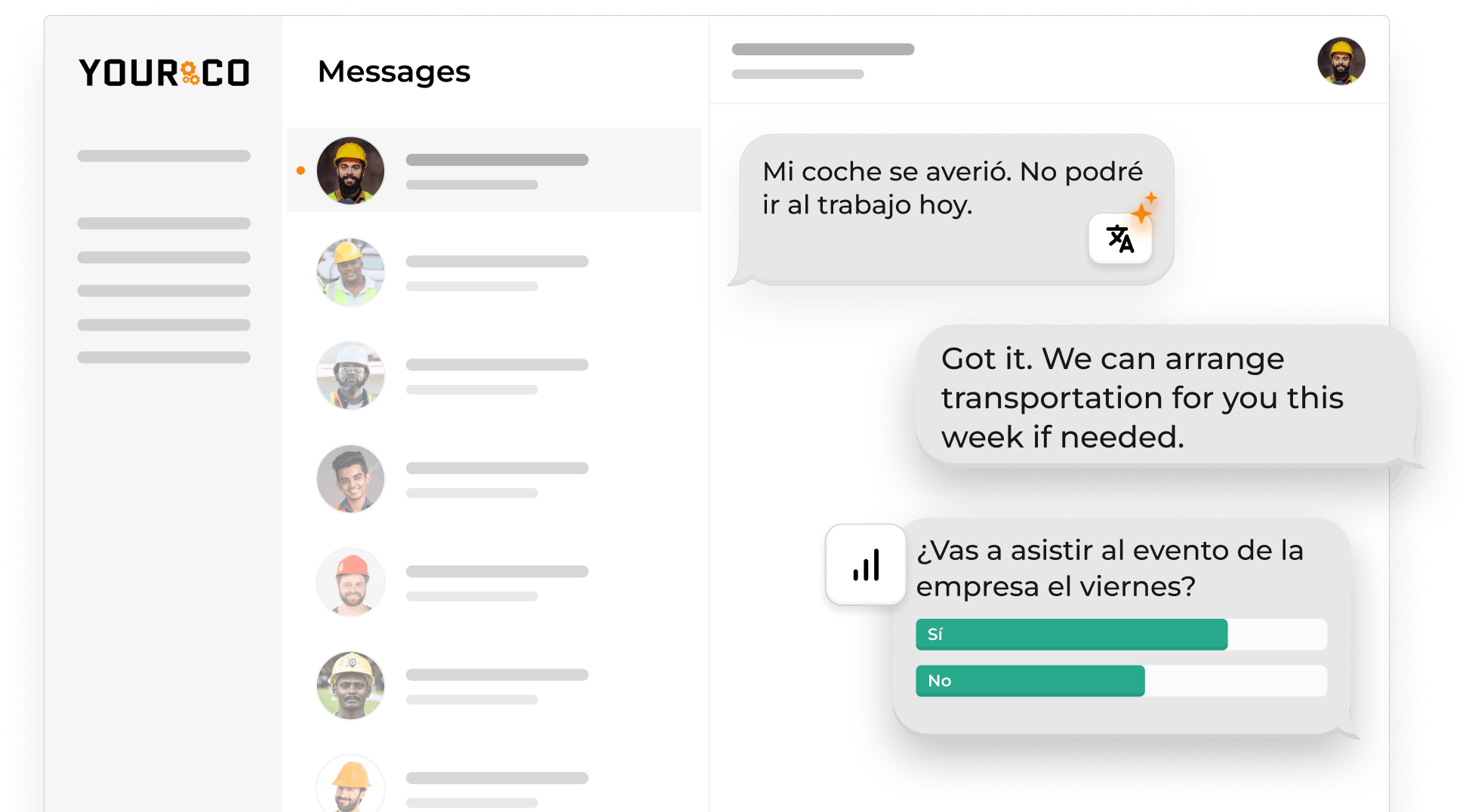
SMS-based platforms like Yourco can support frontline communication around both planned and unplanned absences. For planned PTO and unplanned absences,Yourco's AI Call-Off Agent can standardize the reporting workflow.
For planned vacation, personal PTO, or other routine requests, a documented company text channel gives every worker the same way to submit dates and receive a decision in writing:
- The employer provides a dedicated company text number, and the worker texts it or responds to a recurring prompt.
- The worker texts the dates, leave category, and any project or coverage notes the policy requires.
- The system sends an automatic receipt confirming the request arrived.
- The manager checks the schedule, staffing plan, and certification coverage in the system of record, then sends an approval, decline, alternative proposal, or HR referral back through the same text channel.
- The HRIS or payroll system remains the system of record for approved PTO balances, accruals, and payroll implications.
The worker sees each step in the same text thread: the receipt, the manager's decision, and any coverage details that follow. None of it requires a separate app or login.
Use a Separate Workflow for Unexpected Call-Offs
An unexpected absence should not wait on a routine PTO decision. Yourco's AI Call-Off Agent runs a two-way SMS conversation, follows up on missing details, confirms the dates and reason with the worker, notifies the supervisor, and logs a timestamped, auditable record. Employers should still define when those records need HR review, particularly where an absence may raise a protected-leave or accommodation question.
Review and Decide Planned PTO Fairly
A fair process for planned PTO rests on transparent operational criteria, not manager preference. Supervisors should check each request against the documented master schedule, three-week look-ahead, and staffing plan instead of relying on recall. Run each request through this checklist:
- Does the request overlap a critical-path activity, inspection hold point, shutdown, major delivery, or contract milestone?
- Will the crew still meet minimum staffing?
- Which qualified workers will cover required certifications, such as crane operation, equipment operation, electrical work, welding, scaffolding, and first aid?
- Have managers already approved other workers for those days?
- Could supervisors resequence the work within the float or assign another qualified or cross-trained worker?
- Is the employee the only person with a required certification, site credential, or client approval for the affected work?
- Is HR review appropriate for potentially protected leave?
If a request fails an operational check, managers can propose an alternative or document a decline. HR reviews potential protected-leave flags rather than leaving the call to the supervisor alone. A consistent process keeps declines from reading as favoritism. Every outcome should reach the worker in writing through the company channel.
Managers should not ignore planned PTO requests or leave them in a personal text thread. The written record shows the request, review time, and resolution.
Plan Coverage Before the Absence Begins
Once a request is approved, document who covers the role, the tasks, and the safety duties before the absence starts:
- Update the staffing plan and absence calendar.
- Notify the foreperson, superintendent, scheduler, and safety lead.
- Confirm coverage with a cross-trained employee, temporary worker, or subcontractor, and verify their certification records, site access, protective equipment, and training before assigning them.
- Arrange a handoff of open tasks, safety duties, equipment, and permits.
Yourco can target coverage requests to the affected site, shift, or role group and confirm the assignment by text, keeping handoffs consistent.
Send decisions to the requesting employee, coverage updates to the affected site and shift, and reminders before the absence and near the worker's return. Limit messages to the date, shift, site, and next action, and hold nonurgent messages for breaks.
AI-powered translation can help workers and managers communicate requests, approvals, denials, and return-to-work messages in each person's preferred language. Sending decisions and coverage notes from one place reduces the risk of conflicting instructions.

Track Patterns Before They Become Staffing Problems
Tracking time-off requests by site shows labor-planning, safety, and retention problems early. Group the metrics by what they actually measure:
A Yourco case study with Great Day Improvements (GDI), a home improvement company operating across ten brands, found organization-wide retention rising from 87% to 93% and manufacturing turnover falling from 12.7% to 2.3% after the company expanded frontline communication. This is one company's result and does not isolate the effect of time-off tracking. Leaders can still use the metrics above to adjust policies, coverage, and communication before requests disrupt a site.
Manage Construction Time-Off Requests With Yourco
Construction employers need one company-managed channel where crews can submit routine time-off requests, managers return documented decisions, and HR can see patterns across every site.
Core time-off features include:
- SMS works on any phone, even a basic flip phone, with no app download or Wi-Fi required
- Two-way messaging covers requests, coverage updates, and return dates
- AI translation across 190+ languages puts each message in the reader's preferred language
- The AI Call-Off Agent runs the two-way SMS conversation for unplanned absences, from intake through supervisor notification and a timestamped record
Yourco's 240+ HRIS and payroll integrations keep distribution lists current through hiring, role changes, and departures.
Enterprise Bridge allows corporate leadership to send centralized, one-way time-off policy updates across all locations, while local managers maintain direct communication with their teams.
HR and operations leaders can see what's happening across every job site, with call-off patterns and attendance trends flagged by location. Frontline Intelligence surfaces these patterns so leaders can act before staffing problems spread across sites. Leaders can ask it directly:
- Which locations reported the most call-offs this month?
- Are same-day call-offs increasing at a particular location?
- Are late-ins or early-outs occurring more frequently at certain sites?
- What scheduling concerns are employees raising across our jobsites?
"Yourco has helped me streamline communication between the field and the corporate office. The software is easy to use, and their service department is always available to help when needed."
— Roxana Abreu, HR Director, Central Civil Construction
After 90 days on Yourco, companies see two-way employee engagement reach 86%.
Try Yourco free today or schedule a demo to see the difference the right workplace communication solution can make for your company.

Frequently Asked Questions About Managing Time-Off Requests for Construction Teams
What's the Best Way to Manage Time-Off Requests for Construction Teams?
The most reliable approach combines a written PTO policy covering notice, approvers, restricted periods, and tie-breakers; one documented text channel every worker can use; and a consistent review process checked against the schedule and certification roster. Keep PTO balances and leave records in the HRIS, and track requests by site.
Can Construction Employees Request Time Off by Text Message?
Yes, construction employees can request time off by text when the employer designates a documented company channel. SMS-based platforms like Yourco can log the request, send a receipt confirming it arrived, notify the manager, and return the decision by text once reviewed.
How Much Notice Should Construction Workers Give for Time Off?
For planned PTO, many employers set a notice period, often one to two weeks, based on the project schedule and policy. For unplanned absences or protected leave, have qualified legal counsel review the policy language, since requirements vary by situation.
Can a Foreperson Decline a Planned PTO Request in Construction?
A foreperson may be authorized to decline a planned PTO request under the employer's written policy when coverage, certifications, or project milestones make approval impractical. Whether an absence involves FMLA, USERRA military leave, jury duty, or another protected category is a different question that many employers route to HR instead of leaving to the foreperson alone.
How Do You Decide When Two Workers Request the Same Week Off?
Apply the published tie-breaker consistently, whether that is first-come, first-served, rotating holiday priority, or seniority. Document both requests and the reason for the decision in the written record. When project coverage allows, offer the second worker alternative dates within the three-week look-ahead window instead of an outright decline.


