Exit interviews at frontline-heavy companies keep surfacing the same cause: information that never reached the worker. Great Day Improvements (GDI), a 5,000-employee home improvement provider, hit that exact wall before standardizing its frontline communication on one channel.
A 98% SMS open rate makes text messaging one of the most reliable ways to reach hourly employees who never sit at a computer during a shift, yet many companies still route schedule changes and policy updates through email or an app workers never open. Reducing frontline turnover starts with fixing which channel carries that information, the fix GDI made and the one this piece walks through next.
TL;DR
- Frontline turnover often traces back to which channel carries information, since workers who never receive a message cannot act on it.
- Most companies default to email, an app, or a supervisor relay, and each one asks the worker to do something extra just to receive it.
- Standardizing text messaging puts the burden of reach on the employer, not the worker, because it works on any phone with nothing to install.
- GDI cut manufacturing turnover from 12.7% to 2.3% after making this switch, detailed below.
- SMS-first has real limits: no-phone floors, off-the-clock wage rules, and union agreements can all change the plan.
- SMS-based platforms like Yourco apply this same reach-first approach to schedules, policy updates, and recognition.
Find the Decision Point Behind Frontline Turnover
The decision comes the first time a shift schedule changes or a policy update needs everyone's attention, and someone asks how the plant floor, installation crews, and third shift will hear about it. Most HR and operations teams answer with whatever channel the office already uses, usually email or an internal app chosen years earlier for people who sit at desks. 88% of HR leaders say they need a reliable way to reach frontline employees, while only 55% are confident they have one, according to a Yourco-commissioned survey of 150 HR leaders. That shortfall shows up first in turnover, because employees who never receive schedule changes or benefit deadlines read the silence as being overlooked.
When frontline workers carry personal phones and rotate through shifts and sites, no single inbox, break room, or app login reaches everyone at once. The real decision is which side carries the burden of making the channel work: the employer, who can standardize the tool once, or the worker, who has to install, log in, and remember to check it.
Know What Most Teams Default to, and What It Costs
Three defaults show up at almost every frontline company, each one putting the adoption burden on the worker:
- Frontline employee apps: require a smartphone, a download, and a login before a single message arrives, and any of those steps can leave a worker out.
- Supervisor cascades and shift huddles: the message changes at each hand-off and leaves no record of who actually heard it.
- Break-room boards: assume a stationary workforce and cannot be updated mid-shift for the third shift or a traveling crew.
Each looks cheap because it reuses a tool the company already owns.
The real cost shows up later, in recruiting, onboarding, and training time spent replacing a worker who left over something they were never told, plus the overtime the remaining team covers while the seat stays open. HR teams rarely track that cost against a specific missed message, so a healthy office email metric can sit beside a near-zero frontline reach rate unnoticed.
Choose Text Messaging as the Primary Channel
When frontline employees are spread across hundreds of sites, standardize communication on SMS rather than an app, email, or a supervisor relay, because SMS asks nothing of the worker beyond having a phone that already makes calls and sends texts. A message arrives on any device, including a basic flip phone, with no download, login, or data plan required. The phone number already lives in the human resources information system, so the existing roster becomes the distribution list instead of building a new one.
This does not mean SMS should carry everything on its own. Reach still varies: prepaid plans, data caps, and shared phones mean some texts land later than others, and a small share of workers will need a second channel regardless of which one is primary. The practice is to choose the channel that reaches the most people with the least required from them, then handle exceptions on purpose.
See How GDI Scaled Frontline Communication Across 338 Locations
For Great Day Improvements (GDI), the challenge wasn’t simply finding a better way to send messages. It was creating a consistent way to communicate across a complex organization of 5,000 employees, 338 locations, and multiple brands, while preserving the local communication each location needed to operate effectively.
Corporate leaders needed a reliable way to reach the frontline consistently across brands and locations. Local leaders still needed direct, two-way communication with their own employees. Frontline employees needed an accessible way to receive information and respond without relying on company email or another workplace app. Corporate HR also needed greater visibility into communication across the organization.
Yourco gave GDI a shared communication infrastructure that met all four needs. Corporations could communicate across the frontline at scale while local teams continued their day-to-day, two-way conversations. Those interactions happened within a centralized platform, giving leadership greater visibility across brands and locations without sacrificing local flexibility. That same enterprise principle sits at the center of Enterprise Bridge: create consistency across locations without sacrificing local flexibility.
The business results were significant. During the approved case-study period, GDI’s organization-wide retention increased from 87% to 93%, while manufacturing turnover declined from 12.7% to 2.3%. The Messaging House identifies these as approved GDI proof points supporting workforce stability.
The value goes beyond any individual message. By giving employees a simple way to communicate and giving local and corporate leaders a shared infrastructure for those interactions, GDI created a more consistent way to operate across a distributed frontline workforce. Corporate gained visibility. Local teams maintained the direct relationships they needed. Employees had an accessible way to receive information and respond. Critical frontline communication no longer had to remain fragmented, location by location.
Know Where SMS-First Breaks Down
SMS-first breaks down in a few predictable settings, and naming them before rollout keeps a pilot from creating new problems:
- No-phone production floors: some manufacturing facilities restrict personal phones for safety or product-integrity reasons, and manufacturing communication constraints like these need a verbal or printed channel for anything that cannot wait until a break.
- Hourly workers off the clock: after-hours replies from nonexempt employees can raise wage-and-hour considerations, so many employers set communication windows for routine messages, emergencies, and time-sensitive changes.
- Consent and represented workforces: many employers document consent at onboarding and account for Telephone Consumer Protection Act (TCPA) and FCC consent-revocation rules; represented workforces typically involve labor counsel and union representatives before practices touching contract subjects change.
- High-stakes translation: automatic translation handles routine updates well, but safety procedures and other high-stakes content benefit from professional review in any language.
None of these conditions rule out an SMS-first approach; each defines where a second channel or a policy step belongs alongside it.
This information is for general awareness only. For specific compliance guidance, consult with qualified legal professionals.
Run the Same Playbook with a Lean Team
An enterprise rollout can staff this transition with a dedicated team, but the mechanics scale down. A lean version needs one HR generalist to own the weekly cadence, one payroll or IT contact to connect the human resources information system, and two or three trusted workers per shift to field early questions. Budget weeks, not months, for a single-site pilot, and expect a multi-site rollout to take longer as each site's shift schedule and local workflow gets folded in.
Sequence it in order:
- Document consent: log the onboarding acknowledgment and sync phone numbers from the HRIS so new hires appear, and terminations drop off automatically.
- Pick one site and use case: pilot 30 days around something the worker feels on day one, such as schedule changes.
- Reply to what comes back: polls that HR never answers teach workers to stop responding.
- Measure against a comparison site: use the standard turnover formula (separations divided by average headcount) over the same window, since a pre-post number alone cannot separate the program from labor-market changes.
A wider rollout is earned once the comparison confirms the site changed.
Reach Every Frontline Worker by Text With Yourco
Yourco provides an SMS-based employee communication platform for workforces spanning sites, shifts, and languages, so reducing frontline turnover starts with a channel every worker already has.
The core of it is simple:
- Two-way texting: workers reply to HR and local managers from the phone they already use, with no app download, no Wi-Fi, and no cost to employees.
- AI-powered translation: HR writes a message once, and it arrives in each worker's preferred language across 135+ languages and dialects.
- Segmented sending: HR and operations target messages by location, role, or shift instead of broadcasting everything to everyone.
Together, these remove the barriers that make email and apps unreliable for frontline teams.
Yourco's 240+ HRIS integrations keep phone numbers current as hires, transfers, and terminations move through the record system, so the distribution list updates itself.
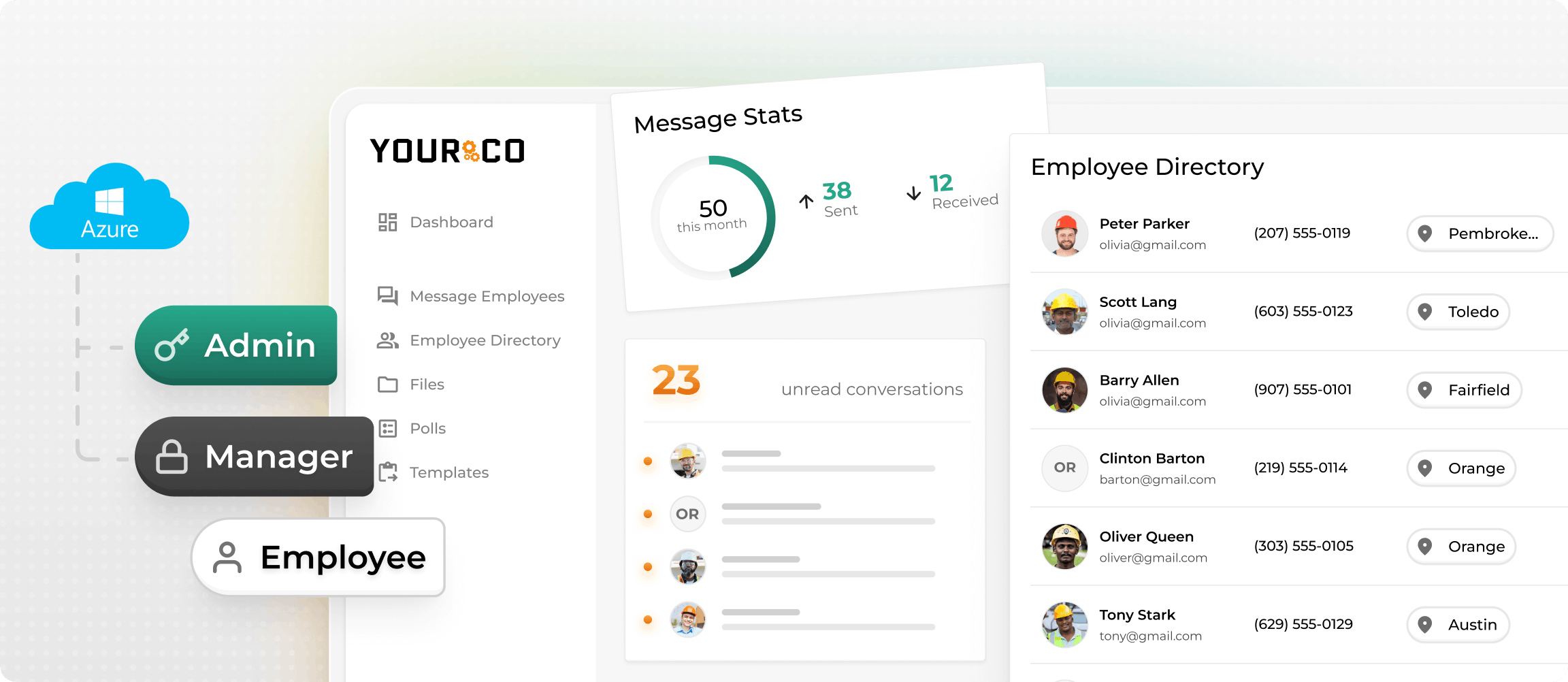
Enterprise Bridge sends one-way broadcasts from corporate leadership to the entire frontline, so every location gets the same policy or culture update while local managers keep their own two-way conversations running underneath it.
Frontline Intelligence gives HR and leadership centralized visibility into the same engagement and response signals that connect to retention, across every location instead of one at a time. A regional HR lead can ask which sites are going quiet or which locations show sentiment shifts that typically precede a wave of exits, then follow up before turnover shows up in the numbers.
"We have nearly 700 employees and 80% are non-desk based, communication is a challenge. Yourco provides a quick easy way to reach everyone and a secure way for employees to reach HR and leadership without a computer."
— Felisha Parker, VP Human Resources, McCarthy Auto Group
After 90 days on Yourco, companies see two-way employee engagement reach 86%.
Try Yourco for free today or schedule a demo and see the difference the right workplace communication solution can make in your company.

Frequently Asked Questions About Reducing Frontline Turnover
How Do You Reduce Frontline Turnover When Workers Have No Company Email?
Move the channel to the phone workers already carry. SMS-based platforms like Yourco deliver schedules, policy changes, and onboarding updates by text without requiring an app or an email address. Two-way replies also give workers a direct path to HR, so questions can surface before frustration builds.
Why Do Hourly Employees Quit in the First 90 Days?
Early exits often stem from uncertainty and inconsistent communication, not pay or the work itself. A short sequence of onboarding texts covering where to be, who to contact, and how to report an absence gives new hires clear answers during the weeks they are most likely to leave.
Is It Legal to Text Hourly Employees about Work Updates?
Texting hourly employees can be part of standard workplace communication, but specifics vary by program and jurisdiction. Common considerations include TCPA consent, FCC opt-out rules, wage-and-hour treatment for after-hours replies, and bargaining obligations for represented workforces. Qualified counsel should review any new texting policy first.
How Long Does an SMS Communication Rollout Take?
A focused single-site pilot usually moves faster than a multi-site deployment because workers have nothing to install or learn. Most of the planning time goes into consent documentation, HRIS syncing, and manager habits rather than the technology itself. Larger rollouts need more time to test local workflows.
Does SMS Work on a Plant Floor with a No-Phone Policy?
SMS works only partly when phones stay in lockers during production. Workers can read schedule changes and policy notices during breaks or shift changes, but not mid-shift. Employers should pair texting with a verbal, printed, or site-based channel for anything urgent enough not to wait.