
20% of employees worldwide were engaged in 2025, according to Gallup's 2026 State of the Global Workplace report, the lowest level since 2020, and frontline teams are often the least visible in corporate dashboards. For teams managing shift-based frontline workers, the data problem runs deeper than a low headline number.
Most engagement tools only see the small slice of workers who downloaded an app and logged in, which means the people doing the most physically demanding work are also the least represented in the data used to support them. Frontline analytics work best on a channel workers can actually use, so the numbers are more complete and the interventions actually land.
You don’t have to start from scratch. Download the ready-to-use Employee Engagement Survey Template and begin capturing insights now.
TL;DR
- Define clear objectives, write questions in plain language, and mix Likert-scale with open-ended formats.
- Deliver via SMS with automatic translation across 135+ languages and dialects, segmented by location, shift, and role through HRIS integrations.
- Use an anonymity toggle so workers respond honestly, then let AI-powered intelligence surface sentiment and retention risk in real time.
- Share a specific action plan through the same SMS channel, and layer annual surveys with regular pulse checks to close the loop.
- SMS-based platforms like Yourco handle delivery, translation, segmentation, and intelligence in one place
Step 1: Define Clear Objectives When Creating Your Employee Engagement Survey
Effective employee engagement surveys start with the end in mind. Before writing survey questions, establish objectives that align with your organization's priorities. A survey should connect directly to business outcomes across the enterprise.
While HR typically leads these efforts, bringing in multiple departments creates surveys that address people-management issues as well as broader operational objectives. This approach transforms survey insights into improvements that affect everything from customer service to safety performance.
Objectives should tie directly to company metrics like turnover or productivity. Useful areas to focus on include:
- Evaluating how values apply in daily operations
- Measuring current engagement levels across all locations
- Identifying where stated values and actual culture diverge
- Understanding what drives engagement on your teams
- Creating benchmarks to track progress over time
Ask yourself: What specific problem are you trying to solve? How will you use the findings? Who specifically are you surveying? How will you track and share progress?
Learning from previous survey efforts and focusing on areas that will yield actionable insights creates a strategic approach that drives real improvement in your workforce.
Step 2: Select the Right Mix of Questions for Your Employee Engagement Survey
Choosing the right questions for a frontline employee engagement survey means balancing proven, validated formats with items tailored to the realities of shift-based, physical work. This combination delivers reliable benchmarking data alongside insights specific to your frontline environment.
Mix these two formats for the best results:
- Likert-scale questions that produce countable data: "On a scale of 1–5, how satisfied are you with the safety measures during your shift?"
- Open-ended questions that let employees speak freely: "What one change would make your work environment better?"
When writing for frontline workers, keep these principles in mind:
- Use plain language without jargon.
- Focus on concrete experiences instead of abstract concepts.
- Make questions relevant to their daily work lives.
- Address real workplace scenarios they encounter.
Sample questions that work well on the front line:
- Do you have all the tools and equipment you need to work safely?
- How satisfied are you with communication between management and your team?
- What challenges during shift transitions might management not see?
- On a scale of 1–5, how physically comfortable is your workspace?
- How effectively does your supervisor communicate schedule changes?
- What would make you feel more valued in your current role?
Avoid leading questions, double-barreled questions, jargon-heavy items, negatively framed questions, hypothetical scenarios, and vague questions. Phrases like "be brutally honest" discourage the candid responses you need. Invite participation with neutral language instead.
Step 3: Build Psychological Safety and Honest Feedback Into Your Survey Design
Frontline workers in high-hierarchy environments such as manufacturing and logistics may give safe, inaccurate answers when they question whether their responses are private. Getting honest data requires designing for psychological safety from the start.
Offer an anonymity toggle. A platform that supports both anonymous and identified responses lets your team choose what fits each situation. For sensitive questions about safety practices, supervisor behavior, or workplace culture, enabling full anonymity removes the fear of identification. For follow-up conversations where a worker wants to continue a dialogue after raising an issue, identified responses allow that two-way exchange. The toggle puts control in the worker's hands and signals that the organization respects that choice.
Communicate the confidentiality commitment clearly. State explicitly in your survey invitation that results will be reported only in aggregate and that no individual response will be linked to a specific person. Include a minimum-threshold commitment: results for any team or shift with fewer than ten respondents will not be broken out separately.
Mark sensitive questions as optional. Allowing employees to skip items they find too personal encourages overall completion rather than abandonment. A skipped question is better than a falsified one.
Building anonymity into survey structure and communicating it clearly produces a specific downstream effect: workers respond honestly rather than safely. That honest response data is what makes Frontline Intelligence useful. Sentiment analysis built on guarded answers produces a false picture of your workforce. Accurate open-text responses give Frontline Intelligence the signal it needs to surface real themes, real risks, and real disengagement patterns by location and shift.
Step 4: Implement Effective Communication Strategies for Your Survey
Survey participation among frontline workers depends heavily on delivery. Factory workers and delivery drivers rarely have access to computers during their shifts. Construction crews may work where the internet is unreliable. Relying on email or intranet to distribute surveys structurally excludes the workers you most need to hear from.
Deliver via SMS
SMS-based communication removes those barriers. Text messages deliver messages with confirmed delivery to any phone, including smartphones and basic flip phones, without requiring an app download, a company email address, or an internet connection. Sending survey links by SMS lets manufacturing and warehouse workers participate directly from their phones. Higher response rates give managers real-time feedback they can act on.
Translate Automatically Across 135+ Languages and Dialects
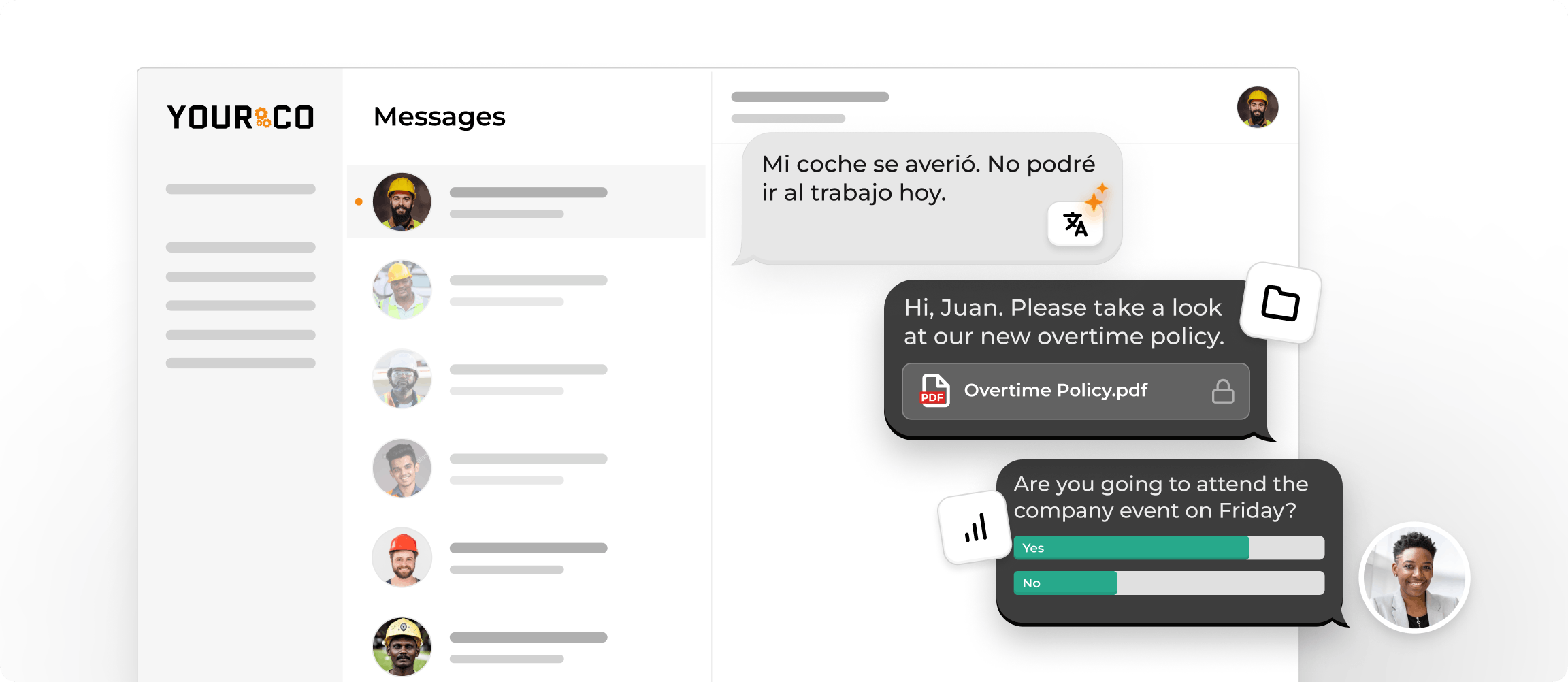
Multilingual frontline workforces are the norm in manufacturing and logistics. Asking workers to complete surveys in a language other than their preferred one introduces measurement error: respondents misunderstand questions, skip items, or disengage entirely. SMS-based platforms like Yourco automatically translate both outgoing survey content and incoming responses across 135+ languages and dialects, so every worker receives and responds in the language they're most comfortable using.
No manual translation overhead, no communication delays, no language groups left out of your engagement data. And because every translated response flows back through the same platform, Frontline Intelligence can analyze sentiment and surface themes across your entire multilingual workforce, not just the English-speaking portion of it. A survey that excludes 30% of your workers by language produces intelligence with the same blind spot. Translation closes it at the source.
Segment Delivery by Location, Department, Shift, and Role
Sending the right survey to the right workers requires accurate, current workforce data. Yourco connects to 240+ HRIS and payroll systems so employee records, including location, department, shift, and role, stay automatically synchronized. That means you can target a survey to second-shift production workers at a specific facility, or send a different pulse check to new hires in their first 90 days, without manually managing distribution lists.
Segmentation at delivery ensures that every question is relevant to the recipient, thereby directly improving response quality. It also makes Frontline Intelligence more precise. When Frontline Intelligence analyzes sentiment and retention risk, it does so by location, shift, and department. That breakdown only holds if the underlying survey data was collected from accurately segmented recipients. Sending a warehousing survey to your entire workforce muddies the signal. Targeting the right workers at the right facility produces data that Frontline Intelligence can act on cleanly.
Step 5: Use Mobile-Friendly Survey Methods That Work on Any Device
Frontline teams need mobile-first delivery that functions across diverse technical environments, including basic phones. Two delivery methods work reliably at scale:
- SMS surveys: send links directly to any mobile number, automate reminders, and eliminate barriers such as forgotten passwords or app downloads. Confirmed delivery means you know the message arrived; two-way interaction means workers can respond and ask follow-up questions.
- QR codes: place codes in break rooms and locker areas so employees can scan and complete surveys during breaks or shift changes.
A frontline-ready employee texting platform should provide native SMS polling for quick pulse checks, integration with tools like SurveyMonkey or Google Forms, automated reminders, and real-time response collection, with no action required from IT or the employee beyond receiving a text.
Time surveys to match shift schedules. Messages for overnight workers should go out at different times from day-shift communications. Targeting delivery by shift, built through your HRIS integration, eliminates the guesswork.
Step 6: Analyze Survey Results with Frontline Intelligence
Collecting frontline employee engagement survey responses starts the process. Survey programs stall when engagement data sits unused. 35% of employees say their organization doesn't effectively act on survey feedback, according to Quantum Workplace's 2025 Workplace Trends Report, and employees who do see action taken are far more likely to stay engaged.
Most frontline survey programs break down between data collection and decision-making. The data arrives, but no one has a clear view of what it means, where the problems are concentrated, or what to do first. Closing that breakdown requires an analysis layer that works across the full data stream: formal survey responses, pulse poll results, and the signals embedded in everyday SMS communication.
Yourco Frontline Intelligence is that layer. It consolidates everything flowing through the platform- survey responses, translated open-text answers from multilingual workers, segmented participation rates by location and shift, and daily message patterns, into a unified, continuously updated view of workforce sentiment. This is why the translation and segmentation work in Steps 3 and 4 matters beyond delivery: accurate, complete input data is what makes Frontline Intelligence's analysis reliable. Specifically, Frontline Intelligence:
- Surfaces retention-risk patterns by location, shift, and department: you can see that disengagement is rising on the night shift at one facility before it shows up as turnover.
- Summarizes open-text responses automatically: processes qualitative answers across languages and surfaces the themes that appear most frequently, without requiring manual review of every response.
- Traces issues to specific sites or managers: identifies whether a safety concern or communication breakdown is widespread or concentrated at a particular location.
- Detects disengagement signals between survey cycles: by tracking sentiment trends across routine daily communication, Frontline Intelligence flags warning signs before a worker stops responding or submits notice.
This continuous view is what separates a frontline survey program from a quarterly snapshot. When a new pattern emerges mid-cycle, such as a drop in response rates at one facility or a shift in tone across a specific department, Frontline Intelligence surfaces it immediately. Leaders can act on it without waiting for the next survey window.
Step 7: Develop and Communicate a Clear Action Plan
An employee engagement survey builds trust only when employees see that their feedback produces real change. Taking action on results is what separates a meaningful program from a performative one, and workers know the difference. Frontline Intelligence makes that action more targeted. Rather than presenting HR teams with raw response data and leaving them to identify priorities manually, Frontline Intelligence surfaces the specific locations, shifts, and issues that need attention first, so action planning starts from evidence, not instinct.
The action-planning phase involves four consistent practices:
- Identify and prioritize areas for improvement based on the patterns that Frontline Intelligence surfaces.
- Set clear objectives and timelines, and assign ownership to specific managers or departments.
- Track progress using the same real-time sentiment data that identified the problem in the first place, so you know whether an intervention is working before the next formal survey cycle.
- Involve employees in action-planning sessions where feasible; workers who help shape solutions are more likely to trust the process.
Communicate to a Dispersed Workforce
Reaching frontline workers after a survey requires the same deliberate approach as the survey itself. Three practices make the follow-through visible:
- Meet employees where they are: use SMS alongside any other channels, and send updates through the same channel the survey arrived in.
- Reference previous successes to build trust: "Last quarter, you told us break areas were too crowded. Here's what we changed."
- Maintain transparency about what will change and when.
Be specific. Instead of "we'll work on communication," say "we're implementing weekly SMS updates about schedule changes and safety alerts, starting next Monday." Vague commitments erode the trust that honest survey responses depend on.
Step 8: Establish a Regular Survey Cadence
Consistency tells frontline employees their voices matter. A single annual survey alone leaves extended periods without feedback. A pulse-only strategy also falls short if it never benchmarks the full picture. The most effective approach layers both. The three core formats that work together are:
- Annual full surveys: deep dives covering all engagement drivers, generating data at every organizational level and creating year-over-year benchmarks.
- Quarterly or monthly pulse surveys: shorter checks of five to ten questions that track progress on specific action plans or surface emerging issues between full cycles.
- Lifecycle surveys: onboarding check-ins, 90-day surveys, and exit feedback that capture the moments when frontline workers are most likely to disengage.
Because Frontline Intelligence monitors sentiment continuously across daily SMS communication, your team has visibility between formal survey cycles, not just during them. Disengagement signals that appear in day-to-day messages surface in real time. An annual survey reflects what employees thought when they filled it out. Frontline Intelligence tells you what is changing right now, across every location, without waiting for the next scheduled cycle.
That persistent layer is what makes a survey cadence sustainable: each formal cycle validates and deepens what Frontline Intelligence has already been tracking, rather than starting the analysis from scratch. Choose a rhythm that lets you collect data, act on it, and demonstrate progress before the next cycle, so every survey builds on the credibility of the one before it.
Why Yourco Works for Frontline Employee Engagement Surveys
Yourco is an SMS-based employee communication and intelligence platform built for organizations where most workers don't sit at desks. 88% of HR leaders say they need a reliable way to consistently communicate with frontline employees, yet only 55% are confident they have that solution today, according to a Yourco-commissioned survey of 150 HR leaders. Core capabilities for engagement surveys include:
- SMS delivery to any mobile device, including basic flip phones, with no app download or company email required
- Automatic translation across 135+ languages and dialects, so every worker responds in their preferred language
- Native SMS surveys and integration with tools like SurveyMonkey and Google Forms
- Anonymity toggle supporting both anonymous and identified responses, depending on the sensitivity of the survey; employees are informed upfront that their responses will be anonymous, which builds the trust needed for honest feedback
- Two-way communication enables workers to respond, ask questions, and continue the conversation after a survey closes
- Real-time delivery confirmation and response tracking without requiring read receipts
Yourco connects to 240+ HRIS and payroll systems, keeping employee data, including location, department, shift, and role, synchronized automatically so segmentation stays accurate as your workforce changes. For enterprise organizations, Enterprise Bridge lets corporate headquarters broadcast policy updates, safety directives, and company-wide announcements simultaneously to every frontline location without requiring employee responses, while site managers continue two-way conversations with their own teams.
Yourco Frontline Intelligence gives HR and operations leaders centralized visibility into survey sentiment, retention-risk patterns, and open-text feedback themes across all locations. It identifies trends by location, shift, department, and manager, and summarizes responses across languages, so leadership can act on what employees are actually experiencing rather than waiting for a quarterly report.
"Yourco has been huge for us, especially during the weather crisis. We were able to keep our employees safe and make sure everyone was notified of updates in a timely manner."
— Scott Pfantz, Operations Manager, Nufarm
After 90 days on Yourco, two-way employee engagement increased to 86%, demonstrating what consistent, two-way SMS communication delivers for organizations committed to reaching their entire workforce.
Try Yourco for free today, or schedule a demo to see the difference the right workplace communication solution can make for your company.
Frequently Asked Questions About Employee Engagement Surveys for Non-Desk Workers
How often should we survey non-desk employees?
An annual full survey provides the full-picture benchmark your engagement program needs. Layer in quarterly or monthly SMS pulse surveys, shorter checks of five to ten questions, to track progress between full cycles. Consistency matters more than frequency; surveying without acting on results erodes trust faster than not surveying at all.
What's the best way to reach employees who don't use email regularly?
SMS is the most reliable channel for frontline workers who lack company email addresses or consistent access to computers. Text messages are delivered directly to any mobile number, work on any device, including basic flip phones, and don't require an app download or internet connection. Pair SMS delivery with QR codes posted in break rooms and common areas for workers who prefer to respond on a shared device.
How can we improve survey response rates among frontline workers?
Send surveys via SMS during breaks or shift changes, keep them short, five to seven questions for a pulse survey, and make it clear upfront how previous feedback led to real changes. SMS-based platforms like Yourco automate delivery, reminders, and translation so participation barriers are removed before workers even see the survey. Workers who have seen action taken on past surveys are far more likely to participate in future ones.
What types of questions work best for manufacturing and warehouse workers?
Concrete, job-specific questions outperform abstract ones for frontline employees. Focus on tool availability, safety conditions, break adequacy, shift communication, and supervisor responsiveness. Avoid jargon, hypothetical scenarios, and double-barreled questions. A five-point scale paired with one or two open-ended follow-ups gives you both measurable data and the context to act on it.
How do we handle language barriers in diverse workforces?
Use a platform with built-in automatic translation. SMS-based platforms like Yourco translate both outgoing survey questions and incoming employee responses across 135+ languages and dialects without requiring manual translation or bilingual intermediaries. Workers receive and respond in the language they're most comfortable using, which improves both response rates and data quality.
What should we do with survey results to maintain employee trust?
Act quickly, share results through the same channel you used to collect them, and be explicit about what is changing and when. Vague commitments, such as "we're working on communication," undermine trust. Specific ones build it: "Starting next Monday, supervisors will send a shift summary by text every Friday." Workers who see a direct line between their feedback and a real change are the ones who keep responding honestly in future surveys.