
SMS messages have a 98% open rate, but most factory dress code updates still go out through channels many frontline workers never check. If your last policy update was met with confusion, non-compliance, or outright resistance, the problem likely was not the policy itself. It was how the message was delivered. This guide walks you through a practical approach to your next factory dress code policy update that actually sticks.
TL;DR
- Lead with the safety rationale before announcing any new rules, so workers understand why a change matters
- Brief supervisors first, so every shift delivers a consistent message through structured toolbox talks
- Replace vague terms like "appropriate footwear" with specific, concrete requirements workers can act on
- Use visual aids with "acceptable vs. not acceptable" photos embedded in face-to-face communication
- Collect signed acknowledgments, but treat them as documentation, not a substitute for active communication
- SMS-based platforms like Yourco ensure every worker across every shift receives policy updates on any phone, in their preferred language, without needing an app or internet access
Explain the Safety Rationale Before Announcing the Rules
The single biggest driver of dress code resistance in manufacturing is workers not understanding why a rule exists. When a hoodie ban feels arbitrary, pushback is predictable. When workers understand that drawstrings near rotating machinery create entanglement hazards, compliance improves because the rule makes sense. OSHA's 2025 PPE final rule explicitly notes that improperly fitted protective clothing can create new hazards, including machinery entanglement, which means how you communicate fit requirements is as important as having them.
According to the Bureau of Labor Statistics, private industry employers reported 2.5 million nonfatal workplace injuries and illnesses in 2024. Many employers follow OSHA practices that require communicating safety policies to all workers, along with the reasoning behind them. According to a Yourco-commissioned survey of 150 HR leaders, 93% believe clear safety communication directly reduces workplace incidents, which means the rationale you build into a dress code rollout is doing safety work, not just HR work.
Build the "why" into every communication touchpoint:
- Connect each restricted item to a specific hazard (e.g., "No loose sleeves near conveyor lines because of entanglement risk")
- Reference real incidents or near-misses from your facility when possible
- Frame the change as protecting the worker, not controlling them
- Distinguish between safety-driven requirements and general appearance standards
Most workplace PPE violations trace back not to workers ignoring rules, but to workers who never understood the specific hazard the rule was meant to prevent. Workers who understand it become allies in enforcement rather than resistors. This is especially critical for company announcements that span multiple departments with different hazard profiles.
Brief Supervisors Before You Brief the Floor
Frontline supervisors are the make-or-break variable in any dress code rollout. They deliver the message, model the behavior, handle the first pushback conversation, and enforce consistently across shifts. Yet they are frequently briefed after decisions are made rather than involved before they are made.
Hold a dedicated supervisor briefing that covers the exact policy language, the safety rationale, accommodation procedures, and the progressive discipline path. Supervisors who are confident in the "what" and the "why" deliver clearer, more consistent messages.
Here is a supervisor huddle script that covers the essentials:
- Open with: "Today I want to walk through a change to our dress code policy that takes effect on [DATE]."
- Explain specifically what is changing and why, tied to floor-level safety outcomes
- State what workers need to wear, what is no longer acceptable, and the lead time before enforcement begins
- Direct workers with questions to a specific contact, then pass around an acknowledgment form and collect signatures on the spot
Every shift supervisor, including nights and weekends, should receive identical briefing materials. Inconsistent enforcement across shifts is one of the fastest ways to destroy policy credibility.
Replace Vague Language With Concrete Specifics
Vague policy language creates legal exposure for supervisors and confusion for workers. When a dress code says "wear appropriate footwear," every person on the floor interprets it differently. Specificity is not a stylistic preference; it is a compliance issue.
Here is the difference in practice:
Your policy should include both what employees can wear and what they cannot. Restrictions alone leave gaps that workers fill with their own assumptions. For SOP compliance purposes, spell out consequences for violations at the point of communication, not after violations begin.
Deliver the Policy Through Face-to-Face Toolbox Talks
A posted memo is not communication. Industry safety manuals consistently identify structured toolbox talks as the primary vehicle for policy changes in manufacturing to frontline workers.
A well-run toolbox talk follows a clear protocol:
- Notify workers in advance of the meeting time and place
- Mandate attendance and remind those who miss that attendance is not optional
- Tie the dress code change to specific work tasks on the floor
- Use visual aids showing compliant vs. non-compliant attire
- Encourage discussion and create psychological safety for questions
- Document attendance with sign-in sheets and collect acknowledgment forms
After the initial toolbox talk, reinforce the policy through daily huddles for the first two weeks. A short reminder at the start of each shift keeps the change top of mind: "Reminder: the new steel-toe requirement takes effect Monday. Here is what that means for today's shift."
Reinforce With Visual Aids and Multi-Channel Messaging
Visual aids help supervisors deliver a consistent message, especially to workers with varying literacy levels.
Create a one-page visual handout with two clearly labeled columns, "Acceptable" and "Not Acceptable," using real photos and minimal text. Link each prohibited item to its specific safety rationale. Post laminated copies in locker rooms, break rooms, near time clocks, and workstation entry points.
Visual aids cannot stand alone, though. Posters must be reinforced in meetings and direct communication. The most effective approach layers multiple channels:
- In-person: Toolbox talks and daily huddles
- Physical: Laminated visual guides in high-traffic areas
- Digital: SMS messages timed for before or after shifts
- Digital signage: Rotating reminders on common-area screens during active shifts
Many employers find that combining in-person delivery with SMS communication accelerates adoption across all shifts, particularly in large facilities where not every worker attends every toolbox talk.
Collect Signed Acknowledgments, Then Keep Communicating
Written acknowledgment can serve as evidence that the employee received the policy. But a signature documents that the employee was told. It does not document understanding.
HR Dive is direct on this point: employers should host meetings to review updates and address questions, and provide a memo or summary of key changes, along with a signed acknowledgment. Your policy acknowledgment statements should include:
- The employee's name, the date, and the specific policy being acknowledged
- A statement that the employee had the opportunity to ask questions
- Signature lines for both the employee and the supervisor
- A witness line for cases where an employee declines to sign
Distribute and collect forms at the toolbox talk rather than by email. Read key points aloud before requesting signatures, and file signed forms in personnel records. Track completion by shift and set a deadline before the effective date.
Open a Feedback Window and Apply Rules Equitably
Gathering worker input before finalizing a policy is the primary mechanism for surfacing comfort, fit, and procurement problems before they become enforcement problems. The National Safety Council's Safety Technology 2024 report identifies comfort (42%) and fit (26%) as the leading barriers to protective clothing compliance, per employee surveys.
Set a specific feedback deadline before the policy is finalized. Announce the proposed changes, invite concerns through supervisors or HR, and close the loop by documenting which feedback was incorporated and which was not. Once the window closes, set a firm, effective date.
Equitable application is equally critical:
- Apply rules identically across all shifts, departments, and tenure levels, and ensure supervisors visibly follow the same standards they enforce
- Articulate role-specific safety rationales when floor workers and office workers have different requirements
- Include a clear religious and cultural accommodation process in the written policy, and train supervisors to recognize that an informal statement about religious practice may begin a formal accommodation review
A dress code that feels fair is one that workers can respect, even when the requirements are strict.
This information is for general awareness only. For specific compliance guidance, consult with qualified legal professionals.
Reach Every Factory Worker Instantly With Yourco
Rolling out a dress code change across multiple shifts, languages, and locations requires a communication platform built for how factory teams actually operate. Yourco gives HR managers and plant supervisors a direct line to every worker on the floor.
Core communication capabilities:
- SMS to any phone: reaches smartphones and basic flip phones alike, with no app download, no internet connection, and no cost to employees
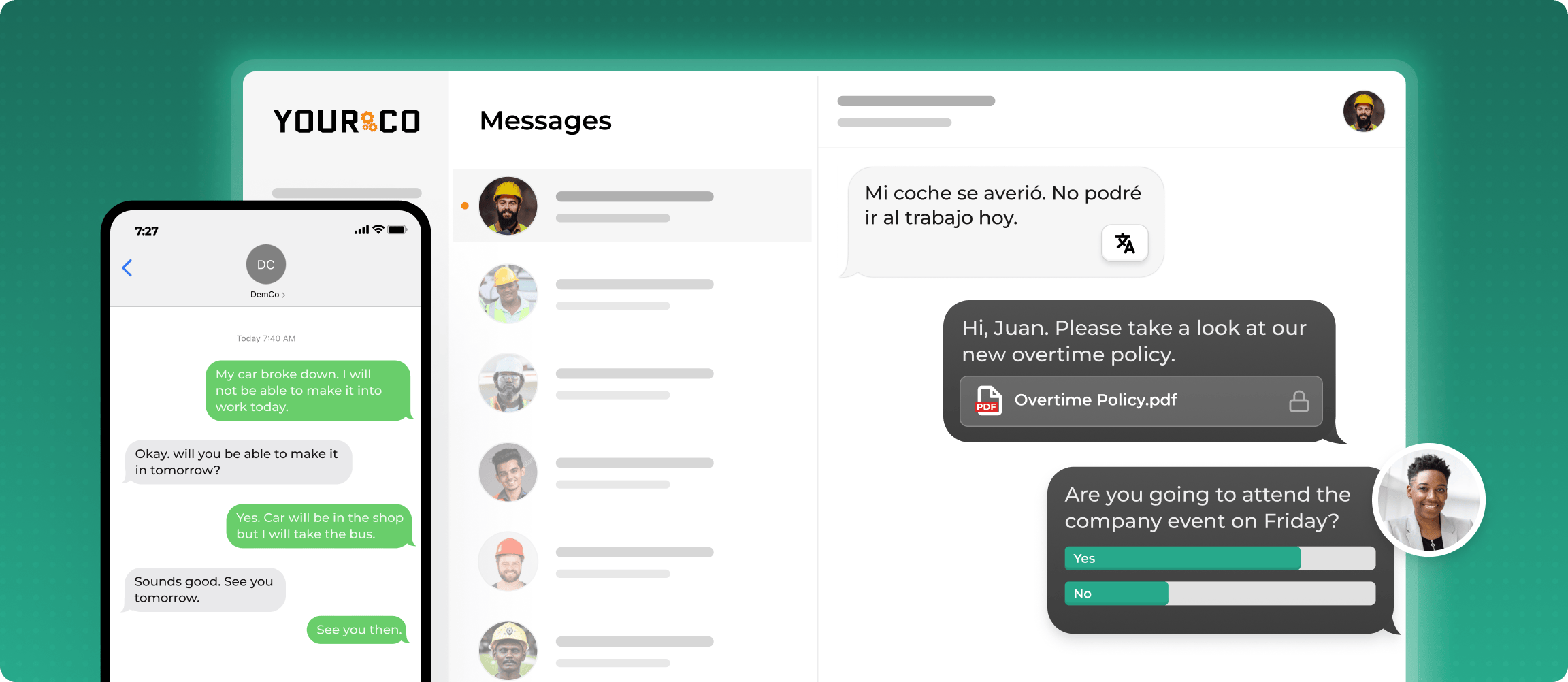
- Two-way messaging: workers can ask clarifying questions about new requirements directly through SMS, and supervisors can respond in real time
- AI-powered translation across 135+ languages and dialects: ensuring every worker receives dress code updates in the language they understand best, aligned with OSHA guidance to communicate safety-related policies in a language workers can understand
Yourco integrates with 240+ HRIS and payroll systems, automatically syncing employee rosters so that new hires, role changes, and language preferences stay up to date without manual updates.
Enterprise Bridge enables corporate leadership to broadcast standardized dress code policies to every frontline location simultaneously via a one-way communication layer, while local managers maintain two-way communication for follow-up questions and to collect acknowledgments.
Frontline Intelligence gives HR and safety teams centralized visibility into policy acknowledgment rates across all locations. It can flag when workers are expressing compliance-related frustrations in everyday communications before they escalate, and surface sentiment trends that reveal whether a dress code rollout is creating morale risk at specific sites or departments.
"Yourco has been huge for us, especially during the weather crisis. We were able to keep our employees safe and make sure everyone was notified of updates in a timely manner."
— Scott Pfantz, Operations Manager, Nufarm - Alsip
After 90 days on Yourco, companies see two-way employee engagement reach 86%.
Try Yourco for free today, or schedule a demo to see the difference the right workplace communication solution can make for your company.
Frequently Asked Questions about Communicating Dress Code Changes to Factory Workers
How far in advance should you communicate dress code changes to factory workers?
Announce the proposed policy early enough for workers to acquire any newly required items. Then reinforce it through toolbox talks, supervisor messaging, and pre-shift reminders before enforcement begins.
What is the best way to handle pushback on the dress code from factory employees?
Lead with the safety rationale rather than discipline. Most resistance comes from workers not understanding why a rule exists or from comfort and fit problems with required items, so address those causes before escalating enforcement.
How do you communicate a dress code policy to workers who speak different languages?
Use communication methods that reach workers in the language they understand best. SMS-based platforms like Yourco can support multilingual policy updates while supervisors reinforce the same message in toolbox talks and visual guides.
Should factory dress code policies differ by department?
Yes, if the safety hazards differ by department. The key is to tie each requirement to a clear operational or safety rationale so workers understand why one area has different standards than another.
What should a dress code acknowledgment form include?
Include the employee's name, date, the specific policy being acknowledged, a statement that the employee had the opportunity to ask questions, and signature lines for both the employee and supervisor. Add a witness line if an employee declines to sign.
How do you enforce dress code rules consistently across multiple shifts?
Brief every shift supervisor on identical materials before the worker-facing rollout. Define the discipline path in advance, track compliance by shift, and correct inconsistencies quickly so workers do not see one standard during the day and another at night.