


If a worker lacks a corporate email or a company laptop and may not own a smartphone, an announcement on the intranet or an "all staff" email never reaches them. Human resources (HR) and operations leaders see the missed updates every day, but the standard advice, "get a frontline app," assumes every worker owns a smartphone and will download it. The right frontline mobile tech starts with the channel a worker already has open, and for nearly everyone, that channel is text messaging.
TL;DR
- A frontline mobile tech strategy asks whether the workers executing a digital transformation can participate in it.
- Channel dependency still leaves workers out when app-based tools require smartphone ownership before they can complete an app store download.
- Text messaging works on flip phones and reaches nearly every worker with zero setup; workers do not need a login, a data plan or a corporate email.
- The divide grows when language, shift handoffs, device access, or information overload block an update; multilingual delivery keeps language from blocking access.
- Better communication access correlates with stronger engagement, lower turnover and safety-incident rates when execution is consistent.
- SMS-based platforms like Yourco turn SMS reach into visibility, so leaders can see which shifts and locations lack reliable digital reach.
Define Frontline Mobile Tech for Digital Inclusion Before Buying Any Tool
Frontline workers often have limited access to corporate communication systems like email and intranets. That lack of access is the starting point for frontline digital inclusion.
Frontline digital inclusion means giving frontline workers equitable, meaningful access to the information and tools they need to do their jobs. Digital transformation describes the organizational process of adopting technology. Inclusion asks a narrower, sharper question: can the people doing the work actually participate in it? A company can modernize every system and still leave most of its workforce outside the communication channel.
For HR and operations teams, frontline mobile tech should provide access before it promises transformation. If a message does not reach workers in a form they can understand and answer during a shift, the tool has not solved the inclusion problem.
Separate Frontline Mobile Tech From App-Based Tools That Still Require a Download
App-free mobile access determines whether workers can receive messages before they download anything. Research on HR technology trends describes frontline workforce design as tools built for smartphones and tablets. That helps workers who own a compatible device. Workers without one still need a channel that does not depend on a downloaded app.
App-based hubs deliver company news and task updates through a downloaded application. They remove the email-login barrier, but they introduce a new one: the app itself. App-free and SMS tools reach workers on any mobile device without installation. For frontline mobile tech decisions, the practical distinctions are worth naming plainly:
- App-based tools still require a compatible smartphone and access to the app store; many also require account setup or login.
- SMS-based platforms like Yourco use standard text messaging, so any phone can receive the message; even basic flip phones work. Workers do not need to download an app, use a data plan or have a login.
- For push notifications to work, the worker must configure another app dependency; SMS lands in the native messaging inbox that every phone already has.
Workers who miss app-based updates are the ones most affected by this distinction. Strong frontline mobile tech reaches those workers before asking them to adopt anything new.
Fix Channel Dependency Before App Onboarding
Phone number or QR code sign-in reduces first-step friction in app onboarding. That method still requires an app workflow.
An app workflow still excludes a worker without a smartphone or app-store access, or one who will not complete another download, no matter how smooth the sign-in becomes. Pew data on smartphone dependency and income-based digital divides shows why app-only communication leaves some frontline workers behind.
Text messaging is one of the most reliable channels workers already have open, with zero setup required. Pew's 2025 mobile ownership data shows that many adults still own a cellphone that is not a smartphone. That group is precisely who apps miss, and SMS reaches. An inclusive frontline mobile tech plan fixes channel dependency before app downloads and login troubleshooting become worker requirements.
Reframe Digital-Inclusion Barriers Around Frontline Mobile Tech Reach
Structural barriers keep frontline workers disconnected more than worker reluctance does. Each barrier shows up differently on the floor.
Device and data-plan constraints often come first: many frontline workers rely on personal devices, and data affordability can be a barrier for lower-income workers. Shift-based handoffs create another access problem because the person closing tonight may never overlap with the person opening tomorrow, so email updates or bulletin-board notices miss entire shifts.
Information overload can bury the update a worker needs; workers understand communication more easily when messages are specific to the job, situation, group, and shift, rather than being mixed into broad, one-size-fits-all broadcasts. Language and literacy barriers increase risk because they can make critical safety and policy updates harder to understand during operations, particularly in manufacturing, construction, and agriculture.
Each barrier points in the same direction: the channel has to reach the worker where they already are, in a language they read, without extra steps. Frontline mobile tech reach matters because every extra step creates another place for an entire shift or language group at a site to fall out of the communication flow.
Build the Frontline Mobile Tech Access Layer Around SMS
Start with text messaging as the lowest-common-denominator channel, then add intelligence on top. Text messaging is the floor because it works on any device without an app download or internet connection, and workers do not need a login. It reaches the worker on the shop floor or halfway through a logistics route.
Platforms need translated delivery so a safety alert or shift change reaches each worker in the language they read, without pulling a bilingual colleague off the line to interpret. Without translated delivery, manufacturers may repeatedly pull bilingual employees from their primary roles to interpret updates. That reduces output and efficiency.
Channel redundancy works best when SMS is the reliable baseline for every worker. SMS handles primary reach, and richer tools can serve workers who have the devices and data to use them. Effective frontline mobile tech treats SMS as the access layer and adds richer experiences only where workers can actually use them.
Make the Frontline Mobile Tech Business Case With Engagement, Retention, and Safety
Clearer access to communication supports the outcomes leaders already track. 63% fewer safety incidents occur in business units in the top quartile of engagement than in those in the bottom quartile, and turnover is lower, too. When information never reaches frontline workers, HR and operations teams cannot build engagement through those messages.
Only 43% of frontline employees consistently receive communications from their companies, and only 36% consistently read them, according to a Yourco-commissioned survey of 150 HR leaders. Fixing reach is the precondition for fixing everything downstream.
Frontline workers keep using communication tools when those tools answer shift and pay questions quickly. Broadcast-only communication struggles because it flows one way. Two-way channels let workers report hazards and confirm shifts, while managers answer questions in the same channel, which is what earns them daily use. Frontline mobile tech gains traction when it helps workers solve real shift-level problems and provides headquarters with a broadcast channel that enables worker participation.
Turn Frontline Mobile Tech Access Into Visibility With Yourco
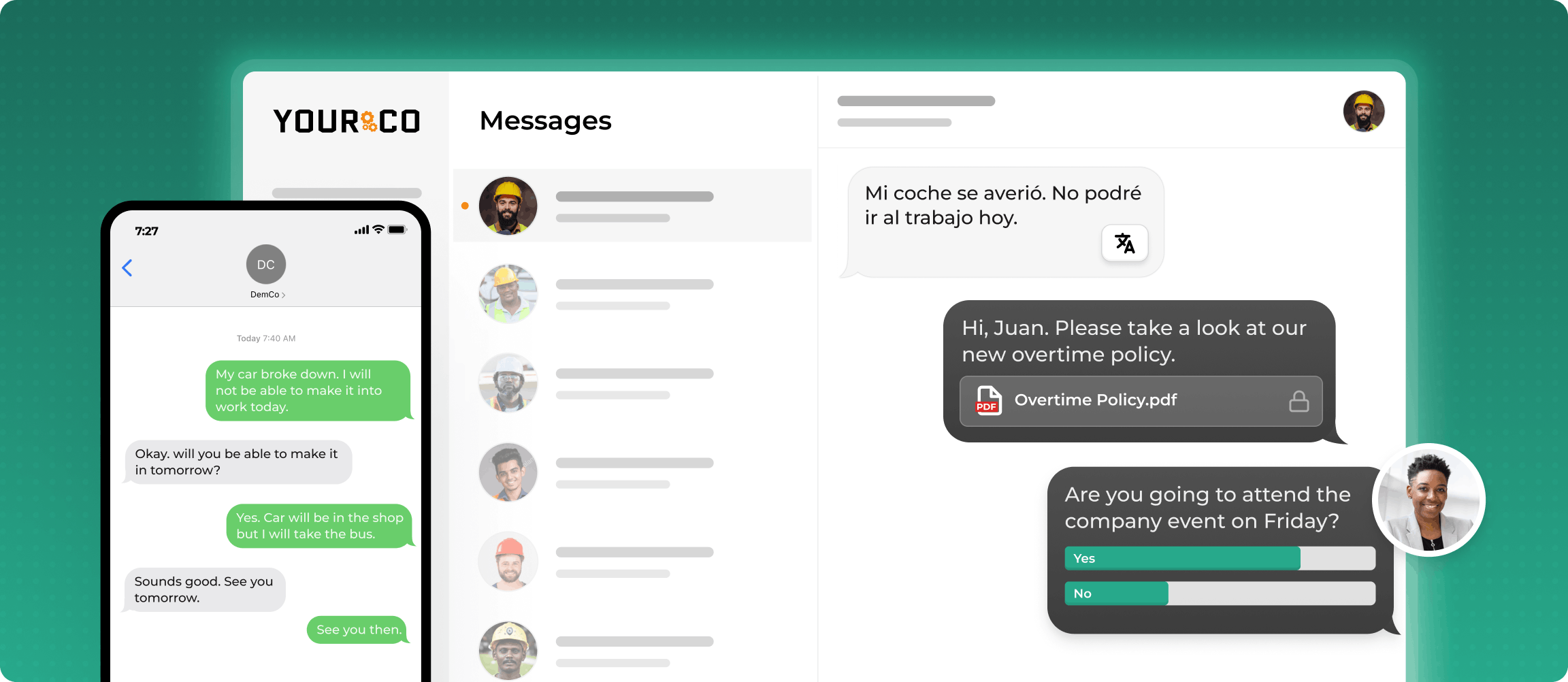
Reaching every worker starts the work; leaders then need to see which workers receive and respond to messages. Yourco gives frontline organizations an SMS-based employee communication platform. HR and operations leaders can reach every worker regardless of device type or access to corporate email and the internet.
Yourco maps to the inclusion problem for workers who cannot depend on apps or email, including teams that rely on shared devices:
- SMS to any phone, including basic flip phones, with no app download required
- Two-way messaging so workers can respond with absences and questions
- AI-powered translation across 135+ languages and dialects
- Enterprise-grade security, so employee data stays protected across every location
Yourco connects to 240+ integrations across Human Resources Information System (HRIS) and payroll systems, keeping employee data in sync across brands and locations. Enterprise Bridge allows corporate leadership to send centralized, one-way updates across all locations, while local managers maintain direct conversations with their teams.
Frontline Intelligence gives HR and leadership teams centralized visibility into daily communication data across all locations, turning everyday messages into business insights. It surfaces call-off patterns by site and identifies the safety concerns and benefits-related questions workers raise most often, broken down by location.
Organizations with large non-desk workforces describe what that reach means in practice.
"We have nearly 700 employees and 80% are non-desk based, communication is a challenge. Yourco provides a quick easy way to reach everyone and a secure way for employees to reach HR and leadership without a computer."
— Felisha Parker, VP Human Resources, McCarthy Auto Group
After 90 days on Yourco, companies see two-way employee engagement reach 86%.
Try Yourco for free today, or schedule a demo to see the difference the right workplace communication solution can make for your company.
Frequently Asked Questions About Frontline Mobile Tech and Digital Inclusion
What does frontline digital inclusion mean?
Frontline digital inclusion means giving frontline workers equitable, meaningful access to the information and tools they need to do their jobs. It focuses on whether the people executing a digital transformation can participate in it; purchased software only matters if it reaches them. Frontline mobile tech supports that access when it reaches workers on the devices they already use.
How is frontline digital inclusion different from digital transformation?
Digital transformation is the organizational process of adopting and integrating technology across operations. Frontline digital inclusion asks the narrower question of whether frontline workers can take part in that change. A company can modernize its systems and still leave most of its workforce unreached.
What does mobile-first technology mean for frontline workers?
Vendors design mobile-first technology primarily for phones and tablets first, so workers can access information on the move. For frontline workers, the strongest frontline mobile tech delivers messages app-free on any mobile device, including basic flip phones, without an app download or data plan, and without an employee login.
Why is SMS better than an app for reaching frontline workers?
SMS reaches nearly every worker because text messaging works on any phone without app setup, internet access or a login. Apps require a compatible smartphone and access to the app store before setup, which excludes workers who lack either. SMS-based platforms like Yourco reach the whole workforce through the channel every worker already uses.
How can leaders see which shifts or locations miss messages?
Leaders need response and engagement visibility across sites in addition to a way to send messages. Analytics tied to SMS-based communication can surface which locations or shifts respond slowly or not at all. Those analytics show where access barriers or message fatigue limit reach; language-specific patterns can also guide follow-up.
How do I identify which shifts have the most communication issues?
Leaders can identify which shifts have the most communication issues by reviewing response and acknowledgment data broken down by shift and location. Frontline Intelligence surfaces patterns such as call-off spikes or unanswered safety messages by site, showing exactly where a shift's communication gap sits.


