


Roughly 70 to 80% of the global workforce operates without a desk, a company email, or regular access to a computer, according to SHRM and Fidelity Investments research, yet most engagement programs were built for the small minority who have all three.
When engagement scores stall and frontline turnover climbs, the people are rarely the problem. The tools and tactics in use were never designed to reach them. This guide breaks down the practices that move the needle for shift-based, multilingual, and distributed teams in manufacturing, logistics, hospitality, and beyond.
TL;DR
- Traditional engagement programs structurally exclude frontline workers because they depend on email, intranets, and desktop tools most of these employees never use
- Mobile-first communication especially SMS, reaches frontline workers on the one device they already carry
- Frontline managers account for most team-level engagement variance, making supervisor development one of the highest-return investments available
- Frequent, specific recognition delivered through accessible channels reduces turnover more than annual awards programs
- Two-way feedback only works when employees see visible proof that their input changed something
- SMS-based platforms like Yourco give human resources (HR) and operations leaders a direct line to every worker, on any phone, in any language
Why Frontline Engagement Insights Demand a Different Playbook in 2026
Legacy training and engagement methods were built for desk-job employees, not the majority working on the front lines without a computer in sight. 48% of manufacturing leaders report that their frontline employees feel actively engaged, compared with 70% of headquarters-based staff, according to PwC. These are access problems, not motivation problems.
For HR directors and operations managers, employee engagement insights for frontline workers mean reaching workers who do not check email, delivering information during or between shifts, communicating across multiple languages, and collecting feedback through channels workers actually use.
The U.S. manufacturing skills shortage could leave 2.1 million jobs unfilled by 2030 at a potential cost of $1 trillion in that year alone, according to The Manufacturing Institute and Deloitte. Any engagement strategy that misses the majority of the workforce carries that pressure forward.
The structural differences between traditional and frontline-first engagement programs explain why most organizations miss the majority of their workforce.
Use Mobile-First Communication as the Foundation
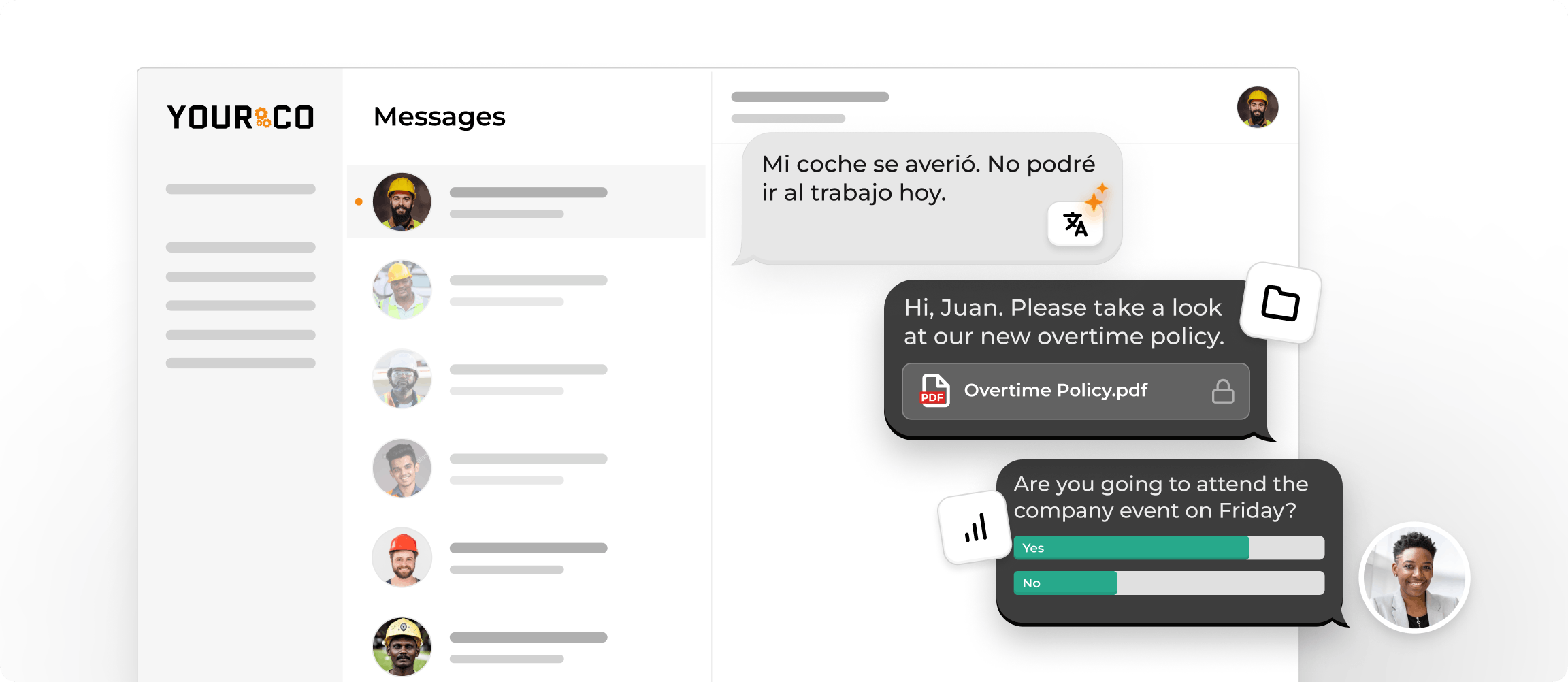
91% of HR leaders say SMS is more effective than email for reaching frontline workers, according to a Yourco-commissioned survey of 150 HR leaders. SMS works because it meets frontline workers where they already are. Every employee has a phone number. Text messages do not require an app download, a Wi-Fi connection, or a login. They work on basic flip phones and smartphones alike.
Practical mobile-first engagement looks like this in frontline communication:
- Shift reminders and schedule updates sent via text instead of posted on a break room bulletin board
- Policy acknowledgments collected through a reply-based SMS workflow rather than an intranet portal
- Safety alerts pushed instantly to every phone on a crew, not relayed through a phone tree
- SMS surveys so every worker, regardless of tech access, can participate
The design principle is direct: if a worker on the third shift at a rural manufacturing site cannot receive and respond to a message, the communication strategy has a structural problem.
Give Frontline Managers the Tools to Drive Daily Engagement
70% of the variance in team-level engagement comes down to the manager, according to Gallup. Most organizations still promote their best individual performers into supervisory roles based on performance or tenure rather than supervisory skills.
Four habits consistently improve team-level engagement:
- Weekly one-on-one conversations: Employees whose manager holds one meaningful conversation per week tend to be more engaged. Even 15 minutes works when it covers priorities, recent contributions, and strengths.
- Daily shift huddles: BCG describes tiered meeting structures in which floor-level huddles surface issues that are then resolved in cross-functional tier 2 meetings during the same shift.
- Goal-setting collaboration: When managers involve employees in setting goals, employees are more likely to follow through and stay engaged with the outcome.
- Talking-point support: Give supervisors pre-built messages for shift starts, company announcements, and safety reminders so they spend less time crafting communications and more time connecting with their teams.
Organizations that invest in structured manager development programs tend to see stronger engagement gains and lower turnover than non-participating teams.
Make Recognition Frequent, Specific, and Accessible
Recognition lands more meaningfully when it is frequent, specific, and tied to observable behaviors rather than tenure alone. On the front line, mobile access is the main barrier to achieving consistent recognition.
Three recognition approaches work well in shift-based environments:
- Peer-to-peer recognition: Peers have direct, continuous visibility into work that managers overseeing multiple shifts or sites cannot. A simple SMS-based shout-out or team message captures what managers miss.
- Public praise with cross-shift visibility: Recognition feeds must cross shift boundaries to create a culture of acknowledgment. A team lead posting recognition after a shift only works if employees on other shifts can see it too.
- Milestone and training-based rewards: Recognition tied to skill milestones, safety streaks, and training completion gives workers concrete reasons to invest in development.
Companies with integrated recognition programs have 81% decreased odds of employee burnout, according to the O.C. Tanner Institute's 2025 State of Employee Recognition Report. For frontline industries already managing heavy workloads and cross-shift disconnect, recognition is a high-impact intervention.
Close the Loop With Two-Way Feedback
Frontline surveys are easy to deploy; the follow-through is where most engagement programs lose credibility with workers. SIOP analysis found that in environments with low trust and inconsistent follow-through, engagement surveys become performative exercises. Employees stop sharing real feedback when they conclude that nothing changes either way.
Building a feedback loop that frontline workers trust requires three steps:
- Collect input through accessible channels: SMS-based pulse surveys and QR codes in break rooms reach workers that email surveys miss. Short, periodic pulses are easier to complete during or between shifts than long annual surveys.
- Act on what you hear, fast: When a pulse survey reveals a concern, the supervisor should address it within days, not quarters. Tying continuous feedback directly to managerial performance metrics keeps the loop honest.
- Communicate what changed: Send a follow-up message to the same group: "You told us the break room schedule wasn't working. Here's what we changed." This visible loop closure transforms feedback from a compliance exercise into an engagement driver.
Build Growth Paths That Reduce Turnover
Workers leave for many reasons, but a lack of visible advancement consistently ranks near the top. Most organizations list upskilling and reskilling as a top priority, yet far fewer rate themselves as effective at delivering it. That mismatch leaves workers without a clear path forward, especially in shift-based roles where day-to-day routines can crowd out development.
Four growth path strategies can improve retention:
- Transparent career mapping: Publish clear pathways and share them through mobile-accessible channels so workers see what comes next.
- Certifications tied to pay increases: Cross-training in adjacent skills provides lateral mobility when vertical advancement is not immediately available.
- Early-tenure mentorship: Workers in their first year are at the highest risk of leaving. Pairing new hires with experienced workers during those first months helps capture institutional knowledge and build a sense of belonging.
- Stay interviews as standard practice: Rather than waiting for exit interviews, supervisors should ask current employees what is working and what would keep them.
When workers can see a future with a company, daily frustrations are less likely to become exit decisions.
Test Frontline Engagement Tactics at One Site First
Use this checklist to get started at one store, site, or shift group:
- Select one location or shift group with above-average turnover
- Audit current communication channels and measure the percentage of frontline workers actually receiving and reading messages
- Deploy an SMS-based communication channel that works on any phone with no app download
- Train shift supervisors on weekly one-on-one conversation structure (15 to 30 minutes, goal-focused)
- Launch a weekly SMS pulse survey (3 questions max) and commit to sharing results within 5 business days
- Implement a peer recognition program accessible via text and share a career pathway document with every frontline employee at that site
- Track baseline metrics (turnover rate, survey response rate, message read rate, absenteeism) at monthly intervals, then present results to leadership with an expansion recommendation
Reach Every Frontline Worker Instantly With Yourco
Turning frontline engagement insights into daily practice requires a communication channel that reaches every worker, on every shift, in every language. 88% of HR leaders believe better communication tools can reduce employee churn, according to the same Yourco-commissioned survey of 150 HR leaders. Yourco is the SMS-based employee communication platform built for exactly this reality.
Core communication capabilities:
- SMS to any phone, from smartphones to basic flip phones, with no app download, no Wi-Fi, and no cost to employees
- Two-way messaging that enables real-time conversations between managers, HR, and frontline teams
- AI-powered translation across 135+ languages and dialects, so every worker receives messages in their preferred language
Yourco integrates with 240+ HRIS and payroll systems to automatically sync employee data.
Enterprise Bridge lets corporate leadership send centralized updates across all locations, while local managers maintain direct communication with their teams.
Frontline Intelligence gives HR and operations leaders centralized visibility into engagement trends, sentiment, and communication patterns across all locations. It delivers AI-powered reporting that lets leadership review call-off data, absence causes, and communication effectiveness across the organization.
"We are absolutely delighted with Yourco, which we use for HR communications with our team. It has significantly improved how we connect with employees, making it easier to share important updates, reminders, and announcements in real time. Yourco has become an essential tool in streamlining our internal communication and helping us maintain a strong, connected team."
– Courtney Martin, Recruiting Manager, The Seagate
After 90 days on Yourco, companies see two-way employee engagement reach 86%.
Try Yourco for free today, or schedule a demo to see the difference the right workplace communication solution can make for your company.
Frequently Asked Questions About Frontline Employee Engagement
Why do traditional employee engagement insights fail for frontline workers?
Traditional programs rely on email, intranets, and desktop tools that many frontline workers cannot access during shifts. When the channel misses the worker, surveys, recognition, training, and updates miss them too. The result is an engagement system built around office access rather than frontline reality.
How does mobile-first communication improve frontline engagement?
Mobile-first communication improves frontline engagement by reaching workers on the phone they already carry. SMS removes common barriers like app downloads, logins, and desktop access. SMS-based platforms like Yourco make it easier to deliver updates, collect feedback, and communicate across shifts and languages.
What role do frontline managers play in employee engagement?
Frontline managers shape daily engagement more than any other single factor. They set expectations, recognize good work, address concerns, and set the tone for each shift. Simple habits like weekly one-on-ones, shift huddles, and collaborative goal-setting have an outsized effect on retention and performance.
How can HR leaders effectively measure frontline engagement?
HR leaders can measure frontline engagement more effectively with short, frequent pulse surveys delivered through accessible channels. The goal is to consistently reach workers, review patterns over time, and follow up visibly. A useful measurement process tracks both employee input and whether managers acted on it.
What is the fastest way to reduce frontline turnover?
The fastest way to reduce frontline turnover is to fix the everyday conditions that make workers feel disconnected or stuck. Clear communication, stronger frontline managers, visible recognition, and real growth paths all help. When workers feel informed, supported, and able to advance, they are more likely to stay.


