
Most HR leaders already know their communication tools aren't reaching frontline workers. The problem is proving it to leadership with numbers that justify real investment. A recent survey of 150 HR leaders shows how directly communication quality connects to the outcomes your leadership team already cares about: productivity, retention, safety, and absenteeism. When "we need better communication" isn't enough, you need a business case built on hard data.
TL;DR
- Frontline communication gaps create real business risk across productivity, retention, safety, absenteeism, and benefits participation
- Manager communication plays a major role in engagement, which directly affects day-to-day performance and attendance
- Missed updates and broken channels can quietly drive preventable turnover, safety issues, and lower benefits participation
- The strongest business case ties communication improvements to outcomes your finance team already tracks
- SMS-based platforms like Yourco help reach every worker on any phone, in 135+ languages, with no app or Wi-Fi required
Recognize the True Cost of Unreachable Employees
The gap between communication intent and communication reality is significant. The data is clear: when 150 HR leaders were surveyed on frontline communication, most said better tools directly increase productivity. Yet many frontline employees still do not consistently receive company communications. That disconnect is not just an inconvenience. It creates delays, missed updates, and avoidable operational friction.
Independent research supports the same pattern:
- The Gallup State of the Global Workplace report reveals that low engagement drives $438 billion in annual U.S. lost productivity.
- Deloitte research found that 82% of frontline workers say better technology and communication tools would enhance their productivity.
When your workforce cannot receive a shift update, a safety alert, or a benefits reminder because they do not have a company email or access to a desk, those gaps carry a real price tag.
Link Communication Quality Directly to Productivity
Productivity is usually the first metric leadership asks about. Gallup shows that highly engaged teams produce better results, and manager engagement remains one of the biggest drivers of that outcome. That makes manager communication one of the clearest levers available to HR and operations teams.
The practical problem is straightforward. Most communication tools were built for people sitting at computers. Email, intranet portals, and collaboration apps assume constant connectivity and easy digital access. Frontline workers do not operate that way. Shift changes, machine alerts, and training materials go unread because the tools were not built for workers without desks.
Reduce Turnover by Closing the Information Gap
Retention is where communication failures hit especially hard. Replacing a frontline worker costs real money, and the cost rises further for skilled roles in manufacturing and other specialized environments. The pattern shows up in practitioner data too: in Yourco's Closing the Comms Gap research, most HR leaders said better communication tools help reduce churn.
The connection between communication and turnover is well documented:
- Gallup research shows 42% of voluntary turnover is preventable through better manager conversations.
- SHRM research shows frontline workers face higher turnover when communication tools are fragmented.
- Gallup finds that one meaningful weekly conversation per direct report makes employees 4 times more likely to be highly engaged.
For leadership teams, the takeaway is simple: even modest improvements in communication can protect a meaningful amount of avoidable turnover cost.
Strengthen Safety Outcomes With Faster, Clearer Alerts
Safety is where communication failures carry the highest stakes. HR leaders surveyed in Yourco's frontline communication study were nearly unanimous in their view that clear safety communication reduces workplace incidents.
Hazard Communication Standard violations continue to rank among the most cited OSHA issues in recent years. These violations often involve gaps in training, written programs, and labeling. In practice, they are closely tied to how clearly safety information is communicated.
Language barriers make the issue even more urgent. Peer-reviewed research shows that language barriers contribute to occupational injuries, and NIOSH findings highlight disproportionate risk for some frontline populations. That is why multilingual communication matters so much in safety programs.
The business case for communication investment is well established. Willis Towers Watson research found that companies with highly effective communication deliver 47% higher total returns to shareholders compared to the least effective communicators.
When employee alerts reach every worker quickly, in the right language, on any phone, safety communication becomes easier to deliver consistently.
This information is provided for general awareness only. For specific compliance guidance, consult with qualified legal professionals.
Cut Absenteeism With Stronger Engagement
Absenteeism is one of the most expensive and least visible consequences of poor communication. When frontline workers miss updates or feel disconnected from managers, attendance problems often follow. That finding holds in the field: HR leaders in Yourco's research identified this same pattern, and Gallup's data shows that engaged teams have far lower absenteeism.
A few communication breakdowns tend to drive the problem:
- Missed updates leave employees unclear on schedules, expectations, and changes.
- Weak manager communication reduces the day-to-day connection that supports accountability.
- Poor channel fit means that important information is sent via tools frontline workers rarely use.
Manager communication quality is the fulcrum. Gallup's 2025 research reveals manager engagement crashed from 30% to 27% globally, dragging down entire teams and driving absenteeism. Yet many frontline managers still lack formal communication support. The more reachable and informed employees feel, the easier it is to maintain reliable attendance.
Stop Losing Benefits Participation to Broken Channels
Benefits enrollment is another hidden casualty of poor frontline communication. When your workforce cannot access email-based reminders or navigate portal-based enrollment tools, participation suffers. It is a problem HR leaders know well: the same cohort of 150 HR leaders reported that ineffective communication directly drives lower participation in benefits.
The gap often shows up in a few practical ways:
- Reminders go unseen when enrollment messages depend on the company email.
- Portals create friction for workers without regular access to computers.
- Feedback loops break down when HR cannot easily confirm who saw key updates.
HR Dive data shows nearly half of frontline employees feel there are two separate workplace cultures: one for them and one for everyone else. SMS-based surveys help close that gap by sending enrollment reminders and feedback requests directly to every phone. Clearer outreach helps benefits communication feel more accessible and more equitable.
Build the Business Case Your Leadership Team Will Approve
With Gartner data showing many HR leaders are managing flat or reduced budgets, approval for a new communication platform depends on a business case tied to measurable outcomes.
SHRM guidance recommends a practical four-step approach:
- Audit existing resources. Document where current channels fail to reach frontline workers.
- Calculate ROI. Connect better communication to lower turnover, fewer incidents, stronger attendance, and better participation in key programs.
- Define the solution. Choose a platform that fits the way your workforce actually communicates.
- Implement with success metrics. Track core outcomes before and after deployment.
The risk-reduction frame often resonates with CFOs. OSHA violations, workers' compensation exposure, and undocumented policy acknowledgments all represent avoided costs that finance teams understand.
The key is to lead with business outcomes, not features. Instead of saying a platform sends messages, explain how it addresses the communication gap behind missed shifts, preventable turnover, or delayed safety responses.
Reach Every Frontline Worker Instantly With Yourco
Better frontline communication supports the outcomes leadership already cares about: stronger productivity, better retention, safer operations, and more reliable attendance. Yourco is built to solve that challenge by helping organizations reach every frontline worker quickly and consistently.
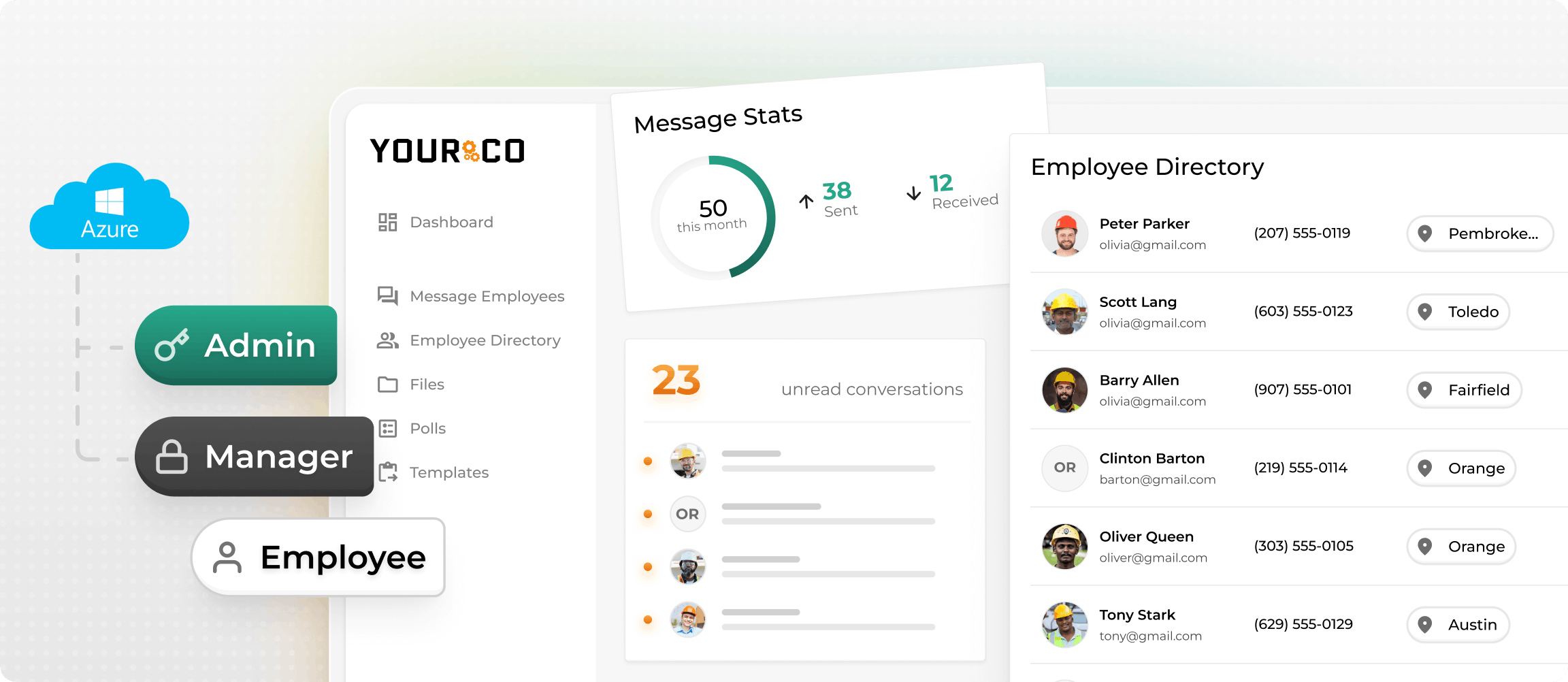
Yourco is an SMS-based employee communication platform designed specifically for frontline workforces:
- SMS to any phone with no app downloads, no Wi-Fi, and no data plan required
- Two-way messaging so employees can respond to managers, report absences, confirm shifts, and share feedback through an SMS-based channel
- AI-powered translation across 135+ languages and dialects, so every worker receives messages in their preferred language
Yourco connects to 240+ HRIS and payroll systems, keeping employee data synced automatically across all locations.
Enterprise Bridge enables corporate leadership to broadcast one-way announcements, policy updates, and safety alerts to every frontline location simultaneously, while local managers maintain direct two-way conversations with their teams.
Frontline Intelligence gives HR and operations teams centralized visibility into communication patterns across all locations. Leadership can identify response trends by site, spot patterns in call-off activity, and see where employee disengagement may be building before it turns into larger retention or attendance problems.
"Yourco has helped to change the way we communicate at McCarthy Auto Group. We have nearly 700 employees and 80% are non-desk based, communication is a challenge. Yourco provides a quick easy way to reach everyone within our organization and a secure way for employees to reach HR and leadership without a computer."
— Felisha Parker, VP Human Resources, McCarthy Auto Group
After 90 days with Yourco, two-way employee engagement increased to 86%.
Try Yourco for free today, or schedule a demo to see the difference the right workplace communication solution can make for your company.
Frequently Asked Questions About Frontline Communication, Productivity, and the Business Case for Better Tools
How do you communicate with frontline workers who don't have company email addresses?
Use the channel workers who already check. SMS-based platforms like Yourco send updates directly to any phone, so employees do not need email, an app, or internet access.
What metrics should I include in a business case for frontline communication tools?
Focus on turnover, absenteeism, safety incidents, and benefits participation. Start with baseline numbers so you can show clear improvement after rollout.
How does poor communication affect workplace safety?
It can lead to missed alerts, inconsistent training, and reporting gaps. In multilingual workplaces, the risk is even higher when critical information is not delivered in the right language.
Can better communication tools really reduce employee turnover?
Yes, workers are more likely to stay when they feel informed, connected, and supported by their managers from the start.
What's the ROI of investing in frontline communication?
It depends on your workforce size and current pain points. In many organizations, preventing even a small amount of avoidable turnover or absenteeism can quickly justify the investment.