
88% of HR leaders say they need a reliable way to reach frontline employees, and only 55% are confident they have one, according to a Yourco-commissioned survey of 150 HR leaders. Supervisors fill the shortfall with personal cell numbers, because frontline workers rarely have company email and a text always lands. Employees receiving those texts on their own phones is how frontline communication works. What needs governing is the other side of the thread, where a supervisor's personal device holds the company's only copy of a business record.
TL;DR
- Frontline BYOD covers two populations with two very different risk profiles.
- Employees receiving work texts on personal phones is the operating model for frontline teams.
- The records' exposure sits on supervisors' and HR personnel's devices, where the company holds no copies.
- Mobile e-discovery can reach those devices, and BYOD policy language often decides employer control.
- Reimbursement, wipe consent, and offboarding rules belong to the manager and administrative population.
- SMS-based platforms like Yourco keep the company side of every work text on a company-owned channel.
Define BYOD Policy Scope for Managers and Frontline Employees
A BYOD policy is a formal policy that specifies when and how authorized users, including employees and contractors, may use personal smartphones and other devices, such as tablets or laptops, to access company data and perform job duties. In a frontline workforce, that definition splits into two populations that need separate treatment.
Frontline employees receive shift texts, safety alerts, and schedule changes on their personal phones because that is the only channel that reaches every worker on the floor. Their devices hold no company data, and the company's copy of the exchange lives on the platform that sent it. Supervisors, shift leads, and HR staff fall into a different category, conducting company business on devices the company neither owns nor controls.
Frontline employers most often miss this distinction, aiming a policy drafted for laptops at a warehouse associate's flip phone while a shift lead's text history goes ungoverned. In September 2023, NIST published NIST SP 1800-22, an example solution to help organizations address the security and privacy risks of BYOD.
Weigh BYOD Benefits Against the Risks
For supervisors and office staff, BYOD reduces hardware purchases and refresh cycles because those employees use phones they already know. For frontline teams, personal phones deliver what a company device cannot: a channel worker already checks between tasks and during a shift change.
Security and records carry the biggest BYOD risks, and both concentrate on the management side. When a supervisor texts shift changes from a personal phone, the company holds no copy of the exchange, and the history walks out the door when either person quits. After-hours texts to nonexempt hourly workers can also count as compensable work time under wage-and-hour rules, which is why employers generally set clear limits on off-the-clock contact.
Build These Seven Components Into a BYOD Policy
A workable BYOD policy for a frontline workforce needs seven parts, most of which govern the supervisors and office staff who handle company data rather than employees who only receive texts:
- Scope: define which workers the policy covers, which devices they may use, and the company systems each device type can access
- Approved devices: permitted device types and minimum operating system versions, so unsupported phones don't touch company data
- Acceptable use: approved work apps and data-handling rules, with workplace texting rules and harassment policies applying to texts, and limits on off-the-clock communication for nonexempt workers
- Security requirements: password standards, two-factor authentication, and current software updates as a condition of access
- Reimbursement: how the company calculates stipends or bill percentages, since California's Cochran v. Schwan's Home Service (2014) found that Labor Code section 2802 reaches a reasonable percentage of the cell phone bill where work use is required, and Illinois has a similar expense statute
- Lost or stolen devices: a clear reporting path without a penalty so harsh that workers hide the loss
- Offboarding: removal of corporate access and company data at departure, with written consent for any remote wipe collected in the signed agreement, since a wipe without prior consent can create liability of its own
Components two, four, six, and seven govern devices holding company data, which on most sites means supervisor and administrative phones. Components one, three, and five reach the whole workforce.
This information is for general awareness only. For specific compliance guidance, consult with qualified legal professionals.
Prepare for Mobile Ediscovery Before a Dispute Arrives
Mobile ediscovery is the identification, preservation, and production of texts and other data from phones when a legal matter requires it, including personal devices that carry business messages. Federal Rule of Civil Procedure 34 covers electronically stored information (ESI) within a party's "possession, custody, or control," which is why BYOD policy language often determines the outcome of these disputes.
The published cases center on management devices. In Miramontes v. Peraton (2023), a court held that the employer controlled texts on a former supervisor's personal phone, found bad faith after messages were deleted following a litigation hold, and denied the employer's motion for summary judgment.
Policy language can shift the outcome in the other direction. The preservation demand in In re Pork Antitrust Litigation (D. Minn. 2022) targeted the personal cellphones of five company executives, and the court held that the employer did not have "control" because its BYOD policy allowed, but did not require, personal device use and gave the company no right to access those messages.
Sanctions in these disputes have included attorneys' fees and adverse inference instructions, and some courts have dismissed cases outright. Because companies rarely log texts centrally, mobile e-discovery often means pulling data off each supervisor's phone, one device at a time.
This information is for general awareness only. For specific compliance guidance, consult with qualified legal professionals.
Move Work Texting to a Company-Owned Number
Mobile device management (MDM) software is designed for devices that store company data, making it the wrong tool for a frontline workforce. Installing agents on employees' phones invites privacy objections and leaves the records problem untouched, because the company's copy of the conversation still sits in a supervisor's thread.
Supervisors carry that records problem every day. A manager who texts from a personal number cannot hand the conversation to a colleague, cannot let HR review or respond, and takes months of shift-coverage history when they leave. That is the pattern behind the personal phone communication risks that frontline employers keep running into.
Call-offs show it at its sharpest. A worker texts a supervisor's personal number before shift, and the notice, its timestamp, and the coverage decision all sit on a device the company does not own, exactly where attendance discipline and leave designation later need evidence. SMS-based platforms like Yourco move that intake onto a company text-off line, where the AI Call-Off Agent collects the dates and reason, confirms them, and logs the absence with an auditable record HR can retrieve.
A company-owned SMS channel captures work messages at the platform level as the company's system of record, with timestamped, searchable records that help HR and legal teams review what the company sent, when, and to whom. Managers compose and send from a web dashboard, so no work conversation begins on a personal number.
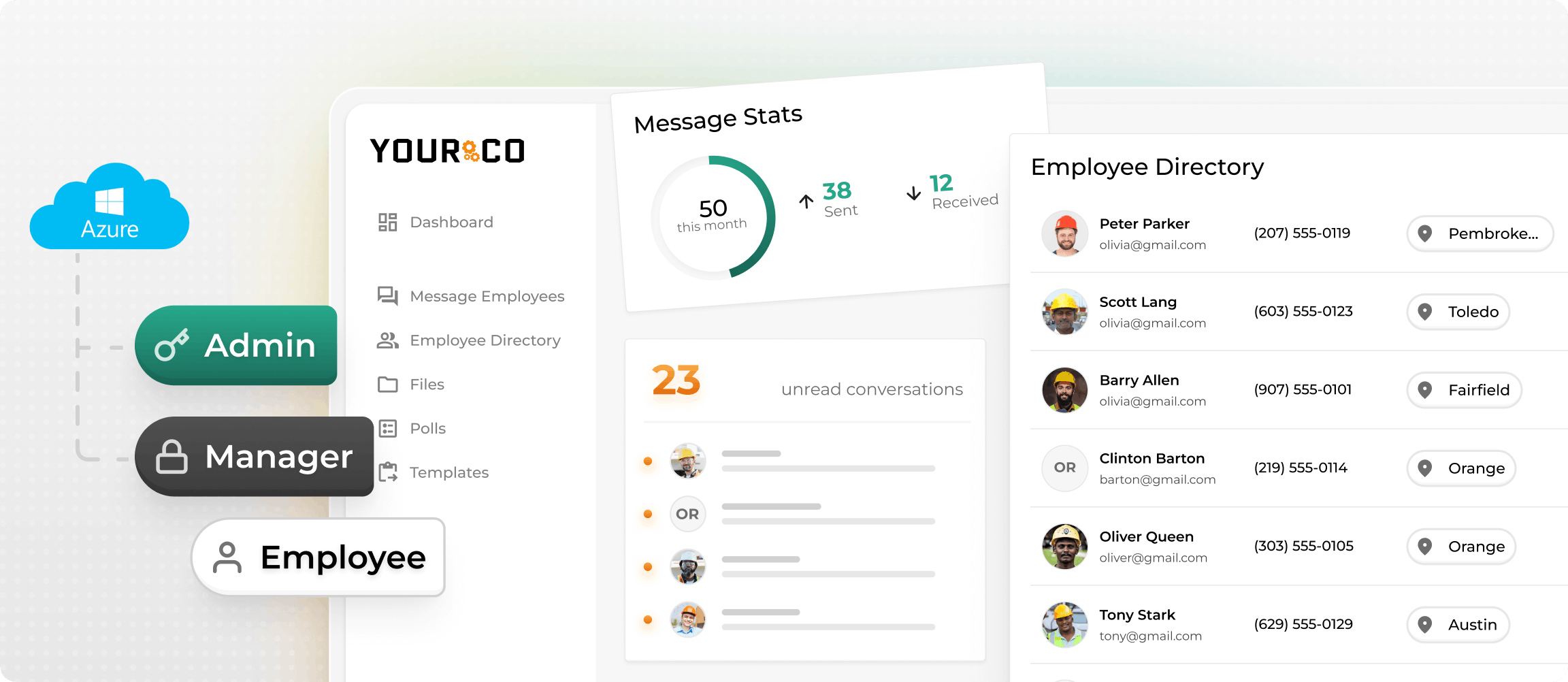
SMS still reaches any mobile phone, including basic flip phones, so the employee side of this model needs no change. When a mobile e-discovery request arrives, the records come from a single archive rather than a dozen personal phones.
Keep Work Texting on a Company-Owned Channel With Yourco
Yourco gives HR teams a company-owned text channel, plus the system of record behind it. Employees keep the phones they already carry, and the company side of every conversation runs through a company-owned number that managers operate from a web dashboard, with full message archiving and timestamped compliance records. That handles the two hardest parts of a BYOD policy, preservation and privacy, without touching anyone's device.
Yourco delivers the core capabilities frontline teams rely on:
- SMS to any phone, including basic flip phones, with no app download required
- Two-way messaging so workers can ask questions and reach HR without a computer
- AI-powered translation across 135+ languages and dialects
- The AI Call-Off Agent collects call-off dates and reasons over text, confirms the details, then logs the absence and notifies the supervisor without HR intervention
The platform connects to 240+ HRIS and payroll integrations to automatically keep employee contact data up to date. For multi-location organizations, Enterprise Bridge supports one-way broadcasts from corporate leadership to the entire frontline, keeping every location aligned without requiring responses.
Frontline Intelligence gives HR and leadership centralized visibility into frontline communication across all locations. Corporate teams can review communication patterns by site or department and produce a record of what the company sent, when, and to whom, all from one dashboard.
One construction employer describes the difference a single company channel makes.
"Yourco has helped me streamline communication between the field and the corporate office. The software is easy to use, and their service department is always available to help when needed."
— Roxana Abreu, HR Director, Central Civil Construction
After 90 days with Yourco, two-way employee engagement increased to 86%.
Try Yourco for free today, or schedule a demo to see the difference the right workplace communication solution can make for your company.
Frequently Asked Questions About BYOD Policies
What should a BYOD policy include?
A BYOD policy should include scope, approved device standards, acceptable use rules, security requirements, reimbursement terms, lost-or-stolen-device procedures, and offboarding steps. Many employers also add data ownership language and privacy expectations for approved communication channels, so workers know what the company can and cannot see.
Does a BYOD policy apply to employees who only receive work texts?
A BYOD policy applies only to employees who receive and reply to work texts, since those phones store no company data. Most provisions, including those governing approved devices, security standards, and remote wipe consent, govern the supervisors and office staff who create and maintain company records.
What are the pros and cons of a BYOD policy?
BYOD lowers hardware costs and lets employees carry a single familiar device. The downsides are security exposure on unmanaged devices, reimbursement obligations in some states, and work records scattered across manager phones the company doesn't own, which can complicate recordkeeping, internal reviews, and the preservation of litigation records.
Who owns the BYOD policy, HR or IT?
Neither owns it alone. Information technology (IT) usually defines security requirements, and Legal reviews agreements and risk. HR handles signed acknowledgments and the training needed for enforcement. Many employers conduct a cross-functional review to ensure the policy reflects security needs and employee privacy expectations.
Do employers have to reimburse employees for personal cell phone use?
It depends on the jurisdiction. California, Illinois, Massachusetts, and Montana are common examples in which employers evaluate reimbursement obligations for the required use of personal phones. Many employers use a flat monthly stipend or a bill-percentage approach, as documented in the BYOD agreement, after reviewing state-specific guidance with counsel.
How does mobile e-discovery apply to personal phones?
Mobile e-discovery can access work texts on a personal phone when the employer has the right or practical ability to obtain them, and published disputes have centered on supervisors' and executives' devices. Courts look at business use, BYOD policy language, and control over the records. SMS-based platforms like Yourco keep work texts on a company-owned channel.