
For workplaces with teams spread across shifts and job sites, getting responses from frontline workers is hard. Many frontline employees don't have a company email account or regular access to the intranet during the workday, yet their feedback matters as much as that of any office employee. The way a company delivers a survey shapes who responds and how useful the resulting data becomes. Strong survey distribution reaches every employee with a survey that drives real engagement and useful insight.
TL;DR
- Frontline workers are hard to reach with traditional survey tools like email, since many don't have a company email account
- Text messaging reaches every employee equally, regardless of shift, location, or device
- Getting timing, segmentation, and follow-up right matters as much as the survey itself
- Six distribution methods exist, each suited to a different workforce, and most companies benefit from combining more than one
- SMS-based platforms like Yourco make shift-based, multilingual survey distribution simple
Why Survey Distribution Determines Success
How a company delivers a survey affects participation rates, data quality, and employee trust. A survey that only reaches employees with a company email creates an incomplete picture of the workforce. When office employees respond at high rates but frontline workers can't access the survey at all, the data reflects office realities instead of the full organization.
Only 40% of frontline employees consistently respond to communications from their companies, according to a Yourco-commissioned survey of 150 HR leaders. Frontline employees also experience survey fatigue when distribution creates friction, and that problem intensifies when they see no follow-up on previous survey results. Smart distribution reduces these barriers by meeting employees where they already are.
Build a Survey Worth Distributing
Poor survey design undermines even the best distribution strategy. Keep these principles in mind when building a survey:
- Focus each survey on one objective, such as satisfaction, engagement, or a specific operational issue, rather than several at once
- Use closed-ended rating scales for most questions, since employees answer them quickly and the results are easy to analyze; add one or two optional open-ended questions for context
- Aim for completion times under 10 minutes on longer surveys; shorter pulse surveys with three to five questions, sent regularly, tend to outperform annual surveys
- Build the survey itself in an established platform like SurveyMonkey or Google Forms, which handles question logic and response collection; the distribution method covered in this article determines how the link actually reaches employees
- For sensitive topics such as safety concerns or leadership feedback, use an anonymous format to encourage honest input
Many organizations note that anonymized survey data can still be traceable in small teams or departments, so confirm any anonymization approach with a data privacy professional before distributing sensitive surveys, particularly across international teams.
This information is for general awareness only. For specific compliance guidance, consult qualified legal professionals.
Why Frontline Workers Need a Different Distribution Approach

Frontline employees account for roughly 80% of the global workforce, according to a 2024 BCG analysis, yet standard office-based distribution methods rarely reach them. Many frontline workers don't have a company email account and don't routinely check one during work hours because their jobs keep them on factory floors, job sites, or delivery routes.
A survey sent at 2 p.m. arrives when third-shift employees are asleep or handling personal responsibilities, reducing participation and creating inequity between shift groups. Workers operating machinery or handling materials also need surveys delivered when they can safely stop and respond, so distribution has to account for safe, available response time as much as survey design itself.
What Are the 6 Core Survey Distribution Methods?
Each method fits or fails based on workforce composition and operational context. For organizations with large frontline workforces, the channel determines who can actually participate.
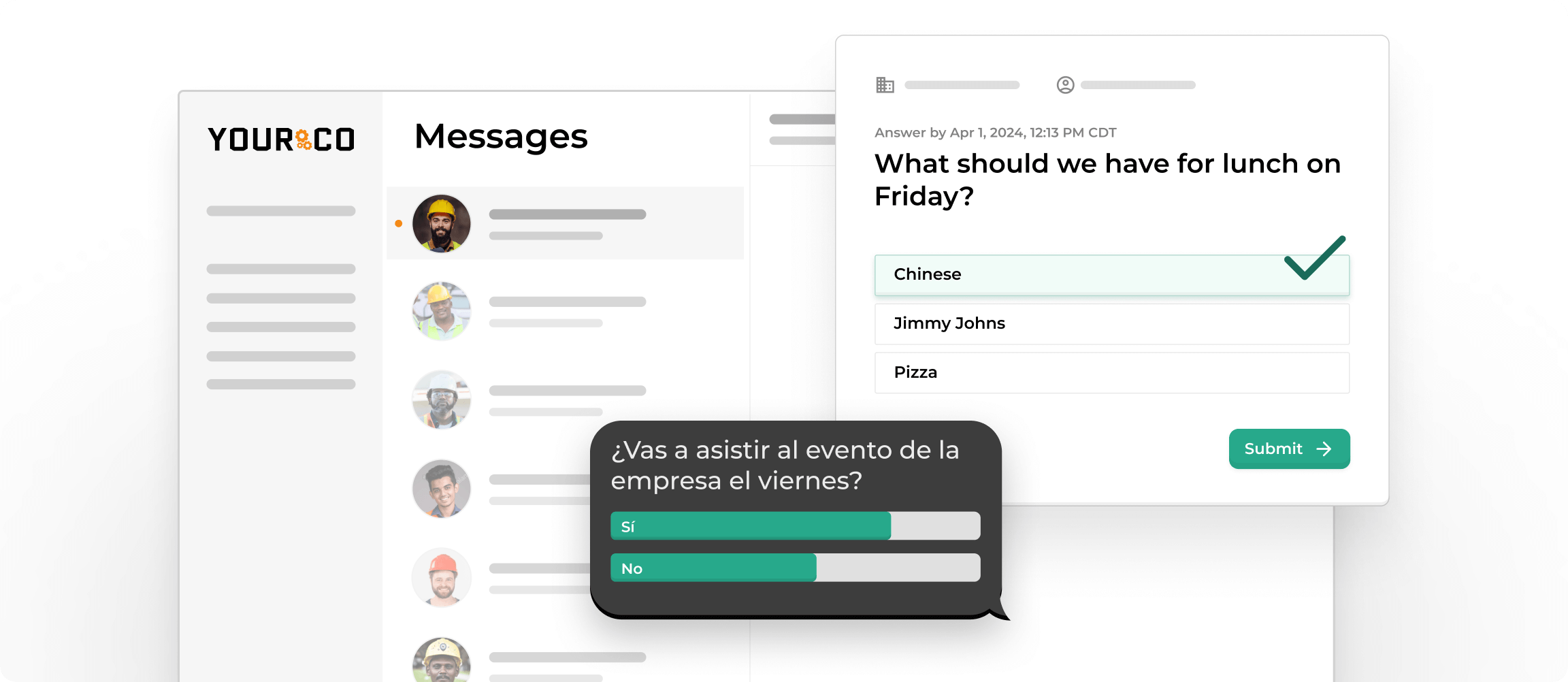
Text messaging belongs at the center of distribution whenever frontline or shift-based employees make up a meaningful share of the workforce. SMS reaches every employee type equally, whether they carry a company laptop or a basic flip phone, and it requires no app, login, or company system to receive. According to Twilio, SMS achieves a 98% open rate, and employees read 90% of messages within three minutes of delivery. That combination of universal access and immediate visibility is why SMS consistently outperforms the other five methods for frontline reach, even though paper, QR codes, and collaboration platforms still play a useful supporting role for specific teams and settings.
Combine Distribution Methods for Maximum Reach
Multi-channel distribution also helps administrators identify groups that consistently respond at lower rates and close that shortfall before the survey window closes.
- Mixed desk and frontline workforces: Send SMS to everyone first, then supplement with email for office staff who prefer desktop completion.
- Geographically dispersed teams: Pair SMS for immediate reach with QR codes posted in break rooms at each site.
- Time-sensitive feedback: Use SMS exclusively; adding channels only delays collection and complicates tracking.
- Longer annual surveys: Send an initial SMS with a mobile-optimized link, then follow up by email a few days later for desk workers who prefer a larger screen.
Whichever combination a company uses, tell employees they only need to respond once, regardless of how many channels deliver the survey.
Time Surveys and Segment Audiences for Higher Response Rates
Even a well-designed survey distributed through the right channel can fail without attention to timing and audience segmentation. Getting these details right can meaningfully increase the number of employees who actually respond.
Send surveys during employees' working hours; for 24/7 operations, that means scheduling delivery by shift, so third-shift workers receive the survey when their shift starts, not at 9 a.m. when day-shift leadership is at their desks. Give employees 24 to 48 hours to respond so the window covers different schedules, and send surveys earlier in the week when possible, since response rates tend to run higher then than on Mondays or Fridays.
Segmentation matters just as much as timing. Personalization can increase response rates by up to 48%, according to Qualtrics, and segmenting by location, department, shift, or tenure ensures that warehouse workers see questions about equipment and safety, while retail staff see questions about customer interactions. Reminders help too: according to SurveyMonkey, sending a reminder yields an additional 10% of respondents on average, and each additional reminder adds a smaller but still meaningful lift on top of that. Send reminders only to employees who haven't yet responded, and stop once participation levels off rather than repeating the same message.
Close the Loop After the Survey
How a company responds after employees complete a survey determines whether the next one earns the same participation or better. Send a brief thank-you within 24 to 48 hours of survey close, then share high-level findings with all employees within two to four weeks using the same channel, typically SMS, so the update is accessible to everyone. When taking action on employee survey results, tell employees specifically what's changing based on their feedback; when a concern can't be addressed, explain why and propose an alternative.
92% of HR leaders say improved communication would strengthen frontline employee engagement, according to a Yourco-commissioned survey of 150 HR leaders, and closing the loop is where that improvement actually shows up to employees.
How Yourco Simplifies Survey Distribution
SMS-based platforms like Yourco make it possible to reach every employee with a survey, regardless of shift, location, or device. Yourco lets companies send two-way text messages to any phone, including basic flip phones, with no app download or data plan required. Key capabilities include:
SMS delivery to any phone, including basic flip phones, with no app or login required
- Two-way messaging so employees can respond directly by text
- Automatic translation into 135+ languages and dialects, so multilingual teams all receive the same survey
Yourco also connects to 240+ HRIS and payroll systems, so employee segments by location, shift, or department stay up to date without manual list-building for every new survey. For company-wide reminders that don't need a reply, Enterprise Bridge lets corporate leadership broadcast one-way announcements to every frontline location from a single dashboard, while site managers keep their own two-way conversations running underneath it.
Frontline Intelligence provides HR and operations teams with centralized visibility into survey participation and sentiment across all locations. It consolidates poll and text-based survey responses to surface engagement trends and flag sites where participation is dropping, so leaders can compare completion rates by shift or department and follow up where it matters most.
"Getting a lot more response from employees than we have in the past, and it's so easy to just be able to send out a quick text company-wide, or just to a specific group. We love it!"
— Maddy Kristjanson, Human Resources Generalist, Plymouth
After 90 days on Yourco, companies see two-way employee engagement reach 86%.
Try Yourco for free today or schedule a demo and see the difference the right survey distribution platform can make for your organization.
Frequently Asked Questions About Survey Distribution
What is the best way to distribute an employee survey?
For workforces with frontline or shift-based employees, text messaging is consistently the most effective distribution method because it reaches every phone without requiring an app, login, or company email account. Desk-based teams can supplement with email. SMS-based platforms like Yourco combine both, sending surveys directly to employee phones while giving office staff a familiar backup channel.
How do you distribute surveys to employees without email or computer access?
Send survey links by text message, which works on any mobile phone, including basic flip phones, without internet access or app downloads. QR codes posted in break rooms or at time clocks give employees with smartphones an additional access point. Manufacturing and logistics teams sometimes add kiosk-mode terminals where employees enter an ID to respond.
How long should an employee survey take to complete?
Aim for under 10 minutes on longer surveys and two to three minutes on shorter pulse surveys with three to five questions. Frontline workers with limited time during a shift respond best to quick polls delivered by text rather than lengthy forms that require sitting at a computer to finish.
How often should you survey employees?
Most organizations run one longer annual survey alongside shorter pulse surveys sent monthly or quarterly. Pulse surveys work best with ten questions or fewer on a predictable schedule. Sharing results and next steps after every survey matters more for future participation than the frequency itself.
What is a good employee survey response rate?
A response rate above 70% is considered strong, and 60 to 69% still reflects healthy participation. Rates below 50% usually point to a distribution or trust problem rather than a lack of employee interest. For frontline-heavy organizations, improving how the survey reaches people often matters more than changing the questions.
Should employee surveys be anonymous?
Anonymous surveys work well for sensitive topics such as leadership feedback or safety concerns, since anonymity encourages honest responses. The tradeoff is limited ability to follow up with individuals, so many organizations keep anonymous questions focused on themes and share results openly instead. SMS-based platforms like Yourco support both named and anonymous survey formats depending on the topic.