
$259 million in back wages went to 176,957 employees in fiscal year 2025, according to the U.S. Department of Labor's Wage and Hour Division, its highest recovery since 2019. Overtime enforcement is intensifying even as the federal rulebook has finally settled. The Department of Labor rescinded its 2024 overtime rule, effective May 15, 2026, restoring the 2019 salary thresholds, while state rules, such as California's, go much further. For the HR and payroll teams that support frontline operations, that mix of federal and state requirements defines the 2026 compliance picture.
TL;DR
- The DOL rescinded the 2024 overtime rule, so the federal salary threshold is back to $684 per week ($35,568 a year).
- Job titles never determine exempt status; both the salary level and the duties test must be met.
- California goes much further, with daily overtime, double time, and an exempt threshold near double the federal one.
- Employers near a state threshold have two choices: raise pay above it or reclassify workers as hourly.
- Clear written notice and a channel frontline workers actually see to make reclassification changes land without confusion.
- SMS-based platforms like Yourco reach every frontline worker on any phone and document policy changes.
Evolution of Overtime Regulations
Congress established the FLSA in 1938, creating federal standards for minimum wage, overtime eligibility, and recordkeeping. One of the Act's primary goals was to combat unfair labor practices, and overtime pay was a key provision. Under the FLSA, eligible employees receive "time-and-a-half" pay for working over 40 hours in a week, so employers pay covered workers for extra time instead of treating it as unpaid labor.
The rules that grew out of the FLSA evolved through amendments that tracked economic conditions and the labor market. Many of those amendments addressed the wage thresholds for overtime exemptions, which determine who qualifies for overtime beyond their standard duties. The DOL typically updates these rules to account for inflation. The threshold covered about 62% of full-time workers in 1975, but infrequent updates gradually reduced that coverage.
The recent history matters for 2026. The DOL's 2024 final rule raised the EAP threshold to $844 per week in July 2024, with a second increase to $1,128 planned for January 2025. On November 15, 2024, the US District Court for the Eastern District of Texas vacated that rule nationwide. The DOL initially appealed, then dropped its defense, and the Fifth Circuit dismissed the final appeal on May 5, 2026. The department formally rescinded the 2024 rule effective May 15, 2026, and republished the 2019 regulations.
Details of the 2026 Overtime Rules
With the rescission final, the federal baseline has returned to the 2019 levels, while several states press ahead with higher thresholds and stricter tests.
Federal Overtime Salary Thresholds in 2026
The currently enforceable federal threshold for EAP roles is $684 per week, or $35,568 per year. For HCEs, the annual threshold is $107,432, which has to include at least $684 per week paid on a salary or fee basis. Employers can count nondiscretionary bonuses and incentive payments paid at least annually toward up to 10% of the standard salary level, according to DOL Fact.
The vacated 2024 thresholds ($844 and $1,128 per week) are not enforceable federal law, and the automatic three-year update mechanism is gone as well. Employers that raised salaries or reclassified employees to meet the 2024 levels now face a choice: keep those changes or unwind them.
Exempt vs. Nonexempt Employees
An employee qualifies for a white-collar exemption only by passing all three tests: payment on a salary basis, the $684 weekly salary level, and job duties that satisfy the executive, administrative, or professional standard. Job titles do not determine exempt status. Nonexempt or hourly employees qualify for overtime beyond the standard 40-hour workweek.
Two nuances matter for planning. The salary-level test does not apply to certain roles, including teachers, doctors, lawyers, outside sales employees, and computer workers paid at least $27.63 per hour. And the exemption belongs to the employer, not the employee: DOL Opinion Letter FLSA2026-1, issued in January 2026, confirmed that employers may classify a qualifying employee as nonexempt and pay overtime.
State-Level Variations
Many states impose stricter requirements, and federal and state rules diverged further in 2026. With the federal threshold frozen at $35,568, states like California, New York, Washington, and Colorado maintain exempt thresholds well above it. An employee earning $60,000 can be exempt under federal law but nonexempt under California law.
California regulates both the salary threshold and daily hours. California Labor Code section 510 sets five overtime triggers:
- 1.5x the regular rate for hours over 8 (up to 12) in a workday
- 1.5x for hours over 40 in a workweek
- 1.5x for the first 8 hours on the seventh consecutive workday
- 2x (double time) for hours over 12 in a workday
- 2x for hours over 8 on the seventh consecutive workday
The federal FLSA has no daily trigger, so an employer must pay a California employee who works a 10-hour day overtime for hours 9 and 10, even in a 30-hour workweek. Exceptions exist for valid alternative workweek schedules and qualifying collective bargaining agreements.
California's exempt tests run higher, too. Effective January 1, 2026, California's minimum wage rose to $16.90 per hour, which puts the general exempt salary threshold at $70,304 per year ($1,352 per week), nearly double the federal level. California exempt employees also have to spend more than half their time on exempt work, a stricter duties standard. Industry thresholds apply as well: $58.85 per hour ($122,573.13 per year) for computer software professionals and $107.17 per hour for licensed physicians. The regular rate for California overtime includes nondiscretionary bonuses, commissions, and piece-rate earnings, not just base pay.
Colorado and Nevada also apply daily overtime triggers in certain circumstances. Many employers operating across jurisdictions track these state rules closely to manage payroll and classification accurately.

Legal Challenges
The litigation that clouded 2025 has ended. The overtime threshold question could still return: senators introduced the Restoring Overtime Pay Act of 2026, which would phase the threshold from $45,000 in 2026 to $75,000 by 2029, but Congress has not enacted it, and future rulemaking remains possible.
This information is for general awareness only. For specific compliance guidance, consult with qualified legal professionals.
2026 Outlook on New Overtime Rules for Frontline Workers and Relevant Industries
Industries that rely on frontline workers feel the effects of overtime regulation most directly, especially manufacturing, construction, and logistics. Manufacturing production and nonsupervisory employees averaged 3.8 hours of overtime per week in 2025, up from 3.6 in 2023–2024, according to the Bureau of Labor Statistics (BLS). With the federal threshold settled, the 2026 pressure comes from rising labor costs, state-by-state divergence, and active enforcement.
Pay Rates
The federal threshold sits at $684 per week after briefly rising to $844 in 2024. That fluctuation is over for now, which makes budgeting easier, but wage pressure persists. Wages and salaries for private industry workers rose 3.4% over the year ending in the first quarter of 2026, according to the BLS Employment Cost Index. For employers with exempt staff near a state threshold, there are two options: raise salaries above the threshold or reclassify employees as hourly and pay overtime. Either path changes what frontline supervisors earn and how their time gets tracked.
Working Conditions
With daily overtime triggers in states like California, shift design matters as much as weekly totals. A four-day, ten-hour schedule that avoids overtime under federal law generates two daily overtime hours per shift in California unless a valid alternative workweek schedule is in place. Redistributing hours can improve work-life balance, but it also introduces uncertainty over hours and earnings. Transparent communication with frontline workers helps employers address those concerns.
Operational Adjustments
Employers responding to rising labor costs weigh more than payroll math. Common responses include raising salaries to stay above the line, converting salaried employees to hourly, limiting weekly hours, or strengthening job duties so that roles genuinely satisfy an exemption. In logistics, companies also adopt route-planning software to maintain efficiency without adding labor hours.
Employers should pair any shift redesign or classification change with updated pay practices and clear messaging, and improve benefits for frontline workers to stay competitive. Retention through the transition also depends on pay design, and incentives for frontline teams are one proven lever.
Compliance Strategies for Businesses
Even with the federal rule settled, HR teams need a proactive approach to compliance, particularly with frontline workforces. The May 2026 rescission is a natural trigger for reassessing practices, and multi-state employers have the added task of reconciling federal, state, and local requirements.
1. Identify Affected Employees
Review employee classifications and wages against both federal and state regulations, with attention to the EAP exemptions. Employers can switch employees back to exempt, according to SHRM, if they reclassified them under the 2024 rule, but only if they still meet the duties test, and some states expect prior written notice before reclassifying. Audit all employees, with particular attention to jurisdictions such as California.
2. Track and Analyze Hours Worked
Track work hours with systems that calculate California's daily overtime, double time, and seventh-day rules separately from federal weekly overtime. Under the federal "No Tax on Overtime" law (Public Law 119-21, July 2025), eligible employees can deduct up to $12,500 in overtime premium pay ($25,000 for joint filers) through 2028, and payroll now needs to isolate FLSA-qualified weekly overtime for W-2 reporting starting with 2026 wages. California daily and seventh-day overtime generally does not qualify for that deduction, so systems have to distinguish the two.
3. Update Policies and Communications
Realign internal policies and make sure staff learn about changes through clear compliance communication. Employers should give written notice before the effective date, explain the change and the timekeeping and break policies that accompany it, name a point of contact for questions, and emphasize the benefits of nonexempt status, such as overtime eligibility, to counter the perception of a demotion.
4. Audit Job Duties of Exempt Employees
Audit exempt roles regularly, because job titles do not determine status. First-line supervisors and working shift leads are the highest-risk group: a lead who spends most of the shift doing the same hands-on work as the crew may fail the primary duty test regardless of title, and in California, the bar is higher, since exempt employees have to spend more than half their time on exempt work.
Overcoming Potential Challenges for Employers
Knowing the 2026 rules is one thing; applying them is another. Payroll systems, employees, and existing technology all have to absorb the change at once, and each area has a workable fix.
Integration With Existing Systems
Integrating current overtime requirements into payroll is a bigger job than it looks. Many organizations rely on systems running on ad-hoc fixes that teams overlook during integration, producing errors in overtime calculations.
The 2026 W-2 reporting obligation adds a new requirement, as payroll must now separate federal weekly overtime from state daily overtime that does not qualify for the deduction. Modern Human Resource Information Systems (HRIS) handle regulatory changes through compliance tracking and automated updates, keeping monitoring effort low.
Resistance to Change
Both managers and employees often push back on reclassification. Workers stripped of exempt status and asked to clock in and out can feel demoted, and managers now tracking time alongside their direct reports tend to feel it just as sharply. Ignore that resentment, and you get lost productivity, disengagement, and turnover.
88% of HR leaders say they need a reliable way to consistently communicate with frontline employees, according to a Yourco-commissioned survey of 150 HR leaders. A culture of transparency, supported by training that explains the upsides, including overtime eligibility, encourages engagement in the transition.
Technological Barriers
Some employers lack the infrastructure to implement and manage overtime changes, which makes administration costly. Employers with frontline workers spread across sites feel this most, since hours data has to move from the floor to payroll accurately and on time. Scalable, cloud-based HRIS platforms provide real-time updates and integrate with existing systems.
Managing Compliance With Yourco's Platform
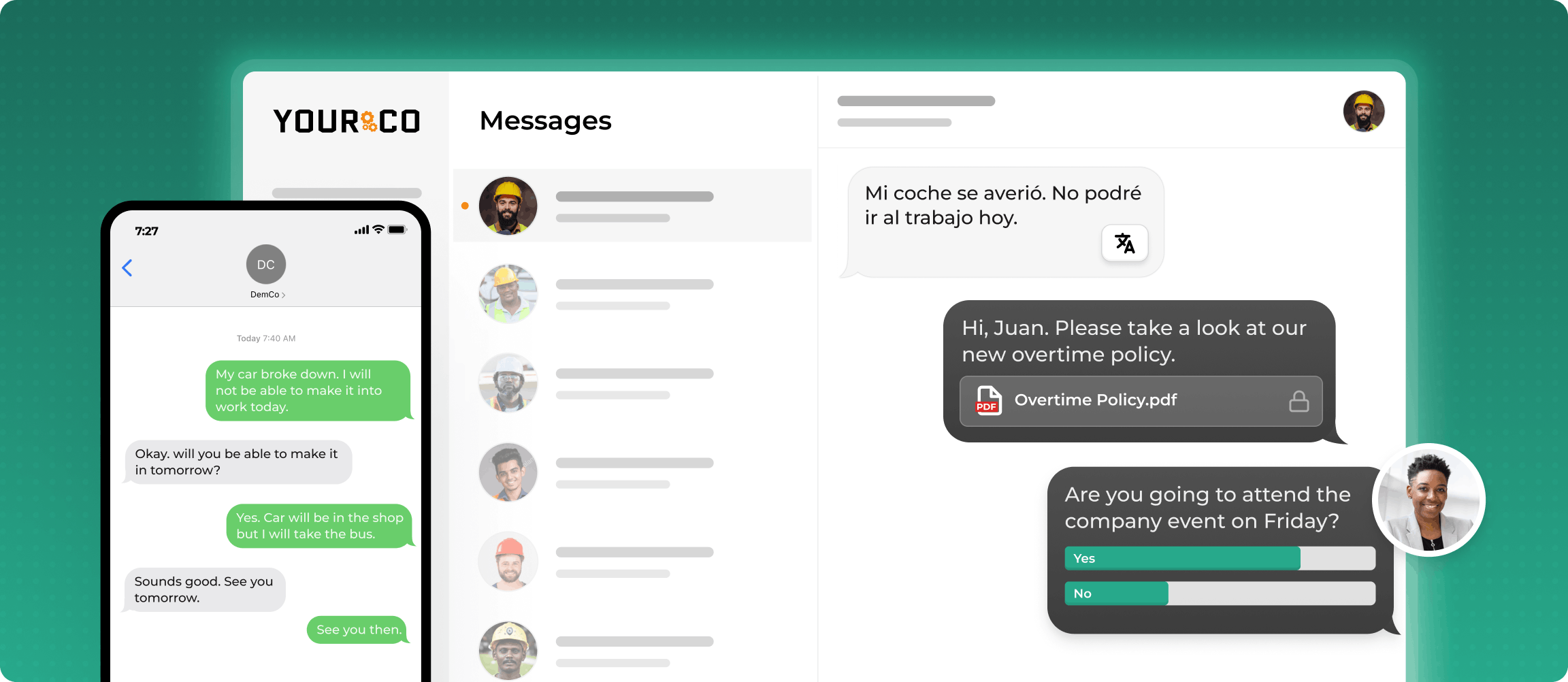
Clear communication makes the 2026 overtime rules easier to manage alongside payroll updates. Yourco supports reaching frontline employees via Short Message Service (SMS), which works on any mobile phone, including basic flip phones, with no app download and no cost to employees.
Yourco delivers the core capabilities frontline teams rely on:
SMS to any phone, including basic flip phones, with no app download or Wi-Fi
Two-way messaging so workers receive policy updates and can reply with questions
AI-powered translation across 135+ languages and dialects, so reclassification notices reach each worker in their preferred language
The system timestamps and archives every message, providing HR with the documentation trail that written-notice best practices call for. Yourco's 240+ HRIS and payroll integrations keep employee data synced as classifications and pay structures change. For multi-location employers, Enterprise Bridge lets corporate leadership send centralized, one-way policy updates across all sites, while local managers keep direct conversations with their teams.
Frontline Intelligence gives HR and leadership centralized visibility into how these changes land across every location. It tracks response patterns to policy updates and identifies sites where questions about pay or classification are increasing, so corporate teams can see which sites need follow-up before confusion turns into complaints.
Companies with large frontline teams describe the reach a single SMS channel provides.
"We have nearly 700 employees and 80% are non-desk based, communication is a challenge. Yourco provides a quick easy way to reach everyone and a secure way for employees to reach HR and leadership without a computer."
— Felisha Parker, VP Human Resources, McCarthy Auto Group
After 90 days on Yourco, companies see two-way employee engagement reach 86%.
Try Yourco for free today, or schedule a demo to see the difference the right workplace communication platform can make for your company.

Frequently Asked Questions About the 2026 Overtime Rules
What is the federal overtime salary threshold in 2026?
The federal threshold is $684 per week, or $35,568 per year, for executive, administrative, and professional employees, with a $107,432 annual threshold for highly compensated employees. The Department of Labor restored these 2019 levels through a technical amendment effective May 15, 2026, after courts vacated the 2024 rule.
Is the 2024 DOL overtime rule still in effect?
No, a federal court in Texas vacated it nationwide in November 2024; the Fifth Circuit dismissed the final appeal in May 2026; and the DOL formally rescinded the rule, effective May 15, 2026. Its $43,888 and $58,656 thresholds are not enforceable.
How does California's overtime law differ from federal law?
California adds daily overtime on top of the federal weekly standard: time-and-a-half after 8 hours in a workday, double time after 12 hours, and special rates on the seventh consecutive workday. California's exempt salary threshold, $70,304 per year in 2026, is also nearly double the federal level, and its duties test is stricter.
Who qualifies as exempt from overtime under federal law?
An employee qualifies as exempt only by meeting all three tests: payment on a salary basis, the $684 weekly salary level, and duties that satisfy the executive, administrative, or professional standards. Job titles alone never determine exempt status, and employers may choose to classify a qualifying employee as nonexempt and pay overtime instead.
What should employers do now to comply with the 2026 overtime rules?
Common practice is to audit every exempt classification against the federal $684 weekly threshold and any higher state threshold, verify duties tests, configure timekeeping for daily overtime rules in states like California, prepare payroll for the new W-2 overtime reporting, and provide written notice before any reclassification takes effect.
How should employers communicate overtime changes to frontline workers?
Give advance written notice that explains the change, the effective date, new timekeeping expectations, and a contact person for questions, using plain language and a channel workers actually see. SMS-based platforms like Yourco reach employees on any mobile phone in their preferred language, so reclassification notices and policy updates actually reach employees.