
California Private Attorneys General Act (PAGA) notices reached a record high in 2025, with an employment-law analysis of Labor and Workforce Development Agency (LWDA) data counting 10,098 notices for the year and reporting that the 2024 reforms did not reduce filings. For Human Resources (HR) and operations leaders running multi-location operations or frontline workforces, that number reflects a familiar tension: communication about last-minute shift changes often goes unrecorded, even when the payroll system is solid. Frontline recordkeeping breaks down when shift-change communications stay in personal texts or voicemail.
TL;DR
- Recordkeeping covers time worked, meal and rest periods, pay rates, and shift-change and call-out messages.
- The usual failure point for frontline teams is the communication layer, not the payroll system.
- Records go missing when a supervisor handles a schedule change via text or voicemail, and the change never reaches payroll.
- Retention often runs longer than baseline because California wage-claim and PAGA lookbacks can reach 4 years.
- SMS-based platforms like Yourco keep those messages timestamped and retrievable across locations.
Understand What Wage-and-Hour Recordkeeping Actually Covers
Wage-and-hour recordkeeping documents employees' work time and how employers pay for that time, including break activity. California's Industrial Welfare Commission Wage Orders require employers to keep records showing when an employee begins and ends each work period, as well as meal periods, split-shift intervals, and total daily hours worked. Labor Code Section 1174 adds a parallel duty to record daily hours and wages paid. These records are the evidence base if a pay question, audit, or claim ever surfaces.
Most organizations maintain several broad categories of records for these purposes. Understanding the categories helps clarify where the coverage is strong and where it thins out.
- Time and attendance records: start and stop times, meal periods, and total hours worked
- Meal and rest period documentation: when breaks begin and end for non-exempt workers
- Pay records: total wages paid and the applicable rates for hours worked each pay period
- Communication records: the messages and acknowledgments tied to shift changes and call-outs
Supervisors often handle shift changes in personal texts or voicemail that never reach payroll.
This awareness summary reflects general practice and is not legal advice; consult qualified counsel for guidance specific to your operation.
See Why the Communication Layer Is the Real Failure Point
Payroll administrators often receive recordkeeping guidance in the form of a compliance checklist. That framing assumes the hardest part is configuring the system correctly. For multi-location operations or the frontline workforce, record failures often begin in the communications that precede payroll. Employers may use any timekeeping method they choose, from time clocks to workers writing their own hours, as long as the records stay complete and accurate.
Supervisors often use personal texts or voicemail to manage shift swaps and call-out processes, which can break the record before payroll sees the change. When a worker deviates from a posted schedule, the record needs the actual hours worked. When a supervisor agrees to an early departure by text and never updates the system, the official record and reality no longer match.
When an employer's records are incomplete or inaccurate, the consequences fall on the employer. Under a longstanding Supreme Court rule, an employer who has not kept proper records cannot defeat a wage claim by arguing that the employee's estimate lacks precision, so a single missing record can create a much larger exposure across many workers and pay periods.
64 percent of HR leaders say frontline workers are significantly harder to reach than desk-based employees, and 69 percent call missed communication with these teams a recurring frustration, according to a Yourco-commissioned survey of 150 HR leaders.

Recognize Where Records Go Missing Across Multiple Locations
Frontline supervisors often spend much of their day on production floors or at field sites, and documenting a single incident, such as a tardiness event or an early send-home, can pull them away from operations during busy shifts. That pressure can delay documentation, and managers may enter timestamps after the fact or leave records incomplete. When this pattern repeats across dozens of sites, small omissions compound.
The classic scenario shows up before dawn. When a line operator calls off two hours before a shift, a manager may use a phone tree with no automatic log that shows which employees responded and what hours they confirmed, as described in shift-change practices. The entire exchange may exist only in text messages and voicemails with no connection to the payroll record.
Several conditions can leave records incomplete for multi-location operations:
- Time pressure: busy shifts leave managers with little room to log incidents as they happen
- Unmonitored channels: personal texts or calls, no one tracks, hold shift-change decisions
- Divergent local rules: an employer operating in Los Angeles County and elsewhere may face different documentation expectations for the same type of shift change
- Automatic deductions: an auto-applied meal-period deduction can miss a worked-through break unless someone flags it
Decisions about actual hours worked often occur through informal channels and never become part of a formal record.
Know How Long Employers Commonly Retain Records
Retention practices vary by record type and jurisdiction. Employers commonly cite baseline retention periods of around two to three years for wage and payroll records, according to DOL Fact Sheet #21, which sets a three-year floor for payroll records and a two-year floor for the underlying time cards and schedules. Many employers use practical benchmarks longer than the baseline periods.
Time records serve as the primary evidence in wage-and-hour lawsuits that can reach back four years under California law, according to an employment-law analysis of state retention rules. Because California's Unfair Competition Law statute of limitations and the PAGA look-back period can both extend that far, many employers align retention to the longer window. Any missing record in the most recent four years can be a live exposure, and communication records tied to shift changes often sit outside that retention plan entirely.
This retention discussion is for general awareness only and not a substitute for advice from qualified counsel.
Explore How Organizations Keep Records Organized and Retrievable
Organizations can address the retrieval problem by centralizing records so that teams can pull a clean report of every shift, break, and edit from a single place. A pen-and-paper record does little when a plaintiff's firm requests four years of documentation. Centralized systems also make it easier to apply configurable retention periods across jurisdictions.
Only 43 percent of frontline employees consistently receive the communications their companies send, and just 36 percent actually read them, according to the same Yourco survey. When shift-change conversations happen in scattered personal texts on top of that reach problem, everyday frustration can turn into missing documentation.
Several internal practices can help keep frontline records retrievable:
- Designated channels: route schedule changes and call-outs through monitored channels, so those decisions stay off personal phones.
- Timestamped logs: capture which workers managers contacted and what those workers confirmed.
- Role-based access: limit casual edits to keep records consistent.
- Regular audits: run internal reviews to catch missing records before an external request arrives.
When supervisors route a schedule-change decision through a monitored, logged channel, they create a retrievable record for decisions that would otherwise depend on memory.
Keep Every Shift-Change Record Logged and Retrievable With Yourco
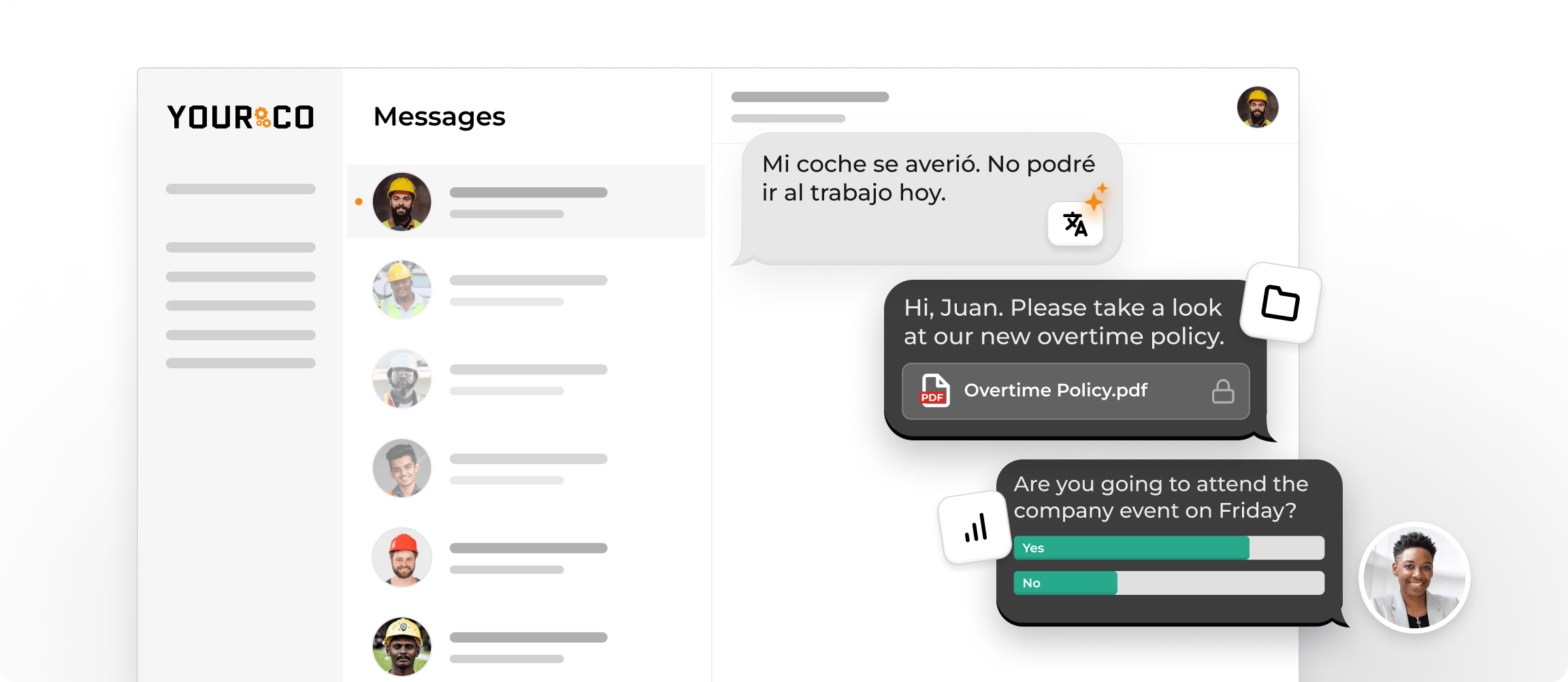
When communication around shift changes becomes a logged, timestamped channel, the gap between what happened and what was recorded narrows. Yourco is an SMS-based employee communication platform for frontline and multi-location workforces, capturing call-outs and shift-change notices in one place with a clear record.
For call-outs specifically, Yourco's AI Call-Off Agent carries the conversation itself: it asks the employee for any missing details, such as the dates and reason, confirms the request in plain language, and logs it automatically once confirmed, creating the same auditable record this article is about.
Yourco supports several recordkeeping-related workflows:
- SMS to any phone: workers receive messages on any phone with no app download, including smartphones and basic flip phones
- Two-way messaging: managers and workers confirm shift changes and call-outs directly
- Automatic translation: AI-powered translation covers 135+ languages and dialects for multilingual crews
- AI Call-Off Agent: automatically collects call-off details over text, confirms the request with the employee, and logs it without manager follow-up
Yourco connects to 240+ integrations across Human Resources Information System (HRIS) and payroll systems, keeping employee data synced across systems.
Enterprise Bridge allows corporate leadership to send centralized, one-way announcements and policy updates across all locations, while local managers maintain direct communication with their teams.
Frontline Intelligence gives HR and operations teams centralized visibility into call-off and shift-change communication activity across all locations. It generates reports on shift confirmations and response times, and it helps leadership identify call-off patterns by site or department. Corporate teams can see activity across all sites from a single dashboard, without waiting for each manager to relay what happened.
"We use Yourco for our absence management and for sending out notices and reminders to our employees. It keeps everyone who needs to know informed when people are absent, and if you have multiple supervisors, it's nice to set up notification settings so messages are only received at the times the supervisor has chosen."
— Kyle Stover, HR Assistant, J-Lenco Inc.
After 90 days on Yourco, companies see two-way employee engagement reach 86%.
Try Yourco for free today or schedule a demo to review how logged SMS records work for shift changes and call-outs.

Frequently Asked Questions About Wage-and-Hour Recordkeeping
What records do California employers commonly keep for wage-and-hour purposes?
Employers commonly keep time and attendance records, meal and rest period documentation, pay rates and wage data, and employee identification details. Many also keep records related to shift changes and call-off communications. These categories together form the evidence base for a pay question or audit that arises.
How long do employers typically retain wage-and-hour communication records?
Retention varies by record type and jurisdiction, and the right window depends on each organization's policy. Many employers align retention toward the longer wage-claim and PAGA look-back horizon, which can reach four years in California. They often retain communication records tied to shift changes, along with other payroll-related documentation.
Why do missing records appear around shift changes and call-outs?
Missing records often appear because shift-change decisions are made in personal texts or voicemails that never reach the timekeeping system. Frontline supervisors are busy on floors and field sites, so contemporaneous logging is easy to skip. The decision about actual hours worked then lives outside the official record.
Can shift-change communication become part of the record?
SMS-based platforms like Yourco capture shift-change and call-off conversations as timestamped, logged messages tied to specific employees and locations, and an AI Call-Off Agent can collect the call-off details and confirm the request automatically. This gives HR and operations teams a retrievable record of exchanges that might otherwise remain scattered across personal texts. Centralizing these exchanges keeps documentation consistent across multiple sites.
What makes multi-location recordkeeping harder than single-site recordkeeping?
Multi-location operations coordinate across different shifts and managers, sometimes under divergent local scheduling rules in places like Los Angeles County. When each site handles call-outs and swaps through personal phones, records fragment quickly. Centralized channels and consistent tools help keep documentation uniform and easy to pull across every location.