
A 30-second pulse survey is the fastest way to hear from busy retail teams and turn feedback into action. One focused question sent at the right moment gives you cleaner data than long forms and helps you make a specific decision. Use it to spot morale dips before peak season or check readiness ahead of a product launch. Keep the goal clear, keep the question simple, and your stores will actually respond.
Perceptyx 2026 data show that 81% of retail workers report burnout, and that feeling ranks as a top retention driver for retail frontline employees, above compensation. A well-designed retail employee sentiment pulse survey is one of the fastest tools available to close the gap between what employees experience and what leadership knows.
TL;DR
- One focused question outperforms long forms for shift workers every time.
- Each question in this guide maps to a specific business decision: morale, readiness, burnout risk, or retention risk.
- Auto-reminders, anonymity, and multilingual delivery are the three things that move response rates for retail teams.
- Closing the feedback loop after every survey is what keeps participation high in future rounds.
- SMS-based platforms like Yourco deliver pulse surveys to any phone, no app needed, with automatic translation in 135+ languages and real-time Frontline Intelligence.
Build a Survey Your Team Will Actually Complete
Single-question pulse surveys for retail employees yield more responses from busy shift workers while still providing reliable data. Store associates often spend eight-hour shifts on their feet, handling inventory, answering customer questions, and covering call-outs. They have a 15-minute break to grab food and check their phone. Completing a brief 30-second questionnaire is manageable in that time frame. A lengthy 20-question form is not.
Every pulse survey should answer one clear question: "What decision will this help me make?" Too many retail organizations send surveys to "check the temperature" without connecting responses to specific actions. Gallup warns that leaders "overuse pulse surveys to get immediate feedback and rarely take action on the results," and employees who see no change after participating stop responding entirely. That distrust kills future participation. Define the decision before you send a single question.
Start by identifying the business decision you need to make within the next two to four weeks:
- Are you trying to spot morale dips before your holiday-rush staffing falls apart?
- Are you preparing to roll out a product launch and need to confirm whether your team feels ready?
The clearer your intent, the more actionable your survey data becomes. If you can't specify the specific decision you'll make based on the results, you're not ready to send the survey. For step-by-step guidance on designing surveys that drive action, learn how to create an employee engagement survey that captures meaningful insights from your frontline teams.
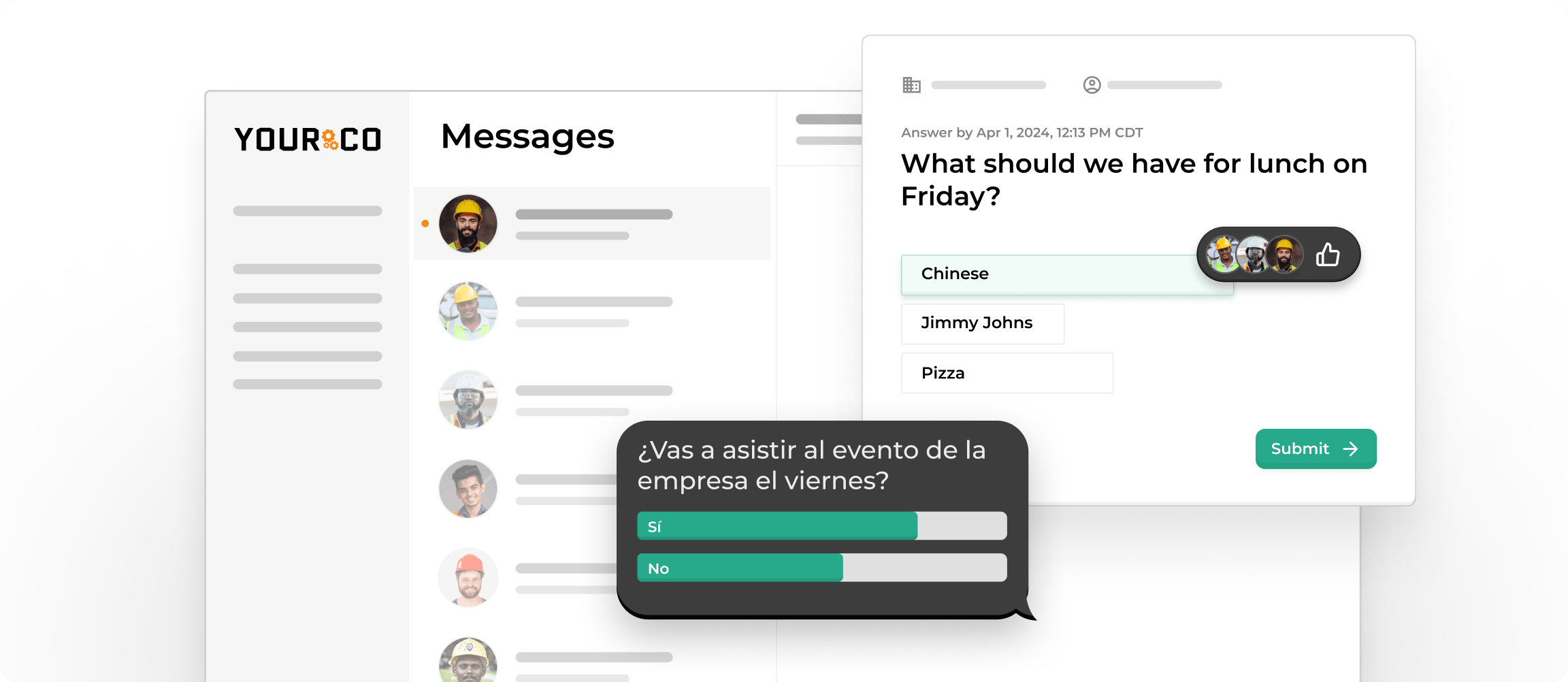
Make sensitive surveys anonymous from the start. More than half of employees are not fully honest when giving feedback to HR because they fear retaliation. Build trust before the first survey by communicating clearly, in every language your team speaks, that responses cannot be traced to individuals. Yourco's SMS surveys include an anonymity toggle you can enable per survey, so employees can see that protection is active before they answer any questions.
Choose One Question That Captures What You Need Most
Each question below targets a distinct insight, so you can pick the one that matches your current decision. Start with the outcome you need, then select the question designed to surface it.
Overall Job Satisfaction
"All things considered, how satisfied are you with your job?" (1–5 scale: Very Dissatisfied to Very Satisfied)
Run this monthly as your anchor question to track baseline morale by location and shift. When scores drop at specific locations, schedule manager conversations within two weeks to identify causes before satisfaction issues spread.
Manager Effectiveness
"Does your supervisor, or someone at work, seem to care about you as a person?" (Yes/No)
Use this monthly survey as a standalone measure of manager connection quality, one of the strongest predictors of engagement. Because this question touches on the direct manager relationship, enable the anonymity toggle before sending. Low scores reveal which managers need coaching on connection and support, while high scores show you which supervisors are keeping teams engaged.
Recognition Consistency
"In the last seven days, have you received recognition or praise for doing good work?" (Yes/No)
Run this weekly to see whether managers are acknowledging good work in real time. The seven-day timeframe makes this well-suited to weekly pulses. Recognition directly impacts motivation and retention. Well-recognized employees are 45% less likely to have changed organizations two years later.
Workload Balance
"Was your workload fair this week?" (1–5 scale)
Send this weekly to catch staffing pressure signals before burnout sets in. A fair workload is balanced relative to staffing and reasonable expectations. If scores remain low for two consecutive weeks, redistribute coverage before burnout spreads.
Role Clarity
"How clear are you about what's expected of you?" (1–5 scale)
Use this monthly to catch expectation shortfalls in customer-facing positions. Gallup data shows that only 46% of employees clearly know what is expected of them at work, down from a high of 56% in 2020. That 10-point drop makes role clarity one of the fastest ways to move engagement scores. Send this monthly to catch unclear expectations early.
Schedule Predictability
"Did you receive your schedule with adequate notice this week?" (Yes/No)
Use this after schedule changes to see whether managers are providing sufficient advance notice. Schedule changes are one of the strongest predictors of retention among hourly workers. When scores stay low after a policy update, something isn't landing as intended.
Development Support
"Does your manager provide helpful feedback?" (1–5 scale)
Deploy this every other week as its own pulse to track coaching quality at the location level. Consistently low scores at specific locations signal that managers need training in giving constructive guidance. Only 21% of workers strongly agree they received meaningful feedback from their manager in the past week.
Operational Barriers
"Do you have the resources you need to succeed?" (Yes/No)
Run this as a weekly standalone to catch on-the-ground friction, missing equipment or system failures, before they affect customer experience or performance. It's fast to complete and easy to track over time.
Event Readiness
"Do you feel ready for next week's product launch?" (Yes/No)
Send this one week before major events to find training coverage shortfalls before they become floor problems. "No" responses give you time to schedule quick refresher sessions or provide additional resources before issues arise.
Morale Status
"How positive do you feel coming into work this week?" (1–5 scale)
Run this as a standalone monthly report to track early warning signs of disengagement at specific locations. If scores drop suddenly at one location, meet with the manager within two weeks to identify the cause.
Wellbeing and Burnout Early Warning
"My organization cares about my overall wellbeing." (1–5 scale: Strongly Disagree to Strongly Agree)
Pair this monthly with your satisfaction anchor to spot burnout risk before it drives turnover. With 81% of retail workers reporting burnout and 40% saying their manager rarely checks on their stress, this question surfaces a concern that ranks above compensation as a retention driver for frontline retail staff.
Retention Risk
"I rarely think about looking for a job at another company." (1–5 scale: Strongly Disagree to Strongly Agree)
Run this quarterly to identify which locations or shifts carry the highest flight risk. Because the cadence is quarterly, set up automated follow-up reminders for non-respondents so the response window doesn't close before everyone has had a chance to reply. Scores trending below the midpoint over two or more quarters are a reliable signal that a location needs attention. Prioritize which managers and teams need the most support before departures hit.
For any of these surveys, consider adding a short text box for optional context: "Anything else you want us to know?" Keep this optional. It reduces completion anxiety while giving employees a chance to share details that might explain their ratings or flag urgent concerns.
As responses accumulate across questions and locations, Frontline Intelligence turns that data into patterns you can act on, surfacing which stores are drifting on morale, which shifts show rising burnout signals, and where retention risk is climbing before it shows up in your turnover numbers.

Close the Feedback Loop with Follow-Up Communication
Retail employees who see no change after participating stop responding, so close the feedback loop after every survey. 92% of HR leaders say improved communication would improve frontline employee engagement, according to a Yourco-commissioned survey of 150 HR leaders, and acting visibly on survey results is one of the most direct ways to demonstrate that communication.
Pick one anchor question to ask consistently, like overall satisfaction or manager support, to track your baseline trend. Rotate between other questions monthly to target different priorities based on what's most important to your operation right now.
When results show problems, respond with specific actions and communicate those changes clearly. If workload fairness scores drop, announce immediate changes with concrete commitments. For example: "You told us coverage was too thin during lunch rushes. Starting next week, we're adding a floater position from 11 a.m.–2 p.m."
Share survey results and action plans with your team through multiple channels. Post commitments visibly in break rooms and stores, and discuss findings in shift huddles. This transparency shows employees that their voices lead to real improvements. To turn survey data into clear action plans, explore our guide on creating survey analysis reports with actionable insights.
SMS makes it easy to keep teams updated on progress without waiting for the next meeting. Send quick text updates when you implement changes based on survey feedback. A simple message like "Based on your feedback about scheduling, we've adjusted shift assignments starting Monday" shows immediate responsiveness and reinforces that participation matters.
Reach Every Retail Associate with Yourco
Retail pulse surveys only work when they reach the people who need to complete them. Most store associates don't have a corporate email address, don't check a company intranet, and are on their feet for most of their shift. Yourco delivers surveys directly via SMS so every associate can respond during a break, without an app or login.
Yourco's core capabilities for retail pulse survey distribution include:
- SMS delivery to any phone, including basic flip phones, with no app or login required
- Two-way messaging so associates can respond, flag concerns, and follow up directly with managers
- AI-powered translation across 135+ languages and dialects, so every associate receives surveys in their preferred language
- Native polling to build and send a quick pulse survey directly from the platform, without setting up a separate survey tool
- Manager seats so individual store leaders can log in and view their own location's results without waiting for a corporate report
Yourco integrates with 240+ HRIS and payroll systems to keep store rosters up to date, so surveys always reach the right associates without manual list management.
Enterprise Bridge enables corporate leadership to send centralized, one-way announcements across all retail locations simultaneously, keeping every store aligned on company-wide updates while store managers maintain direct two-way communication with their teams.
Frontline Intelligence gives retail HR and operations teams centralized visibility into pulse survey sentiment trends, participation rates, and burnout signals across all stores and shifts. For multi-location operators, it shows which stores are falling behind on participation and where morale scores are drifting, so leadership can intervene before disengagement becomes attrition.
"We are absolutely delighted with Yourco, which we use for HR communications with our team. It has significantly improved how we connect with employees, making it easier to share important updates, reminders, and announcements in real time. Yourco has become an essential tool in streamlining our internal communication and helping us maintain a strong, connected team. We couldn't be happier with the results."
— Courtney Martin, Recruiting Manager, The Seagate
After 90 days on Yourco, companies see two-way employee engagement reach 86%.
Try Yourco for free today, or schedule a demo to see the difference the right workplace communication solution can make for your company.
Frequently Asked Questions About Retail Employee Pulse Surveys
How often should I send pulse surveys to retail employees?
For most retail teams, a monthly or quarterly cadence is right. Quarterly aligns with reporting cycles, leaves time to review data and act on it, and avoids survey fatigue. Monthly pulses can supplement your quarterly rhythm when you need to track a specific issue, such as post-season morale or scheduling changes. Always avoid high-pressure retail periods, such as holidays or major sales events, when employees are already under pressure.
Should I make pulse surveys anonymous?
Yes, and communicate it explicitly before every survey goes out. Retail employees worry about retaliation if they share negative opinions, especially about their direct managers. More than half of employees are not fully honest when giving feedback to HR because they fear retaliation. SMS-based platforms like Yourco include an anonymity toggle that allows responses to be anonymous per survey. Communicate these protections in every language your team speaks before each survey goes out. When employees trust the process, response quality improves.
What should I do if survey results are consistently negative?
Consistently negative results require an honest response, not a defensive one. Share the findings with your team and acknowledge the problems they've identified. Focus on the top two or three issues you can realistically address in the next 30 to 60 days. Communicate your action plan clearly, assign ownership for each improvement, and provide regular progress updates. Ignoring negative feedback or failing to act on survey results creates more harm than not surveying at all. 42% of employee turnover is preventable, and most of the preventable departures occur when managers don't address issues employees have already flagged.
How can Yourco help?
Yourco is built for exactly this use case: reaching frontline retail associates without apps, logins, or corporate email. It delivers pulse surveys through text so every associate can answer during a break, regardless of device, including basic flip phones. It automatically translates messages into 135+ languages and dialects, lets you enable an anonymity toggle per survey, and schedules automated reminders to boost response rates. Yourco's Frontline Intelligence surfaces sentiment trends and risk patterns across locations so managers can act on feedback fast, before disengagement turns into turnover.