
Most internal communication platforms were built for people with a desk, a laptop, and a company email address. Yet frontline workers make up 70–80% of the global workforce, roughly 2.7 billion people, and most of those workers lack reliable access to the communication channels companies rely on, according to BCG. If a significant share of the workforce operates on a warehouse floor, a delivery route, a job site, or a hotel floor, those platforms leave a large portion of employees unreachable. This guide compares ten platforms across the criteria that actually matter for frontline reach, starting with the one built specifically for them.
TL;DR
- Most internal communication platforms assume workers have a company email and time to check an app. Most frontline workers have neither.
- Frontline workers are hard to reach: no corporate login, no app, shift constraints, and language barriers all get in the way.
- The right platform works on any phone, needs no training, and confirms delivery without an inbox.
- Slack, Teams, and Staffbase depend on app adoption and logins, which limit their reach to the frontline.
- SMS-based platforms like Yourco reach every worker via text on any phone, with no app, email, or Wi-Fi required.
Why Internal Communication Platforms Fail to Reach Every Employee
Most communication platforms were built for desk workers. They assume a predictable workday with screen access, a company login, and time to check notifications. That works well for office teams, but it creates a blind spot for the workforce in manufacturing, logistics, hospitality, and field services, where reaching people mid-shift is far harder than it looks on a vendor demo.
When Communication Fails at the Worst Moment
A weather emergency on a job site, a safety hazard on a warehouse floor, or an unexpected shift change at a hotel: these are the moments when reaching workers in seconds is the difference between a managed situation and a crisis. When the channel fails, here is what actually happens:
- Phone trees break down at the first unanswered call
- Emails sit unread until someone is near a screen
- App notifications go unseen on a device locked in a locker
In manufacturing, warehousing, construction, and logistics, where critical information must reach people the moment it matters, any platform that relies on workers to proactively check for it is not a reliable emergency channel.
The Slow Burn: Disengagement From Being Left Out
When employees receive information late, inconsistently, or not at all, they read it as a signal that they are not a priority. That feeling drives employee disengagement and turnover, which repeatedly costs HR leaders time and budget to address. Across every metric HR leaders track, the pattern is the same: safety compliance drops, policy awareness becomes inconsistent, and workers who feel out of the loop disengage and leave.
For organizations with large frontline teams, the choice of platform is not just a technology decision. It determines whether workplace engagement is possible at all for a large share of employees.
The Top 10 Internal Communication Platforms at a Glance
The table below summarises how each platform performs across the criteria that matter most for workforce-wide communication and engagement.
Platform-by-Platform Breakdown
Each entry below includes what the platform does best, its key features, and where it falls short for frontline teams.
1. Yourco: Best for Frontline Teams
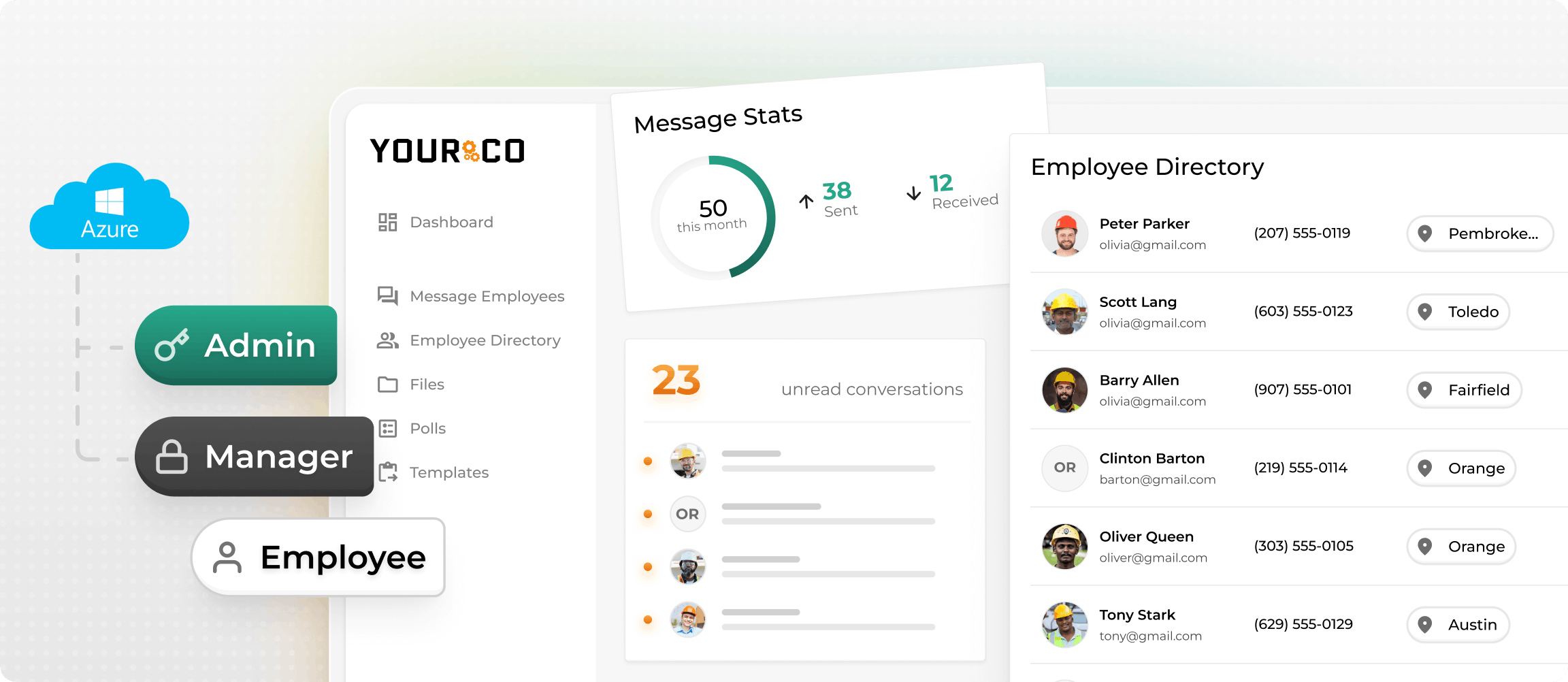
Yourco is an SMS-first, two-way internal communication platform built specifically for frontline workforces, and it's the strongest fit here for traditional industries running hundreds or thousands of frontline employees across multiple locations. Every message is delivered by text to any phone, including basic flip phones, with no app download, no Wi-Fi, and no company email required. Workers reply in their own language, and Yourco's AI translation automatically handles 135+ languages and dialects. For safety alerts, shift changes, absence reporting, and policy acknowledgments, Yourco reaches workers the moment the message is sent.
Key features:
- SMS to any phone, including basic flip phones, no app or Wi-Fi needed
- Two-way messaging for shift confirmations, absence reports, and surveys
- AI translation across 135+ languages and dialects
- Emergency alert delivery via SMS, which carries open rates consistently cited above 90%, significantly higher than email or app notifications
- Frontline Intelligence gives leadership centralized visibility into engagement signals, call-off patterns, and safety concerns across every location
- 240+ HRIS and payroll integrations keep employee records, contact lists, and language preferences synced automatically across systems
- Enterprise Bridge lets corporate leadership send centralized announcements across every location while local managers keep direct two-way contact with their own teams
- Enterprise-grade security, including role-based permissions and enterprise identity and access management, to protect data across every location
Best for: Large, multi-location frontline organizations in manufacturing, logistics, warehousing, hospitality, transportation, and field services.
2. Staffbase: Best for Employee Apps and Digital Intranets
Staffbase provides a centralized employee app with a news feed, HR policy library, and analytics. It works well for organizations with the IT resources to manage app deployment and a workforce that checks workplace apps regularly. Frontline reach depends on app adoption, which introduces a barrier that SMS-based communication entirely removes. Best used alongside an SMS-first tool for frontline workers.
Key features:
- Branded employee app with news feed and content management
- HR policy library and document access
- Intranet with editorial publishing workflow
- Engagement analytics and reporting dashboard
- Push notifications for app users
Best for: Organizations building a branded employee app and digital intranet for desk and hybrid employees.
3. Workvivo: Best for Hybrid Teams and Culture Building
Workvivo delivers a social-media-style experience with peer recognition, live streaming, and community spaces. It builds engagement among employees who regularly check workplace apps, but does not reliably reach frontline workers who cannot check a feed during shifts or who use basic phones.
Key features:
- Social feed with peer recognition and shoutouts
- Live streaming and video broadcasts
- Community spaces and interest groups
- Pulse surveys and employee feedback tools
- Integration with Zoom for video events
Best for: Hybrid teams and organizations focused on culture, recognition, and social connection.
4. Slack: Best for Agile, Desk-Based Collaboration
Slack is a strong collaboration tool for desk workers with a broad app ecosystem and searchable channel history. While it has added mobile and async features over time, frontline workers who cannot monitor a feed during shifts or who rely on basic phones without the Slack app are not reliably reached through this channel.
Key features:
- Real-time channel-based messaging with threaded replies
- Searchable message history across channels
- App marketplace with 2,600+ integrations
- Workflow automation with Slack Workflow Builder
- Voice and video huddles for quick team calls
Best for: Agile, technical, and desk-based teams that need real-time channel-based messaging.
5. Microsoft Teams: Best for Microsoft 365 Organizations
Microsoft Teams integrates tightly with Outlook, Word, and SharePoint and is a natural fit for office-first environments. Microsoft has added dedicated Frontline Worker licenses, a Shifts module, and a Walkie Talkie feature, but these still require an M365 license, a login, and consistent smartphone use. Workers who lack work-provisioned devices or reliable data access fall outside their reach.
Key features:
- Chat, video calling, and file collaboration in one interface
- Deep Microsoft 365 integration, including Outlook and SharePoint
- Teams Walkie Talkie app for push-to-talk on mobile
- Meeting recording and transcription
- Enterprise-grade security and compliance controls
Best for: Organizations standardized on Microsoft 365 that need unified calling, chat, and document collaboration.
6. Connecteam: Best for Mobile Field Operations
Connecteam is a mobile-first operations platform with scheduling, task management, time tracking, and in-app chat. It has strong adoption among small and mid-sized frontline operations where managers can actively drive app installation. Workers on basic phones or without reliable data connections fall outside its reach, and adoption remains dependent on individual employee uptake.
Key features:
- Mobile app with scheduling, time clock, and task management
- In-app team chat and direct messaging
- Digital forms, checklists, and a knowledge base
- Employee training and onboarding modules
- GPS time tracking for field teams
Best for: Mobile field operations teams where managers can ensure smartphone app adoption.
7. LumApps: Best for Global Enterprise Personalization
LumApps delivers personalized news feeds, knowledge management, and HR integrations through a web and mobile portal. Its analytics make it effective for large organizations managing complex internal communication. Frontline accessibility is limited by the login requirement and the assumption of regular screen time.
Key features:
- Personalized news feed by role, location, and language
- Knowledge management and document repository
- HR system integrations, including Workday and SAP
- Engagement analytics and content performance reporting
- Multi-language support with localized content delivery
Best for: Global enterprises that need personalized employee communications across a desk-based workforce.
8. Happeo: Best for Google Workspace Organizations
Happeo combines intranet, social communication, and knowledge management within the Google Workspace environment. Teams already using Gmail and Google Drive will find the integration straightforward. Frontline reach is limited by the Google login dependency and the assumption of regular browser or app access.
Key features:
- Intranet with pages, channels, and a unified search
- Native Google Workspace integration across Gmail, Drive, and Meet
- Social feed with reactions, comments, and @mentions
- Knowledge base and structured content pages
- Analytics on content reach and employee engagement
Best for: Google Workspace-centric organizations building an intranet and communication hub.
9. Poppulo: Best for Enterprise Internal Email and Signage
Poppulo is built around email, with digital signage and intranet capabilities added alongside. It helps internal communications teams manage editorial calendars, segment audiences, and measure email engagement. Frontline workers without company email accounts are not reached through its primary channel.
Key features:
- Internal email campaign management with audience segmentation
- Digital signage for break rooms, lobbies, and shared screens
- Intranet with news and policy content
- Email engagement analytics, including open and click rates
- Multi-channel publishing from a single editorial dashboard
Best for: Mid- to large enterprises that rely on strategic internal email campaigns, newsletters, and digital signage.
10. Sociabble: Best for Employee Engagement and Advocacy
Sociabble combines employee engagement tools with advocacy features, surveys, and analytics. It includes some frontline communication features and supports mobile access. Reach still depends on workers downloading and regularly using the app, which creates the same adoption barrier as other app-first platforms.
Key features:
- Employee advocacy tools for social media sharing
- Pulse surveys and engagement measurement
- Gamification with challenges, points, and leaderboards
- Mobile app with news feed and team communications
- Content targeting by role, location, or team
Best for: Employee engagement, brand advocacy, and frontline communication in organizations where app adoption is achievable.
How to Choose the Right Internal Communication Platform
Choosing the right platform depends on three things: who your workers are, what devices they actually use, and whether your strategy is built for everyone or just the people nearest a screen.
Start With Your Workforce Mix
- Mostly frontline or shift-based: An SMS-first platform is the only reliable option. Every worker needs to be reachable on any phone without an app, login, or company email. Platforms that depend on app adoption will leave a portion of your workforce unreachable before they even launch.
- Mostly desk-based: Slack, Microsoft Teams, Workvivo, or Poppulo match how office workers already communicate. These tools are built for screen-first workdays and integrate well with existing productivity stacks.
- Mixed workforce: The most effective approach pairs an SMS-first tool for frontline workers with an app or intranet for desk-based employees. Forcing a single channel on both audiences results in low adoption in at least one group.
Evaluate Any Platform Against These Criteria
Not all communication tools deliver equally on the dimensions that matter most for workforce-wide reach. Before committing, check each platform against:
- Accessibility: Does it work on any phone, including basic flip phones, with no app or email required?
- Reliability: SMS open rates consistently exceed 90%, significantly higher than email or app notifications, making it the most reliable channel for time-sensitive messages.
- Emergency alerts: Can urgent messages reach workers in seconds, not after they next open an app?
- Two-way engagement: Can workers reply, report absences, and acknowledge safety directives?
- Multilingual support: Do messages translate automatically into each worker's preferred language?
- HRIS integration: Does employee data remain in sync without manual upkeep?
- Compliance: Does the platform archive messages and provide audit trails for regulated industries?
Ask Whether Your Strategy Is Genuinely Inclusive
A platform choice is also a signal to employees. When the same information reaches everyone simultaneously, in a language they can read, through a channel that fits their workday, it signals that workers are part of the operation. When communication is inconsistent or filtered through layers of verbal handoffs, workers read that signal too.
Before committing to any platform, ask these questions to test whether it is genuinely built for inclusion:
- Can every employee receive a message right now, without downloading anything or logging in?
- Will a worker who speaks Spanish, Vietnamese, or Haitian Creole automatically receive it in their own language?
- Can workers respond, ask a question, or flag a problem through the same channel?
- Does the platform create a record that HR can review for compliance or audit purposes?
- Can leadership see whether a message actually reached workers, or only whether it was sent?
SMS-based platforms like Yourco answer yes to all five by design. The platforms that score highest on the criteria above are those where inclusive communication is built into the product's design, rather than treated as an add-on feature.
Reach Your Entire Workforce With Yourco
The best internal communication platform is the one that reaches every employee, not just those with a laptop and a company inbox. For organizations with large frontline workforces, that means starting with SMS. 69% of HR leaders say missed or poor communication with frontline employees is a recurring source of frustration, according to a Yourco-commissioned survey of 150 HR leaders.
Yourco gives HR and operations leaders a direct, reliable way to reach every worker on the device they already carry:
- SMS to any phone, including basic flip phones, with no app download or Wi-Fi required
- Two-way messaging so workers can confirm shifts, report absences, and respond to surveys
- AI translation across 135+ languages and dialects
Yourco connects to existing systems via 240+ HRIS and payroll integrations, keeping employee data and language preferences automatically synced.
Enterprise Bridge enables corporate leadership to send centralized, one-way updates to every frontline location while local managers maintain direct two-way communication with their teams.
Frontline Intelligence gives HR and operations teams centralized visibility into communication patterns across all locations. It surfaces disengagement signals, highlights safety concerns as they appear in messages, and tracks engagement trends by site or department so leadership can see where updates are not landing before the problem compounds.
"The Yourco texting system has helped the Railroad communicate with a 24/7 workforce. Sharing weather events, safety concerns and company bulletins have been priceless."
— Carl Kocur, Vice President of Engineering, New Orleans Public Belt Railroad
After 90 days on Yourco, companies see two-way employee engagement reach 86%, according to Yourco internal data.
Try Yourco for free today, or schedule a demo to see the difference the right workplace communication solution can make for your company.y
Frequently Asked Questions About Internal Communication Platforms
What makes an internal communication platform good for frontline workers?
A platform works for frontline workers when it reaches them without requiring a company email, app download, or reliable Wi-Fi. SMS-based platforms like Yourco deliver messages to any phone and support two-way replies, acknowledgments, and multilingual translation without any app or login.
Why do tools like Slack and Microsoft Teams miss frontline employees?
Slack and Microsoft Teams are designed for desk workers who spend the day at a screen. Frontline employees on warehouse floors, job sites, or delivery routes cannot watch a chat feed during shifts, and many lack company accounts or smartphones that support these apps.
Can one platform work for both desk and frontline employees?
One platform rarely serves both audiences equally well. Most organizations use a desk-first tool for office employees and an SMS-first tool for frontline workers, since forcing frontline workers onto a desk-first platform leads to low adoption and missed messages.
How does multilingual support work in SMS-based platforms?
SMS-based platforms like Yourco use AI translation to automatically convert messages into each worker's preferred language before delivery. Workers reply in their own language, and the system translates responses back to the manager with no manual step required.
What is the 98% SMS open rate, and why does it matter?
The 98% SMS open rate is an industry benchmark reflecting how frequently text messages are opened compared to email or app notifications. Safety alerts and shift changes need to reach workers reliably, not sit unread in an inbox that workers check only when near a screen.
How do I start communicating with frontline workers today?
Start by identifying which workers have no access to company email or apps, then choose a channel that reaches them by phone number alone. SMS-based platforms like Yourco require only a phone number, support two-way messaging from day one, and integrate with most HRIS systems automatically.