
SHRM-aligned benchmarks commonly estimate the cost of replacing an employee at 50% to 200% of annual salary, depending on role level; practitioners often use around 150% as a working figure for mid-level roles when building a CFO-ready business case that includes separation, recruiting, training, and lost productivity.
A purchase of a frontline communication platform runs into buying-committee friction long before that math gets a hearing. Human Resources (HR) owns the reach-and-adoption case; Information Technology (IT) assesses whether the vendor poses a security risk; and Finance needs a number that withstands scrutiny. Each function holds an effective veto, and a stalled purchase can sit in review for months. Committees move faster when reviewing one business case in parallel than when reviewing one queue at a time.
TL;DR
- Build the business case before the vendor shortlist, starting with turnover and missed-shift costs
- A platform can demo well and still fail where workers lack email, devices, or app downloads
- Give each stakeholder the proof they need: reach for HR, security docs for IT, ROI/TCO for Finance
- Run security, legal, and commercial reviews in parallel to shorten procurement
- Plan rollout, manager training, and adoption metrics before signature
- SMS-based platforms like Yourco remove the reach barrier by working on any phone, no app or company email required
Build the Business Case Before the Vendor Shortlist
Finance approves purchases that reduce costs it can already see, which makes the starting point: turnover and missed shifts rather than platform features. For hourly roles, the cost of frontline turnover is high enough that even a modest retention gain can cover the cost of a subscription many times over.
Great Day Improvements, a home improvement company with 5,000 employees across 338 locations, shows how the arithmetic works in practice. Organization-wide retention rose from 87% to 93% after the company rolled out Yourco, according to its case study. Applying a conservative replacement-cost assumption of $5,000 per frontline employee puts the estimated annual value at $1.5 million. Manufacturing turnover fell from 12.7% to 2.3% over the measured period.
The cost of doing nothing belongs in the same document. 56% of HR leaders say their company has missed vital deadlines because it could not reach a frontline employee in time, according to a Yourco-commissioned survey of 150 HR leaders. Put platform cost and ROI beside documented stakeholder feedback, and ask the most conservative finance leader in the organization to pressure-test the assumptions before the pitch rather than after.
Pressure-Test Reach Before Features
A conference-room demo does not prove a platform reaches the warehouse floor. Many frontline workers have no company email or corporate device, and mid-shift intranet logins add another obstacle, so app-based tools stall during downloads, password resets, and resistance on personal devices.
The reach mechanism warrants scrutiny before the feature list. SMS works on any handset, including basic flip phones, with no internet connection, login, or training required. SMS-based platforms like Yourco make reach verifiable by sending messages to the phones workers already carry, which is why frontline-heavy buyers prioritize reach over richness when comparing employee communication tools.
A reach test settles what a demo cannot. Committees that assume the current channel works rarely check whether the night shift, the newest hire, or the worker on a basic handset actually received the last three announcements, and a proof of concept at the hardest site answers that before signature.
Reach belongs in the Request for Proposal (RFP) as a pass/fail requirement: the platform reaches every eligible worker without an app download or company email. The proof of concept should run at the hardest-to-reach site rather than the best-connected one.
Reach and security turn out to be the same question asked twice. Workers using the phones they already own are the operating model on a frontline site, not a risk to be engineered away, so neither review is about controlling employee handsets. Both come down to whether the company side of the conversation is governed, archived, and retrievable once the supervisor who had it moves on.
Give Each Stakeholder the Artifact That Answers Their Question
Consensus pays off. Buying groups that reach consensus are 2.5 times more likely to report that their deal was high-quality, according to a Gartner survey of 632 B2B buyers conducted in late 2024. Consensus comes faster when each function receives evidence tied to its own concern.
One shared case should go to the full committee. Gartner found that content tailored to the buying group fosters understanding and consensus, while individual-level relevance can reinforce confirmation bias and leave stakeholders less likely to embrace a unified direction.
Run the Security Questionnaire Before Negotiation Starts
An IT and security review should come before contract negotiations, because a late review that fails resets the timeline. The questionnaire can go out as soon as a shortlist is in place, and the answers that come back are as revealing as the controls themselves.
This section describes common buyer practice rather than legal or compliance advice, and organizations commonly confirm requirements with qualified professionals.
- Attestations: a current third-party security attestation or certification from an accredited body, such as ISO/IEC 27001 or SOC 2 Type II, plus a third-party penetration test from the past twelve months
- Encryption: named standards for data at rest and in transit, such as AES-256 and TLS 1.2 or 1.3. Protecting only one of the two leaves the other exposed, so both should be included in the answer.
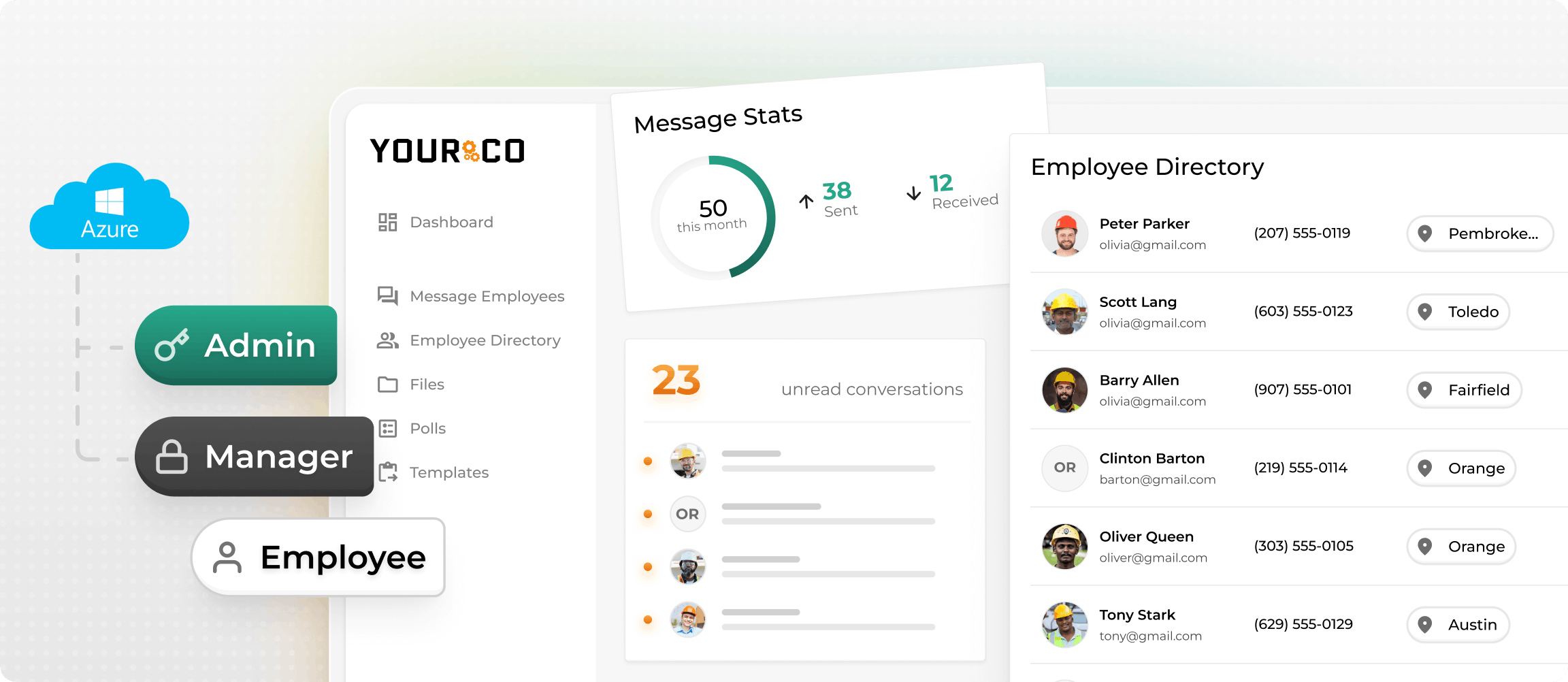
- Access controls: single sign-on (SSO) via Security Assertion Markup Language (SAML) 2.0 or OpenID Connect (OIDC), vendor-enforced SSO for admin accounts, multi-factor authentication for privileged access, and System for Cross-domain Identity Management (SCIM) provisioning so departing employees lose access automatically
- Data handling: named hosting regions, a named subprocessor list, configurable retention and deletion policies, and documented tenant segregation
- Incident response: a written and tested plan, contractual breach notification timelines, and post-incident root cause reports
A frontline questionnaire needs four items a desk-software questionnaire never asks, because the workforce owns the handsets:
- Device footprint: whether anything installs on a worker-owned phone, and what the vendor can access on it if so
- Number privacy: whether employee cell numbers stay hidden from other employees on group and all-staff sends, and whether supervisor numbers sit behind a company number
- Offboarding reach: whether removing someone from the directory ends their messaging and revokes access to files already sent, rather than only disabling a login
- Company-side records: whether the employer holds a retrievable copy of the exchange independent of any supervisor's handset, with timestamps
Vague answers such as "industry-standard encryption" signal a vendor that has not documented its controls and cannot name a specific control; it usually cannot provide evidence for it either. The last item is the one buyers skip and regret, because it decides whether the organization can produce a conversation after the supervisor who had it leaves.
Sequence Approvals in Parallel
An enterprise platform purchase involving security review, legal negotiation, and cross-departmental approval commonly runs 60 to 90 days. Legal review often becomes the single largest bottleneck, which supports triggering intake, legal, and IT reviews simultaneously.
A duplicate-tool check comes first, followed by a structured intake form covering what the team wants to buy and why, including the budget, routed to IT, Finance, Security, and Legal at once. Locking requirements before vendor evaluation begins matters because rescoping mid-process can delay approval.
A buyer-led proof of concept with written success metrics works best when the committee agrees in advance that hitting those metrics triggers commercial negotiation. Budget approval follows identification of a preferred vendor, then executive sign-off, then contract execution.
Two reviewers get left off the routing slip on frontline purchases. Operations owns shift coverage and will be asked to absorb any adoption friction, and site leadership decides whether supervisors treat the tool as their job or as an extra task. Where a collective bargaining agreement covers workplace communication or monitoring, union or works council consultation belongs in the same parallel track rather than after signature.
Naming an application owner before signature is worth the five minutes it takes. Without someone accountable for provisioning, support, and the renewal calendar, tools drift into zombie status and keep billing after teams stop using them.
Plan the Rollout Before Signature
The rollout plan belongs inside the business case because Finance remembers the implementation failure from the last HR technology purchase. Organizations that treat change management as a discipline rather than an afterthought tend to see better outcomes from HR technology, and adoption planning is usually where that difference shows up.
Managers come first. Gallup's global engagement research consistently identifies manager behavior as the strongest lever for team-level engagement, placing manager training ahead of worker training in the sequence.
A supportive site leader makes a good first location. Training runs in short, shift-friendly sessions across every shift, so night crews see the same announcements as day shift, and multilingual delivery should be live from day one. Workers engage when the platform becomes the home for something they need, such as schedule updates or absence reporting, and when their feedback visibly changes something.
Enrollment cannot assume an inbox. A platform that onboards workers by emailing an invitation excludes the people for whom the purchase was made, so the roster comes from the HRIS, and enrollment happens on the channel itself.
Measurement then closes the loop against that roster rather than against sign-ups: registered users as a share of the eligible workforce, delivery rates by location, and response rates by department, reported back to Finance on a set cadence after launch. Progress reports against the business case build credibility for renewal even when some targets land short.
Bring the Whole Committee to Yes with Yourco
When the business case depends on reach, the platform must be built for it. Yourco built its SMS-based employee communication platform for workforces without company email, corporate devices, or desk time, which puts the reach question to rest before the feature comparison begins.
- SMS to any phone, including basic flip phones, with no app download, login, or Wi-Fi required, at no cost to employees
- Two-way messaging so employees can respond, raise concerns, and report absences
- AI translation across 135+ languages and dialects, delivered in each worker's preferred language
- Enterprise-grade security with full message archiving and timestamped audit trails, plus real-time delivery tracking and invalid number identification
Yourco's 240+ HRIS and payroll integrations via open APIs keep employee data automatically synced, which addresses the integration debt IT raises early on.
Multi-location enterprises can use Enterprise Bridge for one-way corporate broadcasts from headquarters and senior leadership to the entire frontline, running alongside the two-way conversations local managers keep with their own teams.
Finance gains post-approval accountability through Frontline Intelligence, which turns everyday SMS communication into real-time insights into reach, engagement, sentiment, and workforce risk across locations. Adoption can be reviewed by site or department, and progress against the business case gets reported with data rather than anecdotes.
"Yourco is the best thing we did last year! We are able to send instant text message communications to all our employees. We have had other sites within Sherwin start to use them as well."
— Carolina Abrams, HR Manager, Sherwin-Williams - CEP
After 90 days with Yourco, two-way employee engagement increased to 86%.
Try Yourco for free today or schedule a demo to test SMS reach with a frontline workforce.
Frequently Asked Questions About Choosing a Frontline Communication Platform
Who should be on the buying committee for a frontline communication platform?
HR typically owns the purchase and champions the business case; IT and security review integrations and vendor risk; Finance and procurement own budget and contract terms, and Legal joins for negotiation. Adding operations leaders and a few frontline managers who will use the tool daily surfaces adoption problems before rollout.
How is ROI calculated for a frontline communication platform?
Start with costs that are already measured: turnover, missed shifts, and admin hours spent chasing acknowledgments. Model conservative improvements in each, compare against the total cost of ownership, and have the most skeptical finance leader review the assumptions before the presentation.
What should the total cost of ownership include?
License fees, implementation and professional services, training time, integration work, per-message costs for SMS-based platforms, and the internal admin hours required to run the tool. Quotes limited to license fees routinely understate multi-year cost, so every vendor should itemize the full picture before comparison.
What security questions should a frontline communication vendor answer?
A current third-party security attestation, named encryption standards for data at rest and in transit, single sign-on and automated deprovisioning support, data residency and retention policies, and contractual breach notification timelines. Vague answers such as "industry-standard encryption" signal a vendor that has not documented its controls.
How do buyers get IT and leadership buy-in for a new communication platform?
Involve IT at intake rather than after vendor selection, and hand over security artifacts up front so review runs in parallel with the business case. For leadership, lead with retention and absenteeism results and include the risk of missed safety communication. SMS-based platforms like Yourco simplify the IT conversation because there is no app to deploy, patch, or support on employee devices.