
A business text messaging service is a platform that lets a company send and receive SMS with employees or customers from a central, admin-controlled system, rather than from individual personal phones. For internal use, it reaches frontline workers on any mobile phone, including basic flip phones, without an app download, a company email address, or a data plan.
The best fit depends on the workforce: office teams with company email have more options, while frontline teams need a channel that works on the device every worker already carries.
Efficient communication underpins every successful business, but not every workforce sits at a desk with constant email and meetings. Internal text communication keeps warehouse floors, job sites, and production lines in the loop where email and chat apps cannot reach. The team at Yourco put this guide together to compare the options and explain why the channel matters most for frontline teams.
Office-first communication tools fail frontline workers because they assume a desk, a company email address, and constant screen access, which most frontline roles don't have. Email, intranets, and chat apps were built for office workers, so messages sent through them never reach the floor.
Frontline workers make up the large majority of the global workforce while receiving a fraction of enterprise software investment. These employees in manufacturing, construction, transportation, hospitality, and healthcare are the backbone of operations, yet they are dispersed across locations, shifts, and roles without consistent access to computers or corporate tools.
Most have no company email address, so the channels office teams rely on never reach them. Office workers process dozens of emails a day, but frontline employees are constantly moving, so those messages go unread. That breakdown undercuts engagement, operational efficiency, and business outcomes.
The main options are Slack, Microsoft Teams, WhatsApp, group texting, email, and dedicated SMS platforms like Yourco. For a frontline workforce, the deciding factor is whether a tool works without an app download, a company email, or a data plan, and whether HR retains visibility into what was sent. The table below compares them on that basis:
Slack is an instant messaging system that allows for numerous add-ons. Its primary function is to create channels where people share messages and files with one another. The problem is that frontline employees usually do not have access to this software, and more often they simply will not download and use it. That stays true even when the company already pays for in-office employees to use it.
Teams is a business communication platform developed by Microsoft. It performs many of the same functions as Slack but puts a higher emphasis on video conferencing. Its major downside is the same as Slack's: frontline and non-office employees will not easily use the product during the work day.
WhatsApp is a downloadable app that functions like normal texting. One problem is that employees get distracted and annoyed by group notifications that don't pertain to them. Because the service runs as a downloadable app that sends and receives over data rather than SMS, employees also need a data plan or Wi-Fi range to download the app and take part in the messaging.
Group chats and direct texting between employees are likely already happening during the workday. The major problem for employers is that managers and human resources have no visibility or control over the company texting that happens across the business.
Email remains a standard channel in many organizations, but it is far from ideal for frontline teams. Many frontline workers have no company email address at all, and those who do rarely open it during a shift. A channel that reaches only part of the workforce cannot carry urgent operational messages, whatever its engagement looks like among office staff.
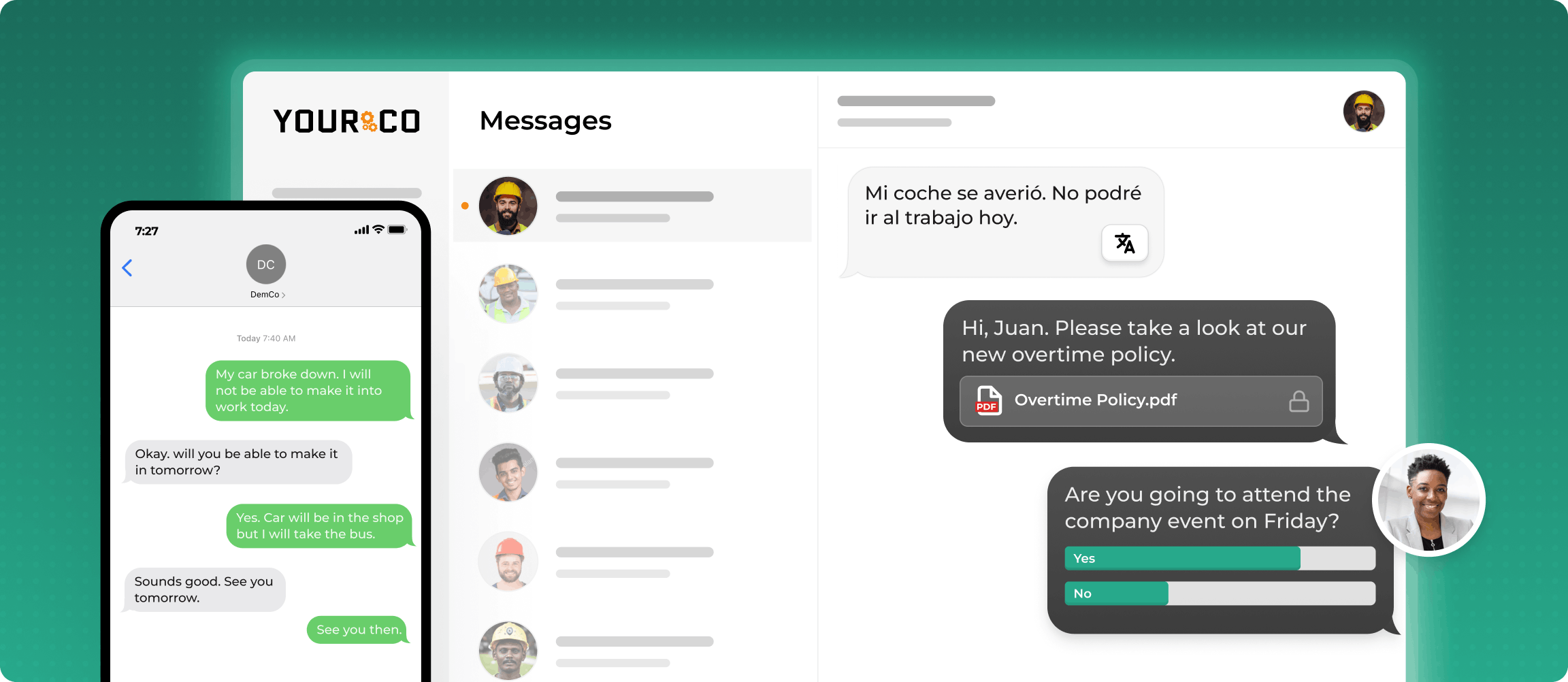
Yourco is a two-way communication platform that helps managers instantly reach frontline employees out in the field, around the shop, or on the production line where permitted. There is nothing to download, and employees can take part regardless of what phones they carry. A message sent through Yourco arrives as a regular text, so workers don't have to stop working or install an app.
Text messaging is the most effective channel for frontline communication because it reaches any phone instantly with no app, account, or internet required. That universality is exactly what office-first tools lack.
A text arrives on the lock screen of any mobile phone, with no app to open and no account to log into. Specifically for internal communication, 91% of HR leaders say that using SMS increases frontline employee response rates, according to a Yourco-commissioned survey of 150 HR leaders. Text messaging cuts through the noise that leaves emails buried and calls unanswered, and it carries no learning curve, so critical information reaches the floor almost immediately.
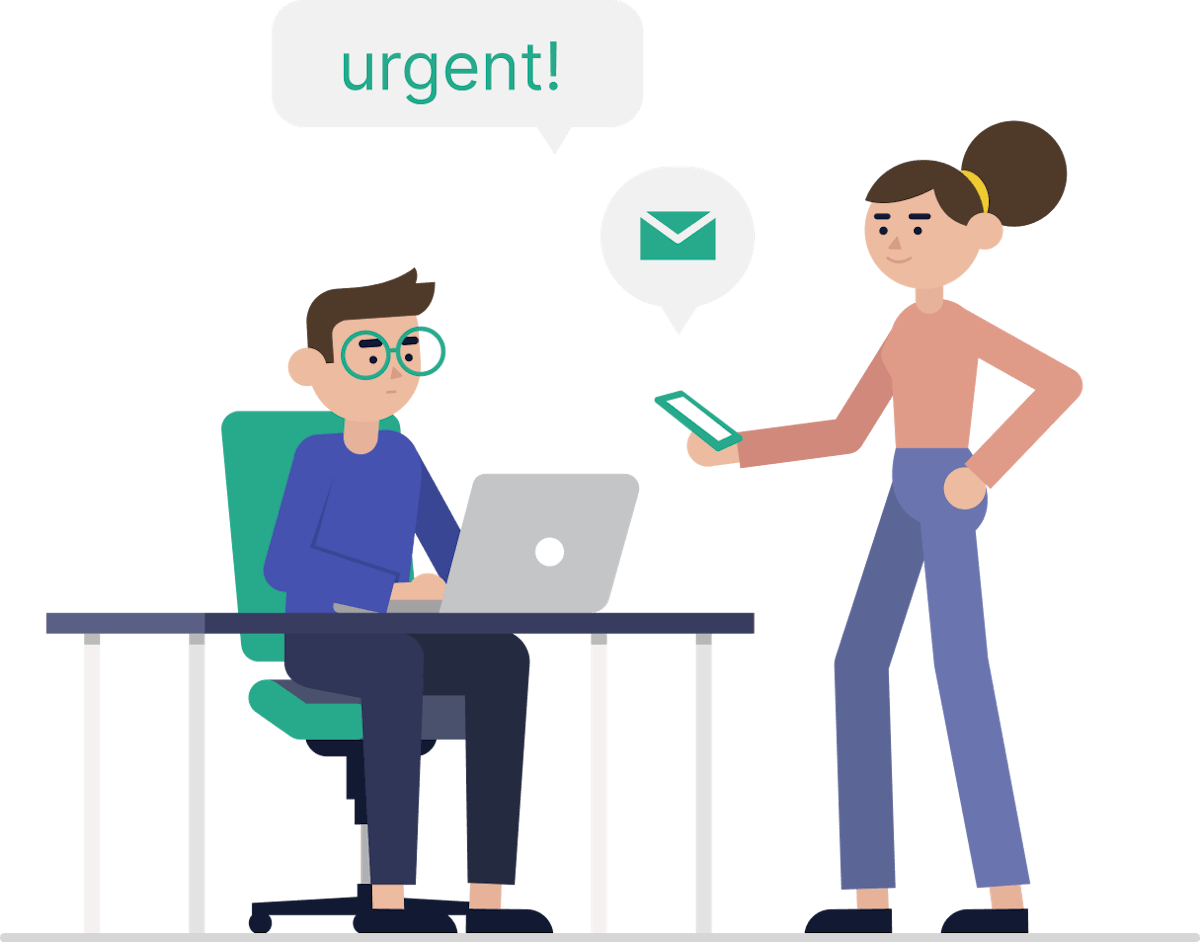
Internal business communication by text covers any operational message a company needs a frontline worker to see quickly: emergency alerts, company-wide announcements, scheduling, surveys, operational updates, and recognition. A capable SMS platform handles all of these through a single channel.
Emergency alerts warn teams about fires, severe weather, or other on-site hazards in seconds, which, in extreme cases, is a safety- and life-saving function. Company-wide announcements keep every department on the same page for organizational news. Scheduling messages confirm shifts, fill unexpected absences, and let workers flag conflicts early.
Employee surveys, sent anonymously, surface feedback workers may not raise face-to-face. Operational messaging communicates workflow and task changes clearly across the whole team. Employee recognition, a quick congratulatory text when a worker or crew does exceptional work, supports morale, and engaged employees tend to be measurably more productive.
An effective business text messaging service pairs universal SMS reach with enterprise features: security, scalable architecture, HRIS and payroll integration, and analytics with automation. Basic SMS sending alone is not enough for a workforce channel.
Security and data protection matter because consumer messaging apps lack enterprise-grade controls. A business platform should offer encryption, secure authentication, and full message archiving. Scalable architecture lets the system grow with the organization, with flexible plans for different messaging volumes.
Integration with HRIS and payroll systems keeps rosters and employee records automatically synced and reduces administrative work. Analytics and automation, including delivery and response tracking, message templates, scheduled sends, and role or location targeting, turn a broadcast tool into a manageable one. Team management features allow multiple admins to send and receive messages while maintaining a consistent voice.
Employers generally need employee consent to text them, and a compliant business SMS platform helps document that consent and ensure compliance with the Telephone Consumer Protection Act (TCPA), the Telemarketing Sales Rule (TSR), and carrier requirements. Capturing opt-in during hiring or onboarding is a common practice.
A service like Yourco supports compliance by confirming with carriers that the employer collected employees' cell numbers during recruitment or employment, and by monitoring the company's number to keep it in good standing. Respecting workplace boundaries by reserving after-hours texts for genuinely important matters, such as a schedule change or a benefits update, keeps internal SMS a positive channel.
This information is for general awareness only. For specific compliance guidance, consult with qualified legal professionals.
Yourco is an SMS-based employee communication platform built for frontline teams. Messages reach employees' phones as standard text messages, while HR and admins maintain web-side visibility, which supports transparency and accountability. The platform operates via dedicated business numbers to ensure compliance and professionalism.
Yourco delivers the core capabilities frontline teams rely on:
Yourco connects to 240+ HRIS and payroll integrations to keep employee data automatically synced as workers join, move, and leave.
For multi-location organizations, Enterprise Bridge supports one-way broadcasts from corporate leadership to the entire frontline, so every site receives the same update without requiring responses.
Frontline Intelligence gives HR and operations centralized visibility into communication activity across every location, so leadership can see which sites and departments are actually being reached rather than assuming a company-wide send landed everywhere.
One transportation employer describes what the channel handles across a round-the-clock operation.
"The Yourco texting system has helped the Railroad communicate with a 24/7 workforce. Sharing weather events, safety concerns and company bulletins have been priceless."
— Carl Kocur, Vice President, Engineering, New Orleans Public Belt Railroad
After 90 days with Yourco, two-way employee engagement increased to 86%.
To see the difference Yourco can make, contact us to set up a demo or try it out for free today.
The best service depends on the workforce. For frontline and non-office teams, the best fit is an SMS platform that works on any phone without an app, company email, or data plan, while giving HR central visibility. For all-office teams already on company email, chat tools like Slack or Teams can suffice. Yourco is built specifically for frontline internal communication.
The main business messaging tools are Slack, Microsoft Teams, WhatsApp, group texting, email, and dedicated SMS platforms like Yourco. Slack and Teams suit office teams; SMS platforms reach frontline workers who lack company email or won't install an app. The right choice depends on whether the workforce is desk-based or frontline.
For frontline workers, yes. Many have no company email address, and a text reaches any mobile phone without an app, an account, or a data plan. Email remains useful for office staff and for longer, document-based communication where attachments and a threaded record matter.
Generally, yes, employers should obtain consent, typically obtained during hiring or onboarding, and comply with the TCPA, TSR, and carrier rules. A compliant business SMS platform helps document consent and maintain good standing with carriers.
Yes, a standard SMS platform reaches any mobile phone, including basic flip phones, without requiring an app download, Wi-Fi, or a data plan. This is the main reason SMS reaches frontline workers that app-based tools miss.