
Each additional patient added to a nurse's workload raises the risk of patient death by 7%, according to an Ontario staffing brief. An early-morning text that a nurse cannot make day shift starts a familiar charge-nurse scramble: check the census against the licenses on the floor, then work down a call list. Managers who pair a defined coverage process with Short Message Service (SMS) outreach to off-duty staff fill shifts sooner and keep a record that defends the decision later.
TL;DR
- A healthcare call-off is an employee's notice that they cannot work a scheduled shift.
- It differs from a no-call/no-show and from a facility-canceled low-census shift.
- An uncovered shift raises patient risk and can drop a unit below mandated ratios.
- Cover open shifts in tiers: float staff, off-duty outreach, the float pool, per diem, then agencies last.
- Document every call-off with a timestamp, the stated reason, the coverage outcome, and a protected-leave check.
- SMS-based platforms like Yourco reach every off-duty nurse's phone and automatically keep records.
What a Healthcare Call-Off Means
Healthcare call-offs are employee-initiated notifications that a nurse or staff member cannot work a scheduled shift, typically made within 24 hours of the shift's start. Facilities use "call-off," "call-out," and "calling in sick" interchangeably, and the preferred term depends mostly on region and facility convention.
Two related terms carry different weight. A no-call/no-show (NCNS) means the employee never notified anyone, and published healthcare policies assign heavier consequences, such as final written notice, separation, or job abandonment, when the pattern repeats, whereas a proper call-off carries a lesser consequence. In a low-census call-off, the facility cancels a nurse's shift because patient volume is too low, and well-written policies exclude that time from attendance tracking entirely.
Attendance policies also set notice windows, and dedicated nursing call-off guidelines may require staff to notify a designated call-off line before the start of the shift. Miss the window and the facility may process the absence as an NCNS rather than a call-off.
Treat Every Healthcare Call-Off as a Patient-Safety Event
Replications of the added-patient mortality finding have been reported in Canada, Europe, Australia, and South Korea. An uncovered shift raises the patient load on everyone left on the floor, so a single healthcare call-off can push a unit into that danger zone.
Four states have enacted mandatory nurse-to-patient ratio laws, according to a staffing-ratio overview: California and Oregon across all units, Massachusetts and New York in intensive and critical care. Where those ratios bind, an uncovered shift becomes a same-day, documentable exposure.
In long-term care, CMS repealed its 2024 minimum staffing rule in an interim final rule published on December 3, 2025. The Federal Register notice states that the pre-existing staffing standards are restored, while the quantitative minimum staffing provisions remain unenforceable until September 30, 2034.
This information is for general awareness only. For specific compliance guidance, consult with qualified legal professionals.
Follow a Tiered Process to Cover the Open Shift
When healthcare call-offs land, managers escalate through internal resources before paying external premiums. A consistent sequence keeps coverage decisions uniform across charge nurses and shifts:
- Start with census, patient acuity, and minimum staffing thresholds: not every open slot requires backfill
- Float from overstaffed units when the float nurse's competencies match the receiving unit's patients
- Contact off-duty staff with voluntary overtime and incentives such as bonus pay or paid time off (PTO), and let people decline without pressure so fatigue does not become the next safety risk
- Activate the internal float pool: credentialed, flexible staff hired specifically to cover open shifts
- Post remaining openings to per diem or on-demand staff when credentialed professionals are available
- Use an external agency last
External agency coverage is expensive: travel nurses average $91 per hour, according to the 2026 NSI report, which is why agencies belong at the bottom of the sequence rather than the default. The same tiered escalation works in high-volume logistics operations.
Document Every Healthcare Call-Off for an Auditable Record
Every healthcare call-off record should follow documentation basics: who, when, how, and what happened next. Capture at minimum:
- Date and shift of the absence
- Time the employee gave notice, and the method used, including the call-off line or text channel when applicable
- The stated reason, which flags whether leave-law review applies
- Who received the notification
- Who covered the shift, by what method, and at what cost
- Any points or occurrences managers assessed, with protected absences excluded
Managers use these records for two purposes. For skilled nursing facilities, CMS calculates staffing hours from Payroll-Based Journal (PBJ) submissions, so a call-off log showing who covered the shift and for how many hours helps show how the facility staffed a call-off date.
For leave disputes, the Department of Labor requires employers to keep Family and Medical Leave Act (FMLA) records for at least three years and to issue a written designation notice within five business days after obtaining sufficient information. The rule does not require a specific form or digital system, only that records are kept and made available for inspection.
Digital tools that keep an online absence log, timestamp every message, and store manager responses in one searchable place can help auditors, insurers, and union reps review those records.
This information is for general awareness only. For specific compliance guidance, consult with qualified legal professionals.
Reduce Repeat Healthcare Call-Offs With a Fair Attendance System
Chronic healthcare call-offs are addressed by a consistent attendance system. A no-fault attendance policy assigns points per occurrence and applies progressive discipline at set thresholds over a rolling 12-month window, with points typically dropping off after 12 months of active service. Facilities may flag patterns as misconduct: absences that consistently hug weekends, holidays, approved days off, or denied time-off requests.
Protected-leave review should come before attendance points, since FMLA regulations state that employers may not count FMLA leave under no-fault attendance policies or use it as a negative factor in disciplinary or other employment decisions.
Disability-related absences may require accommodation under the Americans with Disabilities Act (ADA), which can include modified schedules or policy adjustments, so human resources (HR) teams often build a protected-leave review step into their processes before assessing points.
Root causes deserve the same attention as absence counts. 85% of HR leaders say improved communication would reduce absenteeism, according to a Yourco-commissioned survey of 150 HR leaders, and that work starts with the schedule itself. More shift preference input can improve control over assigned shifts, though outcomes depend on context and implementation, and exhaustion can drive many of the same absences.
Stay interviews and workload reviews belong in the same toolkit as the point tracker. The same coverage discipline applies in manufacturing, where unplanned absences hit production lines the same way.
Reach Off-Duty Nurses for Healthcare Call-Offs by Text
Many nurses never see company email in time for shift-fill outreach. Frontline healthcare workers often work long shifts, including nights and weekends, away from workstations, and the Centers for Disease Control and Prevention/National Institute for Occupational Safety and Health (CDC/NIOSH) notes that healthcare staff working consecutive long shifts may lack time to read email at all.
91% of HR leaders say the use of SMS increases frontline employee response rates, according to the same Yourco-commissioned survey, and SMS reaches any phone, including basic flip phones, without requiring app downloads or company email.
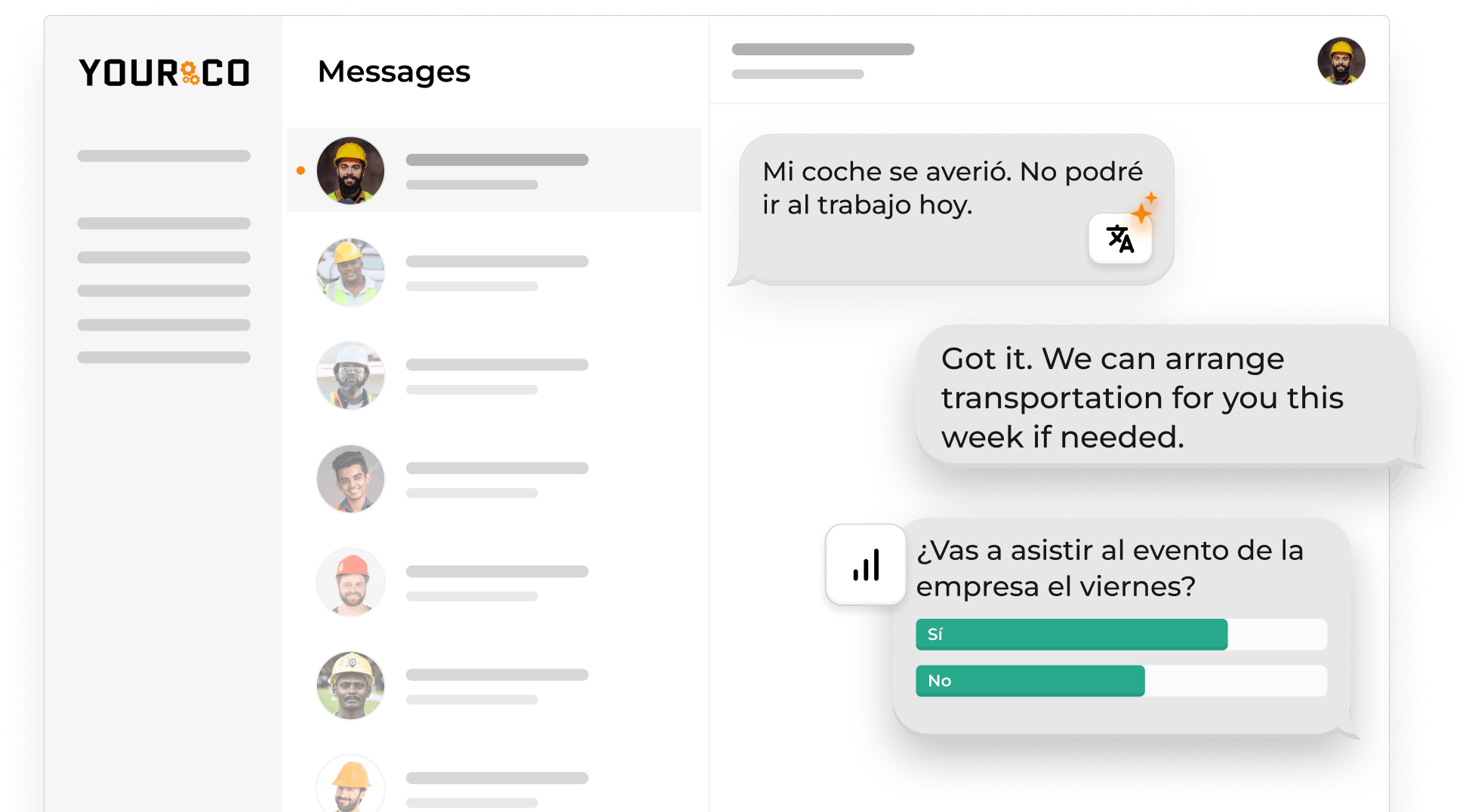
SMS-based platforms like Yourco let managers broadcast open shifts to qualified, credentialed nurses simultaneously, and the AI Call-Off Agent handles intake when a nurse needs to text off. Nurses review shift details and claim one with a reply, replacing the sequential phone-tree calls that eat up coordinator time.
The agent gathers the call-off dates and reasons, automatically continues the conversation if information is missing, sends a confirmation message, logs the call-off, notifies the supervisor, and updates reports with an auditable record. No HR intervention or employee training is required, so the backfill and the audit trail come from the same channel.
Fill the Shift and Keep the Record With Yourco
Covering healthcare call-offs at 5 a.m. comes down to how quickly a manager can reach the right off-duty people and how cleanly the entire exchange is recorded. Yourco handles both over the one channel healthcare workers reliably check: text.
- SMS reaches any phone, including basic flip phones, with no app download, Wi-Fi, or company email required
- Two-way messaging lets a nurse ask a question or claim an open shift with a reply
- AI-powered translation across 135+ languages and dialects gives multilingual teams every message in their preferred language
- The AI Call-Off Agent collects the dates and reason when a nurse texts off, confirms the details, then logs the absence and notifies the supervisor without HR intervention
For human resources information system (HRIS) data, Yourco connects to 240+ HRIS and payroll systems via HRIS integrations, keeping rosters, units, and shift groups up to date without manual upkeep. For multi-facility health systems, Enterprise Bridge supports one-way broadcasts from corporate leadership to the entire frontline, keeping every location aligned without requiring responses.
Frontline Intelligence provides HR and nursing leadership with centralized visibility into call-off activity across all units and locations. Leaders can generate reports on call-off patterns by site or department, including shift confirmations and response times, and corporate teams can identify the units where absences cluster before coverage becomes a chronic problem.
One behavioral health provider describes the difference an organized channel made.
"Yourco has helped us organize staff communications and drive many operational efficiencies."
— Jennifer Nestor, HR Coordinator, 1st Step Behavioral Health
After using Yourco for 90 days, two-way employee engagement increased to 86%.
Try Yourco for free today, or schedule a demo to see the difference the right workplace communication solution can make for your company.
Frequently Asked Questions About Healthcare Call-Offs
What is the difference between calling off and calling out?
There is no operational difference. "Calling off," "calling out," and "calling in sick" all describe an employee notifying the employer on short notice that they cannot work a scheduled shift, and the preferred term varies by region and facility. No-call/no-show matters more because the employee never notifies anyone, and the discipline is far more severe.
How many healthcare call-offs lead to termination?
Termination decisions vary by organization and by how managers apply the policy. Thresholds depend on the employer's written attendance policy, whether the employer excused the absence, whether protected leave applies, and whether the pattern repeats. SMS-based platforms like Yourco help managers apply those thresholds consistently by keeping a timestamped record of every call-off.
Do employees need a doctor's note to call off?
Employers usually do not require a doctor's note for a single absence. Many facilities trigger documentation after a multi-day absence or when absences show a pattern. Examples vary by jurisdiction, including New York City, Massachusetts, and California, so facilities often set note requirements by written policy and apply them uniformly.
How should employers handle chronic absences tied to a medical condition?
Many HR teams treat them as potential leave and accommodation matters before discipline matters. That means reviewing whether the absences may qualify under the Family and Medical Leave Act, excluding protected absences from attendance points, and beginning the ADA interactive process when a pattern appears medical. Documenting each step protects both the employee and the facility.
What is a low-census call-off in healthcare?
In a low-census call-off, the employer cancels or shortens a nurse's scheduled shift because patient volume fell below staffing needs. It is the opposite of an employee call-off. Facilities often cancel agency and per diem staff first, rotate cancellations equitably, and exclude low-census time from attendance tracking.