
Enterprise frontline communication platforms are rarely evaluated in the way they get deployed. Most purchasing decisions are shaped by demo performance and feature checklists, not by whether the platform can reach a warehouse worker with no corporate email, a shared device, and inconsistent internet access.
For HR directors, operations VPs, and IT procurement leads, closing that gap is what determines whether a deployment reaches the workforce or quietly fails. This article provides six evaluation categories and a pilot methodology for enterprise deployment across manufacturing, retail, healthcare, and logistics.
TL;DR
- Evaluate platforms across six categories: mobile UX, message targeting, two-way communication, HRIS integrations, content tools, and security compliance
- Audit where communication breaks down before shortlisting vendors
- Access architecture decides reach: platforms requiring corporate email, app downloads, or internet exclude workers before deployment starts
- Define pilot key performance indicators (KPIs) across three buckets before launch: corporate communications, workforce management, and task execution
- AI translation, shift-aware messaging, and platform consolidation are reshaping what enterprise buyers should require
- SMS-based platforms like Yourco reach any phone without app downloads, email accounts, or internet access
Audit Where Communication Breaks Down Before Evaluating Any Platform
Enterprise buyers commonly jump to feature comparisons before auditing where communication actually breaks down. Low employee engagement costs the global economy $10 trillion in lost productivity in 2025, according to Gallup's State of the Global Workplace 2026 report, with only 20% of employees worldwide engaged at work.
96% of HR leaders agree that better communication tools boost productivity, according to a Yourco-commissioned survey of 150 HR leaders, reinforcing the case for a structured audit before selecting any vendor.
Before building a shortlist, define where communication falls short by shadowing frontline workers across three buckets:
- Corporate communications: Policy updates, safety alerts, and benefits enrollment. What percentage of workers confirm receipt today?
- Workforce management: Shift changes, shift reminders, and compliance task assignments. What is the time lag between the message sent and the worker's acknowledgment?
- Task execution: Job instructions, checklists, and real-time operational guidance. Are workers relying on manager relay or informal channels?
Record the numbers for each bucket because that is what your pilot measures against, not what a vendor tells you to expect.
Assess Mobile UX and Access Architecture First
Access architecture is where the sales pitch and deployment reality diverge most often. Platforms that look strong in demos frequently fail in real workforce conditions.
When evaluating frontline communication platforms in 2026, pressure-test these sub-criteria with your actual workforce conditions:
- No-corporate-email access: Can workers enroll using a phone number, employee ID, QR code, or SMS without a corporate email address?
- No-app-download delivery: Can the platform deliver content and collect responses via SMS or mobile browser with no app installation required?
- Offline capability: Does it cache content for offline reading? Can forms and acknowledgments be completed offline and synced on reconnection?
- Shared device support: In environments where workers cannot carry personal phones, can multiple workers use a shared tablet with individually tracked sessions?
Test the platform with workers who have the least access to technology, not only those who already have smartphones and data plans.
Evaluate Message Reach and Targeting by Role, Shift, and Location
Forrester identifies personalized content as one of the leading intranet trends for 2025 to 2026, making targeting capability a core evaluation criterion beyond company-wide blasts.
Your Request for Proposal (RFP) should require granular segmentation and verifiable delivery across the following criteria:
- Role and shift segmentation: Can messages be targeted by role, shift, and physical location simultaneously using live workforce management data instead of static fields?
- Proof of acknowledgment: Can the platform generate a timestamped report of exactly which workers acknowledged a specific communication?
- Per-message analytics: Does the platform provide per-message reach and engagement metrics available to frontline managers, not only to central communications teams?
- Multi-channel delivery: Can the same message reach workers across SMS, app, email, and digital signage simultaneously, with unified delivery reporting?
Managers often believe communications are landing while frontline employees report otherwise. This disconnect is a documented evaluation risk, which is why pilot measurement should rely on verified delivery, acknowledgment, and response data rather than internal assumptions.
Require Two-Way Communication, Content Tools, and Verified HRIS Integrations
One-directional communication is where frontline engagement breaks down. Three in five respondents say people managers underperform when communicating with teams, according to a Gallagher study.
91% of HR leaders report that SMS use increases frontline employee response rate, according to the same Yourco-commissioned survey. Two-way capability has become a baseline requirement for evaluation.
Each of the three capability areas below warrants specific RFP requirements:
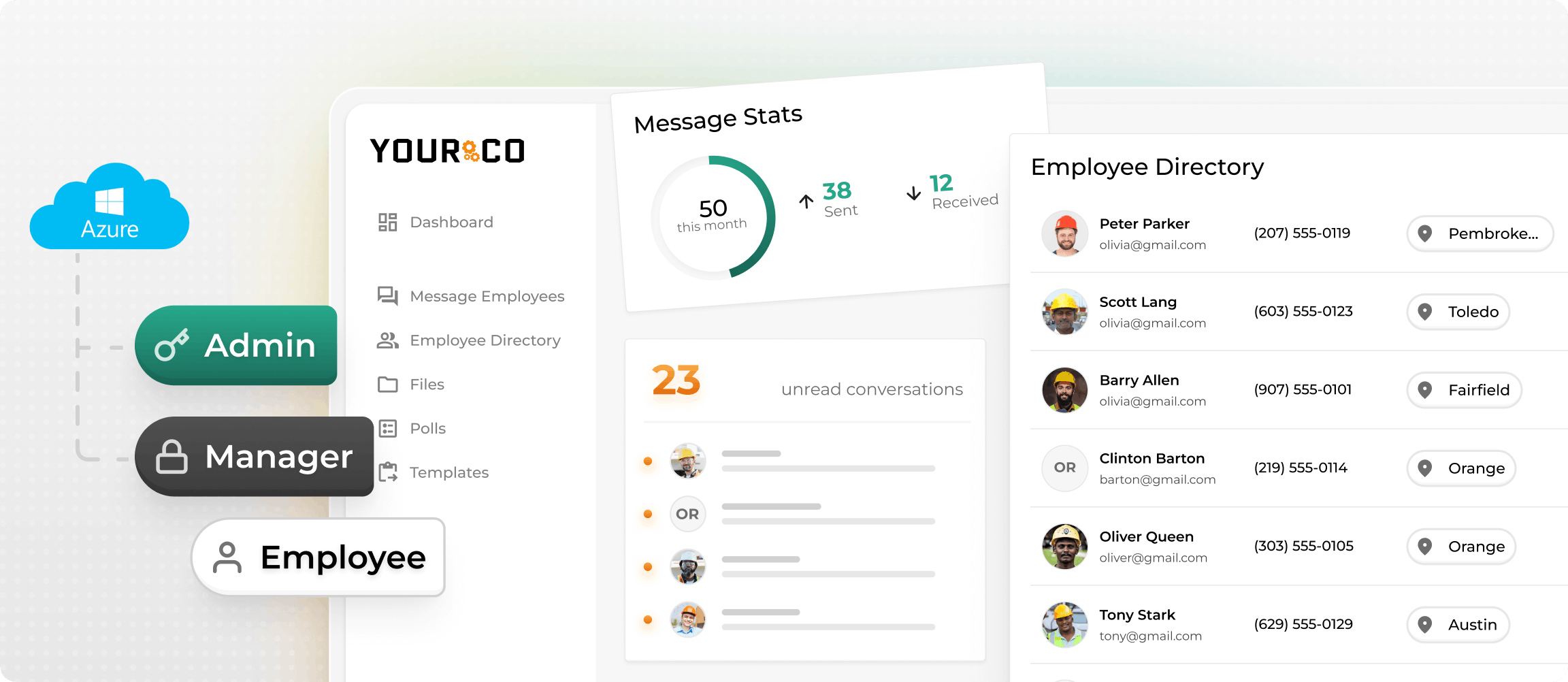
Bersin research establishes that stronger integration of payroll and workforce management capabilities provides significant value to the frontline. Without HRIS integration, every new hire risks missing onboarding messages for days, and terminated employees may retain access to the platform.
Prioritize Security Requirements That Match Your Industry
Security and compliance requirements vary sharply by industry. Healthcare buyers commonly look for Health Insurance Portability and Accountability Act (HIPAA) Business Associate Agreement (BAA) coverage that filters out many platforms. Manufacturing and logistics operations with EU workers commonly seek General Data Protection Regulation (GDPR)- compliant Data Processing Agreements (DPAs) that ensure contractual EU data residency.
Many enterprise buyers use this baseline stack as a minimum threshold during vendor review:
Ask vendors for the full SOC 2 Type II report, including the auditor's opinion. A marketing summary is not sufficient. Check for exceptions indicating control failures during the audit period.
This information is for general awareness only. For specific compliance guidance, consult with qualified legal professionals.
Run a Structured Pilot With Defined KPIs
Platforms that skip the pilot phase tend to fail at access. This is because low adoption, misconfigured workflows, and unreached worker segments surface after full rollout, when they are far more expensive to fix.
A structured pilot in a single location or department should run four to eight weeks, with KPIs mapped to the communication buckets you documented during your audit.
Here are these KPIs to measure against your pre-pilot baselines:
- Corporate communications: Delivery and acknowledgment rates versus pre-pilot baseline, reply volume, time from send to first acknowledgment
- Workforce management: Shift change acknowledgment rate, compliance task completion rate, time-to-productivity at 30/60/90 days
- Platform health: Adoption rate, weekly active user rate, user satisfaction pulse score
Alongside your managers, involve frontline workers in configuring the platform by testing message delivery across the channels workers actually use.
Watch Three Emerging Trends Reshaping Enterprise Evaluation
Enterprise buyers in 2026 should factor three market trends into their evaluation criteria.
Auto-Translation Has Become a Baseline Expectation
Slator reports that corporate respondents reported stable or increasing internal demand for translation services in 2025. The evaluation question is no longer whether a platform translates, but how it governs translated content. Ask whether auto-translated messages maintain one governance object or create separate objects per language, requiring individual approval workflows.
Shift-Aware Delivery Needs a Live Workforce Management Feed to Be Useful
A UKG study found that frontline workers report feeling burned out, and untimely messaging contributes to that load. Platforms claiming shift-aware delivery without a live workforce management integration rely on static schedules, which quickly go stale in high-turnover environments.
Single-Platform Deployments Are Replacing Fragmented Tool Stacks
Enterprise buyers are consolidating vendor relationships around platforms that handle communications, acknowledgment tracking, and task execution in one place. A platform that solves the communication problem while adding a fifth login to an already crowded workflow is solving half the problem.
Reach Every Frontline Worker Instantly With Yourco
Building an evaluation framework matters, but it only works if the platform can actually reach your workforce. Yourco is an SMS-based employee communication platform built for enterprises with large frontline populations. It removes the access barriers that cause traditional tools to stall.
Yourco's core capabilities include:
- SMS to any phone: No app download, no WiFi, no data plan required, and no cost to employees. Works on smartphones and basic flip phones alike.
- Two-way messaging: Connects managers and frontline workers directly, enabling real-time feedback, absence reporting, and individual conversations.
- AI-powered translation: Covers 135+ languages and dialects, so every worker receives messages in their preferred language.
Yourco integrates with 240+ HRIS and payroll integrations, automatically syncing new hires, role changes, and terminations so your communication roster stays current without manual updates.
Enterprise Bridge enables corporate leadership to send centralized, one-way broadcasts across all locations, while local managers maintain direct communication with their teams.
For enterprise buyers evaluating communication across multiple sites, Frontline Intelligence gives HR and operations teams centralized visibility into engagement patterns, sentiment trends, and communication insights across all locations. Leadership can track patterns across sites, flag underperforming locations, and generate reports that inform workforce communication decisions.
"We have tried 3 text communication tools, and this is the best experience we've had by far. A consistent line of communication to our employees is one of the most important things, and Yourco is the most reliable system around."
— Terri Kasper, HR Manager, Calumet Carton Company
After 90 days on Yourco, companies see two-way employee engagement reach 86%.
Try Yourco for free today, or schedule a demo to see the difference the right workplace communication solution can make for your company.
Frequently Asked Questions About Frontline Communication Platforms
What are the most important criteria for evaluating frontline communication platforms?
The most important criteria are mobile UX and access architecture, message reach and targeting, two-way communication, HRIS integrations, content tools, and security compliance. Access architecture matters most in many evaluations because it determines whether frontline workers can actually receive and respond to messages.
How long should a pilot of a frontline communication platform last?
A pilot of a frontline communication platform should last long enough to measure adoption, message delivery, and response behavior in a real operating environment. Many enterprise buyers start with one location or department to validate workflows, gather frontline feedback, and make adjustments before scaling.
What KPIs should we track during a frontline communication pilot?
Track delivery, acknowledgment, reply volume, adoption, and user satisfaction against your pre-pilot baseline. The most useful KPIs connect back to your communication audit, so you can measure whether the platform improves corporate communications, workforce management communications, and day-to-day execution support.
Can frontline communication platforms work without corporate email or app downloads?
Yes, SMS-based platforms like Yourco can reach workers without requiring corporate email addresses or app installations. That makes them especially useful in environments where employees rely on personal phones, shared devices, or inconsistent internet access during the workday.
What security requirements should a frontline communication platform have?
A frontline communication platform should align with your industry's security and compliance needs. At a baseline, many enterprise buyers look for SOC 2 Type II-compliant vendors, strong access controls, encryption standards, and clear documentation for healthcare or EU-related requirements, where applicable.
Why do frontline communication platform deployments fail?
Most deployments fail when buyers choose a tool before confirming how frontline workers will access it. If the platform depends on logins, apps, or channels the workforce does not use, adoption stalls quickly, and managers fall back to relay-based communication.