
The absence rate was 3.2% among full-time wage and salary workers in 2025, according to federal labor data. An employee warning letter for absenteeism has two jobs: change the behavior and hold up in court. Most letters manage the first and fail the second, citing "ongoing attendance issues" instead of dates, times, and the policy violated. Human resources (HR) teams can use the eight templates below for the full progressive sequence, including no-call/no-shows, chronic tardiness, and long-term absence.
TL;DR
- A defensible warning letter names the exact dates and times and cites the policy that was violated.
- It states the consequence of no improvement and includes an acknowledgment signature line.
- Progressive discipline runs verbal warning, first written, second written, final written, then termination; no-call/no-shows escalate faster.
- Confirm absences are not protected under FMLA, the ADA, or state leave laws before issuing any warning.
- A refusal to sign does not invalidate the warning; note the refusal with a witness and file it.
- SMS-based platforms like Yourco log every call-off with a timestamp, so the dates in the letter match an auditable record.
Confirm the Absence Is Not Protected Before Writing
Before an employee warning letter for absenteeism is issued, check whether any absence falls under leave administration rather than discipline. Use this quick screen first:
- FMLA: protections generally apply to private employers with 50 or more employees, and eligible employees may take job-protected leave that employers generally do not count under a no-fault attendance policy or treat as a negative factor in discipline. If one of three latenesses behind a warning was FMLA leave, that point may need to come off.
- ADA: coverage generally starts at 15 or more employees. For employers that meet that threshold, disability-related absences may require an interactive accommodation process before discipline.
- State leave laws: a growing number of states have paid sick leave laws, and New York attendance rules are one example of state limits on the assessment of attendance points for legally protected absences.
- Protected-leave routing: if any absence in the record might qualify for protection, route it to leave administration before a warning goes out.
This information is for general awareness only. For specific compliance guidance, consult with qualified legal professionals.
Build the Letter Around Specifics That Hold Up
Vague references to misconduct leave employees unsure what triggered the warning and give opposing counsel material to work with. Every template below carries the same skeleton:
- Record exact absence dates, times, and total count, plus whether required notice was given
- Include dates of earlier verbal or written warnings
- Cite the named policy and section violated, plus the CBA provision for unionized workers
- Set measurable expectations, a 60--90 day review window, and support offered
- State the next disciplinary step and how long the warning stays active (commonly 6--12 months)
- Add manager and employee lines, with the employee line labeled "signature confirms receipt only"
Each template below follows this structure, so HR fills in only the case-specific brackets.
If the employee refuses to sign, bring in a second manager as witness, note the refusal with the date, have both sign, and send a follow-up email confirming the discussion. The warning remains valid, and its requirements still apply.

Set Clear Thresholds for Excessive Absenteeism
No legal threshold defines "excessive"; the employer's policy draws the line. No-fault attendance policies set point thresholds that commonly escalate. The values below are illustrative, not a standard:
A typical point policy assigns 1 point for tardiness, 2 for an unexcused absence, and 3--5 for a no-call/no-show, with termination at 8--12 points over a rolling 12-month window.
Employee Warning Letter for Absenteeism Templates
One rule covers all eight templates: if any cited absence may qualify for protection under FMLA, ADA accommodation, or state leave law, pause the warning process and route the matter for leave review first.
Verbal Warning Script for Attendance
Use this as the first formal step and document it in the personnel file.
This is a formal verbal warning about your attendance. Our records show unexcused absences on [dates]. [Policy name] requires employees to notify [contact] at least [X] hours before a shift if they cannot work.
Effective immediately, we expect you to be on time for every scheduled shift. I will document this conversation, and we will review your attendance on [date]. If it does not improve, the next step is a written warning.
Is anything affecting your attendance, including a medical or family situation, that we should know about?
First Written Warning Letter Template
Issue this after a documented verbal warning fails.
Date: [date]
To: [Employee name, ID, position, department]
Re: Written Warning (Attendance)
You were absent from scheduled shifts on [dates] without approved leave and [did not provide notice / provided notice after the required window], in violation of [policy name, section]. We discussed your attendance verbally on [date].
Effective immediately, report to all scheduled shifts on time and follow the absence reporting procedure. We will review your attendance on [date]. Failure to demonstrate immediate and sustained improvement may result in further disciplinary action, up to and including termination of employment.
This warning remains active in your file for [6-12] months. If you need support or flexibility, or if any listed absence relates to a medical condition or protected leave, contact [HR contact] immediately.
Employee acknowledgment (signature confirms receipt only): ______
Manager signature: ______ Date: ______
Second Written Warning Letter Template
List every prior step when absences continue.
Re: Second Written Warning (Attendance)
Since your written warning of [date], you have had additional unexcused absences on [dates]. This is your second written warning under [policy name, section]. We addressed this verbally on [date] and in writing on [date].
The expectations in your prior warning remain in effect. We will review your attendance on [date]. Any further unexcused absence during this period may result in a final written warning or suspension.
Employee acknowledgment (signature confirms receipt only): ______
Manager signature: ______ Date: ______
Final Written Warning Letter Template
State that no further chances remain. A warning that promises termination should be followed through absent extraordinary circumstances, or later warnings lose their force.
Re: Final Written Warning (Attendance)
Despite a verbal warning on [date] and written warnings on [dates], you were absent without approved leave on [dates]. This is your final written warning.
Any additional unexcused absence or tardiness before [review date] will result in termination of employment. We will issue no further warnings.
If any circumstances we should consider, including a medical or protected leave issue, contributed to these absences, contact [HR contact] before [date].
Employee acknowledgment (signature confirms receipt only): ______
Manager signature: ______ Date: ______
Adapt the Letter for No-Shows, Tardiness, and Long-Term Absence
No-Call/No-Show Warning Letter Template
Under policies that escalate no-call/no-shows faster, a first offense may warrant an immediate written warning rather than a verbal one. Document the operational impact and the employee's explanation.
Re: Written Warning (No-Call/No-Show)
On [date], you failed to report for your scheduled shift and did not notify [contact] at least [X] hours before the start of the shift, as required under [policy name]. Your absence required [who covered], caused [delays], and led to [overtime incurred]. Your explanation, if provided: [___].
Effective immediately, notify [contact] at least [X] hours before your shift if you cannot report to work. We will review your attendance on [date, 30 days out]. A further no-call/no-show may result in suspension or termination.
Employee acknowledgment (signature confirms receipt only): ______
Manager signature: ______ Date: ______
Tardiness and Early Departure Warning Letter Template
Use exact timestamps with the dates.
Re: Written Warning (Tardiness and Early Departure)
Our records show: [date] arrived [time]; [date] left at [time] before shift end; [date] arrived [time]. Your scheduled shift is [start] to [end], and [policy name] requires punctual arrival and full-shift attendance.
Effective immediately, we expect you to arrive by [time] and remain through the end of each scheduled shift. We will review your punctuality on [date]. Continued tardiness or early departure may result in further disciplinary action, including suspension or termination.
Employee acknowledgment (signature confirms receipt only): ______
Manager signature: ______ Date: ______
Unexcused Long-Term Absence and Job Abandonment Letter
Send this when an employee has stopped reporting and the policy treats consecutive no-call days as job abandonment. Thresholds vary, and some states apply a longer standard for unemployment purposes. Send by registered mail with return receipt, plus email.
Re: Unexcused Absence, Response Required by [deadline]
You have been absent without contact since [date], missing scheduled shifts on [dates and times]. Under [policy name], the company treats [three] consecutive days of absence without notification as job abandonment.
Contact [name] at [phone/email] by [deadline, one week from this letter's date] to discuss your circumstances and your intention to return to work. If we do not hear from you by that date, we will consider that you have abandoned the position, and further action may follow, including termination of employment.
Frontline SMS Acknowledgment Template
Deliver the letter in person or by email, then use a text as timestamped confirmation.
[Company] HR: [First name], this confirms that HR reviewed the written attendance warning with you in person today, [date]. A copy is in your personnel file; contact [HR contact] with questions. Reply RECEIVED to confirm.
Keep Attendance Records That Match the Letter
A warning letter is only as strong as the log behind it. Federal guidance calls employer records "normally the best source" of evidence in a discipline charge, which cuts both ways: thin or inconsistent records work against the employer. When frontline call-offs live in voicemails and on supervisors' personal phones, the dates in a letter rest on memory.
85% of HR leaders say improved communication would reduce absenteeism, according to a Yourco-commissioned survey of 150 HR leaders, and the same channel produces the documentation discipline that depends on. A documented text-off line closes the gap: employees text their absence, and every report is automatically timestamped and preserved.
Track Every Call-Off Instantly With Yourco
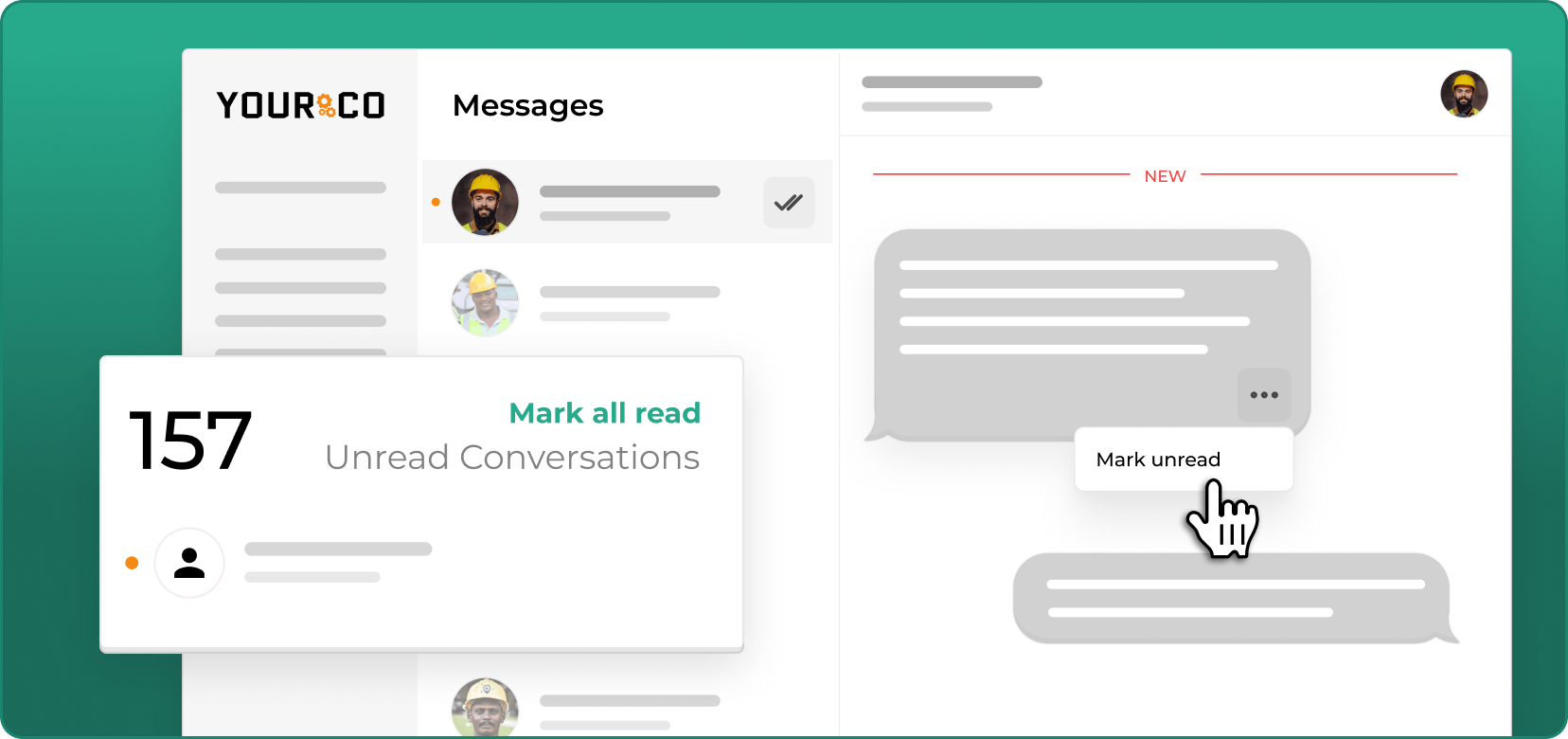
Every template above depends on one input HR often lacks: exact, verifiable dates and times for each call-off. With Yourco, employees text their absence to a dedicated line from any phone, and each report is logged with a timestamp HR can cite in a warning letter.
Yourco delivers the core capabilities frontline teams rely on:
- SMS to any phone, including basic flip phones, with no app download required
- Two-way messaging so follow-up questions and manager replies stay in one documented channel
- AI-powered translation across 135+ languages and dialects, so attendance policies and acknowledgments reach every worker in their preferred language
- The AI Call-Off Agent gathers the call-off dates and reason, follows up automatically if information is missing, sends a confirmation, and logs the report with no HR intervention required. It also automatically generates a downloadable call-off report, without the need to manually capture and update call-off records
Yourco integrates with 240+ HRIS and payroll systems to automatically sync employee data. For multi-location organizations, Enterprise Bridge supports centralized, one-way updates to attendance policies across all locations, while local managers maintain direct communication with their teams.
Frontline Intelligence gives HR and operations teams a central view of call-off activity across all locations. Leaders can generate reports on shift confirmations and response times, and identify absence patterns by site or department before discipline escalates.
One manufacturer describes how the absence record works day to day.
"We use Yourco for our absence management and for sending out notices, reminders, and event announcements. It keeps everyone who needs to know informed when people are absent."
— Kyle Stover, HR Assistant, J-Lenco Inc.
After 90 days with Yourco, two-way employee engagement increased to 86%.
Try Yourco for free today, or schedule a demo to see the difference the right workplace communication solution can make for your company.

Frequently Asked Questions About Employee Warning Letters for Absenteeism
How do you write a warning letter for absenteeism?
List the exact dates and times of each unexcused absence, cite the policy violated, reference prior warnings, state measurable expectations with a review date, describe the next disciplinary step, and include signature lines. Keep it factual and avoid commentary beyond the attendance record.
When should you issue a warning letter for absenteeism?
Issue it promptly once absences cross the policy's trigger point and none qualify as protected leave. Delays weaken the record, since timely warnings show the concern is legitimate rather than pretextual. A common sequence opens with an absence review conversation, followed by a written warning if the pattern continues.
How many warnings before termination for absenteeism?
There is no universal required number. The most common progressive sequence gives verbal, first written, and final written warnings before termination. Serious violations such as an extended no-call/no-show can justify skipping steps, and point-based policies set their own thresholds for when each stage of discipline begins.
What counts as excessive absenteeism?
No universal standard exists; each employer defines it in policy. Point-based approaches weight tardiness the lowest, full absences higher, and no-call/no-shows highest, with discipline triggered once an employee exceeds set thresholds over a rolling window. Newer employees often face lower thresholds.
How should you document call-offs for frontline workers without email?
Use a channel that automatically timestamps every absence report. SMS-based platforms like Yourco let employees text a call-off from any phone, notify supervisors instantly, and keep an auditable record that supports defensible warning letters. Deliver the formal letter in person or by email, with the text as confirmation.