Hotels and restaurants report high turnover, yet most properties still rely on email, bulletin boards, and informal group chats that miss much of their workforce. Housekeepers, kitchen teams, and maintenance technicians have limited computer access during shifts, meaning the default communication stack was never built for the people who keep a property running. SMS has a 98% open rate, an industry-standard benchmark, making it one of the most accessible channels for frontline workers. Employee texting closes the communication gap, but only when it's done right.
TL;DR
- Collect documented, affirmative opt-in consent from every employee before sending automated texts
- Keep operational messages short with a clear action or next step
- Enable two-way replies so workers can confirm shifts, report issues, and share feedback
- Segment all messages by department, shift, and property to prevent notification fatigue
- Set written business-hour limits for non-emergency messages and automate shift reminders to reduce no-shows
- SMS-based platforms like Yourco make employee texting accessible on any phone, including flip phones, with built-in translation, compliance records, and two-way messaging
Obtain Documented Opt-Ins Before Sending a Single Text
Employee texting programs in hospitality start with consent, not convenience. Many employers add a standalone SMS consent clause to onboarding paperwork that specifies the types of messages workers will receive, approximate frequency, and how to opt out. FCC changes effective April 2025 raised the bar for how hospitality employers manage consent programs. Here's what those changes mean in practice:
- Employees may revoke consent by reasonable means, and verbal opt-outs to a supervisor count, not just "Reply STOP."
- Revocation must be honored within 10 business days
- The burden of proof for valid consent falls on the employer
- Pre-checked opt-in boxes are insufficient to establish consent
Maintain a consent log recording each employee's name, phone number, date of consent, and collection method. Train shift leads and managers on opt-out handling; this is not solely an HR responsibility.
This information is for general awareness only. For specific compliance guidance, consult with qualified legal professionals.
Keep Messages Short, Actionable, and Professional
Frontline hospitality workers consume information between room turnovers, during kitchen prep, and on the move. Long messages get skimmed or ignored entirely. The best employee texts for hospitality follow a consistent, scannable format.
Effective hospitality SMS messages share three traits:
- Short enough for quick operational reading
- A clear urgency prefix like "ACTION REQUIRED:" when a reply is needed
- One call to action per message: confirm a shift, reply with a status, or acknowledge a policy
Build a template library for recurring scenarios like shift reminders, VIP arrival alerts, and emergency closures. For complex information, send a brief text with a link to the full document rather than embedding everything in the message itself. Never include sensitive personal information, such as payroll details or medical information, in any text message; misdelivered messages create immediate compliance exposure.
Enable Two-Way Conversations That Drive Real Engagement
SHRM research found that employees feel more engaged when leaders communicate transparently, and regular feedback mechanisms are linked to lower turnover. The gap runs deeper than channel access: according to a Yourco-commissioned survey of 150 HR leaders, only 43% of frontline employees consistently receive the communications their companies send, and just 36% actually read them. For housekeeping and kitchen teams that rarely interact directly with management, two-way SMS is often the most practical feedback channel available.
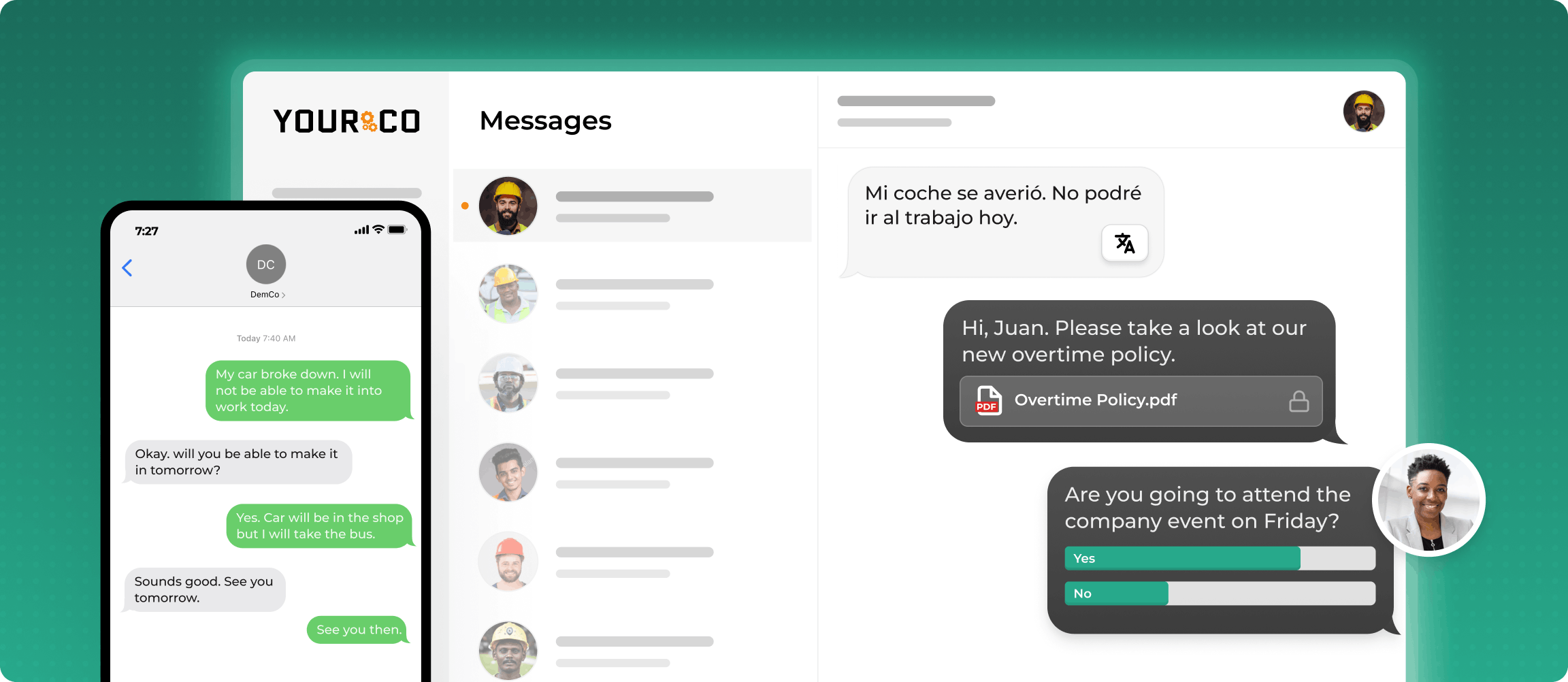
Two-way SMS transforms operational workflows across hotel departments. Housekeepers text questions about room assignments or report maintenance issues directly. Kitchen teams request shift swaps through the platform rather than in personal group chats. Managers receive and respond to call-offs via text rather than relying on voicemails, which create compliance gaps. Setting a clear response-time standard during active shifts signals to frontline workers that the channel is genuinely two-way, not another broadcast tool they will learn to ignore.
Pulse feedback surveys sent via text at the end of the shift are particularly effective for night and weekend crews. A simple "Rate your shift today 1-5" captures real-time feedback from workers who would never complete an online survey, with responses aggregating in a manager dashboard without requiring any worker login, giving operations teams survey visibility they may not get from other channels.
Segment Alerts by Role, Shift, and Property
Sending a banquet setup alert to housekeeping, or a VIP checkout reminder to the kitchen crew, degrades trust and trains workers to ignore messages. Irrelevant texts are the fastest path to notification fatigue.
A practical segmentation structure for a mid-sized hotel includes:
- Department: Housekeeping, Food and Beverage, Front Desk, Maintenance, Kitchen, Events
- Shift: AM, PM, Overnight
- Location: Property-specific for multi-property operators
- Role: Line cook vs. server vs. host vs. manager
Reserve company-wide messages for genuinely broad announcements: new benefits, safety emergencies, or major policy changes. For everything else, target the smallest relevant group. Use delivery confirmation on critical operational messages to verify that role-specific information reached the right people.
Automate Shift Reminders and Operational Task Alerts
Missed shifts cost hospitality operators in overtime, guest experience, and manager time spent scrambling for coverage. Research on SMS reminder programs in analogous settings shows better attendance outcomes. The behavioral mechanism, a timely reminder reducing forgetting and increasing commitment, is directly analogous to shift management.
Shift reminders eliminate the manual burden of calling workers to confirm schedules. The system sends reminders before shift start, workers reply to confirm, and the platform logs each confirmation with a timestamp, freeing managers from phone trees entirely. The same principle applies to operational tasking: a housekeeping dispatch text replaces paper task sheets, with worker replies creating a timestamped completion log visible to managers without physical floor checks.
Deliver Every Message in Each Worker's Preferred Language
Hotel housekeeping and kitchen departments are among the most linguistically diverse workplaces in any industry. English-only operational instructions create safety risks, productivity friction, and a sense of exclusion that accelerates turnover. Multilingual management is one of the core HR challenges in hospitality.
During onboarding, record each employee's preferred communication language as a profile field. Evaluate any texting platform on three criteria: auto-translation of incoming and outgoing messages, the ability to publish one message in multiple languages simultaneously, and language-based segmentation. Research from Yourco's Closing the Comms Gap survey found manual translation of operational messages takes 20 to 30 minutes per update. In hospitality, where room turnover targets don't wait, that delay means multilingual workers start tasks without the same information their English-speaking colleagues already have.
For safety-critical messages such as evacuation instructions and compliance notices, many employers use human-reviewed translations alongside automated translations. Pair text with visual content, such as photos, to bridge language gaps regardless of translation quality.
Set Business-Hour Boundaries to Prevent Message Fatigue
Hospitality already struggles with retention. Industry turnover remains high, and poor work-life balance is a documented driver. A communication system that floods workers with off-hours messages doesn't just create friction; it actively accelerates the attrition problem operators are already trying to solve. Protecting your team's downtime is a retention strategy, not just a policy courtesy.
Establish a written SMS policy that distinguishes between two message categories:
- Emergency broadcasts (any hour permissible): fire evacuations, severe weather, active threats
- Routine operational messages (restricted window): shift reminders, policy updates, recognition. Many employers limit these to 7 a.m. to 9 p.m. local time
For emergency broadcasts, pre-build templates for the most common scenarios: fire evacuation, severe-weather shelter-in-place, active-threat lockdown, and utility failure. That gives managers accurate, multilingual alerts they can send within seconds rather than composing messages under pressure. Protecting your team's downtime is not just the right thing to do; it is a retention strategy.
Top Employee Texting Platforms for Hospitality Teams
Not all SMS tools are built for the realities of hotel and restaurant operations. General business texting platforms lack the frontline-specific features that make communication reliable at scale. Here's how the leading options compare at a glance.
Connect Every Hospitality Worker Instantly With Yourco
Yourco gives hospitality teams a single SMS channel that reaches every housekeeper, line cook, front desk agent, and maintenance technician, regardless of phone type or language. The platform is built for how hotels actually operate: multi-shift, multilingual, and always moving.
Core capabilities include:
- SMS to any phone with no app download, no Wi-Fi, and no cost to employees
- Two-way messaging so workers reply directly to confirm shifts, report issues, or share feedback
- AI-powered translation across 135+ languages and dialects, delivering every message in each worker's preferred language automatically
Yourco integrates with 240+ HRIS and payroll systems, keeping contact lists current even with hospitality's high turnover. New hires, terminations, and role changes sync automatically.
Enterprise Bridge enables corporate leadership to send centralized, one-way updates across all properties, while local managers maintain direct, two-way conversations with their teams.
Frontline Intelligence gives hospitality leadership centralized visibility into engagement patterns, call-off activity, and sentiment trends across all properties. Spot disengagement risks before they become attrition, and identify which locations have the slowest shift-confirmation response times so leadership can act before losing strong performers.
"Yourco has significantly improved how we connect with employees, making it easier to share important updates, reminders, and announcements in real time. It has become an essential tool in streamlining our internal communication."
— Courtney Martin, Recruiting Manager, The Seagate
After 90 days with Yourco, two-way employee engagement increased to 86%.
For the research behind SMS-based frontline communication, explore Yourco's Closing the Comms Gap study of 150 HR leaders.
Try Yourco for free today, or schedule a demo to see the difference the right workplace communication solution can make for your company.
Frequently Asked Questions About Employee Texting For Hospitality
How do I get opt-in consent for employee texting in hospitality?
Many employers add a standalone SMS consent clause to onboarding paperwork, separate from the general employment agreement. This clause specifies the types of messages employees will receive, approximate frequency, and how to opt out. Maintain a log recording each employee's name, phone number, date of consent, and collection method.
What should a hospitality shift reminder text look like?
An effective shift reminder is short, includes the role, date, and start time, and asks for a reply confirmation. For example: "HOUSEKEEPING REMINDER: Your shift starts Sat 7:00 AM. Reply CONFIRM to acknowledge." Keep each message to one clear action.
Can I text hospitality employees outside of business hours?
Many employers restrict non-emergency operational texts to a defined window, commonly 7 a.m. to 9 p.m. local time. Emergency broadcasts for genuine safety situations are typically treated separately. Establishing a written policy that distinguishes between emergency and routine messages helps protect work-life balance and reduces opt-outs.
How does employee texting work for multilingual hotel teams?
SMS-based platforms like Yourco allow managers to write one message that is automatically translated and delivered in each worker's preferred language. Workers reply in their own language, and their responses are translated back for the manager. Record each employee's preferred language during onboarding so the system can deliver messages correctly from day one.
What types of messages should I segment by department or shift?
Operational task assignments, shift-specific reminders, VIP alerts, and department-level policy updates should be segmented to the relevant group. Reserve company-wide broadcasts for universal announcements like benefits changes, safety emergencies, or major policy updates. Targeting the smallest relevant group reduces notification fatigue and keeps workers engaged.