
Most companies have an emergency action plan in a binder or on a shared drive. The problem is that when an actual emergency hits, those plans fail the people who need them most: frontline workers on the factory floor, at remote job sites, or mid-shift without access to email or an intranet. The gap between policy and delivery is wider than most organizations realize, and the workers most at risk are the ones least likely to be reached. An emergency plan built on channels that reach only a minority of your workforce is not a plan. It is a liability. This guide walks HR teams through a practical, step-by-step process to move from policy on paper to a fully operational emergency communication system.
TL;DR
- Most emergency plans fail frontline workers by relying on email and intranets that shift-based employees never access, leaving critical messages unread.
- HR owns communication accessibility, employment continuity, and pre-emergency training within any emergency response structure.
- SMS leads on response rates, 91% of HR leaders confirm it, vs. 36% for mobile apps. It's why Yourco is built SMS-first.
- Pre-translated templates, segmented contact lists, and a clear escalation tree are the three infrastructure elements most plans are missing.
- 93% of HR leaders believe clear safety communication reduces workplace incidents. Drills are where you find out if yours qualifies.
Clarify HR's Role in Your Emergency Communication Plan Structure
Emergency response breaks down when nobody owns what. HR manages people, safety managers handle hazards, and operations manages resources. These boundaries need to be defined in writing before any incident occurs.
HR's specific domain during emergencies includes three areas:
- Communication accessibility: ensuring alerts reach every worker across shifts, locations, languages, and device types.
- Employment continuity: managing pay, benefits, EAP coordination, and family notifications during and after an incident.
- Pre-emergency training: scheduling plan reviews and drills so employees know their duties before an alarm sounds.
Establishing in advance where HR ends and corporate communications begins (who owns town halls, who drafts external statements, who manages employee-facing updates) prevents competing messages during a live crisis.
Map Incident Types and Stakeholders for Your HR Emergency Plan
Before choosing channels or writing templates, identify what you plan to do and who you need to reach. Not every emergency affects every worker the same way.
Start by listing your most likely incident types based on your facility and industry:
- Severe weather (tornado, ice storm, flooding)
- Active threat or security incident
- Chemical release or hazardous material spill
- Facility issue (fire, structural, utility outage)
- IT or system outage affecting operations
- Workplace injury requiring evacuation or medical response
Frontline workers are rarely a single uniform group. Your contact architecture needs to account for on-site shift workers, off-duty employees, field crews, temporary workers, contractors, and, where applicable, union representatives. Each group may need different information, at different times, through different channels. SHRM research on frontline workforce communication underscores why channel segmentation by worker type is a baseline requirement rather than a best practice.
Choose and Configure Emergency Communication Channels With Clear Backups
No single channel works for every worker in every scenario. The goal is a primary channel that reaches the broadest possible audience instantly, backed by alternatives in case that channel fails.
SMS is the foundational primary channel for frontline workers. It works on any phone, requires no app, and reaches workers on- or off-site without internet access. The delivery problem is measurable: according to Yourco's Closing the Comms Gap research of 150 HR leaders, only 43% of frontline employees consistently receive company communications, and just 36% read them. On channel effectiveness, 91% of HR leaders say SMS increases frontline employee response rates, while only 36% are satisfied with mobile app communication for these teams. For emergency alerts where response time is measured in seconds, the channel with the highest reach and fastest read time is the only defensible primary choice.
Your plan should designate a primary and backup method for each stakeholder group. The table below provides a starting framework.
Build HR-Managed Contact Lists and an Escalation Tree
A contact list is only useful if it is current, segmented, and accessible when systems go down. Organize contacts by location, shift, department, and role, not just in one flat spreadsheet.
Your escalation tree should answer this question without ambiguity: Who has the authority to send each type of alert? Who is the backup if the primary decision-maker is unavailable? Who coordinates with external emergency services? Who communicates with the media, and who communicates with employees' families? For companies that use temporary or contract workers, contact lists must include staffing agency emergency contacts as well as individual workers' information.
Maintain both digital and physical copies. Hard copies stored in weatherproof containers at key locations serve as your failsafe when primary IT systems are down. Review and update the full list monthly, and test distribution with acknowledgment tracking at least twice per year.
Draft and Approve Emergency Communication Templates
Writing clear, concise emergency messages under pressure is nearly impossible. Pre-approved templates reduce delays and errors when seconds matter.
Every template should follow a simple structure: what is happening, what action employees must take, and where to get updates. Here are examples for the most common scenarios:
- Severe weather: shelter in place. URGENT: Severe weather alert issued. Seek shelter immediately in [designated area]. Avoid windows. Do not leave. Updates will follow.
- Active threat: lockdown ALERT: Find a SECURE LOCATION, lock doors, and stay away from windows. Avoid [location]. Check [emergency website/number] for updates.
- Facility evacuation: URGENT: [Hazard type] in [Building/Location]. Evacuate immediately using [designated] exits. Assembly at [Assembly Point]. Reply OK when safe.
- All-clear: ALL CLEAR. The emergency at [location] is over. Return to normal activities. Contact [number] with questions.
Pre-translate every template into the languages your workforce speaks. Language barriers rank among the top challenges HR leaders face with frontline teams, and according to Yourco's Closing the Comms Gap research, manually translating safety messages takes 20 to 30 minutes per update. During an active emergency, some workers do not know what is happening for 20 to 30 minutes. Pre-translating templates eliminates that delay entirely.
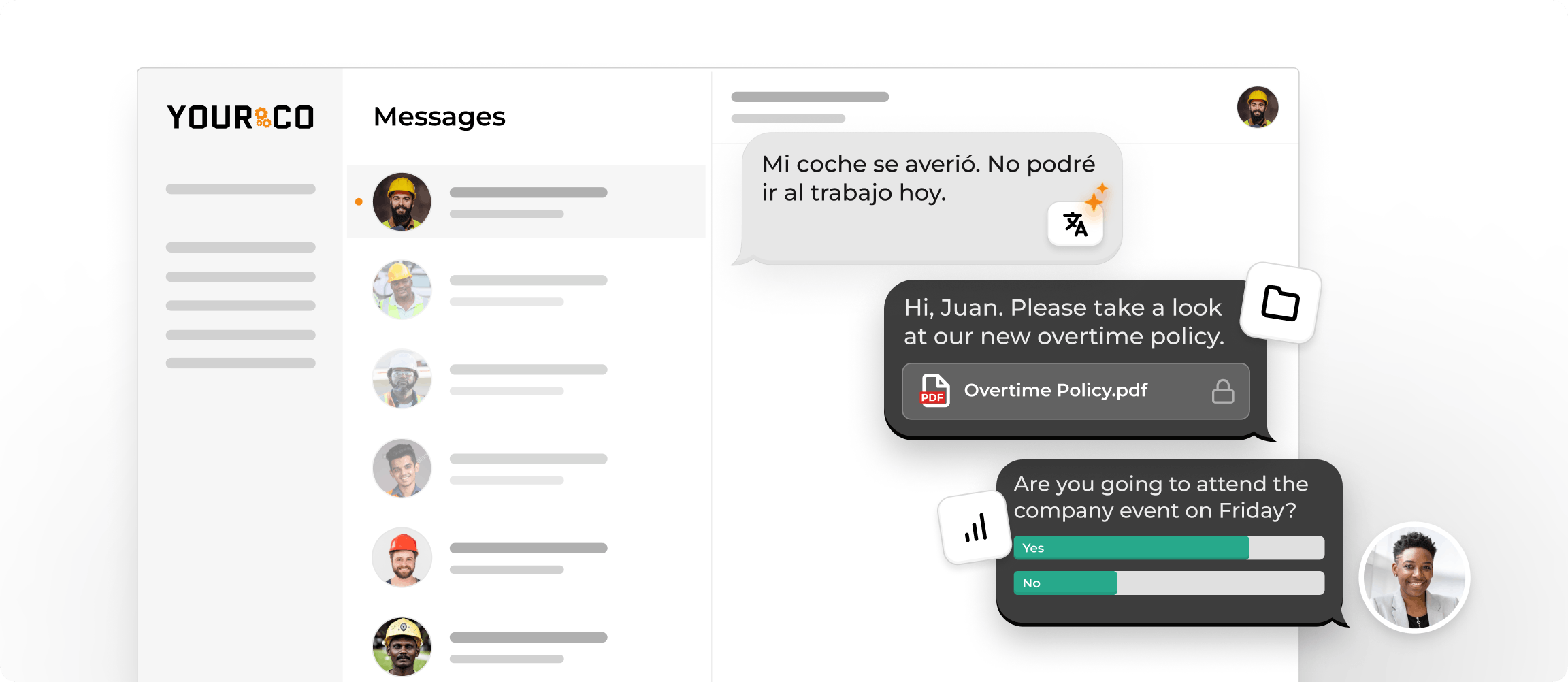
Establish a clear approval chain that documents who can authorize sending each template type, and store templates in a location accessible even when primary systems are down.
Align Your Emergency Communication Plan With OSHA Requirements
Your communication plan needs to integrate with the emergency action plan (EAP) that many employers maintain under 29 CFR 1910.38. Companies with more than 10 employees generally maintain a written EAP available for employee review.
Key OSHA-related elements your communication plan should address:
- Alarm systems should be distinctive, recognizable, and perceivable above ambient noise and light levels, a critical consideration in manufacturing and warehouse environments.
- Emergency reporting procedures should identify the preferred method for reporting fires and emergencies.
- Pre-emergency notification is often overlooked. Employees need to know their specific duties, designated refuge areas, and expected actions before any alarm sounds.
- Accessible alerts for workers who may not perceive standard alarms are required either by multi-modal alarm systems or by designated floor wardens.
Many employers also maintain an emergency communications system, such as a PA system, portable radios, or other means, to notify employees and contact local emergency services. Document how these systems integrate with your digital notification channels.
Train, Drill, and Refine Your Emergency Communication Plan
A plan that has not been practiced will not work. Training should happen at three key points: when the plan is developed, or an employee is hired, when responsibilities change, and when the plan itself changes. Annual review with all employees is the minimum, not the ceiling.
For drills, hold them at random intervals at least annually. Each drill should test whether employees recognize the alarm, know their routes and assembly points, and understand their specific roles. After every drill, gather managers and employees to evaluate what worked and what did not. Document communication gaps, response times, missed steps or role confusion, whether off-shift or remote workers were reached, and suggestions from frontline team members.
According to Yourco's safety communication data, 93% of HR leaders believe clear safety communication reduces workplace incidents. Drills are where you discover whether your communication is clear enough to deliver that outcome, or whether the gap between sending and receiving is wider than your plan assumes. Assign responsibility for fixing identified gaps to named individuals with deadlines.
Quick verification checklist: Is your plan deployable tomorrow?
- Every worker's mobile number is current and segmented by location, shift, and role
- A primary and backup communication channel is assigned for each worker group
- Pre-approved message templates exist for your top incident types
- Templates are pre-translated into every language your workforce speaks
- At least two people are authorized to send each alert type
- Hard-copy contact lists and templates are stored at key facility locations
- Your plan documents how alerts integrate with OSHA-required alarm systems
- Managers and employees have been trained on their specific emergency roles
- A drill has been completed within the past 12 months
- Post-drill gaps have been assigned to named owners with deadlines
Send Emergency Alerts to Every Worker Instantly With Yourco
Building an emergency communication plan is only half the challenge. The other half has infrastructure that reaches your entire workforce, including the shift workers, field crews, and multilingual team members who never open email.
Yourco is an SMS-based employee communication platform built specifically for frontline organizations. It sends emergency alerts directly to any mobile phone, including basic flip phones, with no app download required, no email account needed, and no cost to employees.
With Yourco, HR teams can:
- Send targeted mass alerts by location, department, shift, or role, so unaffected teams are not flooded with irrelevant notifications.
- Communicate in 135+ languages using AI-powered translation, so every worker receives critical instructions in their own language simultaneously.
- Integrate with 240+ HRIS and payroll systems to automatically keep contact lists up to date.
- Archive every message with delivery tracking for compliance documentation.
- Broadcast corporate-level emergency announcements to every frontline location simultaneously via Enterprise Bridge, Yourco's one-way corporate communication channel.
- Track communication response rates and engagement across locations with Frontline Intelligence, Yourco's AI-powered analytics layer.
"Yourco has been huge for us, especially during the weather crisis. It is such a fast and easy way to communicate with everyone. We were able to keep our employees safe and make sure everyone was notified of updates in a timely manner. It could not have been built any easier for the end user."
— Scott Pfantz, Operations Manager, Nufarm
Organizations using Yourco see two-way employee engagement reach 86% after 90 days on the platform, meaning your workforce is not just receiving alerts but actively responding. For a deeper look at the communication barriers that emergency plans must overcome, explore Yourco's Closing the Comms Gap research, based on a survey of 150 HR leaders.
Try Yourco for free today, or schedule a demo to see the difference a right workplace communication solution can make for your company.
Frequently Asked Questions about Emergency Communication Plans
How often should we update our emergency communication plan?
Review and update your plan at least annually, after every drill, and whenever your workforce, facility layout, or hazard profile changes. Contact lists should be reviewed monthly and tested with acknowledgment tracking at least twice per year.
What is the best way to reach frontline workers during an emergency?
SMS is the most reliable primary channel because it works on any mobile phone, requires no app or internet access, and delivers messages in seconds. Yourco recommends SMS as the primary channel for all frontline emergency alerts for this reason.
Who should have the authority to send emergency alerts?
Define this in advance for each scenario type. Safety managers or facility leads typically authorize life-safety alerts, while HR manages broader workforce notifications. Always designate a backup for every authorized sender.
How do we handle emergency communication for multilingual teams?
Pre-translate all message templates into every language spoken by your workforce before an emergency occurs. Do not rely on real-time automated translation for safety-critical messages. Have translations validated by a native speaker before storing them in your system.
What should we document after an emergency drill?
Record the date, participants, response times, communication gaps, and employee feedback. Assign corrective actions to named individuals with deadlines, and track completion before the next drill cycle.