
One inconsistent judgment call about a single absence can unravel a termination years later, when an arbitrator asks why one worker got a pass, and another got a point. Attendance point systems aim to remove that judgment call. Each tardy or call-off, including a no-show, carries a set point value, and discipline follows the math. The risk runs the other way too. A rigid system can create bigger problems than absenteeism when it counts a protected medical absence or pushes a sick line worker to clock in anyway.
TL;DR
- An attendance point system assigns a fixed point value to each infraction, so discipline follows the record instead of a manager's discretion.
- Points accrue over a rolling window and age off individually, and good-attendance credits can reduce balances faster.
- Accumulated points trigger progressive discipline, from verbal warning through termination at a defined threshold.
- Protected absences need written carve-outs, including federal medical leave and disability accommodations.
- A points system is only as defensible as the call-off record behind it, so documentation deserves as much attention as the point values.
- SMS-based platforms like Yourco capture every call-off as a timestamped record, so managers can apply points based on evidence rather than memory, and it also automatically generates call-off reports without any manual input.
Understand How an Attendance Point System Works
An attendance point system assigns numeric values to attendance infractions based on type and severity. A short tardy might cost half a point while a no-call/no-show costs three or more, and points accumulate until they cross discipline thresholds.
Traditional policies leave managers to decide which excuses count, which can produce inconsistent enforcement and accusations of favoritism. A no-fault attendance point system replaces that discretion with automatic consequences, which can support an employer's position that attendance discipline is non-discriminatory when applied consistently.
Attendance point policies also define how long each point stays on record. Under a rolling 12-month window, points roll off 12 months after the date they accrue, rather than clearing at a calendar-year reset. Many policies add good-attendance credits that remove a point after a defined stretch without any occurrences, rewarding recovery rather than penalizing one bad month for a full year.

Set Point Values That Match the Operation
Point values vary by employer, but the pattern is consistent: the penalty scales with the amount of notice the worker gave and the disruption the absence caused. A no-call/no-show carries the heaviest penalty because it leaves no time to arrange coverage. Some policies treat two or three consecutive no-call/no-shows as voluntary resignation.
The table below shows an illustrative structure, not a standard. Values need to be calibrated to the specific operation.
Operational risk shifts these numbers. A single no-show can idle a production line, and industry-specific policies often use shorter rolling windows, peak-period multipliers, and stricter advance-notice call-off windows.
Employers can also pair point systems with rewards rather than relying on penalties alone. Some manufacturers offer attendance bonuses to workers who meet weekly or monthly standards, giving employees something to earn rather than only something to lose.
Build a Progressive Discipline Ladder Workers Can Follow
Point values only matter once they connect to consequences. A discipline ladder maps point totals to escalating steps, typically progressing from a documented verbal warning, through written warnings, to a final warning before termination. Each step sits at a defined threshold, so a worker at four points knows what happens at five.
Two design choices separate a ladder that holds up from one that generates grievances:
- Notice at every step: a worker learns their balance when it changes, not when they cross the termination line
- Written acknowledgment: each step generates a record the worker has seen, which removes the later dispute about whether anyone told them
The second choice matters most at the top of the ladder. When a termination reaches arbitration, the question is rarely whether the point total was correct. It is whether the worker had notice and whether the employer applied the same ladder to everyone at the same total.
Watch for Policy Harms and Legal Exposure
A 2026 study based on 2024 Shift Project data on service workers at sixty-three large firms linked exposure to a points system with an 18.9-percentage-point increase in presenteeism, when employees come to work despite being sick enough to stay home. The effect appeared even among workers who had not yet incurred a single point, and paid sick leave mandates did not soften it.
Employees may also read point systems as punitive, and a rigid system disciplines the symptom without addressing the causes of absence.
The Seventh Circuit's 2024 decision in EEOC v. Wal-Mart Stores East, L.P. shows the same exposure is still live: a jury found that Walmart violated the Americans with Disabilities Act when it changed the schedule of an employee with Down syndrome and failed to accommodate her difficulty adapting to the new hours, and the appeals court upheld the verdict. The EEOC's 2024 litigation summary again targeted inflexible policies "assessing points for absences related to an employee's disability."
This information is for general awareness only. For specific compliance guidance, consult with qualified legal professionals.
Write Carve-Outs That Survive a Challenge
Protected absences sit outside point accrual in many policies, and the carve-out language is where a policy either holds up or falls short. Guidelines suggest naming the protected categories explicitly rather than relying on a general statement that the policy complies with applicable law, because such a statement leaves a supervisor with nothing to act on when a worker calls off.
The decisions below separate carve-outs that work from ones that create exposure:
Many employers also route a worker approaching a threshold to a conversation rather than an automatic step, which surfaces an unaddressed accommodation need before a termination decision.
This information is for general awareness only. For specific compliance guidance, consult with qualified legal professionals.
Communicate the Policy and Capture Every Call-Off
Carve-outs belong in plain language, handed to new hires at onboarding, with call-off expectations reviewed before the first shift. Attendance point systems mostly affect workers on production floors, in warehouses, on routes, or in field roles, so the policy has to reach them where they actually work.
Email and intranet posts miss frontline employees. In a Yourco-commissioned survey of 150 HR leaders, 69% called poor frontline communication a recurring source of frustration. The policy and every point notice can travel through channels frontline workers actually use, including SMS text messaging and printed postings at the worksite.
A clear call-off procedure removes ambiguity from the moment that generates most points. Four elements define it:
- Approved contact: supervisor, hotline, designated number, or platform message inbox
- Approved channel: whether a call, text, or platform message counts as valid notice
- Reporting deadlines: separate timelines for planned absences, unplanned absences, and emergencies
- Required details: name, employee ID, shift date and time, reason code, and expected return date
All of it then needs a permanent home. Voicemails and supervisor relays are where attendance records go missing, and missing records are what turn a point total into a grievance. When a supervisor tells a worker verbally that an absence will not count, nothing in the file reflects that conversation. If the worker later crosses the threshold and the employer terminates, the company has a point total, and the worker has a recollection. An arbitrator has to decide which one holds up.
Online absence management tools timestamp every message, attach reason codes, and alert the right people the moment a shift is at risk. A centralized call-off channel gives managers a searchable log, so a point either matches a documented event or it does not.
Track Every Call-Off Instantly With Yourco
An attendance point system is only as accurate as its call-off record, and Yourco makes that record complete. Employees report absences via text to a single number; Yourco's AI Call-Off Agent gathers the dates and reasons, confirms them, and automatically notifies HR and supervisors. Every message lands in a timestamped, searchable log showing exactly when a call-off arrived and what it said. The call-off reports are generated automatically, allowing HR managers to easily download them for reporting, recordkeeping, and auditing purposes, thereby reducing repetitive admin tasks and saving significant time.
Yourco delivers the core capabilities frontline teams rely on:
- SMS to any phone, including basic flip phones, with no app download required
- Two-way messaging so employees report a call-off and a manager confirms receipt in the same thread
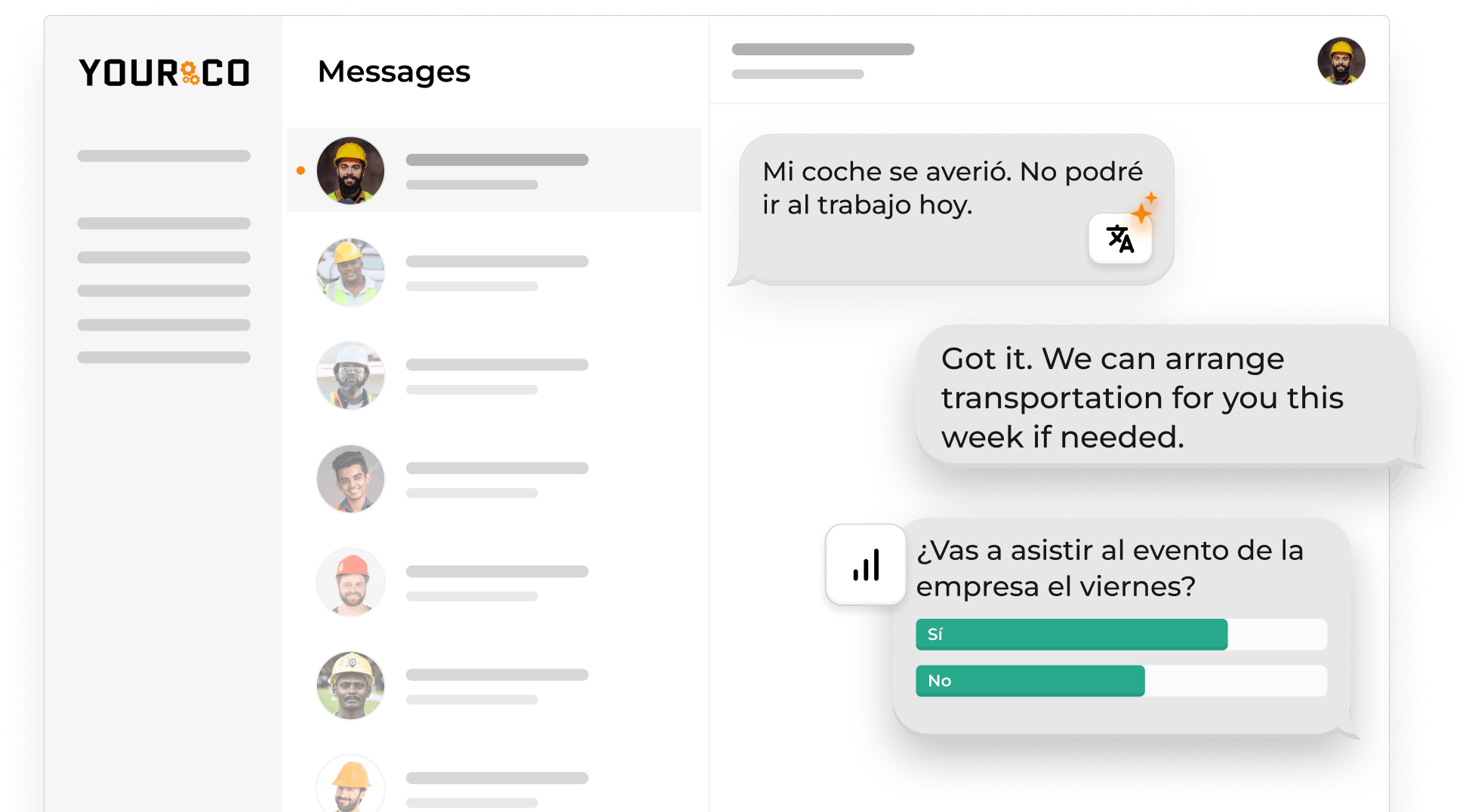
- AI-powered translation across 135+ languages and dialects, so point policies and warnings reach workers in a language they read
Yourco connects with 240+ HRIS and payroll integrations to keep employee data in sync with the systems that already manage employee records. For multi-site organizations, Enterprise Bridge allows corporate leadership to send centralized, one-way policy updates across all locations, while local managers maintain direct communication with their teams.
Frontline Intelligence gives HR and operations teams centralized visibility into call-off activity across all locations. Leaders can generate reports on call-off activity, including shift confirmations and response times, then identify absence patterns by site or department. Point decisions then rest on a single consistent record rather than on supervisor memory.
Manufacturers using Yourco for absence reporting describe how it works day-to-day.
"We use Yourco for our absence management and for sending out notices, reminders, and event announcements. It keeps everyone who needs to know informed when people are absent."
— Kyle Stover, HR Assistant, J-Lenco Inc.
After 90 days with Yourco, two-way employee engagement increased to 86%.
Try Yourco for free today, or schedule a demo to see the difference the right workplace communication solution can make for your company.

Frequently Asked Questions About Attendance Point Systems
How does an attendance point system work?
An attendance point system assigns a set point value to each infraction, such as a tardy or an unexcused absence, and scales them by severity. Points accumulate over the employer's defined rolling window, trigger progressive discipline at set thresholds, and expire individually as they age out.
How many attendance points before termination?
Termination thresholds vary by employer and depend on point values, the discipline ladder, and the rolling window. Many employers place termination after several prior warning stages. Manufacturing and logistics employers may set different thresholds because a single no-show can disrupt coverage, safety, or production flow.
What is a no-fault attendance policy?
A no-fault attendance policy assigns points for absences and tardiness without requiring a reason, so every unprotected absence carries the same consequence for all employees. It removes manager discretion and perceived favoritism, though protected absences, such as federal medical leave, still fall outside point accrual in many policies.
Are attendance point systems legal?
Attendance point systems are generally lawful when protected absences do not accrue points. Federal guidance addresses leave under the Family and Medical Leave Act and disability accommodations under the Americans with Disabilities Act, and some states, such as New York and California, protect mandated paid sick leave from point accrual.
How should employers handle a disputed attendance point?
Disputes resolve fastest when the employer can retrieve the original call-off record, including its timestamp and stated reason, rather than reconstructing events from memory. A defined review step, with a named decision-maker and a set turnaround time, prevents a single disputed point from escalating into a grievance.
What is the best way to track attendance points?
Tracking works best from a single, timestamped record of every call-off rather than voicemails or supervisor notes. SMS-based platforms like Yourco give employees one text channel to report absences and managers a searchable log, so point totals stay accurate, and disputes get resolved with evidence.