
According to SHRM, frontline workers make up 70% to 80% of the global workforce and work outside traditional desk-based office settings. Most employee sentiment programs were built for the other share: workers with corporate email, managed devices, and predictable schedules.
On manufacturing floors, at distribution centers, and across multi-site healthcare operations, disengagement builds for months before HR receives any signal. The sections below lay out how to build a sentiment program that actually reaches those workers.
TL;DR
- Frontline workers are routinely excluded from sentiment tools built for desk-based employees
- SMS pulse surveys remove adoption barriers like app downloads, corporate email, and company-issued devices
- AI analysis can surface burnout signals from existing workplace communications before workers self-report
- Segmenting feedback by location, tenure, and department stops site-level issues from being masked by company-wide averages
- Closing the feedback loop with visible action is what sustains participation over time
- SMS-based platforms like Yourco give frontline teams a direct, two-way channel from any phone, in any language
Understand Why Frontline Sentiment Goes Undetected
U.S. employee engagement hit a decade-low in 2024, and frontline workers bore the brunt. The infrastructure gap between frontline and office workers is not narrowing. 9% of production and frontline workers reported frequent AI use in 2025, a slight decline from 11% in 2023, while adoption among managers of managers climbed to 33%, according to Gallup research. The tools that are getting more sophisticated are also the ones that frontline workers cannot access.
43% of frontline employees consistently receive company communications, according to a Yourco-commissioned survey of 150 HR leaders. A sentiment program that depends on email or an intranet portal cannot reach the majority of the workforce it is meant to measure.
42% of employee turnover is preventable, according to Gallup, and nearly a quarter of those preventable departures could be addressed if managers resolved problems with staffing, workload, scheduling, and broader organizational conditions. Those are precisely the issues that structured sentiment programs surface when they can reach the right people.
Run SMS-Based Pulse Surveys That Reach Every Worker
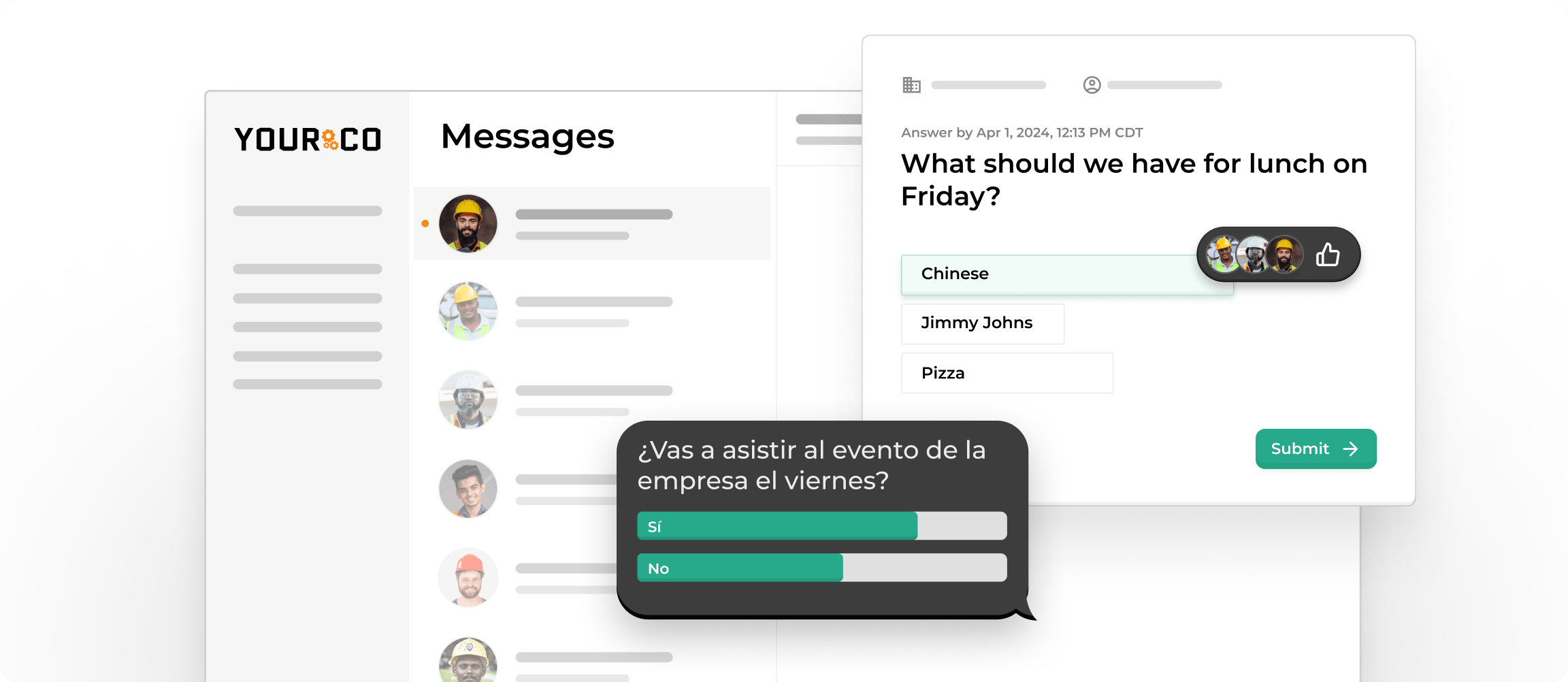
SMS is the only delivery mechanism for frontline populations that does not depend on corporate infrastructure. A short survey sent as a text message reaches workers on any mobile device, from smartphones to basic flip phones, during breaks or between shifts. No app installation, no login credentials, no Wi-Fi connection required.
91% of HR leaders say SMS increases frontline employee response rates, according to the same Yourco-commissioned survey of 150 HR leaders. The design principles for SMS pulse surveys differ meaningfully from traditional desktop surveys:
- Keep each survey to one to three questions maximum; question complexity must match the channel
- Time delivery to natural transition points, such as shift end or break periods
- Use AI-driven branching, so follow-up questions adapt based on initial responses rather than sending a static sequence
- Pair each survey with language translation so multilingual workers respond in their preferred language
- Track participation rates by shift, location, and tenure to identify which groups are still being missed
The constraint of SMS, short and simple questions, is its strength for frontline sentiment tracking. Workers who would never complete a 40-question annual survey will respond to a single well-timed text asking how their shift went.
Use AI-Powered Sentiment Analysis on Existing Communications
Not every sentiment signal needs to come from a survey. Natural language processing (NLP) can analyze existing workplace text data, including open-ended survey responses, shift notes, help desk tickets, and messaging conversations, to detect patterns without adding survey burden to already busy workers.
A narrative review of passive AI detection across healthcare, education, emergency services, and retail found that passive data sources, including workflow metrics and digital communications, may help identify early signs of burnout risk before symptoms become obvious.
The practical value for HR and operations leaders is speed. Rather than waiting for quarterly survey cycles, AI analysis surfaces emerging issues from existing data streams. Shifts in communication tone, increases in negative language, and sudden changes in response patterns are all early warning signals.
Passive AI analysis does carry practical constraints. Employees should be informed that workplace communications may be analyzed, as monitoring without disclosure creates legal risk and erodes trust. NLP accuracy also varies significantly across languages, dialects, and domain-specific vocabulary, and models trained primarily on Western populations may misinterpret behavioral patterns from workers in different cultural contexts."
This information is for general awareness only. For specific compliance guidance, consult with qualified legal professionals.
Segment Feedback by Location, Department, and Tenure
Aggregate sentiment data is almost useless for frontline operations. A warehouse picker, a night-shift nurse, and a retail floor associate face structurally different stressors that company-wide averages will mask completely.
Tenure is the most important segmentation dimension for frontline workforces. Workers in their first 12 months need frequent feedback touchpoints focused on onboarding friction and early workplace experience, while workers past the one-year mark surface different concerns around career development, scheduling, and recognition. Treating these as a single listening cohort produces data too blended to act on.
Location-based segmentation is equally important. Differences in local manager capability, shift culture, and communication norms create meaningfully different employee experiences across sites. Without location-level breakdowns, an HR director looking at survey results cannot tell whether a sentiment dip is company-wide or concentrated at three underperforming facilities.
Lifecycle surveys that automatically trigger at key transitions, such as new-hire milestones, role changes, or returns from leave, ensure the right person receives the right survey at the right time without manual list maintenance.
Turn Manager Alerts Into Immediate Action
The failure point in most sentiment tracking programs is not data collection. It is what happens between insight generation and manager action. SHRM found that retention strategies it identifies as effective are adopted by 40% or fewer managers, underscoring a persistent implementation gap. Organizations know what works, but are not implementing it on the front lines.
Effective sentiment systems now function as a synthesis layer across the manager experience, not simply a data collection tool. Well-designed platforms generate specific manager prompts rather than presenting raw analytics: a nudge to check in with a team showing declining scores, an alert when a location's response rate drops below a threshold, or a recommendation to address a recurring concern raised by multiple workers.
Manager accountability metrics should track four outcomes:
- Percentage of managers who created an action plan after receiving survey data
- Completion rates of follow-up conversations with affected teams
- Improvement in team sentiment scores quarter over quarter
- Response time from alert to first manager action on flagged issues
Tying these outcomes to managerial performance evaluations creates accountability that passive dashboards alone cannot.
Close the Feedback Loop So Workers Keep Responding
Frontline healthcare workers have grown frustrated with responses that address symptoms rather than root causes, according to Perceptyx research. Collecting sentiment data without visible follow-through trains workers to stop responding.
A functional feedback loop for frontline teams requires specific timing and channel choices:
- Share high-level findings with all employees soon after the survey closes, using shift huddles, SMS updates, or printed summaries rather than email or intranet posts
- Connect each feedback theme explicitly to the action taken, the timeline, and how progress will be measured
- Deploy a short follow-up pulse survey three to six months after the action plans launch to confirm workers have observed meaningful change
- Use announcement channels for frontline workers to actually access and communicate what has changed and why
When workers see their input connected to specific operational changes, participation builds as trust accumulates. Organizations that maintain this communication discipline across survey cycles see sustained engagement rather than the declining response rates that follow one-off listening exercises.
Capture Real-Time Sentiment Across Every Location With Yourco
Yourco gives HR and operations leaders a direct line to every frontline worker, on any phone, without requiring app downloads, corporate email, or internet access. For organizations tracking workforce sentiment across shifts, languages, and locations, this removes the single biggest barrier to hearing from the people closest to the work.
Core capabilities that support sentiment tracking include:
- SMS to any phone: no app download required, including basic flip phones and standard handsets
- Two-way messaging: workers respond, ask questions, and share feedback directly through SMS
- AI-powered translation: across 135+ languages and dialects, so every worker can participate in their preferred language
Yourco integrates with 240+ HRIS and payroll systems, keeping employee rosters automatically synced so pulse surveys and sentiment checks reach the right people at the right time.
Enterprise Bridge enables corporate leadership to send centralized, one-way announcements across all locations simultaneously, while local managers maintain direct two-way communication with their teams.
Frontline Intelligence provides HR and leadership teams with centralized visibility into sentiment trends and engagement patterns across all locations. It consolidates poll results, survey responses, and daily SMS communications to surface patterns by site or department.
"Yourco has helped to change the way we communicate at McCarthy Auto Group. We have nearly 700 employees and 80% are non-desk based, communication is a challenge. Yourco provides a quick easy way to reach everyone within our organization and a secure way for employees to reach HR and leadership without a computer."
— Felisha Parker, Vice President of Human Resources, McCarthy Auto Group
After 90 days on Yourco, companies see two-way employee engagement reach 86%.
Try Yourco for free today, or schedule a demo to see the difference the right workplace communication solution can make for your company.
Frequently Asked Questions About Workforce Sentiment Tracking
How do you track employee sentiment for workers without email or a desk?
SMS-based pulse surveys are the most reliable method. Short, one-to-three question surveys delivered by text work on any mobile phone during breaks or shift transitions. SMS-based platforms like Yourco also support multilingual teams through AI-powered translation.
What is the difference between a pulse survey and an annual engagement survey?
Pulse surveys are short, frequent check-ins designed to capture current sentiment signals. Annual engagement surveys are longer and broader. For frontline teams, pulse surveys are more practical because they take less time and can be timed to shift transitions.
How quickly should managers act on workforce sentiment data?
Managers should share high-level results soon after the survey closes, then move into team conversations and action planning within days. Waiting too long weakens trust and reduces the likelihood that workers will keep participating.
Can AI detect employee burnout before workers report it themselves?
AI can help spot early warning signs by analyzing patterns in workplace communications. It can flag shifts in tone, negative language, and changes in responses that suggest a team may need attention. Clear disclosure and a thoughtful privacy approach should come before any passive monitoring effort.
Why do frontline engagement surveys get low response rates?
Most engagement surveys are built for desktop access and standard office schedules. Frontline workers often lack corporate email, work non-standard shifts, or cannot access digital tools during the workday. Language barriers and distrust can further reduce participation.
How do you close the feedback loop with frontline workers?
Closing the loop means showing workers what changed as a result of their feedback. Organizations should use channels workers already have access to, such as SMS or shift huddles, to explain the action taken and the timeline. A short follow-up pulse later helps confirm whether employees noticed a real improvement.