
88% of HR leaders need a reliable way to reach frontline employees, and only 55% are confident they have one, according to a Yourco-commissioned survey of 150 HR leaders. A benefits update goes out through office channels, and a week later a machine operator asks why nobody told her. For plant-floor or job-site workforces, internal communication shows up in turnover, safety notices that miss entire shifts, and uneven reach across sites.
TL;DR
- Office channels exclude frontline workers by design, not by wording.
- Missed messages surface as skipped safety notices, wasted payroll hours, and early turnover.
- HR carries risk when it cannot show that a safety notice reached every worker.
- Five requirements separate tools that reach the floor from those that don't.
- SMS-based platforms like Yourco reach any phone workers already carry.
What Is Internal Communication for a Frontline Workforce?
Internal communication is the exchange of information between a company and its employees. It includes announcements, safety and policy updates, and employee feedback. That definition is narrower than employee engagement software, and the distinction matters when selecting a tool.
A recognition platform cannot reinforce a message a worker never received. When a construction firm posts a revised fall-protection memo to its intranet, the crews it wrote for may never log in to see it. The engagement layer fails because the delivery layer failed first.
Why Email, Intranets, and Bulletin Boards Miss the Floor
Email, intranets, and bulletin boards all assume conditions a plant floor does not provide.
- Hourly workers without a company email cannot receive email announcements because the company never issued them an inbox.
- Production lines and job sites give workers neither the credentials nor the screen time an intranet requires.
- Bulletin boards reach only the workers who walk past them at that location.
Training supervisors to write better announcements leaves the access problem untouched, because the channel still reaches nobody it excluded before.
How Does Internal Communication Affect Engagement and Retention?
Employees who feel informed and heard stay longer, and the effect is most visible in roles that turn over fastest. For an hourly new hire, the first weeks often amount to whatever a supervisor mentions in passing plus one orientation session. Without that, new hires miss the role clarity and social footing early retention depends on.
82% of manufacturers say a positive employee experience significantly reduces attrition, up from 66% a year earlier, according to a 2026 PwC and Manufacturing Institute survey of 102 manufacturers. Great Day Improvements, a home improvement company with 5,000 employees across 338 locations, raised organization-wide retention from 87% to 93% after consolidating frontline communication onto a single SMS channel.
How Should Employers Document Safety and Policy Communication?
When a safety notice or policy change reaches only part of the workforce, HR carries two exposures. Someone may get hurt acting on outdated information, and the company may be unable to show that it sent the message at all. Documentation answers the first question an incident investigator is likely to ask: whether the employee received the training.
Some employers also collect policy acknowledgments. A delivery record shows the company sent something, while an acknowledgment shows that the employee confirmed it. Employers can also document the refusal when an employee declines to sign.
Either record depends on a channel that keeps a timestamped log of what went out, to whom, and what came back. SMS-based platforms like Yourco archive messages and produce that log without a separate workflow.
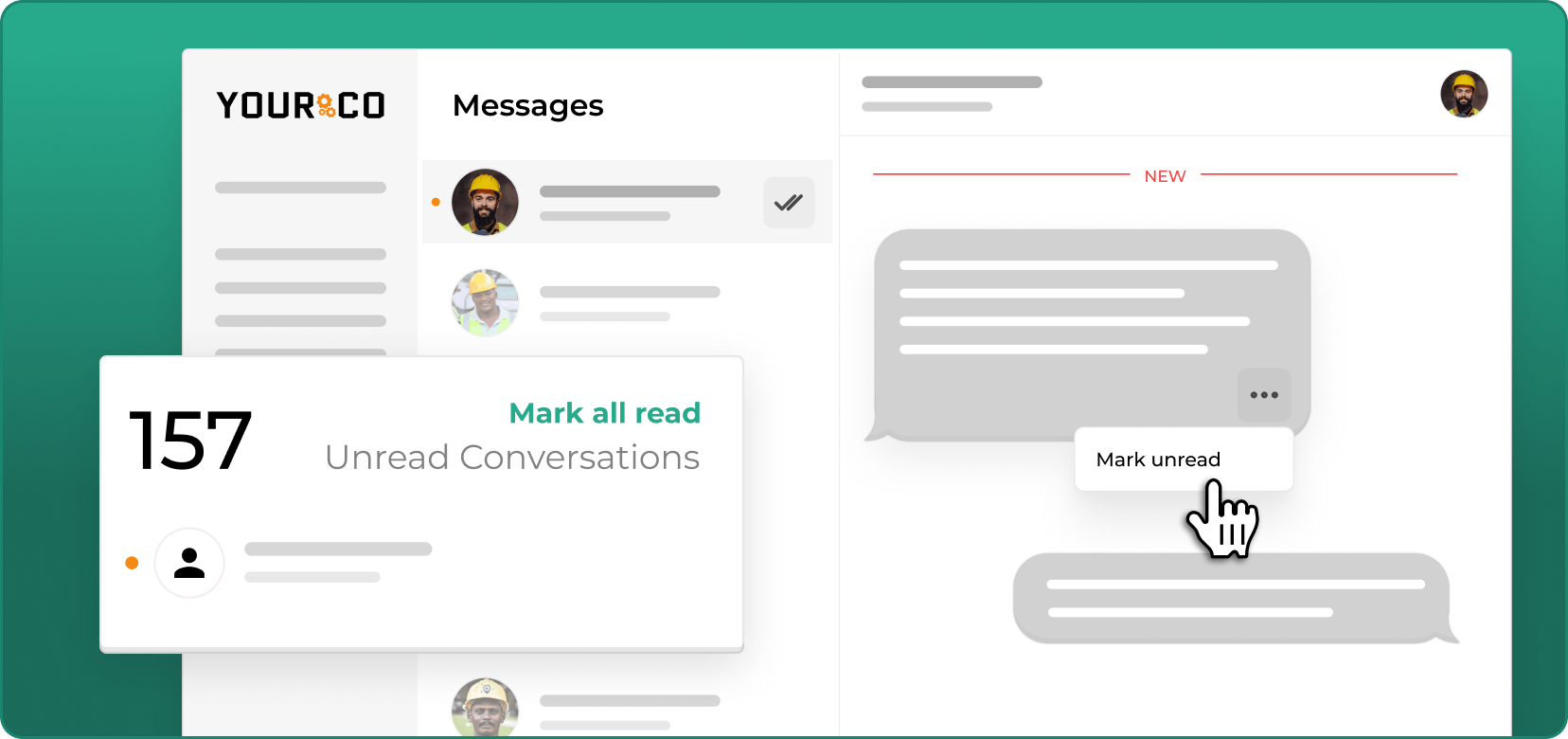
A usable record answers the questions that come up months later, when the person who sent the message has moved on:
- Who received it: delivery confirmation per employee, not a group send count.
- When it went out: a timestamp on the send and on each reply, rather than a supervisor's recollection of the shift.
- What it said: the message text as sent, including the translated versions, so HR can produce both the Spanish and English copies.
- Who acknowledged it: replies tied to named employees, with the non-responders identifiable for follow-up.
- Where it lives: one archive HR can search, rather than a thread on a former supervisor's personal phone.
A channel that produces all five as a byproduct of sending removes the separate task of assembling the record later.
This information is for general awareness only. For specific compliance guidance, consult with qualified legal professionals.
How Does Internal Communication Work in a Crisis?
A severe-weather closure, a line shutdown, or a recall gives HR no window to wait for people to check an inbox at the end of a shift. The channels that merely underperform on a routine Tuesday fail outright when minutes matter.
Crisis communication needs three things routine channels often lack: delivery to every affected worker within minutes, segmentation so one site's evacuation order does not reach a plant three states away, and replies that confirm who received the instruction. That last piece is what turns a broadcast into an accounting of who is safe. The same archive that supports routine documentation becomes the post-incident record of what leadership sent and when.
What Does Communication Failure Cost Across Locations?
Communication failure at multi-site companies costs money in four places: overtime and temp coverage for shifts nobody filled, rework on jobs finished against outdated instructions, benefits enrollment missed past the deadline, and the replacement cost of workers who left early. None of it appears as a communication line item, so it survives budget review year after year.
The delay follows a predictable two-tier pattern:
Headquarters staff read the benefits-enrollment email the day it arrives, while store managers mention it when they remember.
- One location hears weeks later through word of mouth, after the deadline.
No single missed message looks expensive on its own, which is what lets the total accumulate unnoticed.

Three Requirements to Test Any Internal Communication Tool Against
Three requirements do much of the filtering when a company evaluates communication tools against frontline conditions. Each one names a condition the frontline imposes rather than a feature a vendor advertises.
1. Reach Every Employee Without an App, Login, or Company Email
A tool that requires a download or a company email address excludes part of the frontline by design, and passwords add another barrier. SMS works on any phone an employee already carries, including basic flip phones. HR needs only a correct phone number, so adoption does not depend on a smartphone, home broadband, or an information technology (IT) setup process.
2. Two-Way Messaging Employees Can Answer in Their Own Language
Employees need to confirm shifts, ask questions, and report problems, but a broadcast-only channel gives them nowhere to do it. SMS call-off flows, and short text surveys turn the channel into a feedback source a supervisor can act on during the same shift. Without replies, HR may not learn a site is deteriorating until someone resigns.
Replies only help when the message arrived in a language the employee reads. Frontline industries employ linguistically diverse teams, and an English-only message quietly excludes part of the crew from information everyone else received. Many employers provide safety information in a language and vocabulary workers understand, and translation inside the messaging tool removes the wait for a bilingual lead.
3. Delivery That Fits the Shift, and a Record of Who Received It
A line shutdown or site closure needs instant mass delivery to everyone affected. HR can schedule routine messages for shift start, so third-shift workers are not reading yesterday's news when they clock in.
Tracking message reach produces data on who received each message, who replied, and which sites need follow-up. A location whose reply rate declines for two straight months warrants investigation before its turnover data changes.
Reach Every Frontline Employee With Yourco
Yourco is an SMS-based employee communication platform built for hourly, multi-site workforces that email cannot reach. It connects frontline employees through the phones they already carry and gives HR timestamped delivery confirmations and response records.
- SMS to any phone that receives a text, including basic flip phones, with no app download and no login
- Two-way messaging for shift confirmations, surveys, and questions
- Artificial intelligence (AI) translation across 135+ languages and dialects
- AI Call-Off Agent: collects call-off details over text, confirms them with the employee, notifies the supervisor, and logs an auditable record
- A timestamped delivery record for every message, so HR can show what the company sent, to whom, and when
Human Resources Information System (HRIS) and payroll data sync through Yourco's 240+ integrations, which keeps contact lists current.
Enterprise Bridge enables one-way broadcasts from corporate leadership to the entire frontline, while local managers maintain direct two-way communication with their teams.
Frontline Intelligence gives HR and headquarters teams centralized visibility into communication activity across all locations. Leaders can see which sites reply and which stay quiet, and track communication volume over time to identify peak engagement periods. Sentiment analysis across employee messages adds insight into how the workforce is responding to what leadership sends.
"We have nearly 700 employees and 80% are non-desk based, communication is a challenge. Yourco provides a quick easy way to reach everyone and a secure way for employees to reach HR and leadership without a computer."
— Felisha Parker, VP Human Resources, McCarthy Auto Group
After 90 days on Yourco, companies see two-way employee engagement reach 86%.
Try Yourco for free today or schedule a demo and see the difference the right workplace communication solution can make in your company.
Frequently Asked Questions About Internal Communication
Why is internal communication important for business success?
Internal communication matters because it prevents employees from missing policy changes, safety alerts, or benefits deadlines. One reliable channel keeps every worker on the same information. The stakes are highest at companies with large frontline workforces, where workers without company email can miss information office staff receive routinely.
What is the difference between internal and external communication?
Internal communication runs between a company and its own employees, covering policies, alerts, operational updates, benefits, and schedule changes. External communication targets customers, partners, candidates, investors, and the public. Each serves a different audience, so channel, detail, timing, and tone should differ.
How does poor internal communication affect employee retention?
Poor internal communication leaves employees without information or a way to be heard, which weakens their connection to the company. Hourly frontline workers are often affected first, since they receive fewer company touchpoints than office staff. Missed messages weaken onboarding and role clarity, and replacing those workers carries hiring, training, and coverage costs.
What is the best way to reach frontline employees without company email?
Text messaging is one of the most reliable options because it requires no app, login, company email address, or smartphone. SMS-based platforms like Yourco add two-way messaging, automatic translation, archiving, and delivery tracking, which reach workers on basic flip phones and smartphones alike.
What metrics show whether internal communication is working?
Useful measures include delivery confirmations by site and shift, response rates for surveys and call-off flows, and acknowledgment time for urgent alerts. Comparing results across locations shows where messages consistently draw fewer responses. These measures test reach and participation rather than assuming an employee read it.