Supply chain professionals ranked visibility first among 15 trends in a 2024 Maersk survey, ahead of diversification, cybersecurity, and e-commerce. A factory line goes quiet because nobody flagged a critical component stuck at a port. A reefer container loses temperature before anyone notices, and an entire shipment spoils. Every failure traces back to the same root cause: the team found out too late.
TL;DR
- Real-time supply chain visibility is a business imperative because static planning cannot keep up with shifting trade conditions and rising customer demands.
- Real-time data reduces costs across detention fees, fuel, inventory holding, and administrative overhead by showing teams where to act.
- Visibility helps teams respond faster to risk through rerouting, early congestion detection, and deeper supplier monitoring.
- Customers expect accurate tracking, reliable delivery and transparency to protect loyalty when delays occur.
- Visibility data only creates value when frontline workers act on it. Short Message Service (SMS)-based platforms like Yourco help reach drivers, warehouse crews, and dock teams instantly on any phone.
Treat Real-Time Supply Chain Visibility as a Business Imperative
Supply chain planning now changes too quickly for fixed long-term assumptions to hold. Pricing, sourcing, transportation availability, and trade conditions can shift before monthly reports catch up. Static planning collapses when a tariff change or supplier disruption rewrites a cost structure overnight.
The UK Government's Foresight report documents that global supply chain disruptions are becoming more frequent and consequential. Real-time supply chain visibility replaces delayed reports and manual tracking with current data that teams can act on. The two approaches produce different operational results across every dimension:
Many leaders still make decisions with partial information across suppliers, inventory, transportation, and customer commitments. Companies that improve visibility turn the supply chain from a slow cost center into a faster operating asset. The same discipline that strengthens frontline communication applies here: send real information quickly to the people who can act on it.
Cut Costs Across Detention, Fuel, Inventory, and Overhead
Detention and demurrage charges can pile up quickly when containers sit past free time, especially when port teams do not see expiration windows early. Real-time visibility flags those windows before charges escalate.
Beyond port fees, better route planning reduces wasted miles. Better demand forecasting frees up working capital tied up in excess stock, while visibility technology cuts the daily emails and calls that teams spend on locating orders. Real-time performance tracking also sharpens labor, yard, and fleet decisions, from workers who are slow to begin tasks to trailers that leave half-empty.
Spot manufacturing bottlenecks while there is still time to fix them. If a truck is late or inventory is sitting in the wrong node, the cost is lower when teams act before the issue spreads.
13.6 months was the median payback period for full visibility programs across a study of 78 life sciences companies, according to a 2025 study in the European Journal of Computer Science and Information Technology. Results depend on execution, integration quality, and team adoption. Visibility pays off when alerts lead to decisions.
Anticipate and Avoid Disruptions Before They Hit
Static management means teams often learn a shipment is delayed when it fails to arrive. Real-time visibility gives teams time to reroute, resequence production, notify customers, or source from another location before the full cost lands.
Major shipping disruptions have repeatedly demonstrated why that lead time matters. When trade routes become unavailable or congested, organizations with real-time tracking can identify affected cargo and begin rerouting before downstream costs compound. Those without it typically learn about delays only after schedules have already slipped.
Visibility also strengthens vendor compliance monitoring as deeper-tier risk grows. Tier 1 suppliers are often easier to monitor than deeper supplier tiers, where risks can surface later and spread faster. Catching congestion, customs issues, and compliance problems early gives teams lead time to execute contingency plans rather than scramble.
Manufacturers need to protect production schedules, and cold-chain teams need uninterrupted condition monitoring. Across verticals, teams need to know where stock is and when it will move.
Meet the Tracking Expectations Customers Now Demand
Customers expect to know where their order is, and they lose confidence when a brand cannot tell them. When a delivery promise slips and the customer hears nothing, the missed date feels worse.
Delivery reliability makes or breaks retention, but communication changes how customers experience a delay. A proactive heads-up gives them time to adjust. Silence forces them to chase support, refresh tracking pages, or assume the brand lost control.
Supply chain visibility strengthens trust by making delays easier to explain and easier for customers to plan around. Customers may forgive a delay when the brand explains what is happening, but they remember being left in the dark.
Roll Out Real-Time Visibility Without Overcomplicating It
Building real-time supply chain visibility does not require a multi-year overhaul. A practical sequence keeps the project grounded and makes early wins easier to see. Start with the places where delays, manual reconciliation, and missing handoffs create the most pain.
A phased rollout builds momentum rather than stalling on scope:
- Assess visibility blind spots: Look for systems that delay data, silo it, or force teams to reconcile it manually.
- Choose the right technology: A cold-chain program may need Internet of Things (IoT) sensors; transport teams may rely on Global Positioning System (GPS); multi-site networks may use cloud platforms; forecasting may use artificial intelligence (AI).
- Integrate with ERP, WMS, and TMS: Carrier application programming interfaces (APIs) and supplier portals should feed one operational picture through a single Enterprise Resource Planning (ERP), Warehouse Management System (WMS), and Transportation Management System (TMS).
- Train teams on dashboards and alerts: Give every team aligned Key Performance Indicators (KPIs), shared data, and clear accountability. Strong employee engagement on the dashboards turns the data into action.
- Monitor and refine KPIs: Use On-Time In-Full (OTIF), perfect order rate, and Estimated Time of Arrival (ETA) accuracy to see what improves, then tighten over time. Communication analytics, tracking whether alerts reached workers and how quickly teams responded, closes the loop between what the visibility platform surfaces and what actually happens on the ground.
Start small, prove value on Tier 1 suppliers and core inventory, then expand. Solving the most expensive blind spots first keeps the project moving before the scope grows.
Clear Up Common Misconceptions About Real-Time Visibility
A few persistent beliefs keep leaders from acting. The most common is that real-time visibility is only for the largest global shippers. Cloud-native, tiered platforms have made entry-level visibility more accessible for mid-sized operations, especially where customers or enterprise buyers expect shipment and inventory transparency.
The other misconceptions fall quickly when teams examine how work actually happens:
- We already have enough data: Pull the same Stock Keeping Unit (SKU) from the WMS, the ERP, and the 3PL portal at the same time. If three systems return three different inventory counts, the team does not have enough data; it has three versions of uncertainty. Real-time visibility creates a single source of truth that teams can act on without checking who has the right number.
- Customers will understand: They will not wait. When a delivery slips and no one reaches out, customers do not assume good faith. They assume lost control. A proactive update, even in the face of a delay, preserves trust in a way that silence never can. Visibility gives teams the information to communicate before the customer asks.
- It is just another dashboard: Dashboards show what happened. The operating requirement is knowing what to do next and who needs to do it. Alerts without clear ownership sit unseen. SMS-based platforms like Yourco surface sites that acknowledged an alert but did not respond, and how long it took teams to act, giving operations leaders the communication data to sit alongside their supply chain data.
Operations of any size can build real-time visibility step by step.
Turn Real-Time Data Into Real-Time Action With Yourco
The most sophisticated visibility platform still depends on the people on the ground acting on what it surfaces. When a route changes or a weather event threatens a shipment, drivers, warehouse crews, and dock teams need to know immediately. Many frontline workers do not sit at desks or check company email.
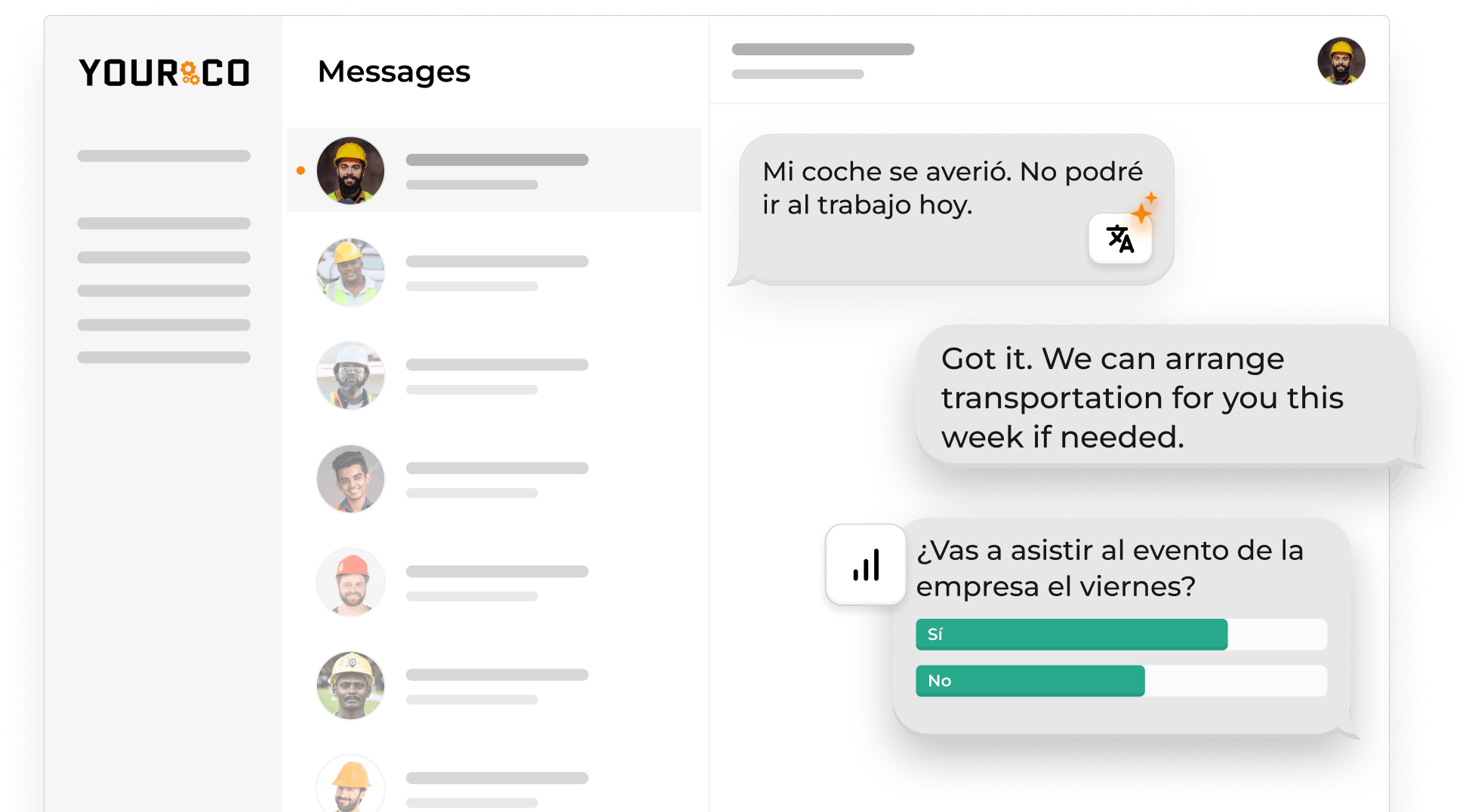
69% of HR leaders say missed or poor communication with frontline employees is a recurring source of frustration, according to a Yourco-commissioned survey of 150 HR leaders. Yourco is an SMS-based employee communication platform that closes the last-mile communication step, reaching every frontline worker on the device they already carry.
Yourco gives operations and HR leaders a reliable way to connect with the entire frontline workforce:
- SMS to any phone, including basic flip phones, with no app download or Wi-Fi required
- Two-way messaging so dispatchers and managers can request confirmations and get answers back
- AI-powered translation across 135+ languages and dialects for multilingual crews
Yourco keeps Human Resources Information System (HRIS) and payroll data synced through 240+ HRIS and payroll integrations across locations without manual upkeep.
Enterprise Bridge allows corporate leadership to send centralized, one-way updates across all frontline locations, while local managers maintain direct two-way communication with their teams.
Frontline Intelligence gives leadership centralized visibility into frontline communication patterns across every site. It surfaces which locations had the slowest response times to urgent supply chain alerts, helps leadership assess how proactively each site responds during disruptions, and tracks engagement patterns so teams can see where critical updates are not landing.
After 90 days on Yourco, companies see two-way employee engagement reach 86%, according to Yourco internal data.
Try Yourco for free today or schedule a demo and see the difference the right workplace communication platform can make in your company.
Frequently Asked Questions About Real-Time Supply Chain Visibility
What is real-time supply chain visibility?
Real-time supply chain visibility is the ability to continuously track shipments and inventory, along with operating conditions, as they occur. It pulls information from tools such as GPS, IoT sensors, carrier systems, and supplier portals into a single operational view, enabling teams to respond before small issues become costly disruptions.
Why does real-time visibility matter for supply chains?
Real-time supply chain visibility matters because static planning cannot keep pace with rapidly changing trade conditions and customer expectations. It helps businesses reroute around problems, control costs, protect delivery promises, and give teams enough warning to act before an issue spreads across the network.
Is real-time visibility worth it for mid-sized companies?
Real-time visibility can benefit mid-sized companies because many platforms now support phased rollouts and targeted use cases. Teams can start with core inventory, Tier 1 suppliers, or priority lanes, then expand once the business sees value and workers understand the process.
How do frontline workers fit into real-time visibility?
Frontline workers turn visibility data into action. Drivers, warehouse crews, and dock teams need alerts the moment routes change or disruptions hit. SMS-based platforms like Yourco help reach these workers on any phone, so real-time information reaches the people closest to the work.
What are the first steps to implement real-time visibility?
The first step is auditing current systems to find where they delay data, silo it, or force teams to reconcile it manually. From there, choose technology that matches the operation, connect it with ERP, WMS, and TMS workflows, and train teams on dashboards and alerts with clear ownership. Prove value on a focused use case first, then expand.