Poor frontline communication costs employers more than most leadership teams realize, and commonly cited SMS open-rate benchmarks suggest a large divide between channels that reliably reach workers and channels they ignore. For HR and operations leaders in manufacturing plants, warehouses, and retail stores, the symptoms are familiar: critical updates that never reach the floor, safety procedures lost in email, and turnover that keeps climbing.
The challenge is building a case with numbers your CFO will accept. This guide provides the data, frameworks, and business case structure to secure budget approval.
TL;DR
- Poor frontline communication costs employers across productivity, turnover, safety, and revenue, all of which can be quantified for a CFO presentation
- A significant share (42%, in Gallup's data) of employee departures is preventable, with communication and management quality among the top drivers
- OSHA's most cited violations are functionally communication and training failures, which make safety a defensible argument for investment
- A structured business case built on turnover reduction, productivity recovery, and compliance savings gives leadership a clear reason to invest
- SMS-based platforms like Yourco reach frontline workers on any phone, no app, email, or Wi-Fi required
Quantify the Productivity Cost of Poor Frontline Communication
The productivity case starts with a simple question: how much time do your frontline teams lose to unclear instructions, missed updates, and repeated work?
Gallup's State of the Global Workplace research estimates that employee disengagement costs the global economy roughly $10 trillion in lost productivity each year, with frontline roles often among the most affected. Ineffective communication consumes a meaningful portion of employees' time, much of which is spent clarifying messages, redoing work, or dealing with operational delays. Employees frequently redo work because of miscommunication, according to Grammarly's Business Communication Report, generating rework and operational delays that compound quickly across large frontline workforces.
Research by SHRM and others shows that many frontline workers lack access to computers during the workday, making traditional email or desktop-based tools an ineffective primary channel. If your primary communication channel requires a login, an app, or a desk, it structurally excludes the majority of your workforce. Only 36% of HR leaders say their current employee communication app is effective, according to a Yourco-commissioned survey of 150 HR leaders, illustrating why many teams adopt employee communication tools designed for workers who are rarely at a workstation.
In manufacturing specifically, the numbers compound quickly. 30 hours of production per month is the average loss to unplanned downtime, according to the L2L Manufacturing Downtime Report, and six in ten leaders say these disruptions cost their businesses more than $250,000 annually.
Calculate the Turnover Costs You're Already Paying
Turnover is where poor frontline communication costs hit the budget hardest, because replacement costs are concrete and auditable. 42% of voluntary employee departures are preventable but often ignored, according to Gallup's research on preventable turnover. Compensation and benefits issues account for a meaningful share, while management-related issues such as workload, staffing, and scheduling round out the leading drivers of preventable turnover. These categories map closely to communication and culture.
Replacement costs vary by industry, but they are always significant. The figures below give a reasonable starting range for internal modeling:
- Retail frontline: roughly $10,000 per departure, reflecting industry-specific cost-of-turnover studies, including analyses summarized by SHRM Labs
- Manufacturing frontline: $10,000 to $40,000 per skilled worker, based on industry benchmarks
- General roles: 50% to 200% of annual salary, according to SHRM's guidance on replacement-cost modeling
For a 500-person manufacturer with 10% annual attrition, even a conservative estimate means 50 departures per year at $25,000 each: $1.25 million. If a large share of those are preventable, you're looking at hundreds of thousands of dollars in avoidable turnover costs annually at a single site.
Gallup's Q12 research finds that employees who feel clearly informed about expectations and regularly hear from leadership report higher job satisfaction and engagement. 91% of HR leaders consider SMS the most effective way to reach frontline workers, according to the same Yourco-commissioned survey, which explains why many organizations are rebuilding employee retention strategies around more consistent communication.
Trace the Revenue Leakage Back to Communication Breakdowns
Revenue impact is harder to isolate than turnover, but the available data points in a consistent direction. Gallup's recent data shows that fewer employees clearly understand what is expected of them at work, and research indicates that when frontline workers lack clarity on expectations, downstream metrics such as quality, safety, and productivity typically suffer.
The operational consequences are measurable. Workers regularly report that poor communication caused them to miss deadlines, and a notable share say their organization lost customers as a direct result of miscommunication. McKinsey's analysis of frontline talent investment suggests that for a 10,000-employee manufacturer, frontline labor challenges driven by attrition and engagement failures can create an annual EBITDA impact in the hundreds of millions.
Gallup's Q12 meta-analysis provides the causal link: top-quartile engagement versus bottom-quartile correlates with significantly higher profitability and far fewer quality defects. Communication affects morale, but it also shows up directly in profitability and quality metrics on the P&L.
Expose the Safety and Compliance Risk Hiding in Plain Sight
For operations leaders, the safety case may be the most defensible argument for addressing the costs of poor frontline communication. Industry research has consistently found that poor communication contributes to a large share of workplace incidents. Meanwhile, total U.S. work injury costs remain in the hundreds of billions annually, with the average medically consulted injury costing tens of thousands of dollars.
Many employers follow Occupational Safety and Health Administration (OSHA) standards that, at their core, are communication and training requirements. The most frequently cited violations tie directly to how well employers can reach workers with the right information:
- Hazard Communication (1910.1200): Written programs, hazard labels, and worker training
- Lockout/Tagout (1910.147): Documented energy-control procedures and employee training
- Fall Protection Training (1926.503): Training workers to recognize fall hazards and follow procedures
$16,550 per serious violation and $165,514 per willful or repeat violation are the current maximums under OSHA's penalty schedule. Enforcement cases regularly result in six-figure proposed penalties due to failures to correct training and procedural communication breakdowns identified in prior inspections.
This information is for general awareness only. For specific compliance guidance, consult with qualified legal professionals.
When you can show leadership that a single penalty can exceed the annual cost of a communication platform for thousands of employees, the safety ROI argument writes itself.
Build a Business Case Your CFO Will Approve
Calculating the ROI of fixing poor frontline communication costs is more straightforward than ever. AI-powered translation, mobile-first reach, and two-way feedback loops enable organizations to measure delivery, acknowledgment, and engagement across the entire workforce in real time. The strongest business cases rest on three independently quantifiable pillars.
Pillar 1: Turnover Reduction
Use the inputs below to size your organization's annual turnover exposure before any reduction assumptions:
For a 500-person manufacturer at 10% attrition with a $25,000 average replacement cost, annual turnover exposure totals approximately $1.25 million before any reduction assumptions.
Pillar 2: Productivity Recovery
Annual lost-time cost equals frontline headcount multiplied by the fully loaded hourly rate, multiplied by hours lost per employee per week, multiplied by 52 weeks. Even recovering 15 minutes per employee per day across 1,000 workers generates meaningful savings at fully-loaded rates.
To strengthen this pillar, segment productivity losses by category: shift handoff delays, clarification requests routed through supervisors, and rework caused by outdated instructions. Each of these has a measurable time signature that finance teams can validate against payroll data, which makes the recovered hours defensible rather than theoretical. Pair the calculation with a baseline measurement period of 30 to 60 days to show before-and-after deltas tied to specific communication interventions.
Pillar 3: Safety and Compliance Savings
Track the number of safety-related alerts that currently go unacknowledged or undelivered. Multiply unacknowledged incidents by your average injury cost or potential citation cost. Even one prevented incident can offset an entire year of communication platform investment.
Beyond direct injury and citation costs, factor in the secondary expenses that often escape initial ROI models: workers' compensation premium increases, OSHA-mandated abatement costs, legal fees, and the productivity loss tied to incident investigations and temporary line shutdowns. Documented acknowledgment trails also serve as evidence of good-faith compliance efforts during inspections, which can influence how regulators classify a violation and the penalty tier that follows. Treat acknowledgment data as both a leading safety indicator and a legal defense asset when presenting to your CFO.
Success Metrics to Track Post-Implementation
Set targets before you launch. Most organizations do not track policy acknowledgment rates, so setting a policy acknowledgment target provides teams with a concrete standard and demonstrates readiness for compliance.
Pair acknowledgment tracking with employee survey response data and engagement trends to build a complete picture. Setting an engagement lift target within the first year provides leadership with a measurable outcome directly tied to communication investment.
Reach Your Frontline Workforce With Yourco
Building the business case is one side of the equation. Executing on it requires a platform designed for how frontline teams actually work: on the floor, in the field, on any phone.
Yourco is an SMS-based employee communication platform built for frontline organizations. Core capabilities include:
- SMS to any phone: Messages reach smartphones, basic flip phones, and other mobile devices with no app download, no Wi-Fi, and no cost to employees
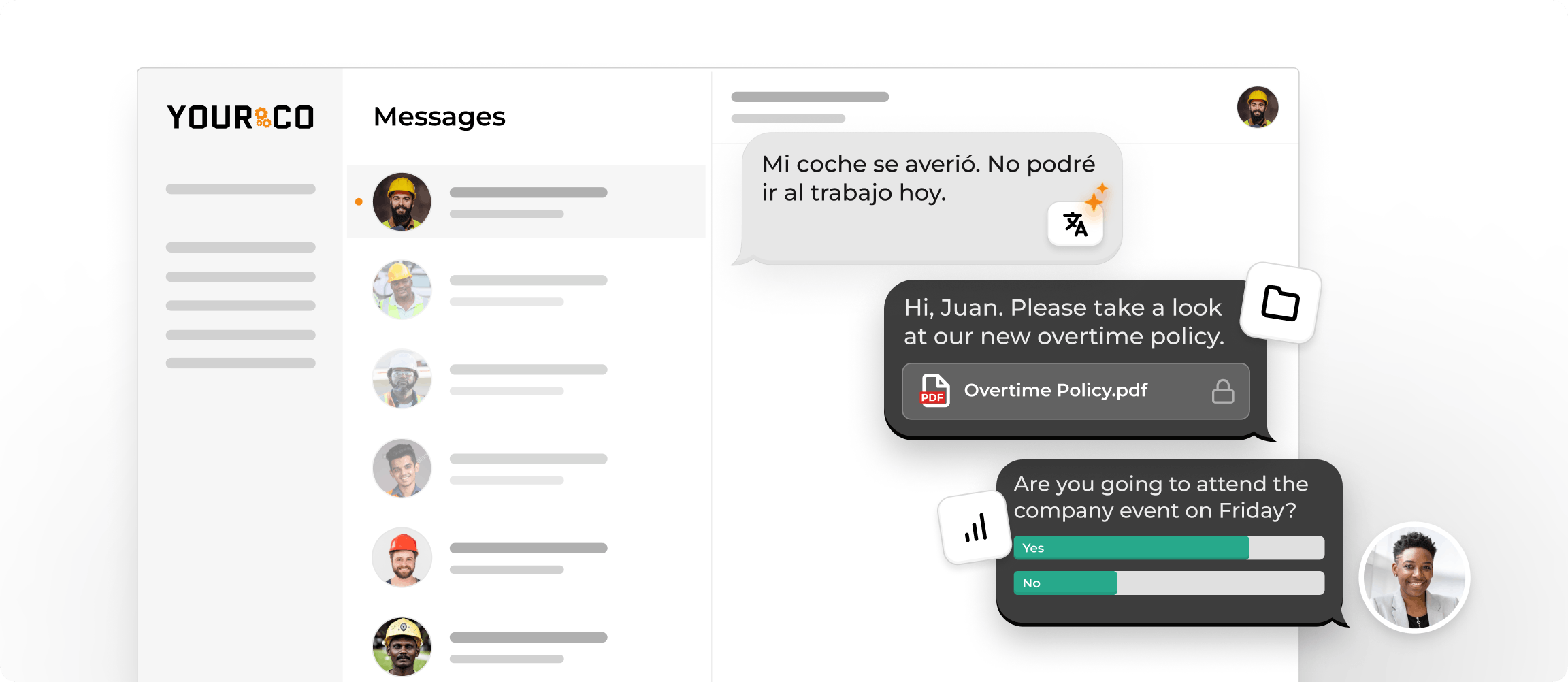
- Two-way messaging: Employees can respond, report absences, and share feedback directly through text
- AI-powered translation: Communication in 135+ languages and dialects, delivered in each worker's preferred language
Yourco connects with 240+ HRIS and payroll systems, helping keep employee records up to date without manual imports.
Enterprise Bridge gives corporate leadership a one-way broadcast channel to send policy updates, safety directives, and company announcements to every frontline location at once.
Frontline Intelligence gives HR and operations teams centralized visibility into communication and acknowledgment trends across all locations. Leaders can identify patterns across sites, surface engagement and sentiment signals, and review workforce activity signals to support more informed decisions.
"Yourco has allowed us to scale frontline employee communications through rapid growth of the organization, while driving increased levels of engagement, employee retention, and productivity. We use it daily for HR and operational communications at the local level, and for organization-wide communications and frontline employee data analysis at the corporate level. The ease of use and implementation has driven full adoption across our workforce, becoming our most effective frontline employee communication channel."
— Madison Farrell, Director of Culture and Internal Communications, Great Day Improvements
After 90 days on Yourco, companies see two-way employee engagement reach 86%.
Try Yourco for free today, or schedule a demo to see the difference the right workplace communication solution can make for your company.
Frequently Asked Questions About Poor Frontline Communication
How much does poor frontline communication cost per employee?
Poor frontline communication results in per-employee losses due to rework, delays, and missed updates. For frontline roles, the financial impact also manifests in turnover, safety incidents, and production disruptions across shifts and locations.
What percentage of employee turnover is caused by communication problems?
Communication problems are a significant driver of turnover, but the exact share varies by organization. The strongest way to measure impact is to review preventable turnover, manager communication quality, and exit patterns across your own frontline workforce.
How do you build a business case for frontline communication tools?
Build the case around turnover reduction, productivity recovery, and safety or compliance cost avoidance. Use your own headcount, attrition rate, and replacement cost data, then show how SMS-based platforms like Yourco can improve delivery, acknowledgment, and workforce visibility.
What are the most common OSHA violations related to communication?
Hazard Communication, Lockout/Tagout, and Fall Protection Training are commonly tied to communication and training shortfalls. These standards depend on clear worker instruction, documented processes, and consistent delivery of safety information across locations and shifts.
How do you measure communication ROI for frontline teams?
Measure communication ROI by tracking acknowledgment rates, message delivery confirmation, employee survey response rates, and engagement trends over time. Then compare those communication metrics against turnover, absenteeism, safety incidents, and other operational KPIs your leadership team already uses.