
In 2025, 2.2% of full-time wage and salary workers were absent from work because of illness or injury in an average week, according to the Bureau of Labor Statistics; on a production line or loading dock, those absences are often reported by text because there is no company inbox to report them through.
Knowing how to respond to an employee texting in sick starts with a fast, warm acknowledgment. A simple "Thanks for letting me know. Get some rest and feel better soon" tells them their well-being comes first and leaves coverage questions for a second message.
TL;DR
- Acknowledge the text within minutes, wish the employee well, and hold operational questions for a second message.
- Ask about timing, duration, and urgent handoffs; leave the illness itself alone.
- Agree on contact preferences, cadence, a named point person, and a definition of emergency before any foreseeable leave begins.
- Keep contact during protected leave infrequent and free of work requests, and route anything that hints at protected leave to HR.
- Log every sick text the day it arrives, and store medical details separately from general personnel files.
- SMS-based platforms like Yourco reach frontline employees who have a phone but no company email, and keep a timestamped record of each exchange.
Craft Empathetic Responses to Sick Leave Texts
A thoughtful response respects both the employee's situation and the company's coverage needs. Four habits carry most of the weight:
- Listen attentively: read for the emotions behind the words, not just the words themselves.
- Acknowledge feelings: a line such as "I know this isn't easy" changes how the rest of the exchange lands.
- Be specific: express sincere concern and state the next step rather than leaving it open.
- Offer support: name what the company can do, and avoid promises that depend on someone else's approval.
Applied to a real message, that becomes "I know this isn't easy. Let's figure out a plan so you can rest, and we'll keep things moving here." Two sentences confirm the absence, express care, and signal that coverage is being handled.
Ask Only What You Need to Plan Coverage
Operational questions are generally appropriate when limited to necessary planning, while questions about the illness itself may be inappropriate unless HR or legal counsel confirms a lawful, necessary reason to ask. The EEOC treats any question "likely to elicit information about a disability" as a disability-related inquiry, and its enforcement guidance states that such an inquiry of a current employee is generally job-related and consistent with business necessity only where the employer has a reasonable belief, based on objective evidence, that a medical condition will impair essential job functions or create a direct threat. Managers can ask about expected return timing and duration, and about urgent handoffs.
The split below keeps a sick-day exchange on the operational side of that line.
Several states add their own limits. New York's paid sick leave rules, for example, state that no employer may require an employee to disclose confidential information, including the nature of an illness, its prognosis, or treatment. A text that says "I'm sick and need today off" already contains everything a manager needs to plan the shift. On platforms like Yourco, the AI Call-Off Agent asks for exactly that and nothing more, confirms it back to the employee, and notifies the manager automatically. The mechanics are covered in full below.
Adjust Tone to the Likely Situation
An employee never has to name the FMLA or use the word "accommodation" for those protections to apply. The EEOC states that a request for reasonable accommodation "does not require the use of 'magic words'" in its accommodation procedures guidance, so a plain-English text such as "my back is acting up again" or a mention of a hospital stay may be enough to signal that HR should review the situation. Reply with the same warmth a manager would offer for a cold, skip the diagnosis question, confirm that the shift is covered, and forward the text to HR so the paperwork conversation happens with the right person. A mental-health sick day gets the same treatment: acknowledge it, confirm coverage, and leave the details alone.
Sample Response Templates
Four messages cover most of what a supervisor sends in the first hour of an absence.
- Initial acknowledgment: "Thanks for letting me know. Get some rest and feel better soon."
- When timing matters: "Hope you feel better. When you have a moment, could you give me a rough idea of when you might be back so we can plan coverage?"
- For extended illness: "Take all the time you need to recover. Just keep me posted when you can, and let me know if there's anything we can do to help."
- When the text mentions a hospital stay or a condition that may run longer than a few days: "I'm sorry to hear that. Don't worry about the schedule; we've got it covered. I'll ask HR to reach out about time-off options and paperwork so you don't have to sort that out while you're recovering."
Storing these as templates keeps the first reply consistent across supervisors and shifts.
Understand the Legal and Policy Framework
Treat every sick-day text as a written record: limit contact during protected leave and keep it free of work requests, keep medical details out of the conversation and out of general personnel files, and send anything that looks like protected leave or accommodation territory to HR. Texts help because they document what was asked and when, but that same record can also show a pattern of over-contact.
This information is for general awareness only. For specific compliance guidance, consult with qualified legal professionals.
FMLA Guidelines
FMLA leave rules shape how much contact is appropriate during an absence, limiting it to infrequent exchanges about leave status, return timelines, and benefit management.
29 CFR § 825.311 states that an employer may require an employee on FMLA leave to report periodically on status and intent to return to work, and that the policy governing those reports "may not be discriminatory and must take into account all of the relevant facts and circumstances related to the individual employee's leave situation." The rule sets no interval, which is why many employers avoid including a fixed frequency in policy and instead set the cadence by situation. Courts have treated frequent calls asking when an employee will return, or repeated requests for project input, as potential interference with FMLA rights, so update requests should never pressure employees to perform work.
ADA Compliance
The Americans with Disabilities Act (ADA) calls for an interactive process when communicating with employees on disability-related leave. Communication should explore accommodations that might support eventual workplace reentry, such as modified duties or alternative schedules. These discussions focus on employee needs rather than organizational convenience, and each case is evaluated individually. The Job Accommodation Network, a service of the U.S. Department of Labor's Office of Disability Employment Policy, notes that the duty to engage begins when the employee makes a request or when the employer reasonably believes an employee may need an accommodation for a known disability affecting job performance.
Privacy Considerations
Both the FMLA and the ADA carry confidentiality expectations for medical information. Access to sensitive data should stay with direct supervisors and HR personnel who have a legitimate need to know, and managers and HR staff should keep medical details out of team meetings and casual conversations. 29 CFR § 1630.14 is specific on storage, providing that medical information "shall be collected and maintained on separate forms and in separate medical files and be treated as a confidential medical record," with access limited to supervisors and managers who need to know about work restrictions and accommodations, first aid and safety personnel where a condition might require emergency treatment, and government officials investigating compliance. Electronic records get the same treatment. SMS-based platforms like Yourco hold work messages to the same expectation, encrypting data in transit and at rest and using platform security controls and role-based permissions to limit who can open a conversation.
The Health Insurance Portability and Accountability Act (HIPAA), by contrast, reaches none of this. Its definition of protected health information at 45 CFR § 160.103 expressly excludes employment records a covered entity holds in its role as employer, so ADA and FMLA expectations reach a sick text sitting in a manager's phone.
When explaining an absence to the team, share only the work-arrangement impact and leave out the underlying condition. Something like "Maria will be out for a few days and we've redistributed her tasks" protects privacy while keeping operations moving.
Communication by Leave Type
Contact rules shift with the reason for the absence, and the employee's own preferences matter as much as the category. Advisers who work on FMLA administration put the medical-leave baseline at limiting the number of communications and naming one person to handle them, ideally in HR, as the HR advisory organization MEA sets out in its FMLA contact guidance.
The four categories below cover most absences a frontline HR team administers.
Contact only when necessary, such as for a return date, benefits paperwork, or a genuine emergency. Avoid asking, hinting, or checking whether the employee has a minute for work. The DOL's FMLA employee protections fact sheet, revised March 2025, states that employers are prohibited from interfering with, restraining, or denying the exercise of any FMLA right, and discourages an employee from using leave as an example of interference. Hold individualized accommodation conversations where a disability may be involved, and respect stated preferences, so an employee who asked for silence gets silence apart from administrative notices.
Set Clear Policies Before Sick Days Happen
Write down how an absence gets reported, who replies, how quickly, and where the record lives, then keep a separate planning checklist for leave you can see coming. A policy handles the 5 a.m. sick text; a pre-leave conversation handles the surgery scheduled six weeks out.
Key Policy Elements
A sick leave policy, one piece of the internal communications best practices a company maintains, covers four things:
- Communication protocols: how employees should structure sick texts and what details the company needs, such as expected duration and any urgent handoffs
- Response expectations: who responds, and within what timeframe
- Documentation requirements: how texts are logged in attendance records
- Privacy protections: where communications are stored, and who can open them
Say explicitly which channels count as a report, and check the answer against whatever workplace texting rules the company already publishes, since an absence policy that contradicts them puts supervisors in the middle. If a text to a supervisor is not an accepted report, the policy should say so, and if it is, the policy should say that too, ideally with an example of what a noncompliant report looks like. Some jurisdictions take the question out of the employer's hands. Cook County, Illinois' Paid Leave Ordinance rules, approved April 2025, treat a notification policy as unreasonable where it "excludes notification by phone, email or text messaging." A policy that accepts only a phone call to a supervisor would run into that.
One named channel is what makes the rest of the policy work. On SMS-based platforms like Yourco, a dedicated text-off line removes the ambiguity, because every call-off lands in the same place rather than in whichever supervisor's personal messages the employee happened to have.
Train managers and employees on the procedure so expectations are clear from the start. When policies are clear, employees report absences more readily, managers respond consistently, and anyone unsure whether an absence touches protected leave knows to route it to HR before acting.
Plan Ahead When Leave Is Foreseeable
A pre-leave conversation only works where there is notice: a scheduled procedure, a due date, an approved sabbatical. A sudden sick day gets the immediate reply and the documented call-out procedure instead, and a no-call/no-show typically has the supervisor call the worker and alert HR, who checks the file for prior FMLA or ADA leave before anyone treats the absence as unexcused.
Where there is notice, six items are worth settling in writing.
The return side is a reboarding conversation rather than a shift handover: what changed on current and new projects, who has joined or moved, and what success looks like now. Record the estimated return date in writing where possible, and expect to revise it.
Follow Up and Document Properly
Log every sick text in the attendance record the day it arrives, whether it came through a supervisor, a shared inbox, or a dedicated call-off hotline, then match the follow-up to the absence: one "how are you doing" near the expected return for a short illness, and only occasional, pre-agreed well-being or administrative contact for anything longer. Thorough documentation creates a defensible record if questions arise later.
For Short-Term Absences
A one- or two-day absence needs three things.
- Acknowledge promptly and express care
- Set a clear expectation for the next update, such as "Please check in on Friday to let me know how you're doing"
- Document the exchange in the attendance system
That is usually the whole follow-up for an absence of a day or two.
For Extended Absences
A longer absence changes the rhythm, not the principle.
- Send periodic check-ins focused on well-being, not work demands
- Keep messages simple: "Hi [Name], just wanted to see how you're feeling. The team is thinking of you."
- Document all communications with dates, content summaries, and any agreements made
Timestamped digital records are what demonstrate appropriate contact frequency months later. An employee texting platform should automatically log and retain messages, including after an employee leaves. Each entry should note the date and channel, identify who took part, and record what participants discussed and agreed.
Set Check-In Frequency by Situation
No federal rule sets a cadence. A two-to-four-week interval during an extended medical absence is a workable example, not a standard, and frequency should first follow the type of leave and its expected duration. Administrative milestones create the legitimate touchpoints: 29 CFR § 825.308 provides that an employer may request recertification of a medical condition every six months during an absence, and that when a certification indicates a minimum duration, the employer waits until that duration expires before requesting recertification.
Employee preference shapes the rest. Agree the frequency early, and dial it back where the employee is coping with stress or a mental-health condition.
Separating need-to-know from nice-to-know keeps the volume defensible. Benefit changes, reorganizations affecting the employee's role, and pay-cycle changes belong in the need-to-know column and should travel through the agreed channel. Team social events, routine stand-up notes, and general company news sit in the nice-to-know column and can wait until the employee returns unless the employee asked to hear them.
Separate Well-Being Check-Ins From Work Requests
A check-in asks how the employee is doing, confirms a return date, or handles benefits paperwork. A work request asks for a memo, a decision on a shift swap, or "quick" input on a problem, and it belongs off the table during protected leave. Many employers draw that line in writing before a leave starts, so nobody has to judge it in the moment. Where an employee volunteers to help anyway, the safer practice is to record that it was voluntary rather than to rely on it having been offered.
For hourly workers, the exposure runs on two tracks, because answering a work question can amount to time worked that nobody recorded or paid. If an employee volunteers help, document that it was voluntary and pay for the time.
Define Emergency Contact Rules
Only a business-continuity problem that no one else can resolve qualifies as an emergency during leave. A practical test many employers use is how long a reply would take: asking where a file sits or how to reach a client differs from asking someone to produce work. Write the protocol down with the employee before leave starts, name what counts, and require the team to exhaust other options before anyone interrupts a recovery.
Five elements make the protocol usable by whoever is on shift when the situation arises.
Filling this in during the pre-leave conversation means whoever is on shift at 2 a.m. does not have to decide alone whether the situation justifies the call.
Reach Frontline Workers Effectively
Pick the channel the employee can see. For office staff, that is often email; for a frontline worker without a company inbox, Short Message Service (SMS) is the practical default, backed by a designated liaison and physical mail for major updates.
The obstacle is reach. 88% of HR leaders say they need a reliable way to reach frontline employees, while only 55% are confident they have one, according to a Yourco-commissioned survey of 150 HR leaders. An absence-reporting channel inherits that problem in both directions: employees can't report, and the company cannot confirm.
For absence reporting, the shortlist narrows fast. Ranked against reach, most employee communication tools fall away at the first test, because the channel must work on a phone the employee already owns, require no login they have never set up, and leave a record the company keeps rather than the employee. What survives is a company-owned number an employee can text from any handset.
Why SMS Works Best
Team text messaging reaches frontline employees regardless of technical skill or device type, and almost everyone already knows how to send one. Three properties do the work:
- Universal reach: works on any phone, including basic flip phones
- No tech barriers: no apps to download, accounts to create, or internet connection required
- Confirmed delivery: the platform records that the message was sent and delivered, with a timestamp
None of that requires the employee to own a smartphone or remember a password.
Match the Channel to the Workforce
Desk-based and frontline employees need different channels during an absence, and the choice follows access first and preference second.
Where the employee prefers it and is already on site or returning to work, a private in-person conversation suits sensitive planning or reboarding. An employee should not have to come to the workplace during leave simply to receive an update.
For frontline employees, four supports do the work of an intranet:
- Name one liaison to relay information and answer questions during the absence
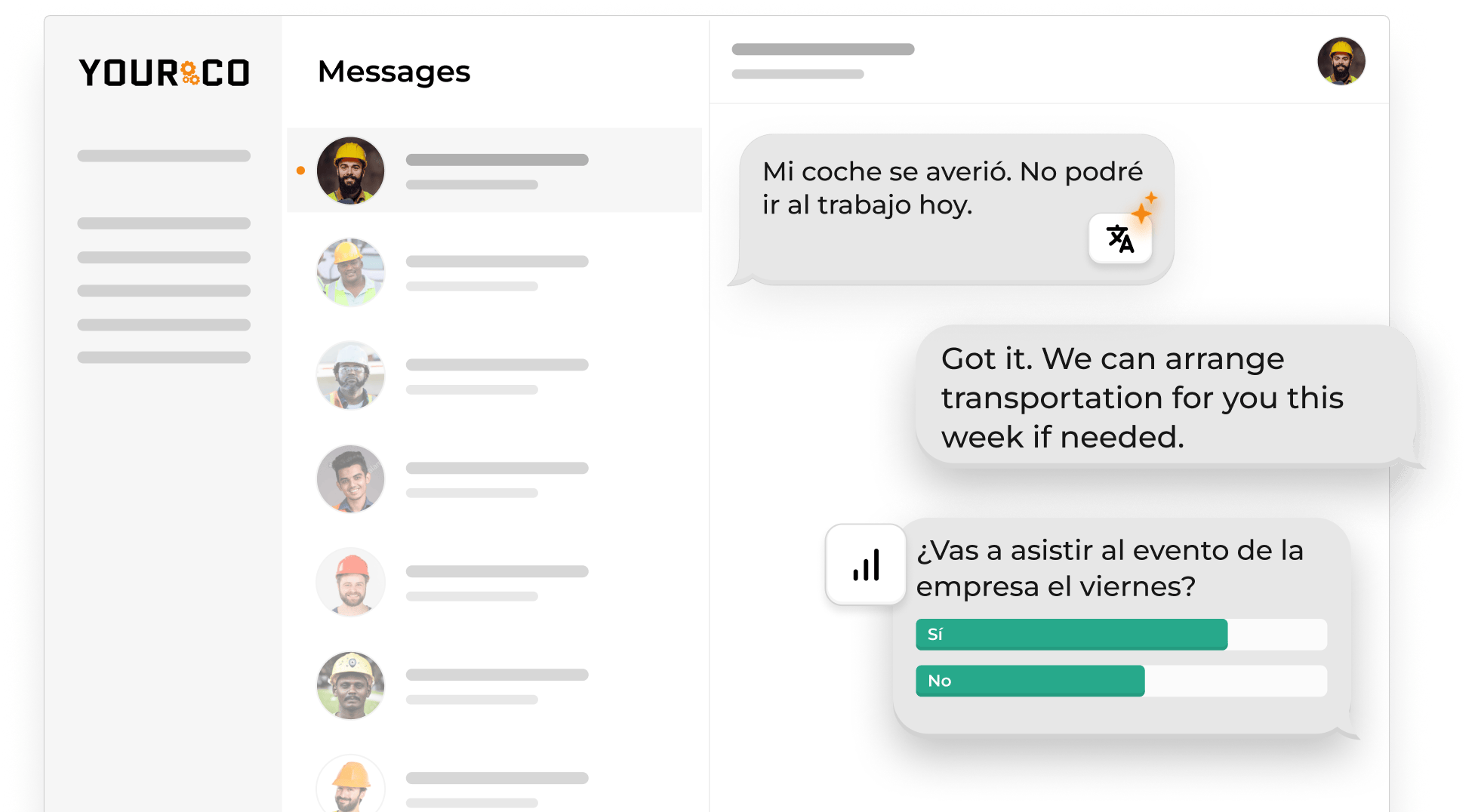
- Use SMS in the employee's preferred language, which matters most when communicating with non-English speakers
- For extended absences or major policy and benefits changes, send physical mail
- Keep a printed packet or a break-room board current for anyone whose phone access is unreliable, so a returning employee can catch up on what changed
When digital options don't reach everyone, a text still arrives on the phone the employee already carries, and the liaison model gives someone on leave a single person to ask. Teams that cannot reach workers without email any other way tend to standardize on SMS first and keep the low-tech supports as backup.
Enterprise SMS platforms built for workplace communication offer scheduled delivery, two-way messaging, delivery confirmation, and timestamped records retained after an employee leaves. Managers compose and dispatch from a web dashboard, so no work conversation has to start on a supervisor's personal phone, which is where the company's only copy of a call-off record otherwise ends up.
Maintain Team Morale During Absences
Tell the team who covers what, in a script that never mentions the reason for the absence, then watch the load on whoever picked up the extra shifts. That discipline matters most when handling no-shows and unexpected absences, when coverage gets arranged in a hurry.
Give the team what they need to know about covering responsibilities and nothing more. Something like "James will be out for the next few days, and here's how we'll cover his responsibilities" does the whole job.
Four practices keep the covering crew from absorbing the cost:
Distribute tasks based on each person's strengths and current workload
- Adjust project timelines where the work allows it
- Bring in temporary help for longer absences
- Say thank you directly to the people who picked up the extra shifts
Having a process for managing scheduling issues makes redistributing work smoother when an absence lands mid-shift.
Hand Off Work Without Burning Out the Team
Assign each of the absent employee's responsibilities to a named person and post the list where the crew can see it. For foreseeable leave, stagger the transfer over several weeks so no one absorbs everything at once. When an absence stretches past the first week, rotate the least popular tasks and revisit timelines out loud in team check-ins rather than letting quiet overtime pile up. A shift coverage plan with a review date gives everyone a point to reconsider the extra load, and regular check-ins with the covering crew surface problems before someone quietly absorbs a second week of doubles.
Share Only What the Team Needs to Know
Coworkers get the coverage plan and, where the employee has approved sharing it, the expected return window. They get nothing about the condition. The confidentiality rule at 29 CFR § 1630.14 names who may be told about a medical condition, listing supervisors and managers, first aid and safety personnel, and government investigators. Coworkers are not on that list. For a bereavement absence, common practice is to ask the employee how they would like the absence communicated to staff before saying anything.
If the employee asked before leaving to hear about major developments, send those through the agreed channel at the agreed cadence, as a courtesy and without requesting input. Reassure an employee on leave who keeps checking in that the operation will hold without them, rather than encouraging them to stay involved.
Handle Repeated Absenteeism
A pattern of absences is a scheduling problem, a well-being signal, and a documentation question at the same time, and attendance records make all three visible. Reviewing them by employee, shift, and site shows whether the issue sits with one person or with a rotation nobody can sustain. Talking about excessive absenteeism before a disciplinary step keeps the record clean either way.
Open the conversation before the discipline. Ask what is making attendance hard, and listen for the answers a schedule can fix: a shift start that no bus reaches, a caregiving conflict, a second job. Offer concrete support such as a schedule adjustment or a referral to an assistance program, then state plainly how consistent attendance affects the crew and what happens next. An attendance improvement plan gives that conversation a structure and a review date.
A working reporting channel reduces part of the pattern before it forms. 85% of HR leaders say improved communication would reduce absenteeism, according to a Yourco-commissioned survey of 150 HR leaders, which is what an unambiguous reporting channel and a consistent first reply are for. AI analytics layers such as Frontline Intelligence read activity across locations, so corporate HR can see which sites and shifts generate the most call-offs instead of inferring it from a supervisor's recollection.
Great Day Improvements (GDI), a vertically integrated home improvement provider with frontline employees across 338 locations in the United States and Canada, cut manufacturing turnover from 12.7% to 2.3%, a 10.4 percentage-point reduction, after consolidating frontline communication onto a single SMS channel. Absence patterns there had only ever been visible site by site.
Before considering discipline, and well before anyone asks whether absences justify termination, check with HR whether any absences may involve protected leave, disability accommodation needs, or other legally sensitive circumstances. That review belongs earlier than it usually happens, because a pattern that turns out to be intermittent protected leave changes what the record needs to show.
Streamline Sick Leave Communication With Yourco
Managing sick leave for frontline workers comes down to one channel everyone can reach, a record that survives the conversation, and a first reply that does not depend on which supervisor is on shift. Yourco handles all three over SMS, so an employee can report an absence from any phone and the company keeps a copy.
Yourco's core capabilities cover the mechanics of an absence:
- Two-way SMS to any phone, with no app download, no WiFi, and no data plan required
- AI-powered translation across 135+ languages and dialects, so a call-off arrives in the employee's own words
- The AI Call-Off Agent, which collects the dates and reason over SMS, asks follow-up questions until the required details are complete, confirms the request with the employee, notifies the supervisor automatically, and logs the call-off with a timestamped audit trail and downloadable reports for HR
- Message templates and scheduled sending, so agreed check-ins go out on the cadence the employee approved
Yourco's 240+ HRIS and payroll integrations keep rosters, locations, and shift assignments current, so absence records attach to the right employee without manual reconciliation.
Enterprise Bridge gives corporate leadership a one-way channel for policy and benefits announcements to every frontline location at once, while local managers keep their own two-way conversations with their crews.
Frontline Intelligence gives HR and operations leaders centralized visibility into absence communication across all locations. Leadership can see call-off activity and response times by site, department, and shift; compare locations using the same definitions; and act on a pattern while it is still forming, rather than after a quarter of overtime. Great Day Improvements (GDI) runs this model across 338 locations and 5,000 employees, and gained real-time visibility into communication activity across the organization, including the issues raised most often by location and its call-off trends.
"We use Yourco for our absence management and for sending out notices, reminders, and event announcements. It keeps everyone who needs to know informed when people are absent."
— Kyle Stover, HR Assistant, J-Lenco Inc.
After 90 days on Yourco, companies see two-way employee engagement reach 86%.
Try Yourco for free today or schedule a demo and see the difference the right workplace communication solution can make in your company.
Frequently Asked Questions About Responding to Sick Leave Texts
What Should I Include in My Response When an Employee Texts in Sick?
Acknowledge receipt promptly, express concern for the employee's well-being, and state the next step. A reply such as "Thanks for letting me know. Focus on getting better, and keep me posted on how you're feeling" covers it. Asking for details about the illness can feel intrusive and may raise privacy concerns.
Can I Require Employees to Text Rather Than Call When Reporting Sick?
Many employers name text messaging as an accepted or preferred reporting method, subject to applicable law, company policy, and any accommodation needs. A policy works best when it also accommodates employees without reliable phone access. Document the channel clearly and train managers to respond consistently, regardless of how the absence arises.
How Often Should I Check In With an Employee on Extended Sick Leave?
As little as the situation allows, with the frequency agreed early and adjusted to the leave type, its expected length, applicable policy, and the employee's preference. A light well-being check-in every two to four weeks is one workable example for a long medical absence rather than a rule. Daily contact can read as pressure to return.
What Should We Agree On Before a Planned Leave Starts?
Settle the preferred contact method, one named point person plus a backup, how often the company will reach out and about what, what counts as an emergency, who covers each responsibility, and an estimated return date. Put the answers in writing before the leave begins, and plan a short reboarding conversation for the first day back.
What Information Can I Share With the Team About a Coworker's Absence?
Share only what the team needs for work coverage, and leave out medical details. Something like "Alex will be out this week, and we've reassigned their tasks" is enough. Confidentiality expectations under the FMLA and the ADA apply to conversations about an absence as much as they do to the file.
How Should I Document Sick Leave Texts for Compliance Purposes?
Log every sick leave communication in the attendance record, including dates, content summaries, and any agreement about return timelines. An SMS platform that timestamps and retains messages automatically builds that record without anyone having to transcribe it. Store medical information separately from general personnel files, and limit access to designated staff.
How Do You Respond to an Employee Texting in Sick Who May Qualify for FMLA?
Respond with the same warmth as any sick text, skip questions about the condition, confirm that the shift is covered, and forward the message to HR right away. Employees do not need to use words like FMLA or accommodation for protections to apply. A hospital stay, a recurring condition, or a pregnancy-related issue is enough to route it.
When Is It Acceptable to Contact an Employee on Sick Leave About an Emergency?
Only for a genuine business-continuity problem that no one else can resolve, and after the team has tried every alternative. Keep the contact brief, use the channel the employee chose before leaving, and limit who may reach out to the direct manager or HR. A short question about where a file sits is not a request to produce work.
What's the Best Way to Reach a Frontline Employee Who Is Out Sick?
Text messaging, because many frontline workers have a phone but no company email or intranet access. SMS-based platforms like Yourco let employees report absences from any phone, including basic flip phones, and give managers a timestamped record of each exchange. Add a designated liaison for questions, and use physical mail for major policy changes during longer absences.