


Frontline engagement is still framed as morale work in many organizations, even though Gallup's meta-analysis links top-quartile engaged units to roughly 23% higher profitability than bottom-quartile units. Disengagement among hourly and shift-based workers quietly drives higher replacement costs, unfilled shifts, and slower customer-facing output, often because frontline teams lack access to corporate email, a desk, or a reliable channel such as SMS.
For Human Resources (HR) and operations leaders sitting across from a Chief Financial Officer (CFO), the real question is how to turn engagement into a board-ready case. This article breaks down the financial returns of frontline engagement and lays out a framework for presenting the case to the board.
TL;DR
- Frontline employee engagement directly affects profitability, productivity, and customer experience, not just morale
- Stronger engagement helps organizations retain trained frontline workers and reduce replacement costs
- Better engagement improves day-to-day consistency by reducing absenteeism, overtime pressure, and coverage gaps
- A focused pilot can give HR and operations leaders measurable evidence for a board-level business case
- SMS-based platforms like Yourco reach every frontline worker on any phone with two-way messaging and Artificial Intelligence (AI)-powered translation
Treat Frontline Engagement as a Profit Lever, Not a Feel-Good Metric
Frontline engagement and employee satisfaction measure different things. Satisfaction reflects how workers feel about job conditions, such as pay, hours, and the physical environment. Engagement captures something more actionable: daily psychological and emotional investment in the work itself.
Peer-reviewed research by Bakker and Schaufeli frames satisfaction as contentment and engagement as activation, marked by enthusiasm, alertness, and energy. Activation drives discretionary effort. Satisfaction surveys typically measure conditions set at the enterprise level that local managers cannot change, while engagement measures psychological states that team-level managers can influence directly.
Engagement is the more useful measure because team-level managers can act on it directly, while satisfaction often reflects enterprise-level conditions outside their control. That makes engagement the actionable lever for profitability, productivity, and retention.
Link Frontline Employee Engagement and Profitability Through Revenue Growth
The financial case for frontline employee engagement rests on Gallup's meta-analysis. The median differences between top-quartile and bottom-quartile engaged units tell the story:
- 23% higher profitability
- 18% higher sales productivity
- 10% higher customer loyalty and engagement
These benefits show up in everyday work. A retail associate who is psychologically invested in their role recovers from service failures more quickly and creates the kind of guest experience that drives repeat visits. A manufacturing operator who feels connected to their team catches quality issues before they become costly defects.
McKinsey's research found that companies treating frontline talent as an investment, not a cost, outperform peers on labor productivity and total shareholder return. Engaged frontline workers interact better with customers, produce fewer errors, show up more consistently, and stay longer. Each of those behaviors flows directly into revenue and margin.
Lower Turnover Costs by Retaining Your Trained Workforce
Replacement costs for frontline employees can be substantial. The Society for Human Resource Management (SHRM) places the range at 50% to 200% of annual wages when indirect costs such as manager time, institutional knowledge loss, and team disruption are included.
88% of HR leaders believe better communication tools can reduce employee churn, according to a Yourco-commissioned survey of 150 HR leaders. Workers who feel invested in their work and connected to their team are more likely to stay. Industry context shapes how much that matters: retail, hospitality, and logistics churn fast for structural reasons, so engagement is one factor among many.
In manufacturing, where workers tend to build great skill over years, every retained employee carries more accumulated expertise. Each departure also erodes role knowledge accumulated over months or years, and the exit of high performers can prompt remaining employees to reevaluate their own positions. For more on reducing frontline turnover, starting with reliable communication to every worker is a strong first move.
Increase Productivity and Cut Absenteeism Across Every Shift
96% of HR leaders agree that better communication tools boost productivity, according to the same Yourco-commissioned survey of 150 HR leaders. Workers who feel invested in their work tend to put in more effort, and that shows up most clearly in customer-facing roles, where each interaction can make or break a sale.
Absenteeism follows the same pattern. Workers who do not feel connected to their work or their team are more likely to call out, which compounds across a frontline workforce where every missed shift creates a coverage scramble.
These benefits translate into specific operational outcomes:
- Fewer coverage gaps from unplanned absences, reducing last-minute scrambles
- Less overtime spend to compensate for missing workers
- More stable operations with experienced workers present consistently
- Better safety adherence, since engaged workers are more likely to follow protocols, report hazards, and look out for one another, which reduces workers' compensation costs and lost time
UKG's 2025 Manufacturing Trends Report shows the sector-level stakes: manufacturers report that frontline absenteeism and overtime costs affect financial performance.
Build a Board-Ready ROI Case for an Engaged Frontline Workforce in 2026
Before requesting a budget for engagement initiatives, HR and operations leaders need return-on-investment (ROI) numbers that hold up in a finance review. A defensible case for frontline engagement builds on three line items pulled from internal data:
- Turnover savings: Multiply the expected reduction in frontline departures by replacement cost per departure, using a conservative percentage of annual wages drawn from internal data or published retention research.
- Absenteeism savings: Multiply the reduction in unplanned absences by the loaded cost of coverage, including overtime, temporary labor, or lost production. Pull the actual numbers from payroll and operations data rather than industry averages.
- Productivity uplift: Model the expected change in revenue per employee or output per shift. This is the most uncertain line item, so finance teams may prefer to strip it out and rely on turnover-plus-absenteeism savings alone for the conservative case.
A 90-day engagement pilot at one site, paired with a matched control site, generates the comparison numbers finance teams need to validate the model before scaling.
Turn Engagement Into Bottom-Line Impact With Actionable Levers
The research points to three pillars that move frontline engagement from aspiration to daily operations.
- Remove daily friction: Unpredictable work patterns, paper-based processes, and manager-only approval chains are documented drivers of burnout and disengagement. Audit current workflows for manual bottlenecks. Replace paper safety alerts and shift briefings with mobile-first delivery. Give workers clearer communication about shift changes and time-off requests without requiring a manager as an intermediary at every step.
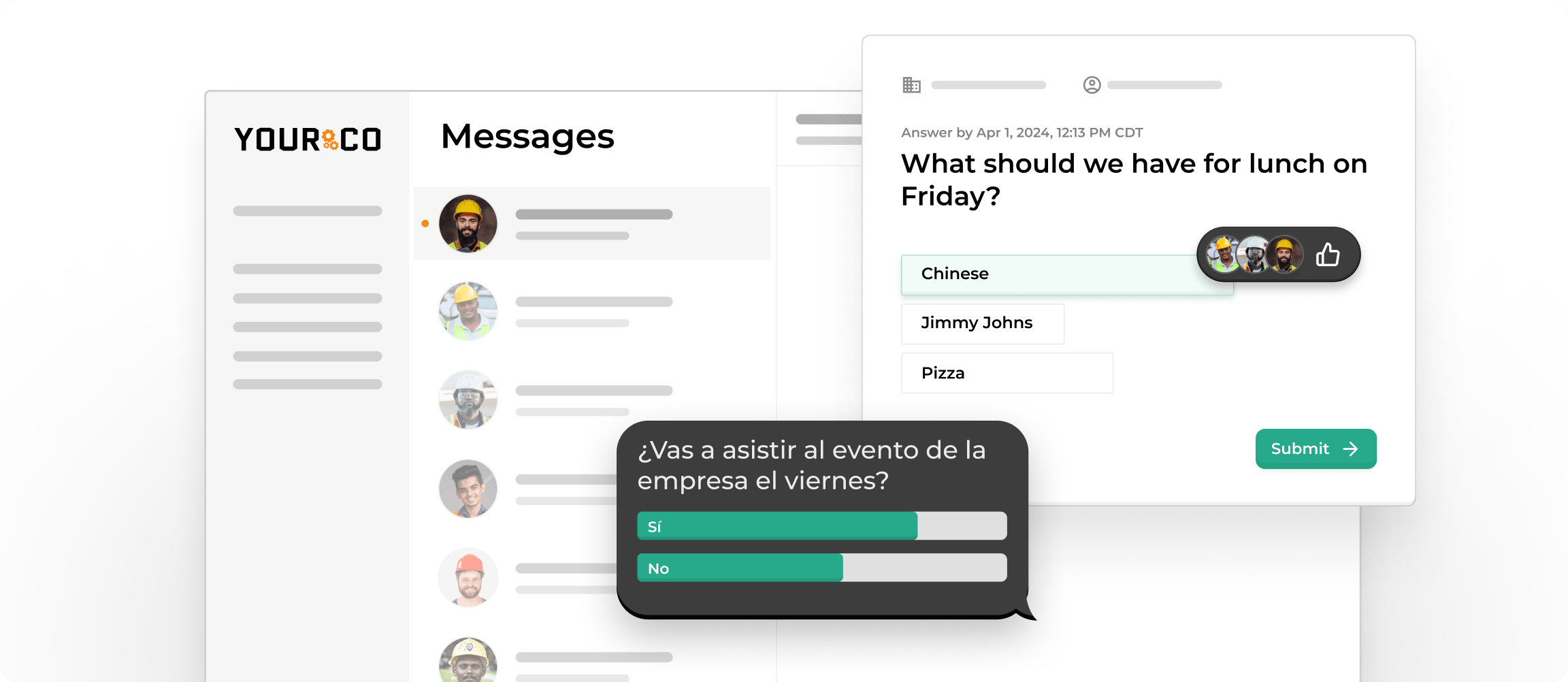
- Invest in frontline-first communication: Industry research consistently identifies the lack of accessible communication infrastructure as a primary driver of the engagement disparity between frontline and corporate workers. Deploy SMS-capable two-way channels that work on any phone. Use scheduled messaging timed to shift start or end. Add multilingual auto-translation as a non-negotiable requirement for any frontline communication platform serving a diverse workforce. SMS-based platforms like Yourco deliver every message in each employee's preferred language, available in 135+ languages and dialects.
- Reward and upskill visibly: Recognition lands more meaningfully when it is tied to observable behaviors rather than tenure alone. Tie recognition to observable behaviors such as safety compliance, on-time delivery, and customer feedback. Deliver micro-training in 5-minute modules accessible on mobile without a corporate email login. Identify and publish 3 to 5 frontline-to-supervisor career paths, with specific criteria to make advancement visible rather than opaque.
Concrete steps HR and operations leaders can take in the next 90 days fall into four practical moves:
- Run a 90-day engagement pilot at one store, distribution center, or plant and track shift-fill rate, absence frequency, and turnover against a comparable control site
- Establish a baseline for what percentage of the frontline workforce actually receives and reads company communications
- Replace annual satisfaction surveys with 2 to 3-question pulse surveys delivered via SMS at shift end, with a 48-hour review protocol and manager-level follow-up within one week
- Add one meaningful conversation per week between each frontline manager and their direct reports, since regular manager check-ins are widely linked to higher engagement
Each of these actions generates baseline data that strengthens the ROI case described above.
Reach Every Frontline Worker and Measure What Matters With Yourco
Turning engagement strategy into daily practice requires a communication channel that actually reaches every worker, on every shift, at every location. Yourco is an SMS-based employee communication platform built specifically for frontline organizations where workers lack company email, desk access, or app-compatible devices.
Core capabilities include:
- SMS to any phone: From smartphones to basic and flip phones, with no app download, no Wi-Fi, no data plan required, and no cost to employees
- Two-way messaging: Direct communication between frontline workers and managers, so messages flow in both directions
- AI-powered translation: 135+ languages and dialects, delivering every message in each employee's preferred language
Yourco integrates with 240+ HRIS and payroll systems to keep employee data synced and communications precisely segmented by location, department, shift, or role.
Enterprise Bridge enables corporate leadership to broadcast one-way announcements, policies, and updates to every frontline location simultaneously, while local managers maintain direct two-way conversations with their teams.
For leaders building the board-level case described in this article, Frontline Intelligence gives HR and operations teams centralized visibility into engagement trends, absence patterns, and sentiment shifts across all locations. It highlights patterns across sites and departments, tracks call-off activity by site and department, and supports AI-powered reporting, enabling leadership to better understand what is happening across the frontline workforce in real time.
"Getting a lot more response from employees than we have in the past, and it's so easy to just be able to send out a quick text company-wide, or just to a specific group. We love it!"
— Maddy Kristjanson, Human Resources Generalist, Plymouth
After 90 days on Yourco, companies see two-way employee engagement reach 86%.
Try Yourco for free today, or schedule a demo to see the difference the right workplace communication solution can make for your company.
Frequently Asked Questions About Frontline Employee Engagement
How does frontline employee engagement affect profitability?
Frontline employee engagement affects profitability by improving how work gets done every day. Engaged teams tend to deliver better customer experiences, make fewer mistakes, and operate more consistently, which helps protect both revenue and margin across locations.
What does it cost to replace a frontline employee?
Replacing a frontline employee usually costs a meaningful share of that worker's annual wages. The total includes hiring, onboarding, training, lost productivity, and the disruption created while a new hire gets up to speed.
How can HR leaders measure the ROI of frontline engagement?
HR leaders can measure ROI by tracking turnover, absenteeism, and productivity before and after an engagement effort. A small pilot at one location, compared against a similar site, gives finance and operations leaders cleaner data for a budget discussion.
What is the fastest way to improve engagement for frontline workers?
The fastest way to improve engagement is to fix communication access first. SMS-based platforms like Yourco help organizations reach frontline workers on any phone, making it easier to deliver updates, recognition, feedback requests, and day-to-day communication consistently.
Why is frontline engagement declining?
Frontline engagement declines when workers deal with inconsistent communication, limited recognition, and unclear growth opportunities. When employees feel disconnected from managers and leadership, it becomes harder for them to stay invested in the work and in the organization.
Should frontline engagement be a board-level metric?
Yes, frontline engagement should be a board-level metric when frontline workers make up a large share of headcount. It affects operating performance through retention, consistency, safety, and customer experience, which makes it relevant far beyond HR reporting.


