
Frontline workers keep your operation running, yet most engagement strategies were designed for people who sit at desks, check email, and have regular access to company systems. That disconnect is showing up in rising turnover, falling productivity, and a growing sense among frontline workers that leadership doesn't see them. The gap between what corporate offers and what frontline teams can actually access has become the central engagement challenge for manufacturing, logistics, hospitality, transportation, and construction companies heading into 2026. This article breaks down the trends that matter most for frontline workforces and walks through practical strategies you can act on now.
TL;DR
- Frontline engagement improves when communication matches how workers actually work: on the move, across shifts, and often without company email.
- Annual surveys and top-down announcements are too slow for frontline environments; continuous feedback and two-way communication work better.
- The biggest gains in engagement often come from better frontline supervisors, clearer career paths, and greater control over schedules.
- Training and development need to be visible, mobile-friendly, and easy to access during the workday.
- SMS-based platforms like Yourco help companies reach every frontline worker quickly, collect feedback, and keep communication accessible on any phone.
Recognize the Real Cost of Frontline Disengagement
The numbers paint a clear picture. Gallup data show that frontline worker engagement trails the overall U.S. workforce (31% national average), underscoring why retention remains critical in blue-collar industries.
Disconnection has a price tag. Reported turnover cost per employee climbed to $45,236 in 2026. For employers running large plants, warehouses, or multi-site operations, frontline engagement becomes a financial issue, not just a culture issue.
The root cause isn't that frontline workers don't care. It's that the tools, programs, and communication channels companies invest in rarely reach them. Limited email access remains a major frontline barrier. When your engagement initiatives can't reach the people who need them most, disengagement isn't surprising. It's inevitable.
The delivery gap is measurable: according to frontline communication data from a Yourco-commissioned survey of 150 HR leaders, only 43% of frontline employees consistently receive company communications, and just 36% actually read them. When engagement initiatives travel through channels workers already ignore, disengagement isn't a motivation problem. It's a delivery problem.
Close the Communication Gap With Mobile-First Channels
Most internal communication infrastructure was built for office workers. Email, intranets, and app-based communication tools all assume employees have a company login and consistent internet access. Frontline workers on manufacturing floors, construction sites, and warehouse docks often have none of these.
Mobile-first communication has become the practical default for reaching frontline workers. The reason is simple: SMS communication works on any phone, requires no downloads, and doesn't depend on Wi-Fi or data plans.
Here's what makes mobile-first communication effective for frontline teams:
- Universal reach. SMS arrives on smartphones and flip phones alike, so no worker is left out based on device type or technical literacy.
- Immediate delivery. SMS is better suited for urgent frontline communication than channels that workers check less often.
- Zero onboarding. Workers already know how to use SMS. There's no training, no password setup, and no app to install.
- Two-way capability. Workers can respond, ask questions, and report issues directly from their personal phones.
The shift to mobile-first isn't a premium feature anymore. It's the baseline requirement for any organization serious about reaching its full workforce. HR leaders confirm the impact: 92% say improved communication would boost frontline engagement, and 91% say SMS increases frontline employee response rates, per Yourco's Closing the Comms Gap research. The connection between channel choice and engagement outcomes isn't theoretical. It's what the people managing these workforces report firsthand. It's also why many teams now use SMS for employee alerts and time-sensitive updates that cannot wait for a supervisor to relay them.
Replace Annual Surveys With Continuous Feedback
Annual engagement surveys were never designed for shift-based workforces. By the time the results come back, the frustrated workers have already left. And in many operations, frontline employees never receive the survey in the first place because it's distributed through email or a web portal they can't access.
Organizations are moving toward real-time sentiment tracking that captures frontline concerns as they emerge. Retention risks in manufacturing, logistics, and hospitality develop fast: a scheduling conflict, a safety concern, or a breakdown in communication with a supervisor can push a worker toward the exit within days.
Practical approaches that work for frontline teams include:
- SMS-based pulse surveys sent directly to workers' phones, requiring only a quick reply
- Short, focused polls that take under a minute to complete during a break or shift transition
- Real-time analytics dashboards that surface patterns across shifts, locations, and departments before small problems become resignations
When you ask workers how things are going through a channel they actually use, you get information you can act on before it's too late. That urgency is backed by data: 69% of HR leaders say missed communication with frontline teams is a recurring frustration, according to a Yourco-commissioned survey of 150 HR leaders. Annual surveys compound that frustration by asking workers for input through the same channels they've learned to ignore. Continuous pulse surveys delivered via SMS bypass the channel failure entirely. Tools built for employee survey distribution make this easier to run consistently across locations. For a broader look at what happens after you collect responses, this guide on managing employee surveys covers how to close the loop effectively.
Develop Frontline Supervisors as Engagement Multipliers
No communication platform can compensate for an ineffective frontline supervisor.
January 2026 Gallup data show that frontline supervisors promoted for performance (not leadership skills) are only 31% engaged, vs. 42% for those selected for supervisory ability, driving the retention crisis.
The problem is how most organizations select frontline supervisors. Gallup data also found that many frontline supervisors were appointed based on individual performance or years of experience, rather than their ability to lead people. The result is technically skilled workers thrust into management roles with no training in coaching, communication, or team retention.
Changing your promotion criteria for frontline supervisors may be the highest-ROI engagement intervention available. Some manufacturers have maintained low attrition by building supervisor development around behaviors that actually drive retention:
- Updated promotion criteria that weigh people skills alongside technical performance
- 360-degree feedback so supervisors hear directly from the teams they manage
- Behavioral training focused on coaching, communication, and retention rather than operations alone
- Structured communication training should be a standard part of the supervisor onboarding process
Build Career Pathways Workers Can Actually See
One of the biggest frustrations for frontline employees is feeling stuck. A transportation industry analysis found that a core source of dissatisfaction among frontline workers is the lack of movement from frontline roles into management and executive ranks. When advancement feels invisible, workers start looking elsewhere.
Skills-based talent adoption is rising as organizations create clearer internal pathways. For manufacturing and logistics companies, visible career development means:
- Mapping explicit paths from floor roles to team lead, supervisor, and management positions
- Communicating those paths regularly so workers see who has moved up and how
- Tying skills to advancement so workers know exactly what they need to develop to progress
Professional development trends show career growth remains one of the strongest drivers of engagement. But traditional training delivery doesn't work for shift workers. Classroom sessions and lengthy e-learning modules are impractical when workers are on the floor all day. Microlearning research points to short mobile-friendly modules as a better fit. Delivering these through SMS links or mobile-friendly formats makes workplace training programs accessible without pulling workers off the floor.
Give Workers Control Over Their Schedules
Frontline flexibility doesn't mean remote work. It means control over shift patterns. A global frontline study found that many workers struggle with last-minute shift changes and access to time off.
Replacing a skilled frontline worker is expensive, and self-service scheduling tools directly reduce the friction that pushes workers toward the door in the first place.
Practical scheduling improvements that make an immediate difference:
- Shift swapping through SMS or mobile tools, where peer swaps don't require manager approval
- Advance schedule posting so workers can plan their lives
- Voluntary overtime is posted digitally as an opt-in opportunity rather than a mandate
- Simple mobile time-off requests that don't require logging into a desktop system
When workers feel like they have some say in when and how they work, they're far more likely to stay. The same logic applies to company announcements: when updates are timely and easy to act on, frustration drops.
Shift From Top-Down Announcements to Two-Way Dialogue
Traditional frontline communication flows in one direction, from corporate to manager to worker, with no channel for workers to respond or raise concerns. A feedback loop model documents how organizations build systems that allow workers to communicate their needs and concerns directly.
SMS-based polling, digital suggestion tools accessible from any phone, and real-time recognition channels give workers a voice. Employees who believe their organization genuinely cares about their experience are more likely to feel motivated to work.
Two-way communication also surfaces operational intelligence that one-way channels never capture. When workers can respond directly via SMS, organizations regularly hear about:
- Safety concerns flagged in real time before they appear in an incident report
- Scheduling conflicts that surface early enough to fix without losing the worker
- Language barriers that are causing confusion on the floor
- Process frustrations that managers never pass up because they seem too small to escalate
That is, data leadership can act on immediately, rather than discovering the problem weeks later in an exit interview.
Connect Every Frontline Worker Instantly With Yourco
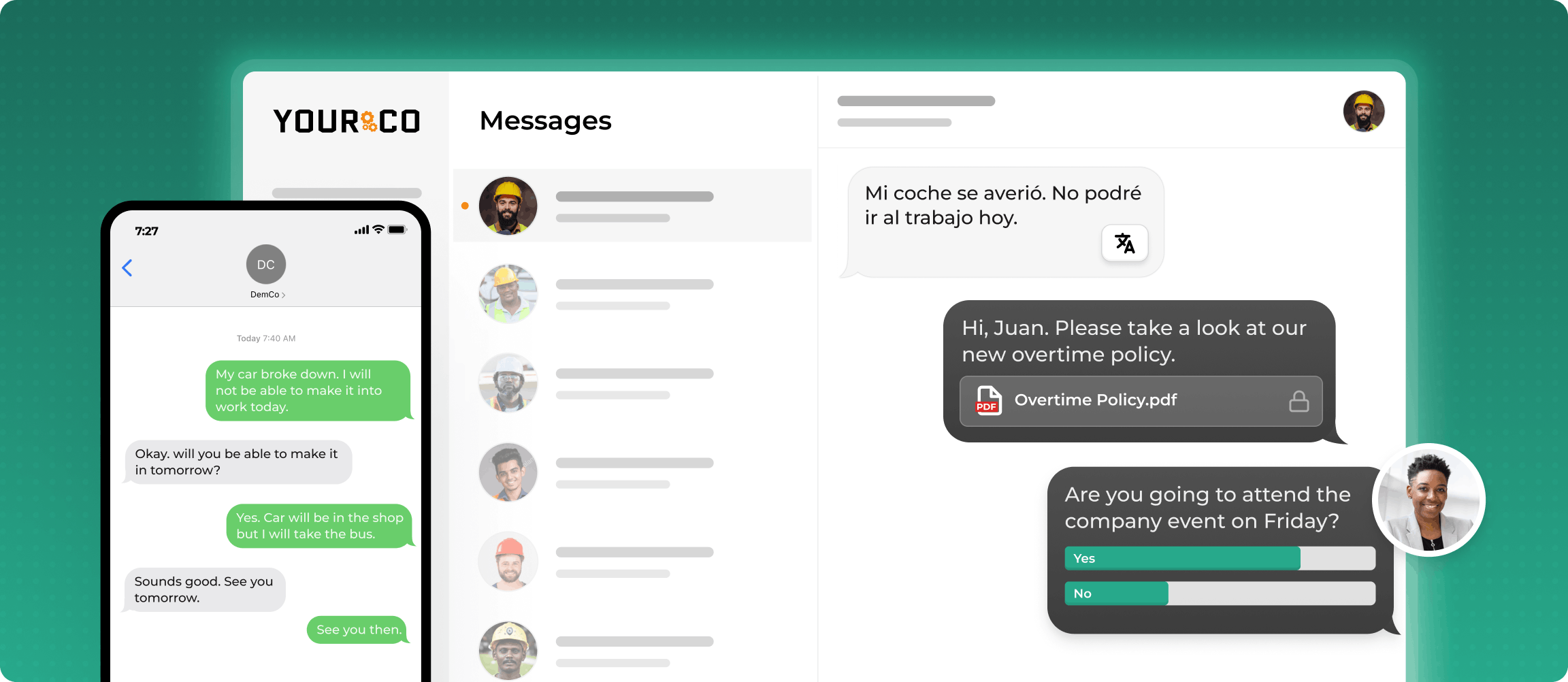
The trends above all point to the same need: communication has to be fast, accessible, and built for frontline workers, not adapted from office habits. Yourco solves that problem with an SMS-based employee communication platform designed for on-site teams across shifts, sites, and languages.
- SMS to any phone. No app download, no Wi-Fi, and no data plan required. Works on smartphones and flip phones alike, at no cost to employees.
- Two-way messaging. Workers can respond to announcements, report call-offs, ask questions, and provide feedback directly through SMS.
- AI-powered translation across 135+ languages and dialects. Every message is automatically delivered in each worker's preferred language, so multilingual teams stay informed without manual translation.
Yourco integrates with 240+ HRIS and payroll systems, so employee data syncs automatically.
Enterprise Bridge enables corporate leadership to send one-way announcements, policy updates, and company-wide communications to every frontline location simultaneously.
Frontline Intelligence gives HR and operations teams centralized visibility into engagement patterns, sentiment trends, and workforce risks across all locations. Leadership can identify which sites show early signs of disengagement, track response patterns by shift or department, and make proactive staffing decisions before small problems turn into turnover spikes.
"Getting a lot more response from employees than we have in the past, and it's so easy to just be able to send out a quick text company-wide, or just to a specific group."
— Maddy Kristjanson, Human Resources Generalist, Plymouth
After 90 days with Yourco, two-way employee engagement increased to 86%.
For the research behind SMS-based frontline communication, explore Yourco's Closing the Comms Gap study of 150 HR leaders.
Try Yourco for free today, or schedule a demo to see the difference the right workplace communication solution can make for your company.
Frequently Asked Questions about Employee Engagement Trends
How do you communicate with frontline workers who don't have email?
SMS is the most effective channel for reaching workers without company email addresses. SMS-based platforms like Yourco deliver messages directly to any mobile phone, including basic flip phones, without requiring app downloads, internet access, or login credentials. Workers receive and respond to messages using standard SMS, which they already know how to use.
What is the biggest driver of frontline employee engagement?
The frontline supervisor has the single largest impact on team engagement. The quality of the direct manager shapes whether workers feel supported, heard, and motivated. Investing in how you select and develop frontline supervisors often delivers a stronger return than adding another program or perk.
How can you reduce turnover in manufacturing and logistics?
Focus on the issues frontline workers feel every day: clear communication, schedule flexibility, visible career pathways, and a supervisor who listens. When companies remove friction in those areas, retention usually improves.
Why do employee engagement apps fail with frontline workers?
Many engagement apps create extra steps. They require smartphone storage, reliable internet, account setup, and regular updates. SMS works better for many frontline workers because it reaches any phone with no setup required.
What does two-way communication look like for shift-based teams?
Two-way communication means workers can respond to messages, report absences, answer survey questions, and raise concerns directly from their phones. Instead of relying on bulletin boards or manager relay, organizations use SMS-based channels where every worker has a direct line to HR and leadership, regardless of shift, location, or device.