


Short Message Service (SMS) makes it hard for hourly employees to miss work texts after their shifts end. A quick route change or a fast question about a machine setting can look harmless. But when that worker reads and replies on a personal phone, federal wage-and-hour rules may treat the time as compensable, and no timekeeping system captures a second of it. For leaders managing HR, operations, or compliance for shift-based frontline teams, those unrecorded minutes are where exposure can accumulate.
TL;DR
- After-hours texting of a non-exempt employee can raise Fair Labor Standards Act (FLSA) concerns when it creates unpaid work time.
- The FLSA covers work an employer "suffers or permits," even without a direct request. A reply outside scheduled hours can be compensable.
- A manager's text can create "constructive knowledge," making the employer aware of the work even if the employee never logs it.
- Ad hoc texting on personal phones leaves no timestamped trail of when a message was sent, read, or acted on.
- Wage issues cluster around required after-hours replies and informal standby between messages that repeat often enough to count.
- SMS-based platforms like Yourco keep every message time-stamped and auditable, replacing the personal-phone patchwork that creates missing records.
Understand What Off-the-Clock Work Actually Means
Off-the-clock work is any compensable time a non-exempt employee spends on job duties that never make it onto a timesheet. The FLSA defines "employ" broadly to include "suffer or permit to work," and the regulations at 29 C.F.R. Part 785 treats work employers request or allow as work time that counts toward the employee's hours. Federal guidance says that "the workday may therefore be longer than the employee's scheduled shift, hours, tour of duty, or production line time."
The FLSA can treat job duties as hours worked regardless of where they happen, whether on the premises, at a job site, or at home. That is why a delivery driver answering a routing text at 9 p.m. and a warehouse worker replying to a supervisor's question after their shift both fall inside the same standard.
5,702 private FLSA lawsuits reached federal courts in 2025, up from 5,456 in 2024, and many proceed as collective actions with significant liability.
See Why a Work Text Can Count as Paid Time
The "suffer or permit" standard captures both required and merely permitted after-hours responses. It asks whether a supervisor told the employee to reply and whether the employer knew, or had reason to believe, that the employee was working.
A common work-related email scenario applies directly to frontline managers: an employee responds to a couple of work-related emails in the evening with no expectation to do so, and without a supervisor specifically asking them to respond outside working hours, yet the replies go to supervisors or managers. In that situation, the employer, through its supervisors, has knowledge that the employee is working off the clock and may need to treat that time as compensable, depending on the facts.
Employers sometimes lean on the de minimis doctrine, which excuses insubstantial or insignificant periods of time. That defense is narrowing for digital communications. Courts weigh three factors: the administrative difficulty of recording the time, the total amount of time involved, and how regularly the work occurs, under the de minimis test cited in the Seventh Circuit's 2024 Mazurek decision. Because texts carry built-in timestamps, the "hard to record" prong, the one most favorable to employers, is difficult to satisfy.
Recognize Constructive Knowledge When a Manager Texts
When reasonable diligence would have revealed hours worked, an employer can have constructive knowledge of those hours. When a manager directly sends or receives a text from a non-exempt employee, the employer has direct awareness. Courts may impute the manager's knowledge to the employer the moment the manager sends or receives the message.
Department of Labor guidance describes management's role in controlling unwanted work and states that "merely making a rule against such work is not enough." A written policy prohibiting off-the-clock work does not, on its own, eliminate concern around work the employer knew about and benefited from.
One appellate case marks the limit of an employer defense. In the Allen case (7th Cir. 2017), the city avoided liability for officers' off-duty smartphone use, but only because it had an established, unblocked time-reporting system officers could use. Where a manager is the direct sender or recipient of a text, or where no accessible way to log the time exists, that defense may be weaker. A required or merely permitted reply can implicate the "suffer or permit" standard, especially when a "quick question" prompts additional work the employee could not ignore without consequence. If the message interrupts personal time, a tight response-time expectation can make the waiting period appear to be compensable on-call time.
Courts look at what managers knew and whether employees had a functioning system for reporting time.
Spot Where Wage Issues Commonly Surface
Recurring patterns drive much of the exposure for frontline teams. Three patterns surface most often:
- Required or expected after-hours replies: federal regulatory guidance states that a supervisor's text constitutes employer knowledge of the communication, and the employer may need to account for the time the employee spends responding, even if a policy prohibits off-the-clock work.
- Informal standby: the FLSA distinguishes an employee waiting to be engaged from one "engaged to be waiting." When workers cannot go about their personal business because they are tethered to a phone waiting for the next message, that waiting period can become compensable.
- Recurring "quick questions": courts evaluate aggregate daily time across all off-clock activity, not each text in isolation, so brief exchanges that repeat five days a week, such as a route text or a coverage request after the shift ends, can quietly add up to hundreds of hours a year.
A delivery driver who finishes at 5 p.m., answers a route text at 7 p.m., and another at 9 p.m., has performed work time; if the week is near 40 hours, that reply may fall into overtime territory.
Close the Record-Keeping Problem That Personal Phones Create
The operational problem is separate: unlogged, ad hoc texting on personal phones generates no entry in any employer timekeeping system, even when the FLSA plainly treats the work as compensable. Federal recordkeeping regulations generally expect covered employers to maintain accurate records of hours worked and permit any method "as long as it is complete and accurate." A scatter of texts across managers' personal devices is neither.
Courts may shift the burden to the employer when records are inaccurate. Under the Anderson burden shift, when an employee presents evidence of inaccurate time records the employer knew or should have known about, courts may shift the burden to the employer to disprove that the work occurred. Without a timestamped trail showing when managers sent messages, when employees read them, and how employees acted on them, employers have less documentation to rebut employee testimony.
Fragmented personal-phone messaging creates ambiguity about urgency and leaves no entry in any employer timekeeping system. A few practices can close that gap:
- Scheduled delivery: send non-urgent messages the next workday, even if a manager composes them after hours.
- Clear emergency definitions: separate safety issues and outages from routine schedule questions.
- An accessible logging mechanism: give employees an easy way to log after-hours replies, the practice that separated the employer defense in Allen.
Together, these practices turn ambiguous after-hours texting into something the timekeeping system can actually capture.
This information is for general awareness only. For specific compliance guidance, consult with qualified legal professionals.
Keep Every Frontline Message Time-Stamped With Yourco
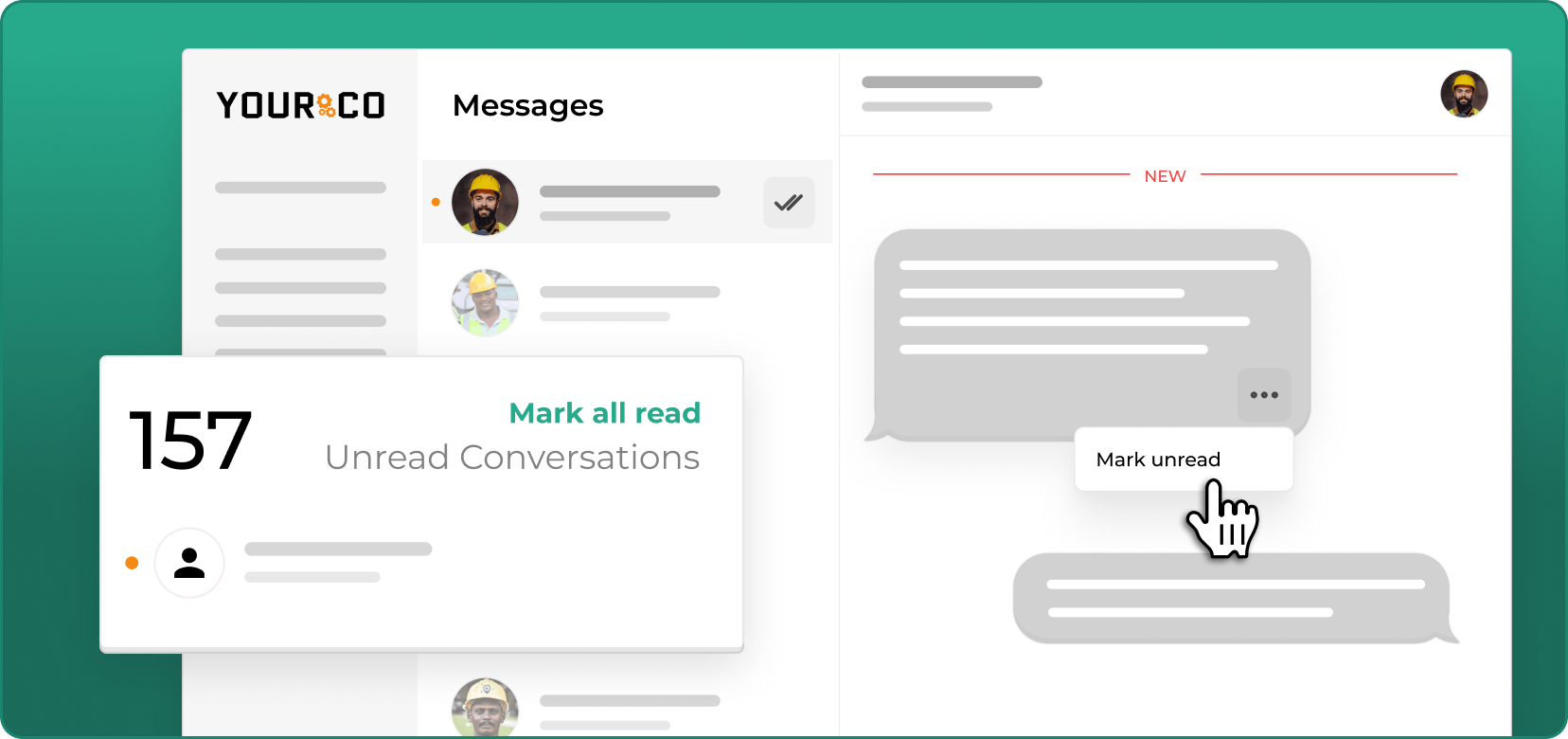
Moving frontline communication onto one auditable channel replaces the personal-phone patchwork with a system that captures when managers send each message and carriers deliver it. Yourco gives HR, operations, and compliance leaders an SMS-based employee communication platform built for the frontline workforce, reaching every worker on the device they already carry.
Yourco delivers the core capabilities frontline teams rely on:
- SMS to any phone, including basic flip phones, with no app download or Wi-Fi
- Two-way messaging between employees and local managers
- AI-powered translation across 135+ languages and dialects for multilingual teams
- Enterprise-grade security, so message records and employee data stay protected across every location
Yourco connects to 240+ HRIS and payroll systems, so HR teams can keep employee data synced across them. For multi-location employers, Enterprise Bridge lets corporate leadership send centralized, one-way policy and safety updates to every location, while local managers maintain their direct, two-way conversations.
Frontline Intelligence gives HR and compliance teams centralized visibility into communication patterns across all locations. Leaders can see message activity by site and department, track policy acknowledgment rates, and identify where after-hours contact clusters. Because every message runs through one platform with timestamped, archived records, logged texting creates a defensible audit trail.
After 90 days on Yourco, companies see two-way employee engagement reach 86%.
Try Yourco for free today, or schedule a demo to see the difference the right workplace communication solution can make for your company.
Frequently Asked Questions About After-Hours Texts and Wage Liability
What counts as an after-hours text that creates wage liability?
An after-hours text creates wage liability when a non-exempt employee reads or replies outside scheduled hours and the employer required, expected, or simply knew about the exchange. A route change, a quick technical question, or any manager-initiated text can trigger the same exposure as a call or email sent after a shift ends.
What does constructive knowledge mean under the FLSA?
Constructive knowledge means an employer should have known about the hours worked if it had exercised reasonable diligence. When a manager directly sends or receives a work text from an hourly employee, the employer's awareness can become direct, so the time may be compensable even if the employee never reported it.
Is it illegal to text hourly employees after hours?
Texting a non-exempt employee after hours is legal under federal law when the employer accounts for any work time that the text creates, especially if the hours push the employee into overtime territory under the FLSA.
Does a written policy against off-the-clock work protect an employer?
A written policy alone generally does not eliminate concerns around work that an employer knew about or benefited from. Regulators and courts often look beyond the policy text to determine whether off-hours work still occurred and whether the employer accepted its benefit.
How can employers keep a record of after-hours texting?
Reliable records depend on capturing when managers send each message, when carriers deliver it, and when employees respond. SMS-based platforms like Yourco route frontline communication through a single channel, with timestamped, archived messages. That channel replaces scattered personal phone conversations that leave no consistent trail for HR or compliance teams to reference.


