
3.2% of full-time US wage and salary workers were absent from work in 2025, according to Bureau of Labor Statistics (BLS) Current Population Survey annual averages. Illness or injury accounted for most of that absence rate. Behind that number sits a cost most operations never total up. An early call-off reshapes the whole day before it starts. A supervisor spends the morning calling in replacements while the line runs short, or a co-worker stays over, driving up overtime costs. Payroll captures only paid sick days, so the cost of absenteeism has to be priced honestly before anyone can fix it.
TL;DR
- The cost of absenteeism goes beyond the paid sick day, including overtime, temp coverage, lost output, and management time.
- Divide the number of absent days by the number of available workdays, then compare the result against national and industry benchmarks.
- Direct costs are the visible slice. Productivity losses and later costs like turnover rarely get counted.
- Uncovered shifts are the most fixable driver because the extra cost comes from not having time to arrange coverage.
- Attendance policy shapes behavior, and inconsistent enforcement across shifts creates its own pattern of absences.
- SMS-based platforms like Yourco let frontline workers text off in seconds and let managers broadcast open shifts fast.
Calculate the Absenteeism Rate
A dollar figure means little without a measure behind it. The absenteeism rate is (total days absent ÷ total available workdays) × 100. For a team or site, the denominator is headcount × workdays in the period. A 50-person crew with 20 working days in a month has 1,000 available workdays, so 50 missed days puts the rate at 5%.
What belongs in the numerator
Two categories of missed time belong in the calculation, and both reflect absences the operation could not plan around:
- Unplanned absences: sick days or other absences managers did not approve in advance, including unexplained absences
- Injury-driven absences: time lost to work-related accidents
Approved vacation, weekends, and holidays stay out. Many employers track protected medical or parental leave separately as a staffing input and exclude it from disciplinary attendance metrics. Multi-shift plants get sharper numbers from an hours-based absenteeism calculation, which captures partial-shift call-offs that day counts miss.
Reading the Rate Against a Benchmark
The BLS national figure provides operations with a rough reference point. The 2025 annual estimate excludes October, so it is not strictly comparable with prior years, which is another reason a site's own trend over time matters more than any national benchmark.
A plant running at 6% while the national average sits near 3% has a coverage problem worth investigating. A plant running at 3.5% but climbing month over month has a different problem, and the trend line catches it before any benchmark does.
Segmenting the rate matters as much as calculating it. A site-wide 4% can hide a night shift at 9% and a day shift at 2%. Absenteeism concentrates by shift, by department, and often by supervisor, and an aggregate number conceals all three.

Break Down What an Absence Actually Costs
Most operations already pay for absences in several places at once but record them in separate accounts, so no one sees the total. National dollar estimates vary too widely to be useful, which makes site-level math the better approach. In a Yourco-commissioned survey of 150 HR leaders, 56% said communication gaps led to missed deadlines.
The costs sort into three layers: what payroll records, what the team loses in output, and what surfaces later as injuries and turnover.
Direct costs traceable to payroll
Direct costs are the easiest to count because they appear as cash outlays. The absent worker draws paid sick time while producing nothing that day. Coverage then costs more than the original wage. A co-worker stays late or comes in on a day off at premium rates, or a contract worker arrives carrying agency markups, onboarding time, and uneven productivity while learning the work.
Finance can usually find these in payroll, though they often sit in separate accounts rather than one absenteeism view. Combining them by site and by shift turns scattered line items into a number leadership can act on.
Productivity losses across the team
A substitute rarely matches the output of the person they replace. They may not know the station, route, machine, or customer flow, and co-workers absorb unfamiliar tasks or wait on a missing role. On a production line, one missing role slows everyone downstream.
Supervisors lose operating time too. Calling replacements, approving overtime, documenting absences, and rebalancing assignments consume hours that the schedule is assigned to run the operation. Those hours are real payroll spent on recovery rather than output, which is why total absence cost usually exceeds the wage line.
Safety, morale, and turnover
Costs build later when an uncovered shift turns into a safety, quality, or morale problem. Less experienced substitutes make more mistakes, and fatigue compounds the risk when the same workers cover repeated overtime.
OSHA notes in its guidance on extended and unusual work shifts that non-traditional shifts and extended hours can disrupt the body's regular schedule, leading to increased fatigue, stress, and reduced concentration, which raise the risk of operator errors, injuries, and accidents. The same guidance suggests managers limit extended shifts where there is a choice, since shifts longer than eight hours generally reduce productivity and alertness.
Repeated overtime also strains morale, and the pattern feeds itself. Rising stress affects health, leading to more missed days and putting more coverage pressure on the workers who already showed up. When reliable frontline workers keep carrying that load, some leave, and the organization pays again through vacancy coverage, recruiting, onboarding, and lost productivity during training.
This information is for general awareness only. For specific compliance guidance, consult with qualified legal professionals.
Shorten the Window Between a Call-Off and Coverage
An absence a manager learns about hours before the shift costs far less than one discovered at the start of the shift. Most of the extra cost comes from having no time to arrange coverage. Yet many operations still run call-offs through voicemail or a supervisor's memory, both of which are slow to update and invisible to anyone outside the conversation. The absences themselves follow predictable patterns around Mondays, Fridays, holidays, and major events.
Two changes shorten the window. Frontline workers need a reporting channel that instantly reaches supervisors, and managers need a way to broadcast the open shift to the right group by location, role, or shift so workers can respond quickly.
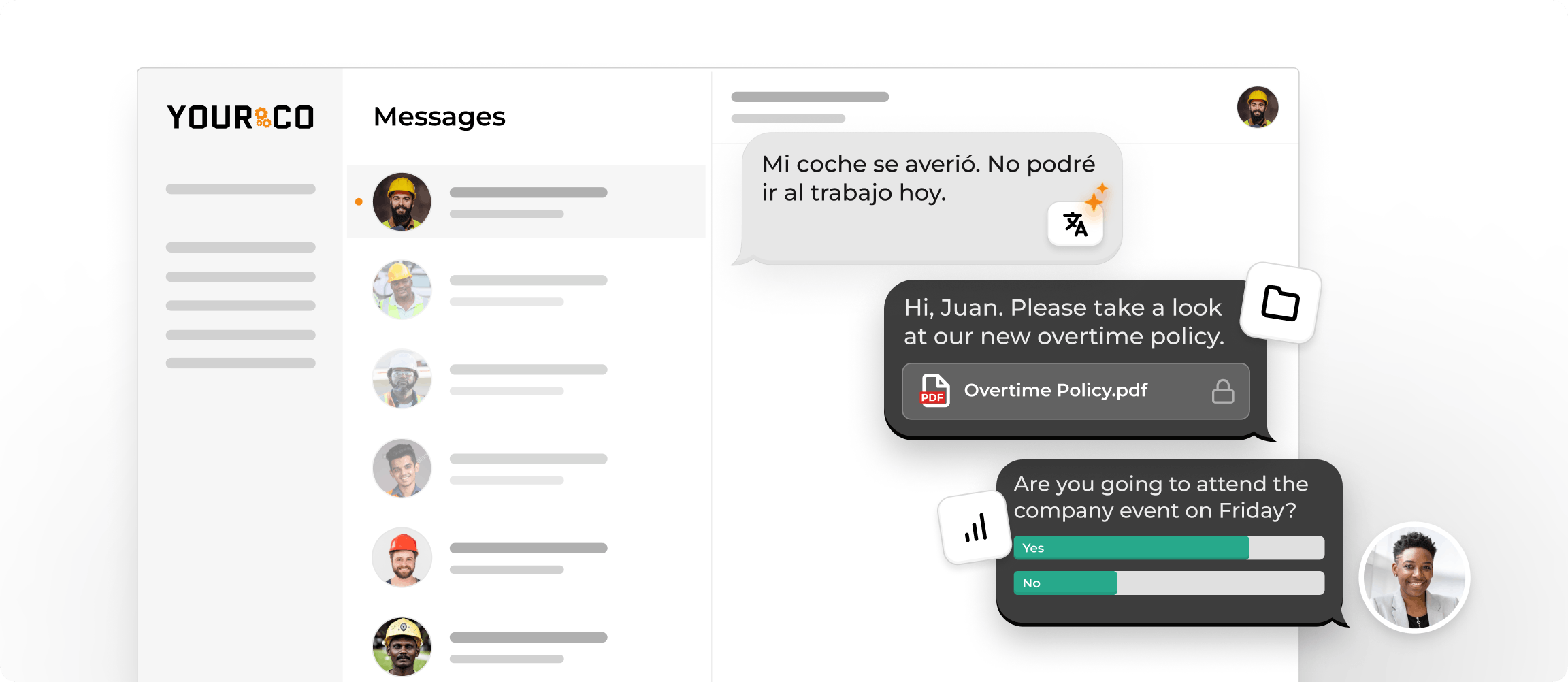
SMS-based platforms like Yourco handle both through a text-off line. A worker texts off in seconds; Yourco's AI Call-Off Agent confirms the dates and reason and automatically notifies the supervisor, and managers send the open shift to the right group before coverage becomes urgent. Each confirmed call-off is logged automatically as a timestamped record, which turns online absence management into a data source: accurate rates by site and shift, day-of-week patterns, and documentation for consistent policy enforcement.
How to Roll Out a Consistent Attendance Policy Across Sites
Policy inconsistency generates absences on its own. When one supervisor documents every call-off and another lets them slide, workers notice, and the looser shift develops a higher rate. Multi-site organizations see the same pattern between plants. The decisions below separate policies that hold up from policies that erode:
Consistency also protects the organization when a pattern turns into a personnel decision. Many employers find that documented, uniformly applied attendance records hold up better than supervisor recollection.
This information is for general awareness only. For specific compliance guidance, consult with qualified legal professionals.
Measure Whether the Fix Is Working
A lower absenteeism rate is the obvious measure, though it moves slowly and reflects several changes at once. Coverage speed indicates how quickly the reporting channel moves and whether it is doing its job. The interval between a call-off arriving and an open shift being filled is the metric to watch week to week.
Three signals show whether the change took hold. Advance notice time indicates whether workers report earlier once reporting becomes easier. Overtime hours attributable to coverage indicate whether managers are finding replacements before premium pay becomes the only option. The response rate to open-shift broadcasts indicates whether messages are reaching the intended audience.
Reading each of these by shift and by site matters more than the aggregate. A company-wide improvement can mask a single plant getting worse, and the plant getting worse is where costs are concentrated.
Cover Every Shift Faster With Yourco
Cutting the cost of absenteeism means shrinking the window between a call-off and a covered shift, and Yourco gives HR and operations teams a faster way to do it. When frontline workers report absences by text, supervisors see them instantly, and managers can send open-shift messages to the right group before overtime becomes the only option. SMS reaches workers on any device, including basic flip phones, with delivery confirmation so managers know the message went through.
Yourco delivers the core capabilities frontline teams rely on:
- SMS to any phone, including basic flip phones, with no app download, Wi-Fi, data plan, or cost to employees
- Two-way messaging with an AI Call-Off Agent that collects and confirms call-off details, then logs each one as a timestamped record, giving HR searchable documentation for attendance policy and payroll accuracy
- AI-powered translation across 135+ languages and dialects, so workers text off in their preferred language and managers read it in theirs
Yourco syncs employee data through 240+ HRIS and payroll integrations, so absence records reach payroll without manual re-entry. For multi-plant organizations, Enterprise Bridge supports one-way broadcasts from corporate leadership to the entire frontline, keeping every location aligned on attendance policies while local managers maintain direct communication with their teams.
Frontline Intelligence gives HR and operations leaders centralized visibility into call-off activity across all locations. It surfaces call-off patterns and reports shift confirmations and response times by site or department. Leaders can compare absence trends between plants and shifts without assembling spreadsheets.
Manufacturers using Yourco for absence reporting describe how it works day-to-day.
"We use Yourco for our absence management and for sending out notices, reminders, and event announcements. It keeps everyone who needs to know informed when people are absent."
— Kyle Stover, HR Assistant, J-Lenco Inc.
After 90 days with Yourco, two-way employee engagement increased to 86%.
Try Yourco for free today, or schedule a demo to see the difference the right workplace communication solution can make for your company.

Frequently Asked Questions About the Cost of Absenteeism
How do you calculate the cost of absenteeism?
Multiply daily wage by days absent, then add overtime premiums or temporary coverage paid to fill the shift. For a fuller picture, add supervisor time spent arranging coverage and the reduced output of substitutes and co-workers. The most useful calculation reflects the specific site and shift mix rather than a national average.
What is an acceptable absenteeism rate?
Results vary by organization and industry, so the useful comparison is a site's own sector and historical trend. Hospitality, manufacturing, logistics, and construction face different staffing realities. A rate that climbs consistently month over month warrants investigation, regardless of where it sits relative to a benchmark.
What is the difference between direct and indirect costs of absenteeism?
Direct costs are cash outlays traceable to an absence: wages paid to the absent worker and any coverage premium, including overtime or temporary labor. Indirect costs are the productivity losses that follow, including slower substitutes, extra work for co-workers, supervisor time rebuilding coverage, and morale erosion.
How does absenteeism affect team productivity?
Unplanned absences hit output hardest because there is no time to prepare. The team produces less while substitutes and co-workers cover unfamiliar tasks, and supervisors lose hours reworking assignments. In interdependent environments like production lines, one missing role can slow the entire team.
How can SMS help reduce absenteeism costs?
SMS-based platforms like Yourco let frontline workers report absences by text in seconds, notify supervisors instantly, and help managers send open-shift messages to the right group before overtime becomes the fallback. Every message is timestamped and logged, so HR gets accurate absence data without having to chase voicemails.
Why does absenteeism vary so much between shifts at the same site?
Night and weekend shifts often pay higher rates due to schedule disruptions, thinner supervision, and fewer available substitutes. Inconsistent policy enforcement among supervisors also results in different rates at the same site. Segmenting the rate by shift usually reveals patterns a site-wide average hides.