48.02% of Android app installs in the United States are uninstalled within 30 days, according to AppsFlyer's 2025 app uninstall benchmarks report.
In a communication app rollout to 10,000 frontline workers across plants and distribution centers, every install depends on app store access, storage space, credentials, and a compatible operating system, and usually on a personal phone the company does not manage.
Short Message Service (SMS) avoids these requirements because the SMS-capable phones workers already carry, including basic flip phones, receive a text with nothing to download. That difference decides whether a frontline communication rollout reaches the whole workforce or stalls at a fraction of it.
TL;DR
- Most frontline workers lack the digital tools they need, so app-based strategies miss them before rollout starts.
- Every app requirement further cuts reach: download, app store access, MDM enrollment, login, notification opt-in.
- HR leaders report far better response rates from SMS than satisfaction with mobile apps.
- Uninstalls and disabled notifications shrink an app's real audience after launch, invisibly.
- SMS needs no device-side deployment, so reach does not degrade as headcount grows.
- SMS-based platforms like Yourco reach workers using numbers already held in HR systems, with no app to roll out.
Understand Why Mobile Apps Fail Frontline Teams
Frontline workers want better access: roughly three-quarters say they would feel more connected if they could access company communications on a mobile device. Each additional device, login, and enrollment requirement increases the number of failed installations as headcount grows.
Before a single message goes out through an app, an enterprise rollout has to clear the way for downloads, logins, storage space, compatible operating systems, and, often, stable internet connections. Device enrollment is often one of the most challenging aspects of a unified endpoint management (UEM) deployment: automatic enrollment requires coordination with device resellers, user-driven enrollment requires training, and bring-your-own-device policies pull HR and legal into what began as a communication project.
For workers starting a shift on a factory floor or construction site, each step is a potential point of failure. The same applies on a loading dock. Multiple forms of limited access and support reinforce the problem:
- Limited access to digital tools: Only about a quarter of frontline employees report having access to the digital tools they need to stay productive.
- Inadequate training for digital tools: Many frontline employees receive training once a year or less, so most workers must learn new tools without adequate support.
- Structural exclusion from app-only strategies: Pew Research finds smartphone ownership is lower among adults earning under $30,000 per year than in higher-income households, so app-only strategies can structurally exclude a share of lower-wage frontline workers before any adoption effort begins.
These barriers to access and support stall app adoption, even when frontline workers want better access.
Workers also remove apps after installation. They uninstall apps they stop using, or that take up storage. They may remove or silence apps that notify too often.
Push opt-in is also shrinking. Android opt-in rates dropped across every percentile in the latest year measured because apps targeting Android 13 and above now have to request consent, as iOS always has, according to Airship's 2025 push notification benchmarks, based on more than 9 billion app users across 13 industries.
A push alert reaches only the workers who installed the app, opted in, and have not disabled notifications since. Each condition shrinks the share of a 10,000-person workforce an urgent message can actually find.
Managers also misjudge readiness. Personal smartphone use leads managers to infer that workers will be proficient and willing users of technology at work, while many workers make little or no use of smartphones at home and sit on very limited data plans, according to interviews with more than 85 shop-floor workers across eight factories in the US, Europe and Asia. Workers can also resist mandatory apps on personal phones when they suspect tracking, monitoring, or data charges.
Recognize Why SMS Cuts Through Where Apps Cannot
SMS for frontline workers runs on a fundamentally different infrastructure than mobile apps. It travels over the cellular network and arrives as a lock-screen notification that workers can read without opening an app or entering login credentials. For a large deployment, operations and HR teams manage no device-side software: no MDM profiles, app versions, or passwords across thousands of employees. SMS removes these deployment requirements for teams managing shift-based, distributed workforces:
- Workers need no downloads, logins, app store accounts, storage space, operating system checks, or update cycles.
- Cellular coverage reaches manufacturing facilities, construction sites, and rural logistics routes that lack reliable internet, though enclosed industrial spaces can still have dead zones worth mapping before launch.
- Messages appear on the lock screen, which matters for time-critical safety alerts and shift coverage requests.
- Workers already know how to read and reply to text messages, whatever their comfort level with technology.
- Flip phones, older smartphones, and budget devices that support text messaging can all receive SMS with no app-specific hardware requirements.
What HR Leaders Say About SMS vs. Apps
91% of HR leaders say SMS increases response rates among frontline workers, while only 36% report satisfaction with mobile apps as a communication channel for frontline workers, according to a Yourco-commissioned survey of 150 HR leaders. That 55-point difference separates the channel that works from the channel most organizations have historically invested in, and the people answering are the ones responsible for reaching frontline workers across shifts, locations, languages, and device types.
The same survey found that only 43% of frontline workers consistently receive company communications, by HR leaders' own assessment. At 10,000 frontline workers, that means the majority do not reliably get what leadership sends through current channels.
Apply SMS to the Frontline Situations That Matter Most
SMS solves specific, recurring operational problems that HR and operations leaders deal with every week, and each one gets harder as headcount grows.
- Safety alerts and emergency communication. When a chemical spill occurs, or severe weather threatens a site, the site team needs immediate notice. The same applies to equipment failures and other urgent safety issues.
- Shift coverage and schedule changes. When an employee calls out before a shift, a supervisor can send a single text: "Open forklift operator shift tonight 5--10 PM. Reply YES to the claim." Role and location segmentation sends the message only to qualified workers at that site, and the first reply fills the slot without requiring a login. Shift coverage tools show how this works for frontline teams.
- Absence management. Organizations that implement absence reporting integrated with scheduling systems have seen absence rates fall, even in the early implementation stages. Automated SMS attendance check-ins remove the friction that leads to missed reporting, and every report becomes a timestamped record supervisors across sites can see.
- Micro-training and compliance nudges. Frontline workers often cannot access desktop-based learning management system (LMS) portals, but they can tap a link in a text message. SMS-delivered links provide a direct way to deliver compliance content to the people who need it, and a single broadcast can cover multiple sites at once.
- Policy acknowledgments. Workers receive a policy via text and reply "YES" to confirm receipt. Across dozens of locations, that single broadcast produces timestamped acknowledgment records for employees who reply, with no portal login between the worker and the confirmation.
Every one of these workflows runs without requiring workers to install an app, reducing rollout friction as deployments grow from 100 to 10,000 employees.
Layer SMS With Existing Systems Instead of Replacing Them
SMS works best as the delivery layer that connects an existing human resources information system (HRIS), learning, scheduling, and attendance platforms to the people they serve. For enterprise IT, that layer has no device-side footprint: nothing to package for an app store, no MDM profile to push, no per-device provisioning, and administration occurs in a single centralized dashboard rather than across thousands of endpoints. A practical SMS-first stack layers on top of systems already in place:
- Employee SMS communication groups update automatically when employers hire or terminate employees. Department changes trigger the same update.
- Training deadlines trigger SMS reminders with mobile-friendly links, and completion confirmations sync back to the LMS.
- For scheduling, unfilled shifts trigger automated broadcasts. The first worker to reply "YES" fills the slot in the scheduling system.
- After a missed clock-in, the attendance system triggers an automated check-in text, routes the response to supervisors, and logs it.
Order matters more than speed. Starting with HRIS directory synchronization gives every later integration an accurate roster to work from, and absence management guidance suggests layering scheduling, LMS, and attendance in stages rather than all at once. Existing systems remain the systems of record. SMS carries their information to the last mile, and the platform logs every message and reply centrally, so the communication record lives alongside those systems rather than being scattered across personal group texts.
Audit the Communication Stack for App Over-Reliance
These questions identify where an organization's channels fail frontline workers, drawing on SHRM guidance and a Reworked analysis on reaching frontline teams.
- Can a new hire receive and respond to a critical message on day one, without downloading anything? If not, the adoption process excludes some new hires.
- Do the tools work on basic phones and without Wi-Fi? Tools requiring smartphones and data plans can structurally exclude a significant portion of lower-income frontline workers.
- What share of the workforce has installed the current app, kept it installed, and left notifications on? Registered accounts overstate reach, and uninstalls and disabled push notifications quietly shrink the audience the dashboard claims.
- Does the primary channel depend on app store access, MDM enrollment, or credentials that expire? At enterprise scale, every device-side dependency creates a support queue and leaves some devices beyond the channel's reach.
- Can frontline workers respond, ask questions, or report issues, or does the channel only broadcast messages? One-way broadcast tools create passive recipients. Workers who can reply, confirm, or flag issues are more likely to act on what they receive.
- Can messages be segmented by location, shift, role, or language? Blanket broadcasts with no targeting lead to irrelevance, and workers who find messages irrelevant disengage from the channel entirely.
If more than two answers show these problems, the communication stack likely depends too heavily on tools that do not fit a frontline workforce.
This article is for informational purposes only and does not constitute legal advice. Employers should consult qualified legal counsel on compliance requirements specific to their organization.
Reach Every Frontline Worker Instantly With Yourco
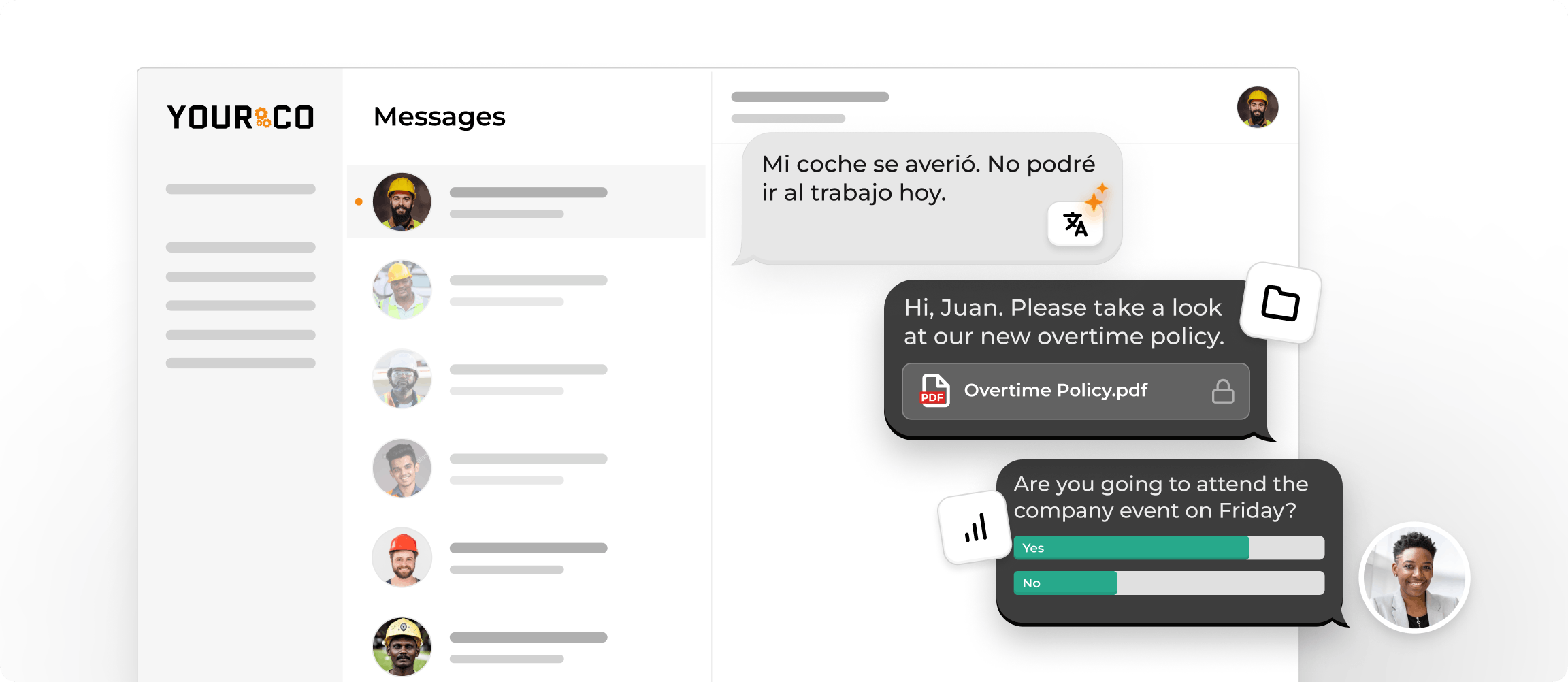
The communication tools their organizations invest in overwhelmingly fail to reach frontline workers, and app rollout friction compounds with every thousand employees added. Yourco removes the app deployment problem. Yourco is an SMS-based employee communication platform for frontline organizations: it works on SMS-capable mobile devices, including basic flip phones, with no app downloads, no logins, and no cost to employees.
There is no app store project and no MDM enrollment. One dashboard centralizes administration, and the platform logs messages and responses with timestamps to create a communication record corporate teams can see across locations. With Yourco, HR and operations teams can:
- SMS to any SMS-capable phone, including basic flip phones, with no app download required
- Two-way messaging so workers reply, confirm shifts, and report absences without a login
- AI-powered translation across 135+ languages and dialects, delivering each message in the employee's preferred language
- Segmentation by location, shift, department, or role, so workers receive only what applies to them
- Role-based access control and single sign-on for admins and managers, with managers scoped to the locations, groups, or departments they are granted
- Centralized communication records, with message archiving and audit trails held on the platform rather than on individual handsets
- Directory-controlled access, so only employees in the company directory can send or receive on the company number, and removal ends messaging and revokes file access
- Secure document access, with files sent as links that require a single-use PIN texted to the employee's own number before they open
Yourco's 240+ HRIS and payroll integrations automatically sync contact lists, keeping employee data up to date without manual maintenance.
For multi-location organizations, Enterprise Bridge supports one-way broadcasts from corporate leadership to the entire frontline, so every location receives the same update without requiring responses.
Frontline Intelligence gives HR and operations teams centralized visibility across all locations, surfacing engagement trends and workforce risks by site or department rather than leaving them buried in local threads.
"We have tried 3 text communication tools, and this is the best experience we've had by far. A consistent line of communication to our employees is one of the most important things, and Yourco is the most reliable system around."
— Terri Kasper, HR Manager, Calumet Carton Company
After 90 days with Yourco, two-way employee engagement increased to 86%.
Try Yourco for free today, or schedule a demo to see the difference the right workplace communication solution can make for your company.
Frequently Asked Questions About SMS vs. Mobile Apps for Frontline Teams
Does SMS reach more frontline workers than mobile apps at enterprise scale?
Yes, apps depend on downloads, app store access, notifications turned on, and compatible devices, and each requirement further shrinks their reach across a large, distributed workforce. SMS arrives on SMS-capable mobile phones, including basic devices, with nothing to install, so a broadcast can reach workers across a multi-site workforce from the day the channel launches.
Does deploying SMS communication to 10,000 employees require MDM or an app store rollout?
No, SMS requires no installation on the employee's device, so there is no MDM enrollment, app packaging, version management, or credential provisioning. SMS-based platforms like Yourco pull employee phone numbers from existing HR systems and run everything from a centralized dashboard, avoiding device-side setup on workers' phones.
Can SMS handle two-way communication, or is it just for broadcasting?
SMS supports full two-way communication. Workers can confirm shift changes, answer survey questions, report absences, and raise concerns via simple text replies. The platform routes structured responses to the right supervisors and logs them centrally, so two-way messaging stays manageable across thousands of employees instead of dissolving into unmanaged group threads.
How does SMS work for multilingual frontline teams?
AI-powered translation automatically delivers each message in the worker's preferred language. A single broadcast can reach a workforce spanning dozens of languages simultaneously, without relying on bilingual supervisors or manual translation. That matters most in large multi-site operations, where translation delays would otherwise hold up urgent safety and scheduling updates.
Will adding SMS mean replacing our existing HR systems?
No, SMS is a delivery layer over existing HRIS, learning, scheduling, and attendance systems. Those tools remain the systems of record, while SMS carries their information the last mile to workers' phones. The platform records responses and acknowledgments with timestamps, so the communication trail stays alongside the data it relates to.
What if some of our workers only have basic phones?
SMS works on mobile phones that support text messaging, from basic flip phones to the latest smartphones, because it travels over the cellular network. Workers need no specific smartphone operating system, app storage capacity, or mobile data plan, so those carrying older or budget devices can receive the same messages as other employees with cellular service.